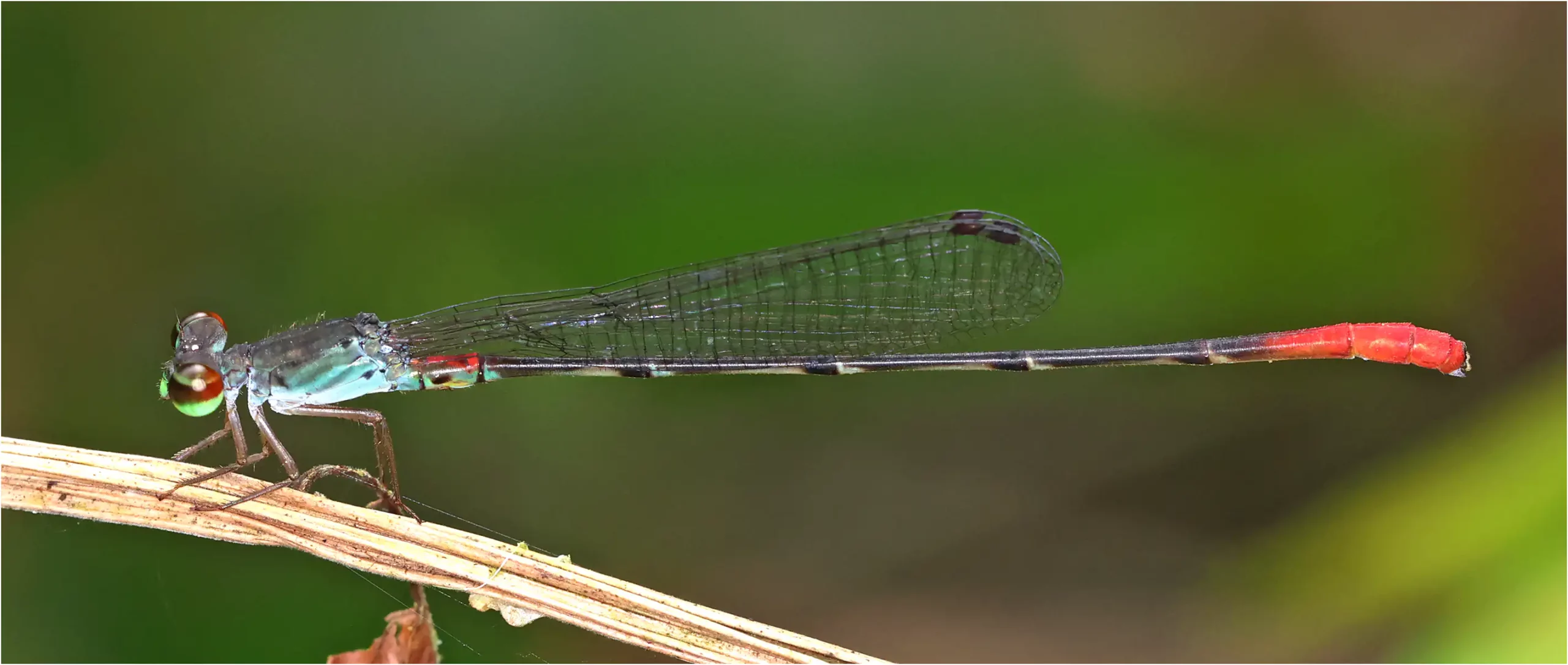
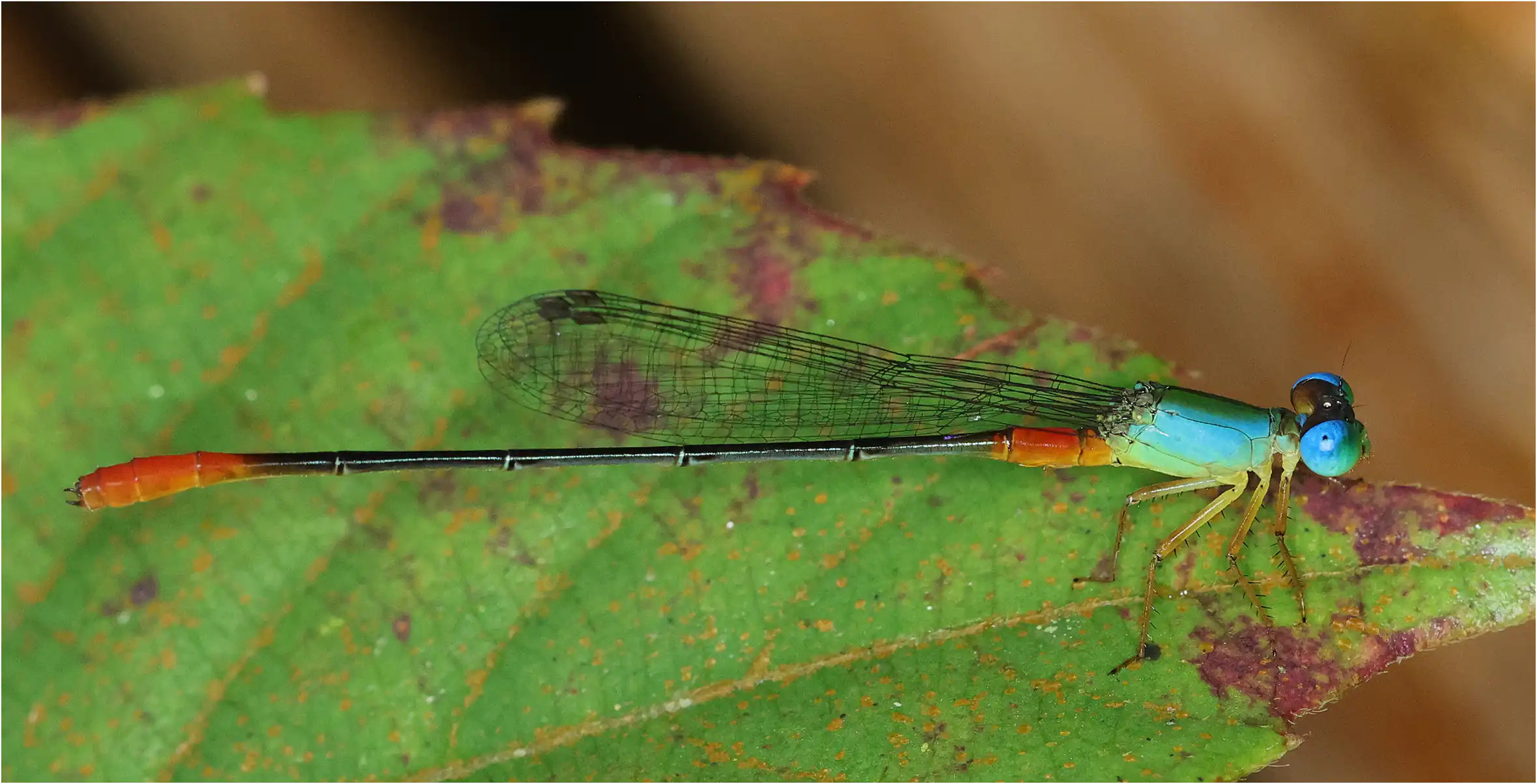
Ceriagrion rubellocerinum, a member of the Coenagrionidae family, naturally brings to mind—especially due to its name—Ceriagrion cerinorubellum, which is widely distributed across Asia. Fraser (1947) wrote that he initially believed he was dealing with this species in Ivory Coast.
Personally, I find the Asian version much more spectacular.
There is no risk of confusion with any other Coenagrionidae; the flexion of the final abdominal segments is truly typical of Ceriagrion, and its coloration rules out all other species.
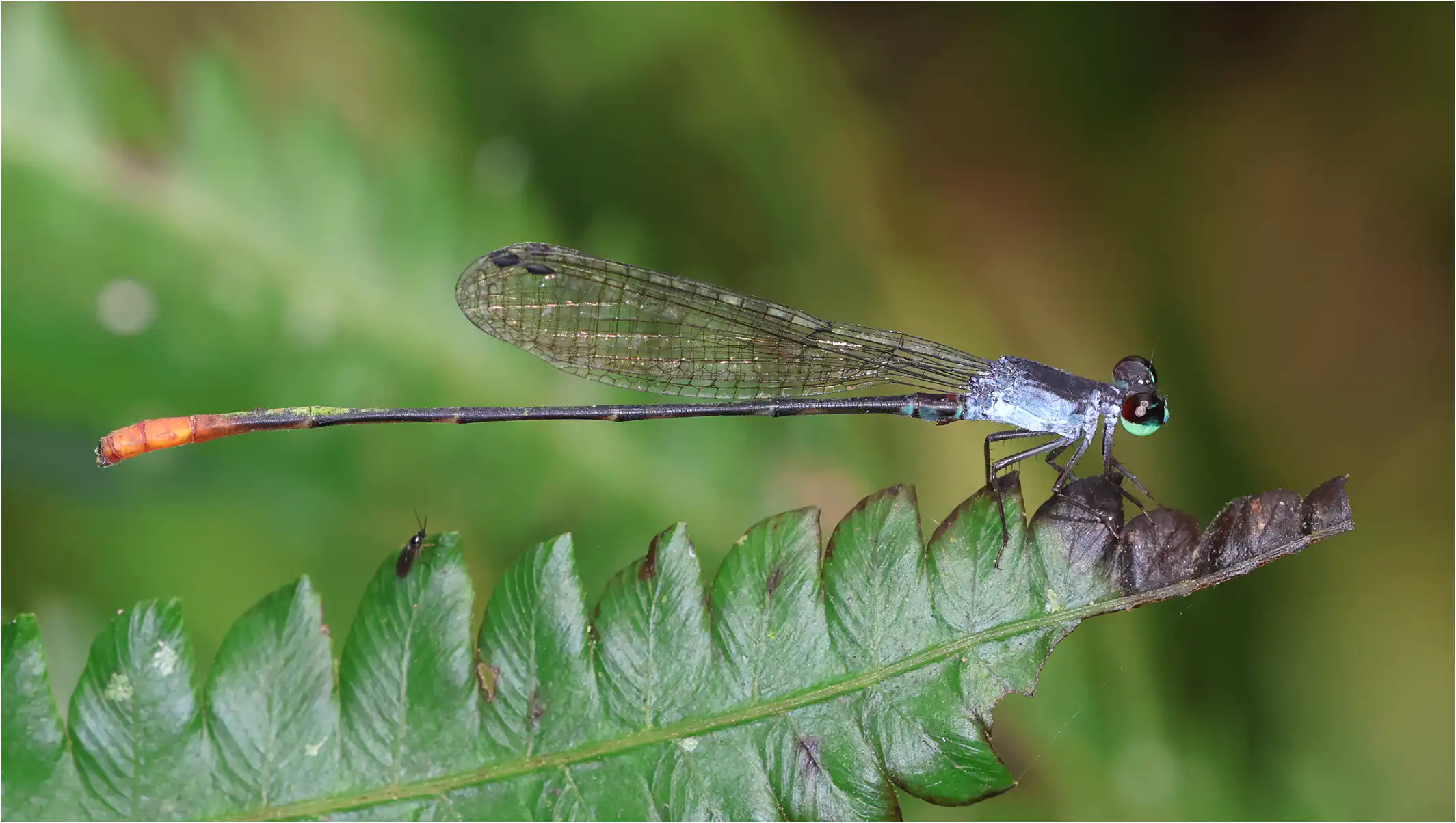
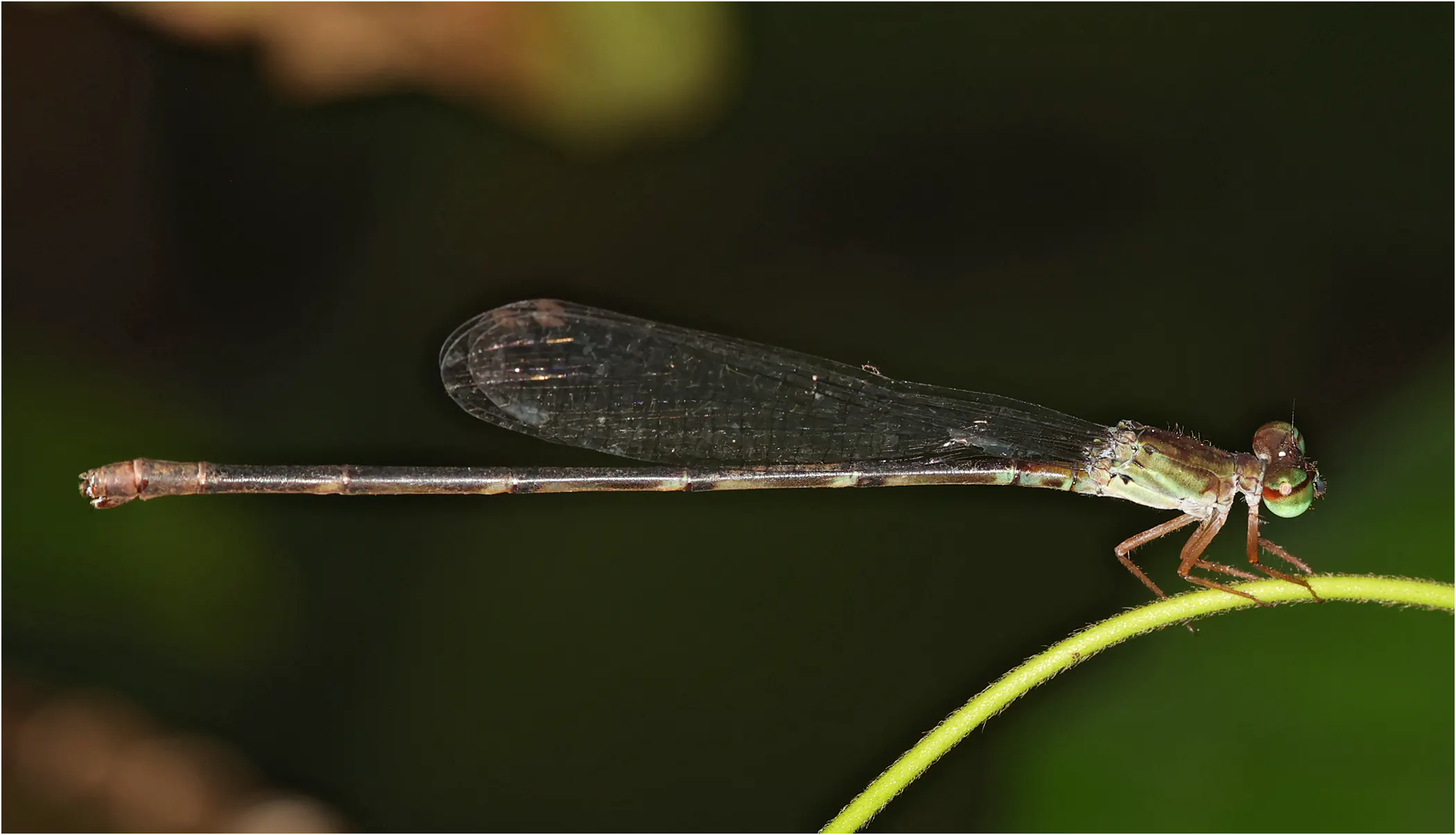
Above is an older mature specimen, remarkable for the pruinosity of its thorax and its distinctly dark green eyes.
Note the moss on the dorsal side of the sixth and seventh segments, a sign of the ambient humidity.
Fraser measured its abdomen at 38 mm. Its total length therefore reaches approximately 46 mm.
Note the tricolored eyes in specimens that are not yet fully mature; green in the lower part, and red and black in the upper part.
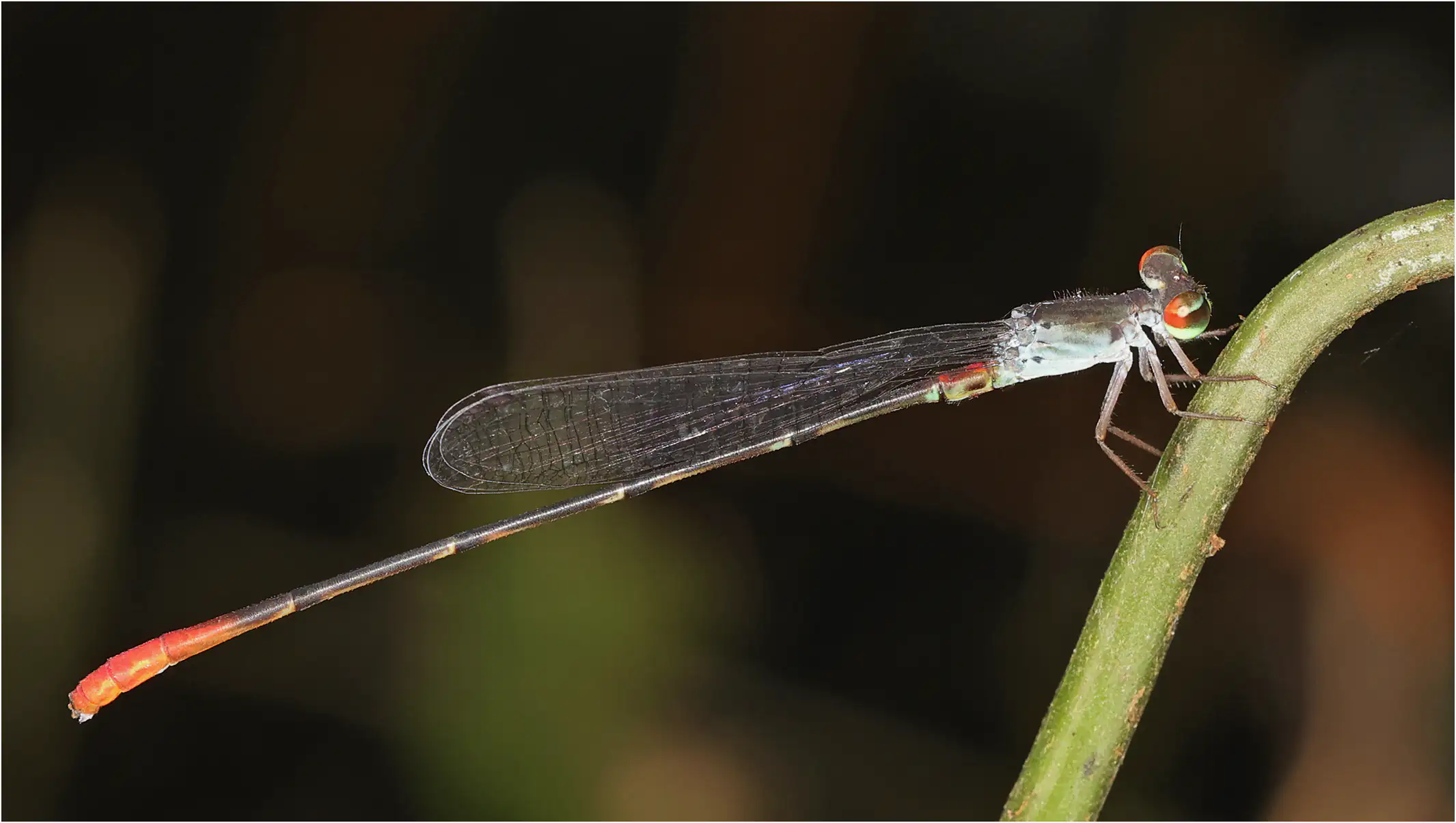
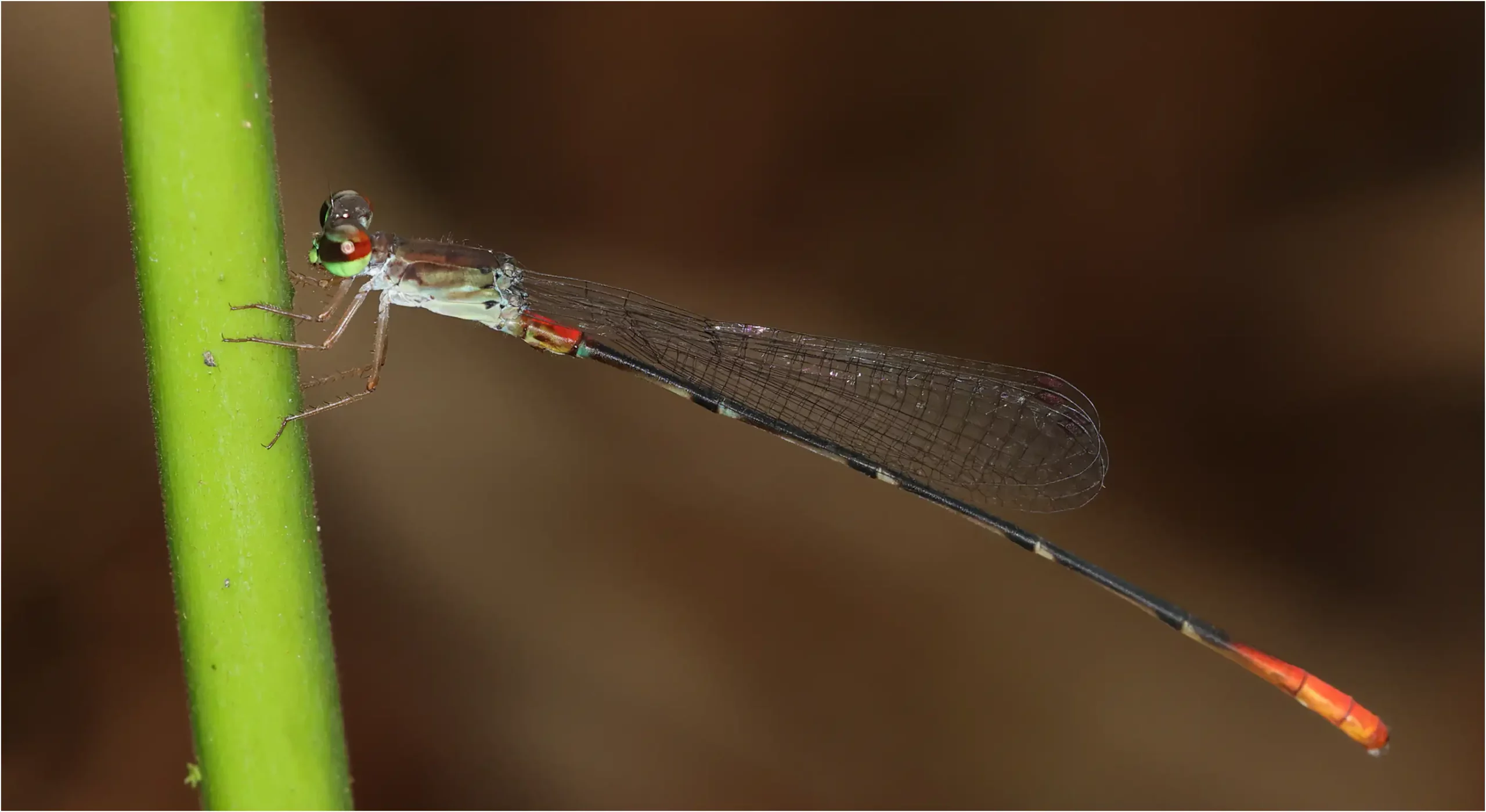
It is much less common than C. glabrum, which can be found in forests or more open environments. Ceriagrion rubellocerinum is primarily found at the edges of forests or wooded areas near ponds, and it quickly hides within vegetation and shrubs.
It is distributed across southern West Africa, from Sierra Leone in the west to Nigeria in the east. It reaches Cameroon, slightly further south.
IUCN Red List.
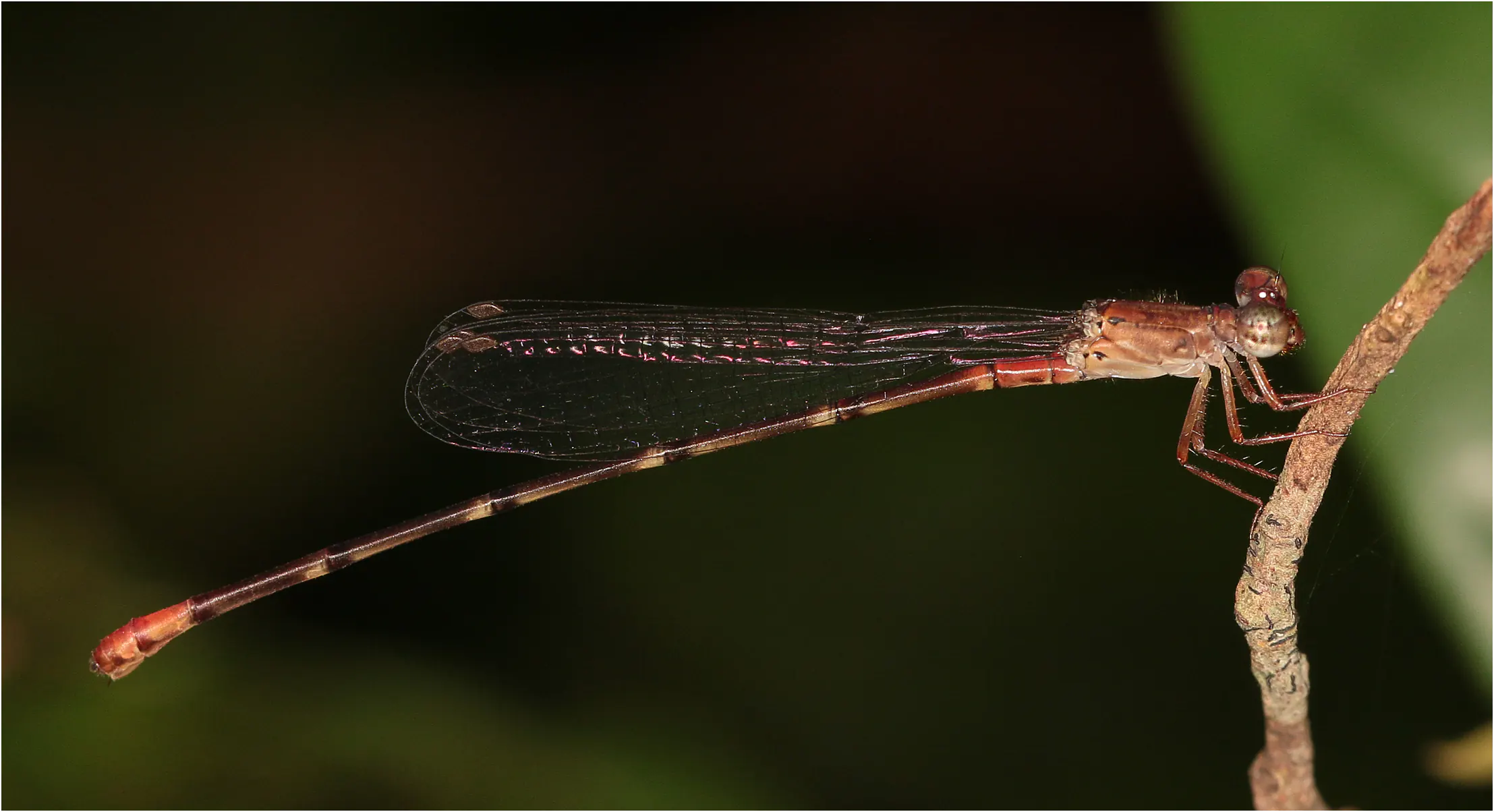
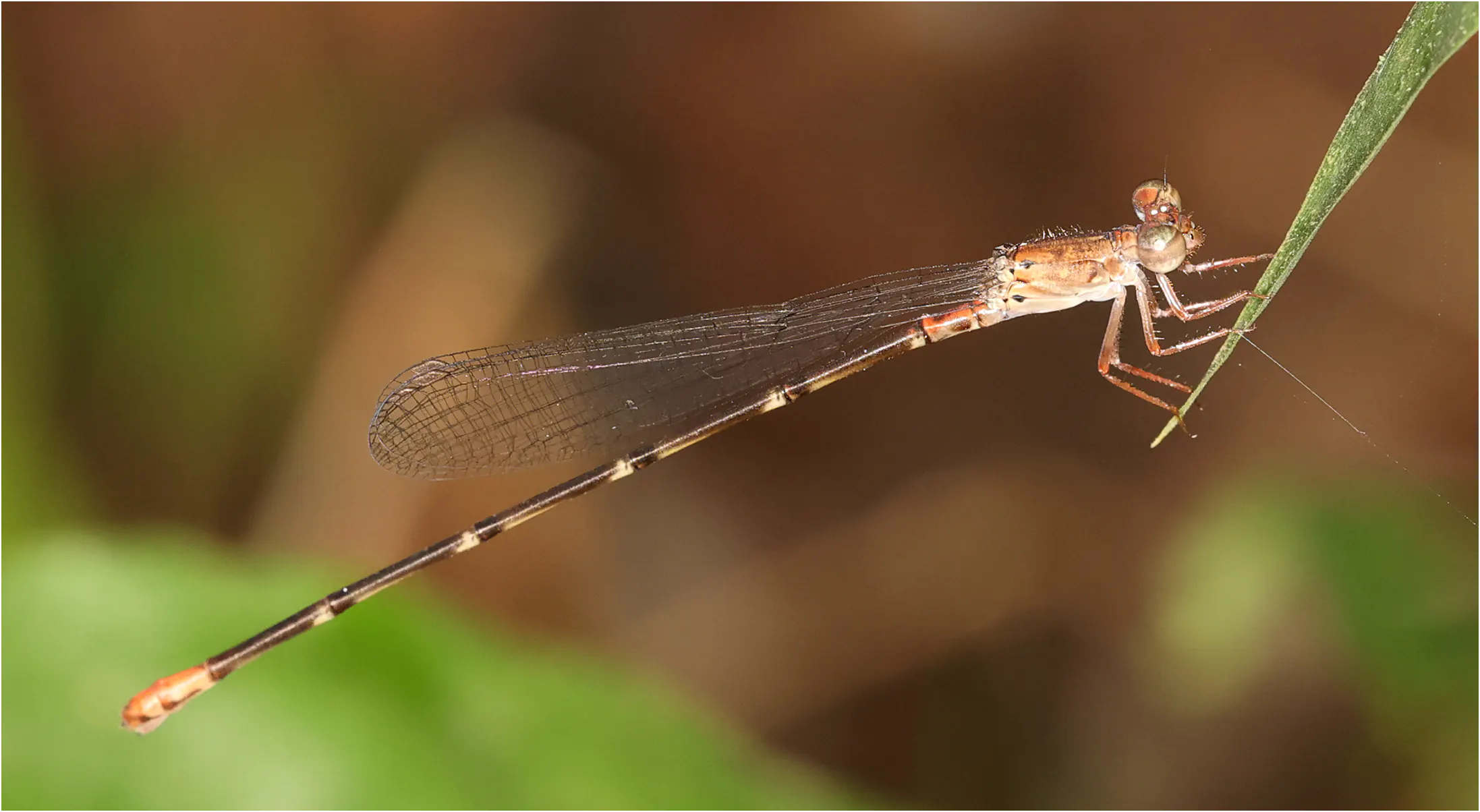
These females are identified by their proximity to the males and, of course, the absence of other Ceriagrion male species. Furthermore, they share certain coloration details with the males.
The two above are young, with the one on the left being almost emergent, while the one below is likely mature.
Etymology
Ceriagrion; the genus was established by Selys in 1876 when he divided the large genus Agrion, likely for the species cerinorubellum, from agrion (frequently used in naming Coenagrionidae and derived from the Greek agrios for wild, living in the fields) and the Latin cerinus meaning wax-colored (or wax-like?) , referring to the smooth and hairless thorax of the genus. See Fliedner, 2006.
Rubellocerinum; this species name is a nod to Brauer, who described Ceriagrion cerinorubellum. Fraser writes: « The colouring of this new species is almost a replica of C . cerinorubellum (Brulle) of the Oriental fauna and I actually mistook it at first for that species and only closer inspection showed it to be a most remarkable case of similarity through convergence.«
Fraser was certainly mistaken as he attributes the Asian species to Brullé; both authors’ names begin with the same letters « Br… »! However, Brullé is well known to European odonatologists for having described Crocothemis erythraea in 1832.
Fliedner, 2006. – The scientific names of the Odonata in Burmeister’s « Handbuch der Entomologie ».
Fraser, 1947 – THE ODONATA OF THE IVORY COAST BASED ON THE MISSION OF DR. R. PAULIAN AND P. LEPESME – Transactions of the Royal Entomological Society of London, 1947. P. 28.