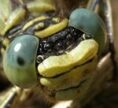
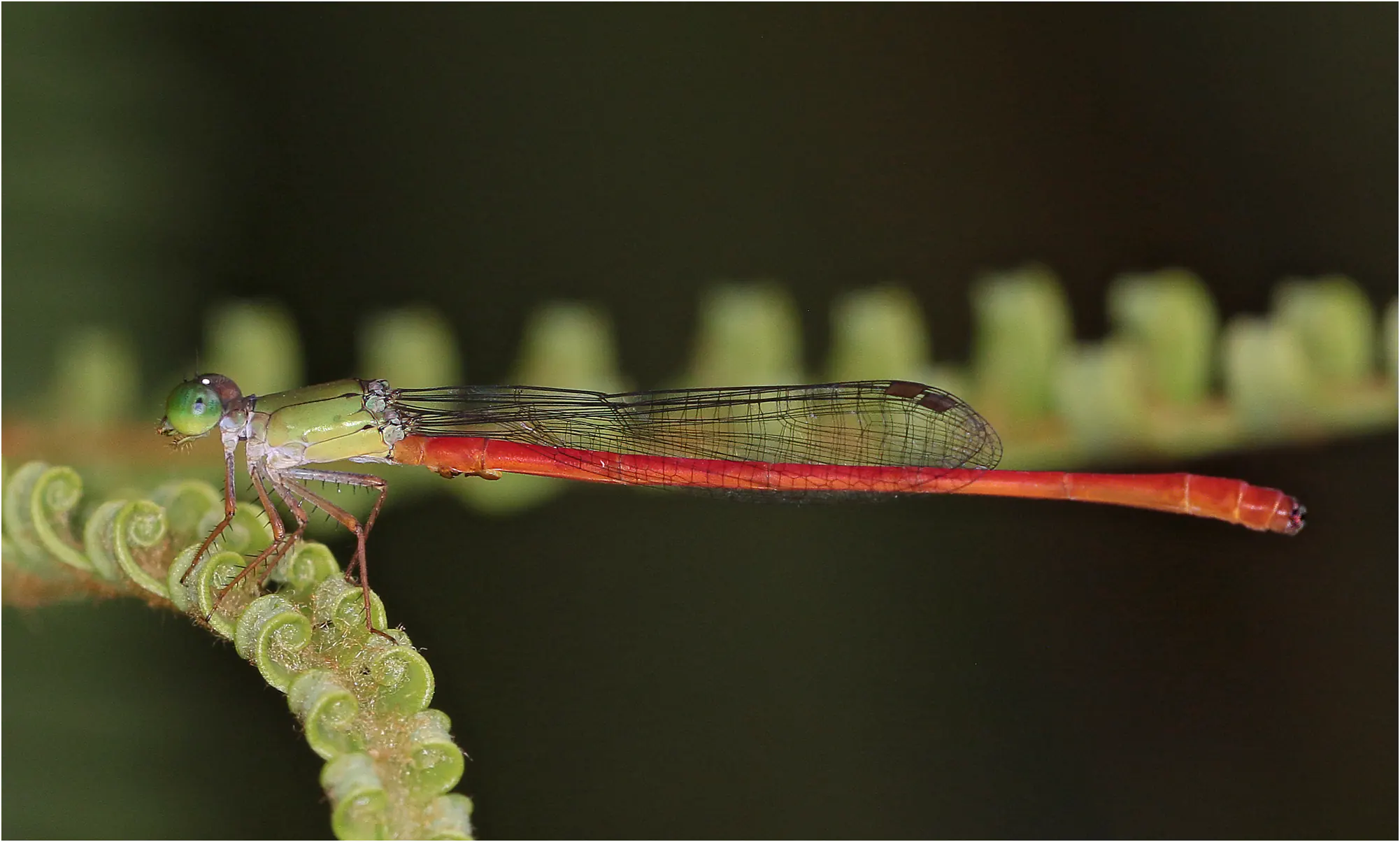
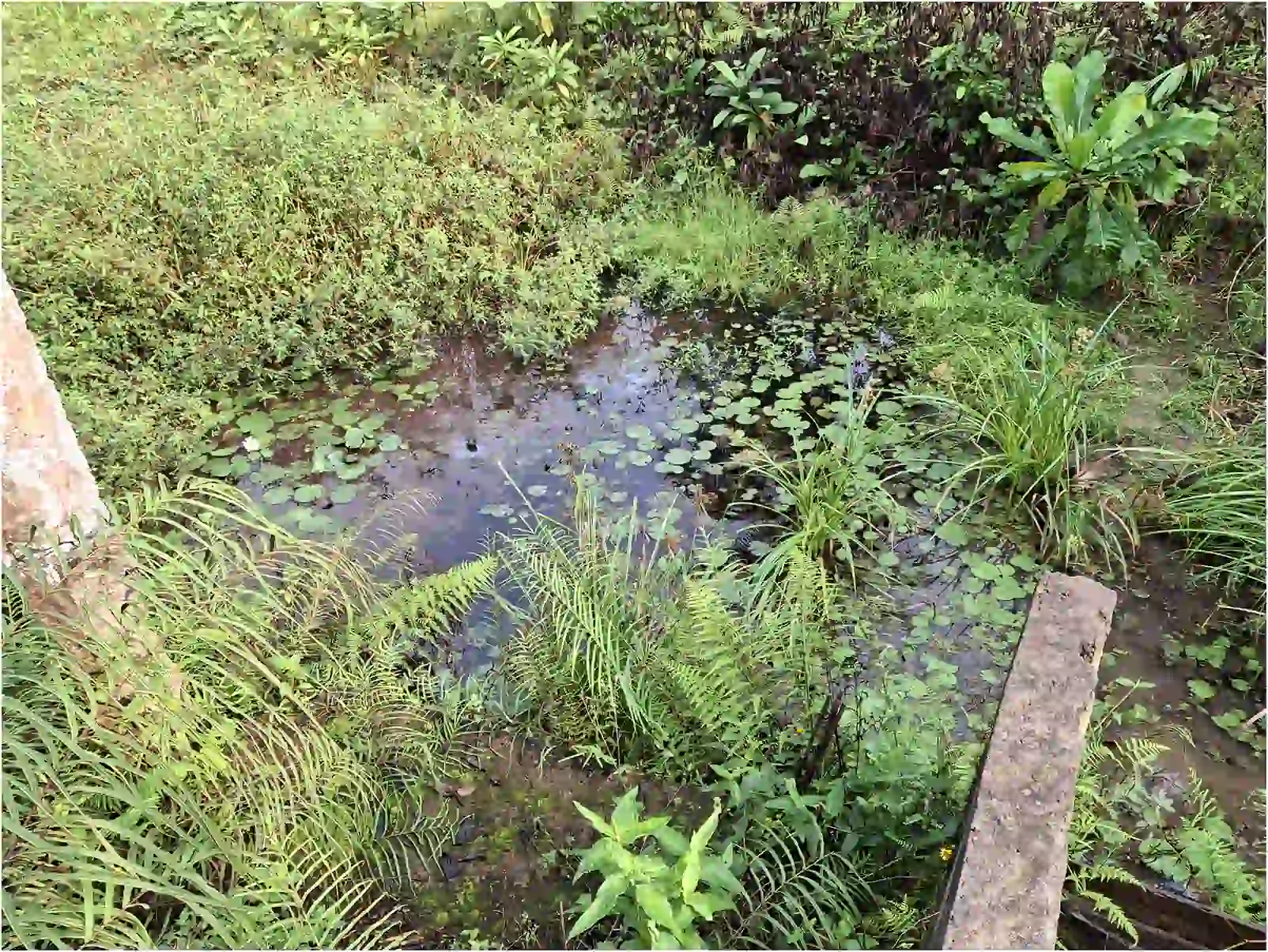
I only had two very brief encounters with the magnificent Ceriagrion corallinum at two nearby sites; the first is a tiny pond with water lilies in a fairly open area, the second a pond overgrown with tall vegetation, in which it was very difficult to move, also in an open area.
It is impossible to confuse it with any other damselfly in Ghana; the green coloration of its thorax is truly rare and striking, especially with its hairless and waxy appearance, and it contrasts splendidly with its bright red abdomen. Elsewhere in Africa, it is very similar to C. whellani, from which it is distinguished by its green labrum (yellow for C. whellani).
English speakers call our species the Green-fronted Ceriagrion, while the other is named the Yellow-faced Ceriagrion.
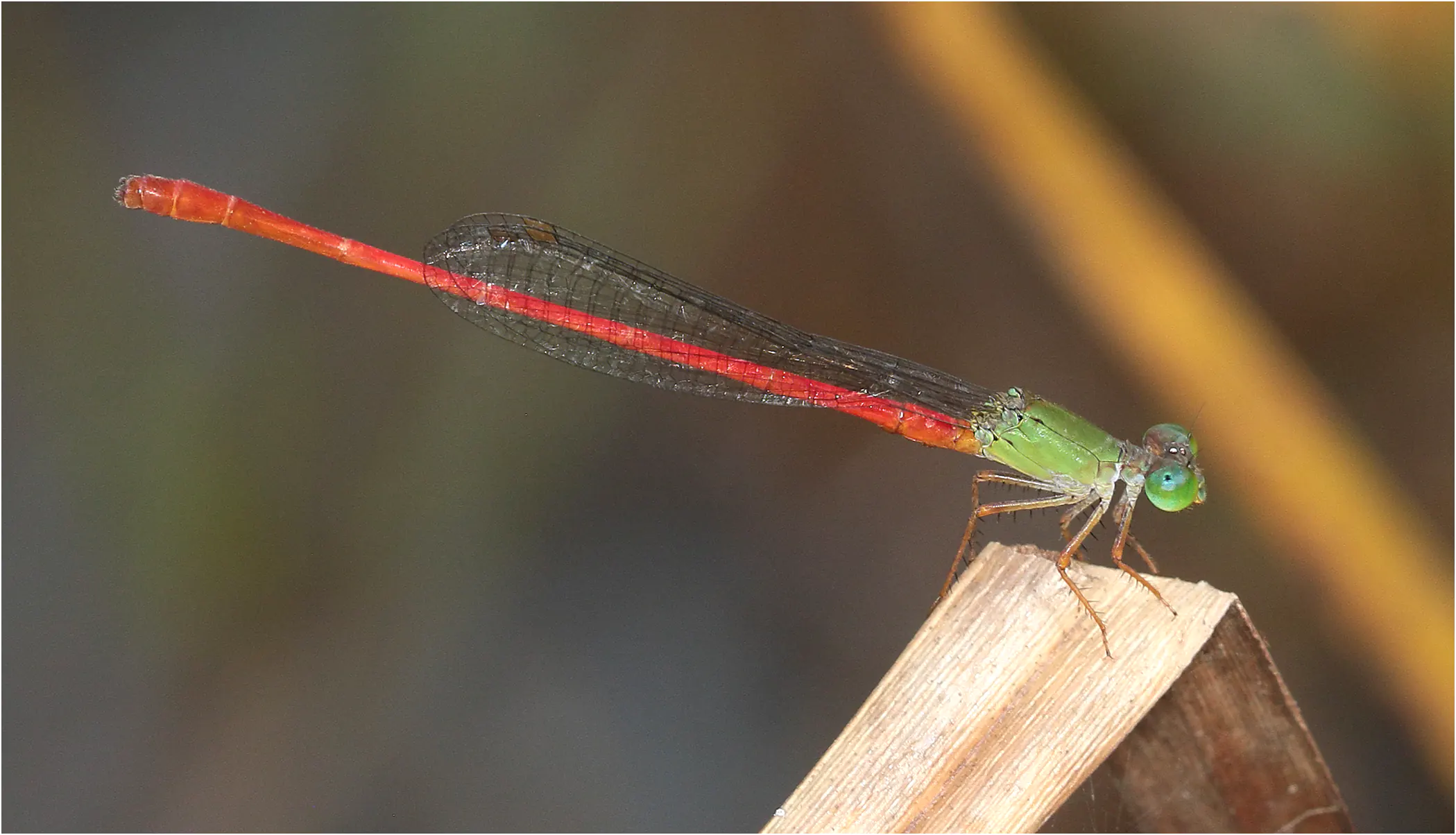
Campion specifies that its abdomen measures 26 mm, giving a total length of approximately 33 mm.
It is found throughout southern West Africa, from Senegal, reaching south to Angola and east from Uganda to Zambia. It is rare in our survey area, where the Ceriagrion population is largely dominated by C. glabrum.
IUCN Red List.
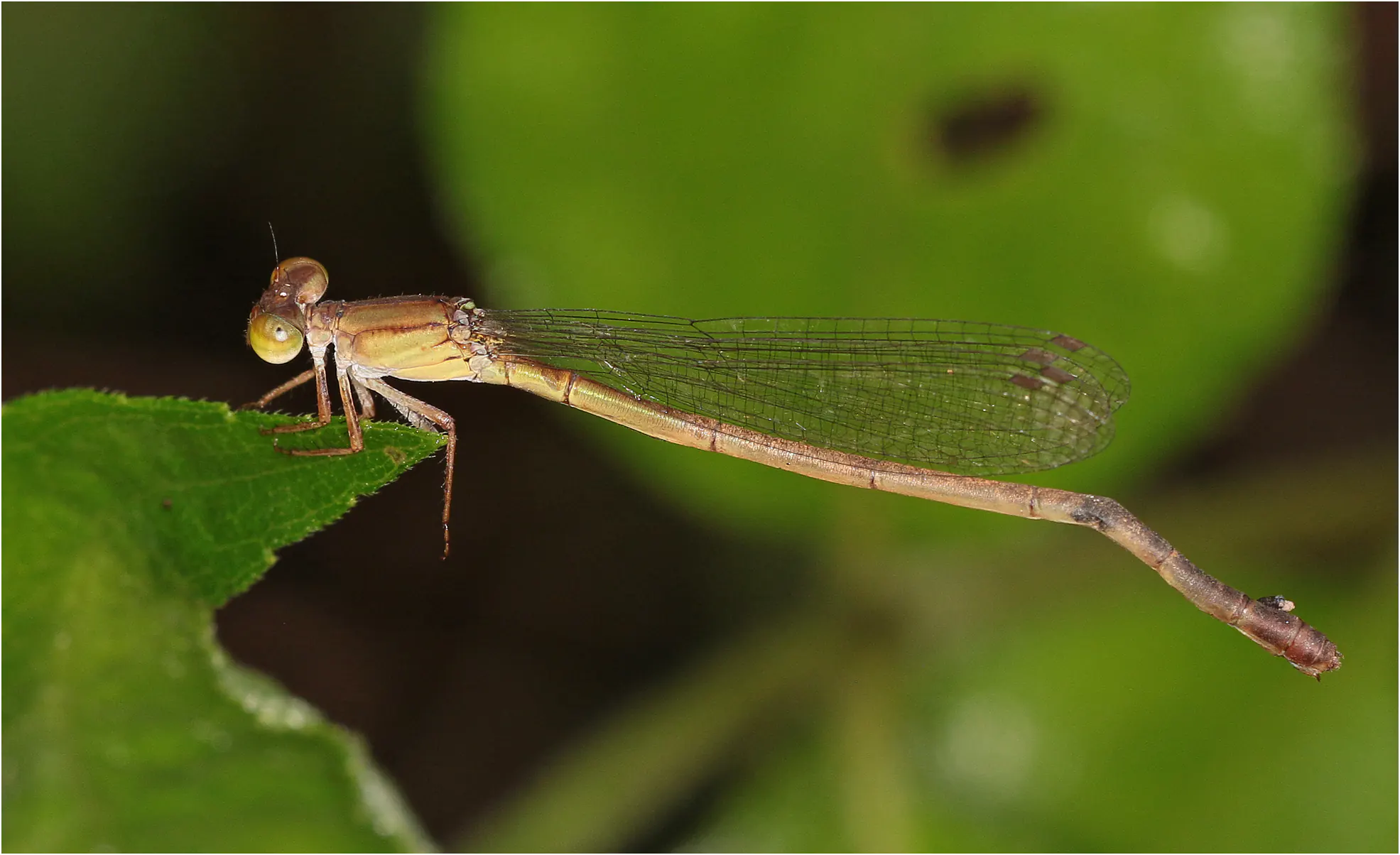
I photographed this female Ceriagrion at the same very small site as the first male; I have no further evidence to prove it is indeed a female Ceriagrion corallinum other than the absence of males from other Ceriagrion species. And, perhaps, a small green spot at the upper part of the wing base.
Etymology: Ceriagrion corallinum
Ceriagrion; the genus was established by Selys in 1876 when he divided the large genus Agrion, likely for the species cerinorubellum, from agrion (widely used for naming… Coenagrionidae and derived from the Greek agrios for wild, living in the fields) and the Latin cerinus meaning wax-colored (or wax-like appearance?), referring to the smooth and hairless thorax of the genus. See Fliedner, 2006.
Corallinum, from the Latin adjective corallinus meaning coral-like or coral red, clearly referring to the color of its abdomen.
Campion, 1914 – Three new species of Ceriagrion from West Africa. Annals Magazine Natural History Series 8, 14, 277-282. P. 279.
Fliedner, 2006. – The scientific names of the Odonata in Burmeister’s « Handbuch der Entomologie ».