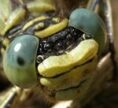
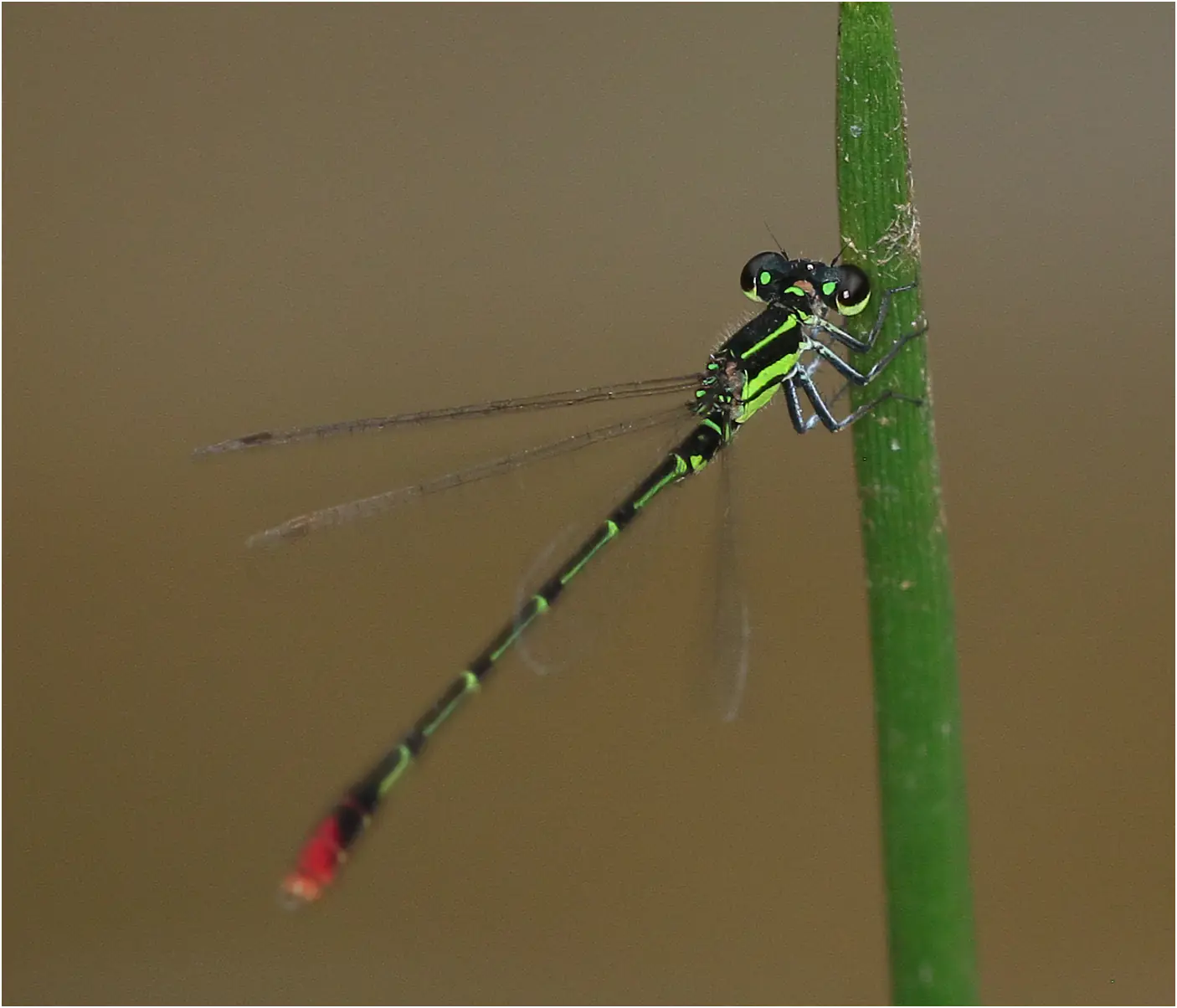
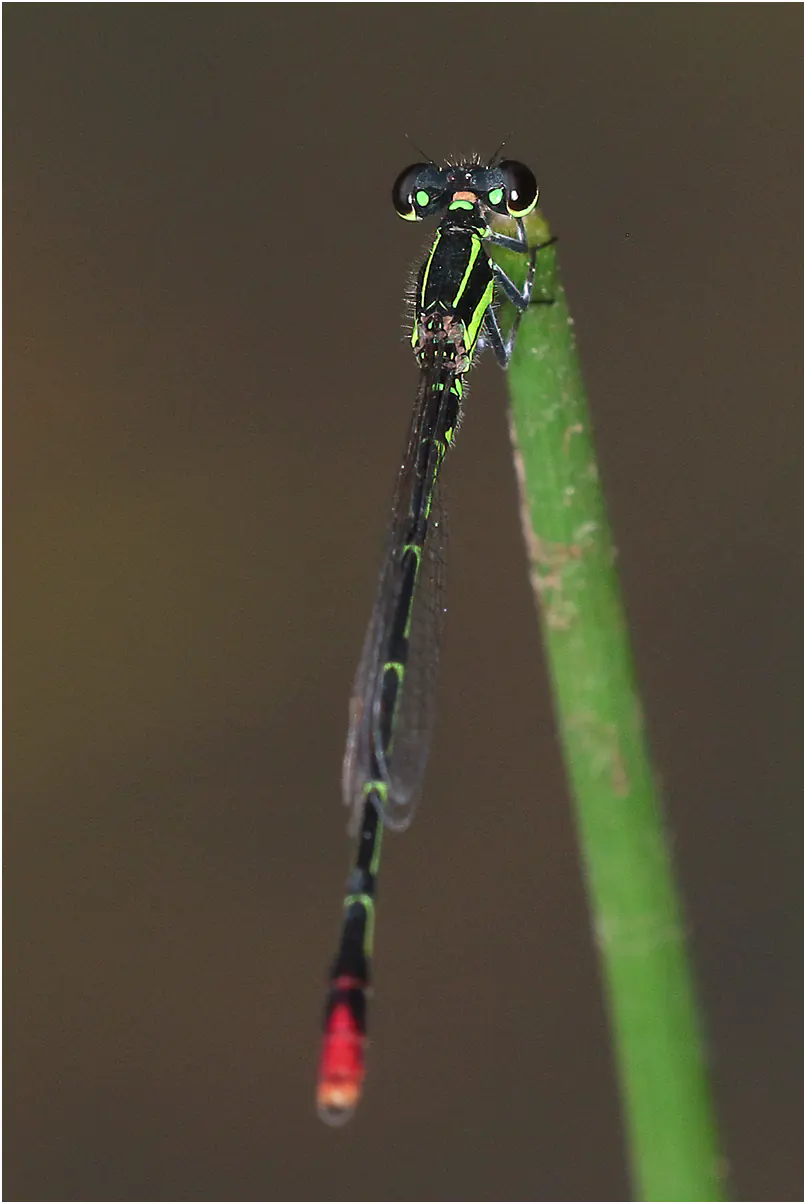
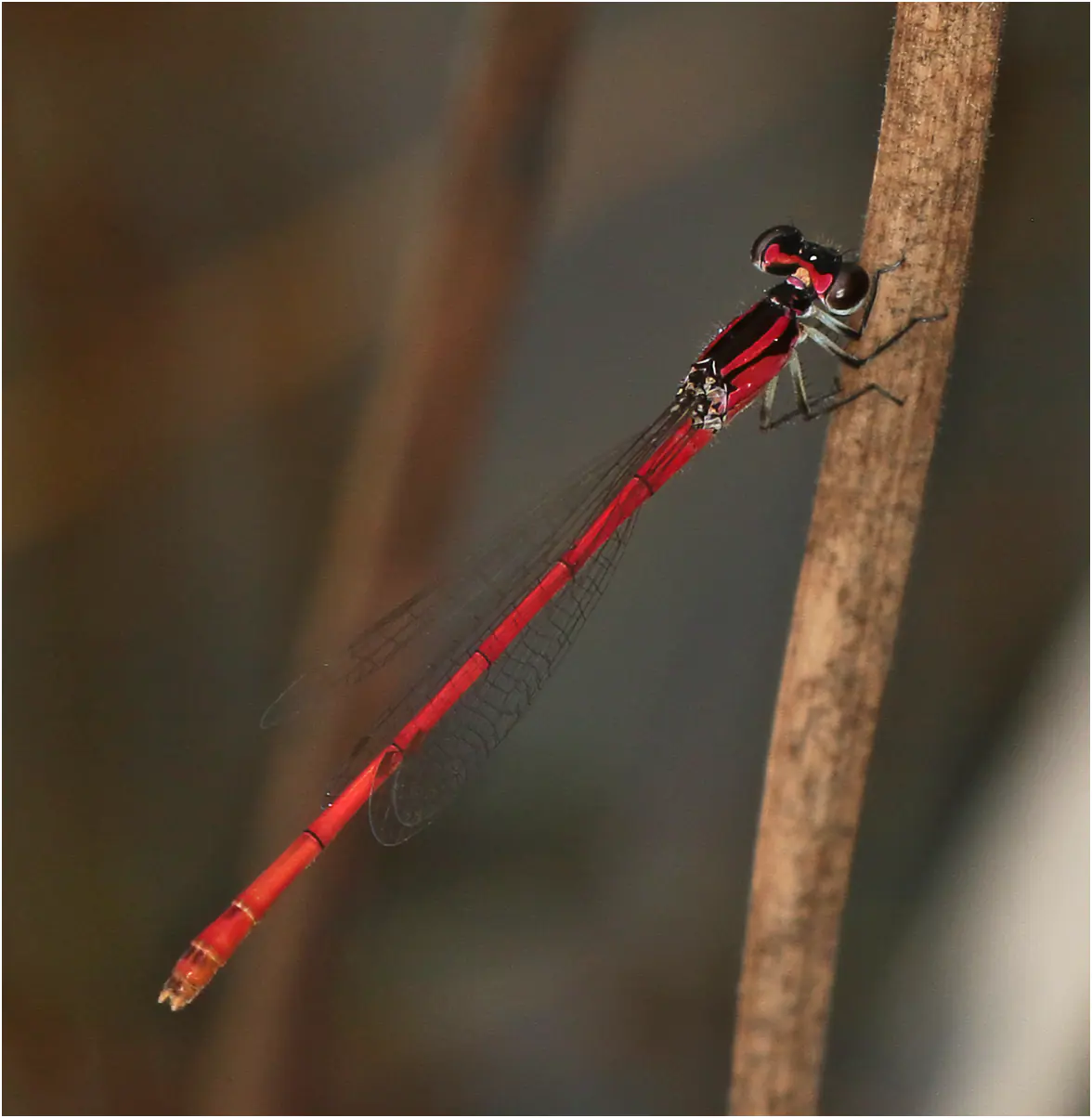
Agriocnemis victoria male (Coenagrionidae) does not appear in the reference lists for Ghana, neither in the Neill and Paulson list (2001) nor the Dijkstra list (2013). Its presence was nonetheless mentioned in Pinhey (1974), not in the text where he reports the species’ distribution, but in a table under the note: "Ghana to S. Leone". However, as it was probably only assumed, it was not taken up later for lack of evidence. It is therefore a new species for Ghana!
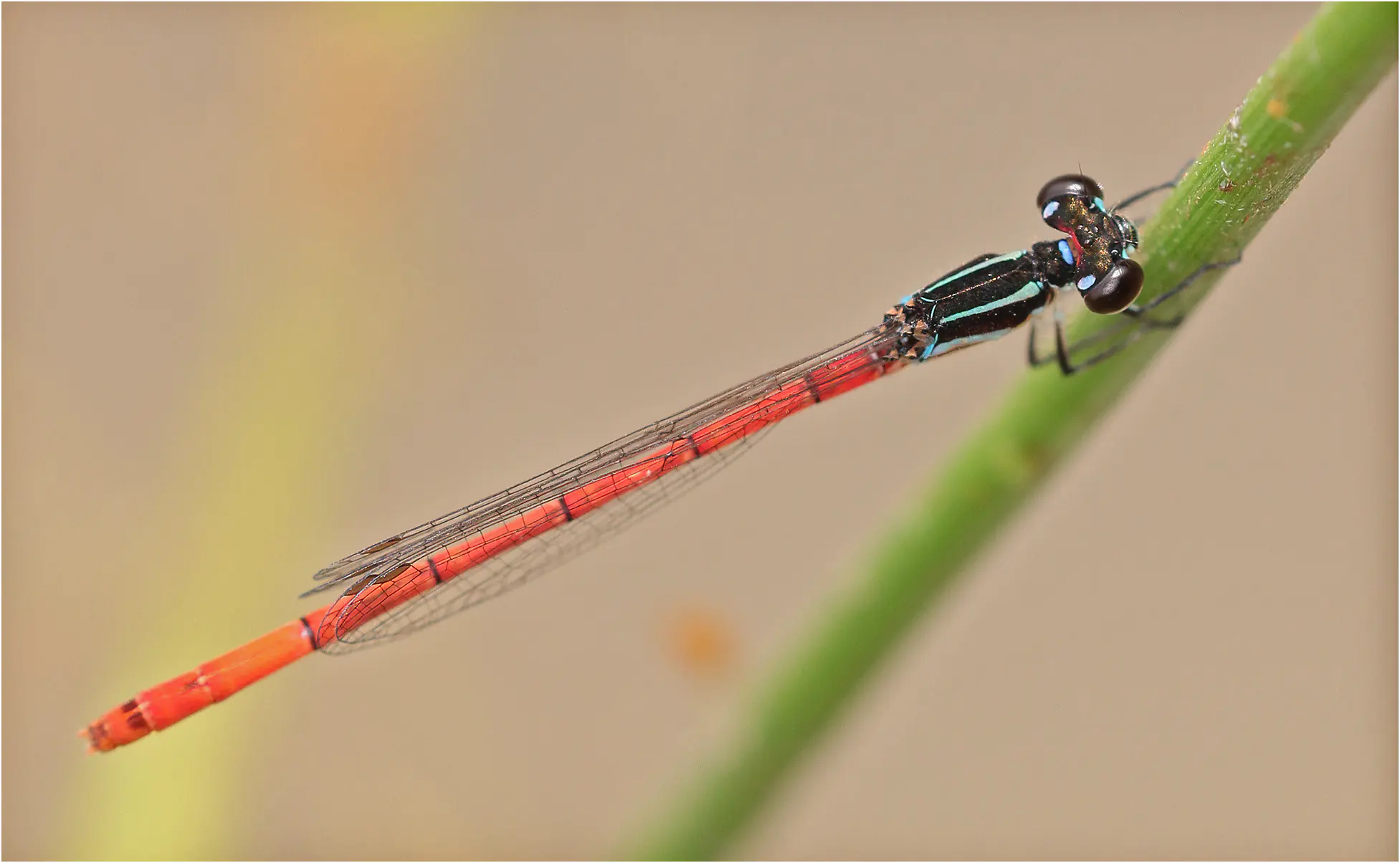
All the photos were taken at the same pond, in roughly 4 m², where young and adult males, and females, were trying to evade us.
I therefore wanted to confirm this identification using the anal appendages, which are illustrated in various documents. And the least one can say is that they vary depending on the authors and geography.
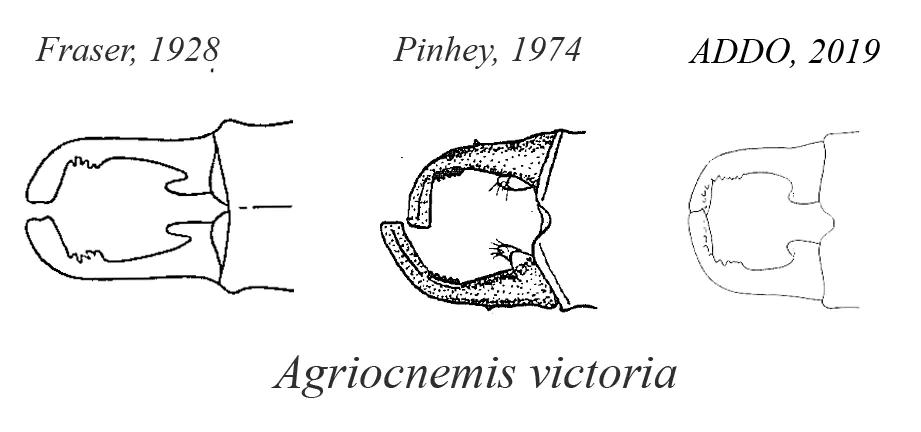
Below, I show the anal appendages of two specimens: one young individual that I find consistent, and another mature one that is clearly less so.
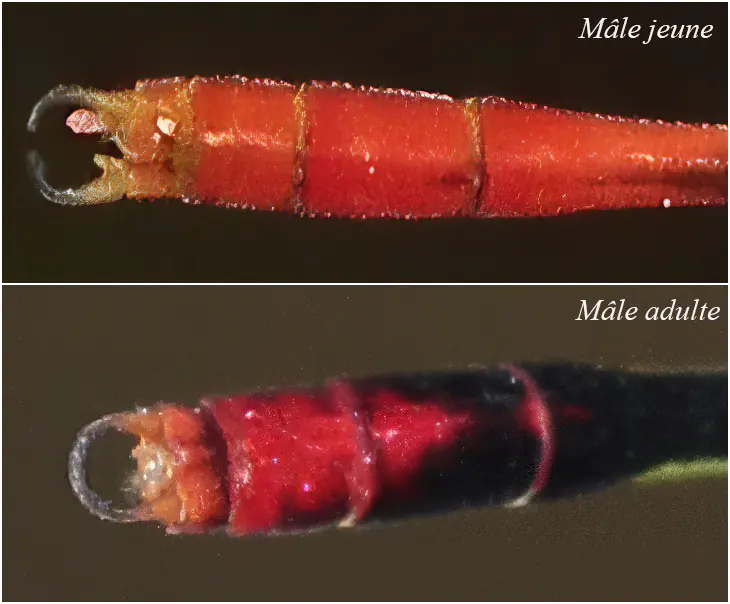
Regardless of the shape of the appendages, which are therefore variable, what also surprised me was this red wedge with an anterior point on S8. In the specimens I had encountered in Namibia and those I find online, on iNaturalist or observation.org, it is a black wedge with a distal point that decorates S8.
As the rest of the individual—the black and green patterns on the abdomen and thorax, with the pronotum in agreement—I nonetheless think this is Agriocnemis victoria. Besides, the shape of the superior appendages is truly distinctive, and only those of A. forcipata (not known from Ghana, and occurring closest in Gabon or Cameroon) are similar; but in that species they are very strongly curved downward.
At present the species is known west of Ghana: in Liberia, and presumed in Côte d'Ivoire. And east of Ghana, in Nigeria. Its presence was not proven in Ghana, Togo, or Benin. Finding it in Ghana is therefore not incongruous.
From Zambia and Senegal, its range extends to Cameroon, skipping the three countries cited, then south to Angola, and reaches Uganda and Tanzania to the east.
IUCN Red List.
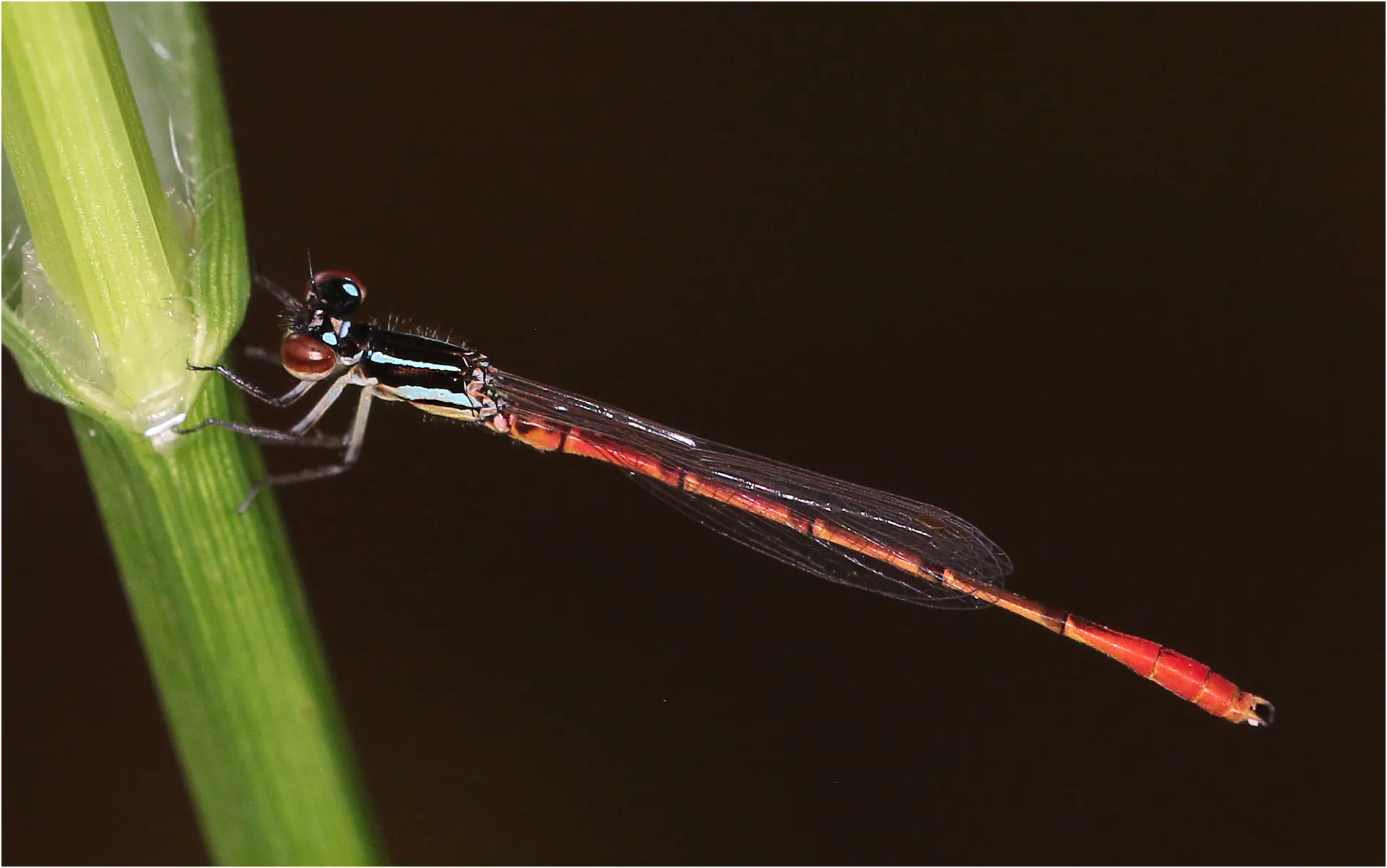
Fortunately, the appendages of this young male Agriocnemis victoria are fully consistent, and its coloration recalls that of the females of the species.
These forceps-like appendages and its small size gave it the English common name Lesser Pincer-Tail Wisp.
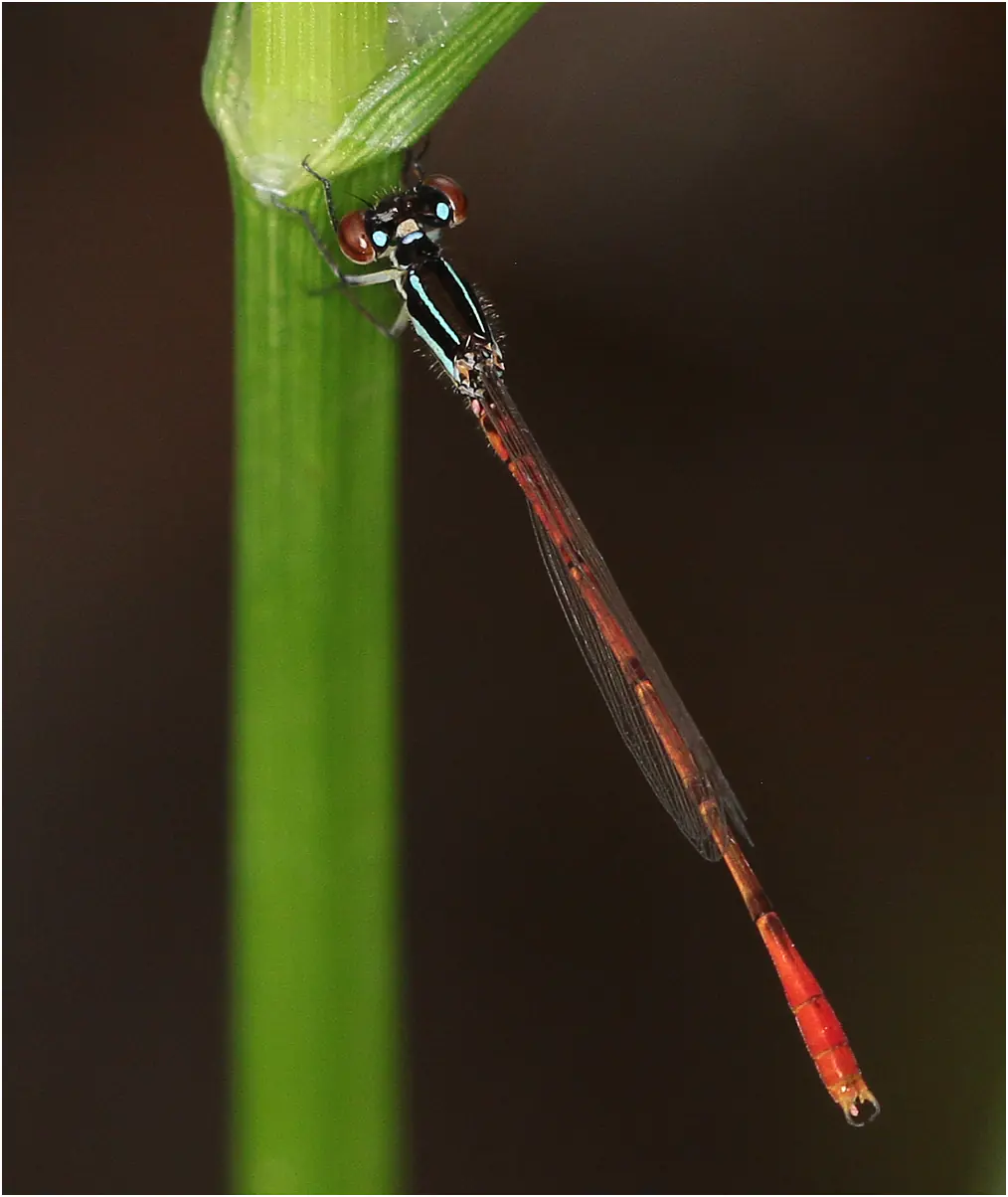
I had therefore already encountered it in Namibia, and on the page devoted to this species I noted that Fraser, in his original description of the species, gives an abdomen length of 16 mm; it would measure barely more than 20 mm in total! Agriocemis forcipata is somewhat larger.
It is a species of open habitats, sometimes in forest, sometimes at temporary ponds. We observed it at a large pond on the forest edge, but as with all the Agriocnemis I know, it stays along the margin, where the water is shallow (unless you flush it!), among emergent grasses.
Unfortunately I did not take any photos of this pond; I forgot, distracted by its exceptional richness in odonates: we recorded 3 new species for Ghana from this single body of water.
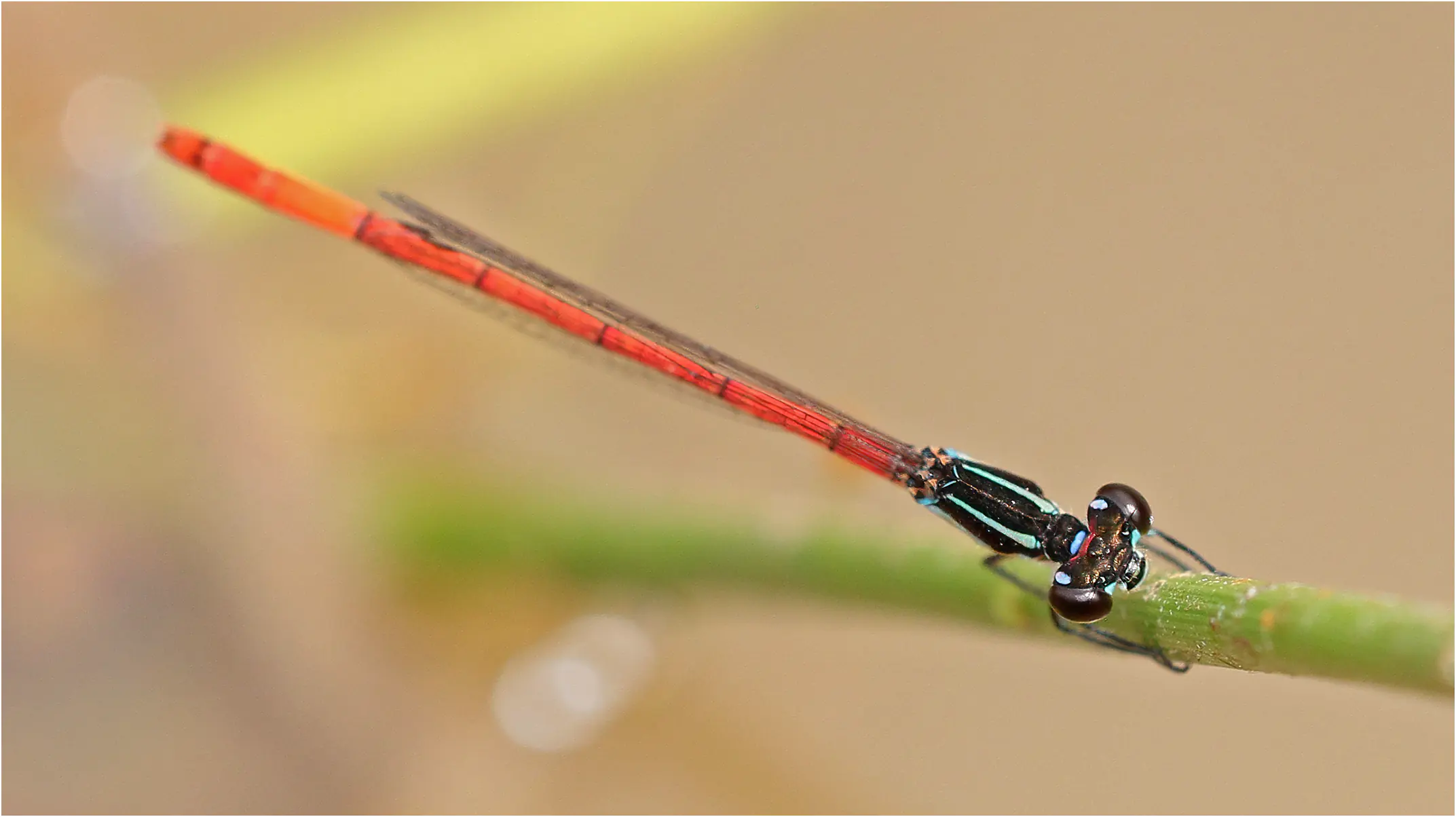
Below are the two female forms described by Fraser: andromorph on the left, very close to immature males, and heteromorph on the right, blood-red, as he describes it.
Etymology
Agriocnemis, from the Greek Agrios- (wild), for living in fields, and knemis, meaning greave or legging, as with our European Platycnemis. Selys believed the genera to be closely related on the basis of the tibiae, which I do not observe at all. Those of Agriocnemis do not seem any broader to me than those of other Coenagrion. But “cnemis” in many compound genus names should rather be understood as “belonging to the Coenagrionidae” (see Endersby & Fliedner 2015).
Victoria is a reference to the type locality, Lake Victoria. Fraser writes: "Distribution.—Two males and two females, collected by Dr. G. Hale Carpenter on the north-west shores of Lake Victoria, Uganda, July—September, 1927."
Dijkstra, 2013 – A Rapid Biological Assessment of the Atewa Range Forest Reserve, Eastern Ghana:137-142. 2013 – Checklist of Odonata Recorded from Ghana – Conservation International.
Dijkstra, K.-D.B (editor ADDO), 2019 - African Dragonflies and Damselflies (ADDO) - Agriocnemis victoria - [The link may not work; web.archive link from the ADDO site, now offline.]
Fraser 1928 – Odonata of the African continent– Transactions of the Entomological Society of London. [The link may not work; web.archive link from the ADDO site, now offline.]
Ian Endersby & Heinrich Fliedner, 2015 – The Naming of Australia’s Dragonflies, Ian Endersby & Heinrich Fliedner, Busybird Publishing.
Neill and Paulson, 2001 – An annotated list of Odonata collected in Ghana in 1997, a checklist of Ghana Odonata, and comments on West African Odonate Biodiverity and Biogeography – March 2001 – Odonatologica 30(1):67-86
Pinhey, 1974 – A Revision of the African Agriocnemis Selys and Mortonagrion Fraser (Odonata : Coenagrionidae)– Occasional Papers of the National Museums and Monuments of Rhodesia. [The link may not work; web.archive link from the ADDO site, now offline.]