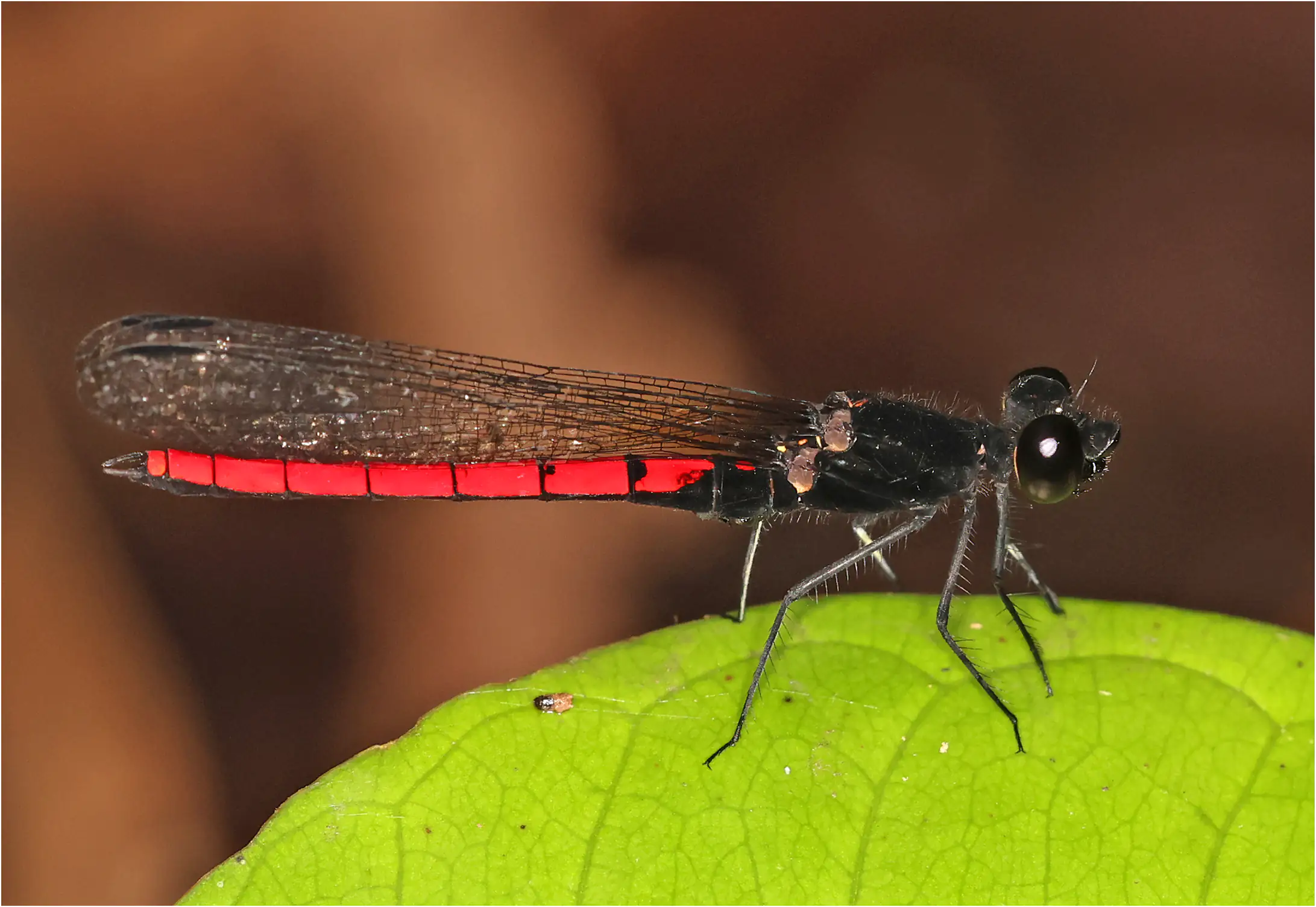
Chlorocypha dispar, Chlorocyphidae, is part of a genus comprising 31 species, all endemic to tropical Africa. The species are sometimes very difficult to identify due to the significant variations they exhibit throughout their development, environment, and even temperature, as they are dulled or darkened by the "cold" (Dijkstra, 2003).
Thus, young Chlorocypha dispar and Chlorocypha luminosa have black thoracic patterns on a yellow background that are virtually indistinguishable, but if C. luminosa retains its yellow thorax, C. dispar becomes completely black—making it, in fact, the darkest (most melanic) of all.
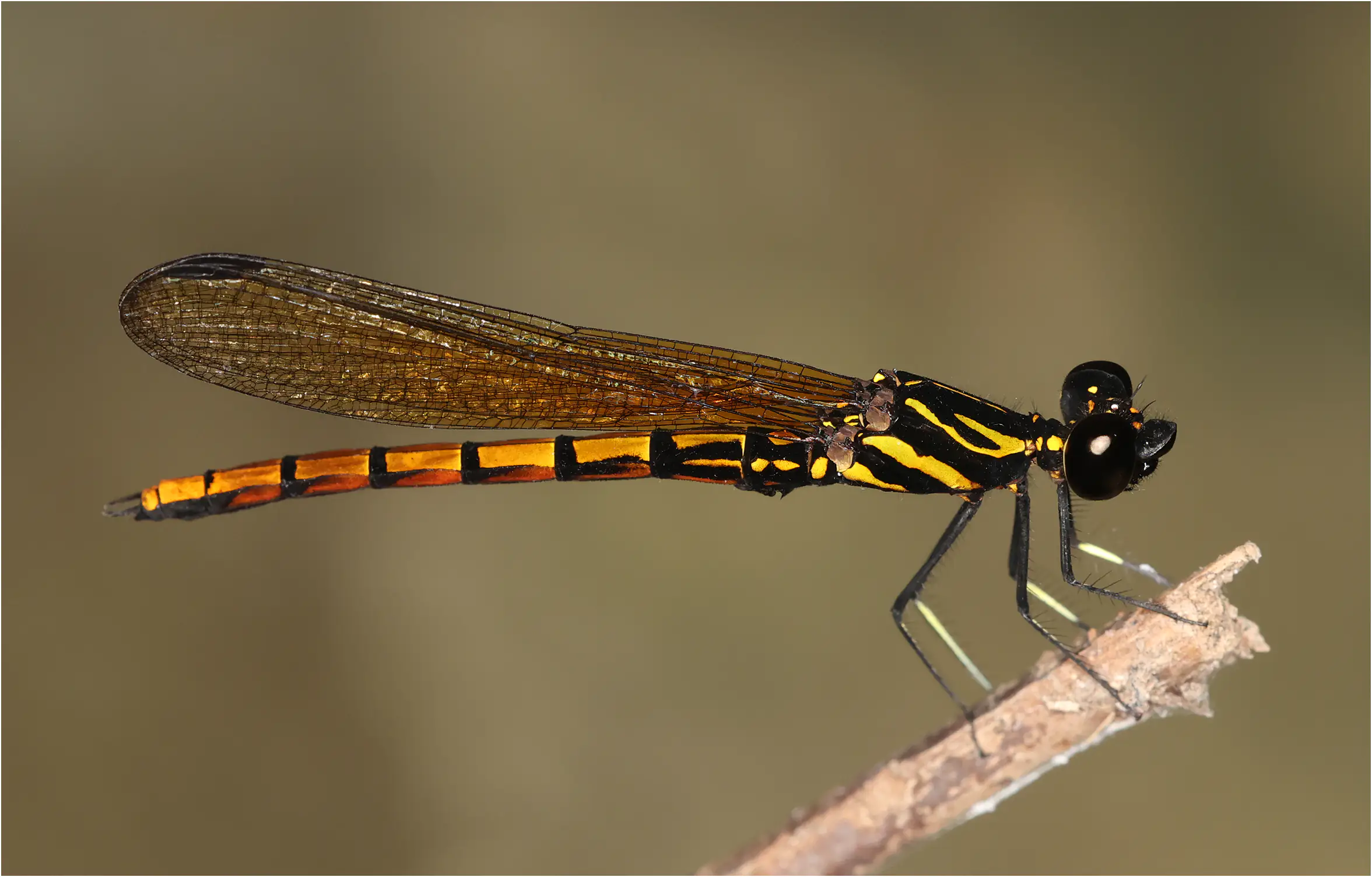
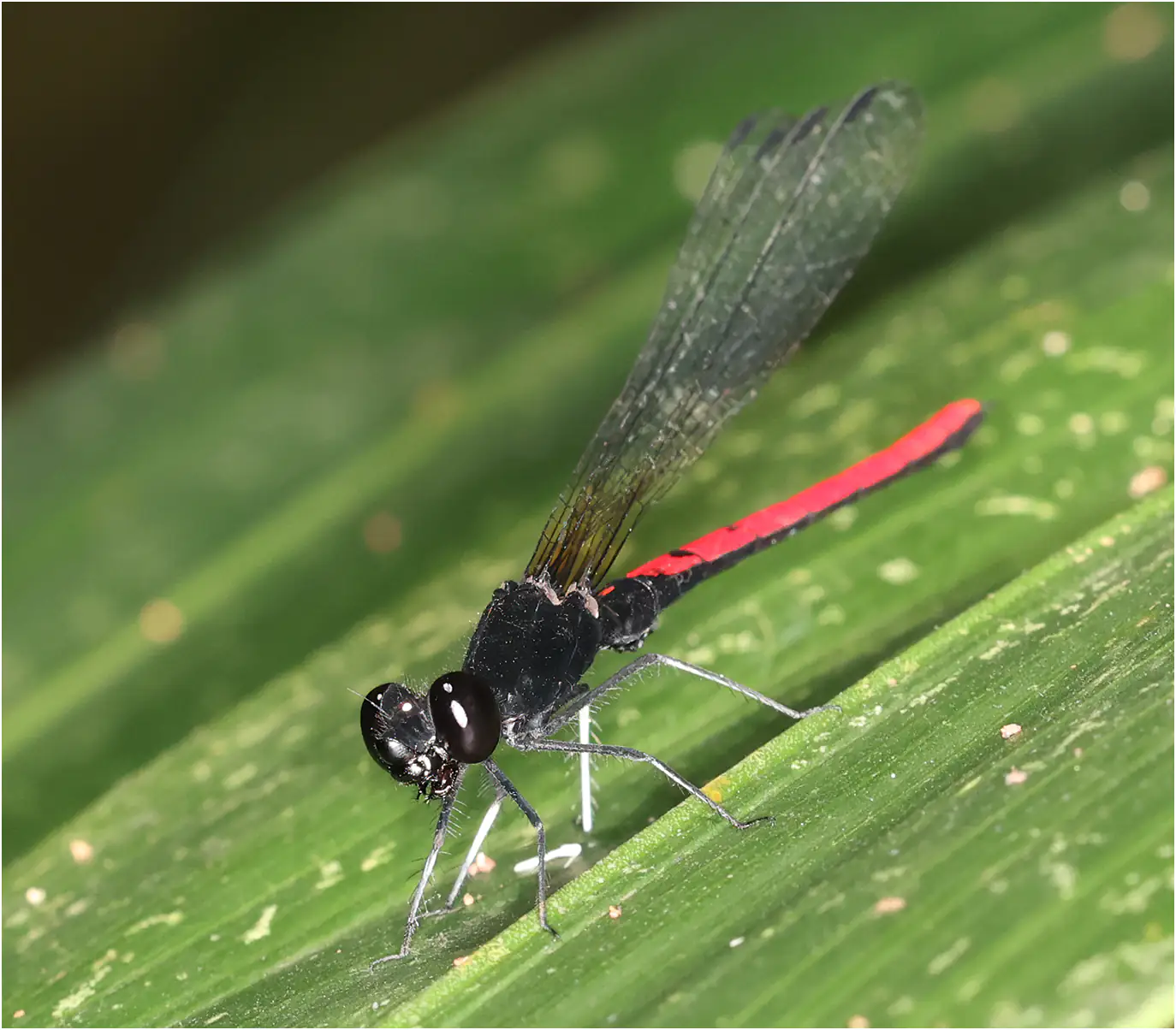
Thus, the face and head of the Little Red Jewel (its English vernacular name) are black, as is its thorax. The tibiae are white on their antero-internal face, and the abdomen is bright red with variable black markings on segments 2 and 3. Segment 2 is often black with a red oval dorsal spot (Pinhey, 1967).

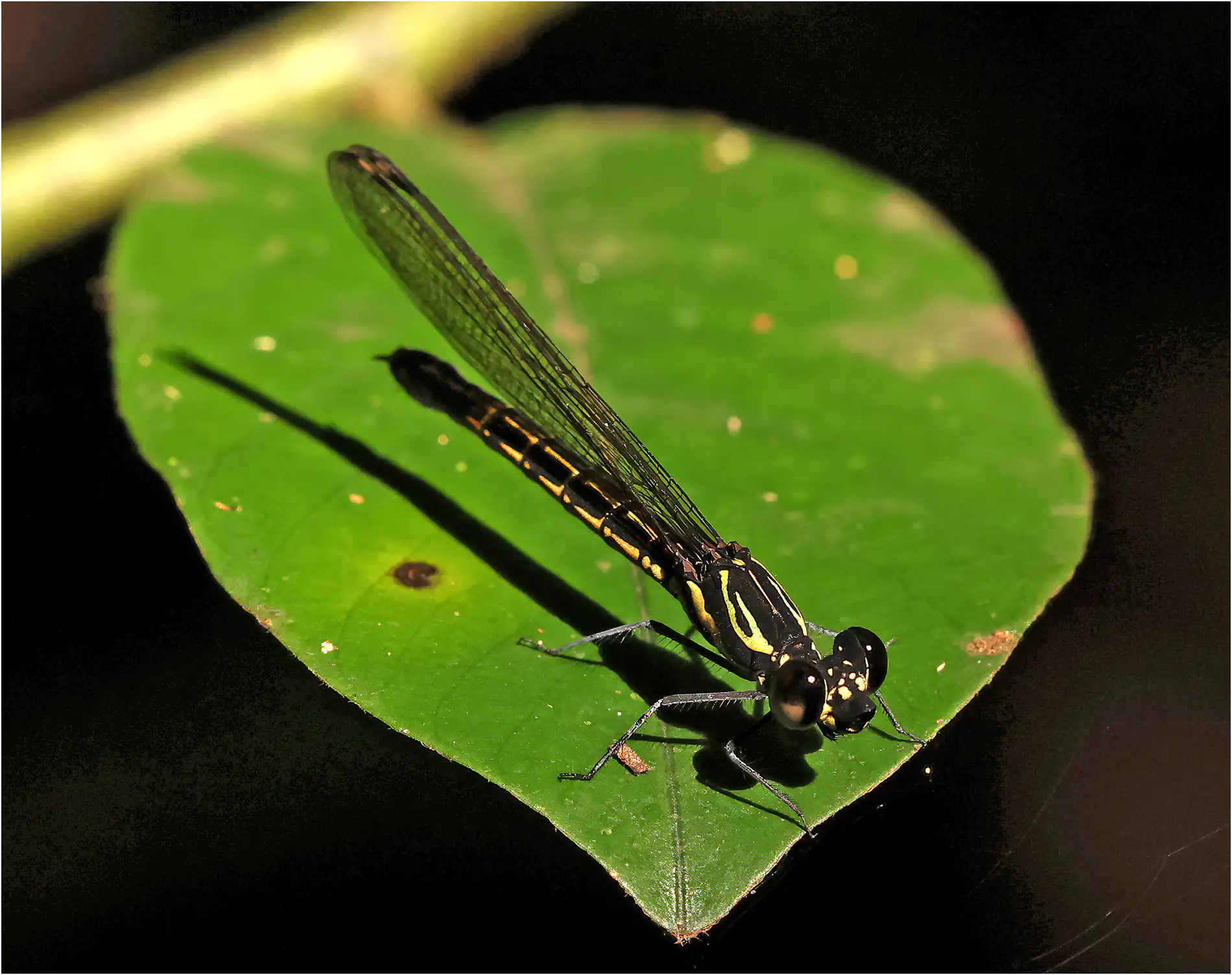
In Ghana, there are seven Chlorocypha species, and we were fortunate enough to encounter them all. With its completely black thorax, the male C. dispar holds a unique position and could only be confused (which was initially our case) with Chlorocypha pyriformosa, but the head and thorax of this species retain yellow markings at maturity.

Opposite are the drawings of the male and female by Fraser (1949).
Below is the same species by Pinhey (1967), then by K.-D. Dijkstra, showing a strong variation in the markings of the first segments.


It is a very small species; Fraser (1949) measured its abdomen at 19 mm, pointing out an error by Selys in his Synopsis des Caloptérygines (1853), where it was given as 29 mm (Selys had classified this Agrion dispar of Palisot de Beauvois under Libellago).
Its total length is therefore about 28 to 29 mm.

We encountered it on a small, shallow forest river in a dark spot, alongside a female Chlorocypha that I believe belongs to the same species, as she was right next to it and we didn't see any other Chlorocypha that afternoon (C. luminosa in the morning).
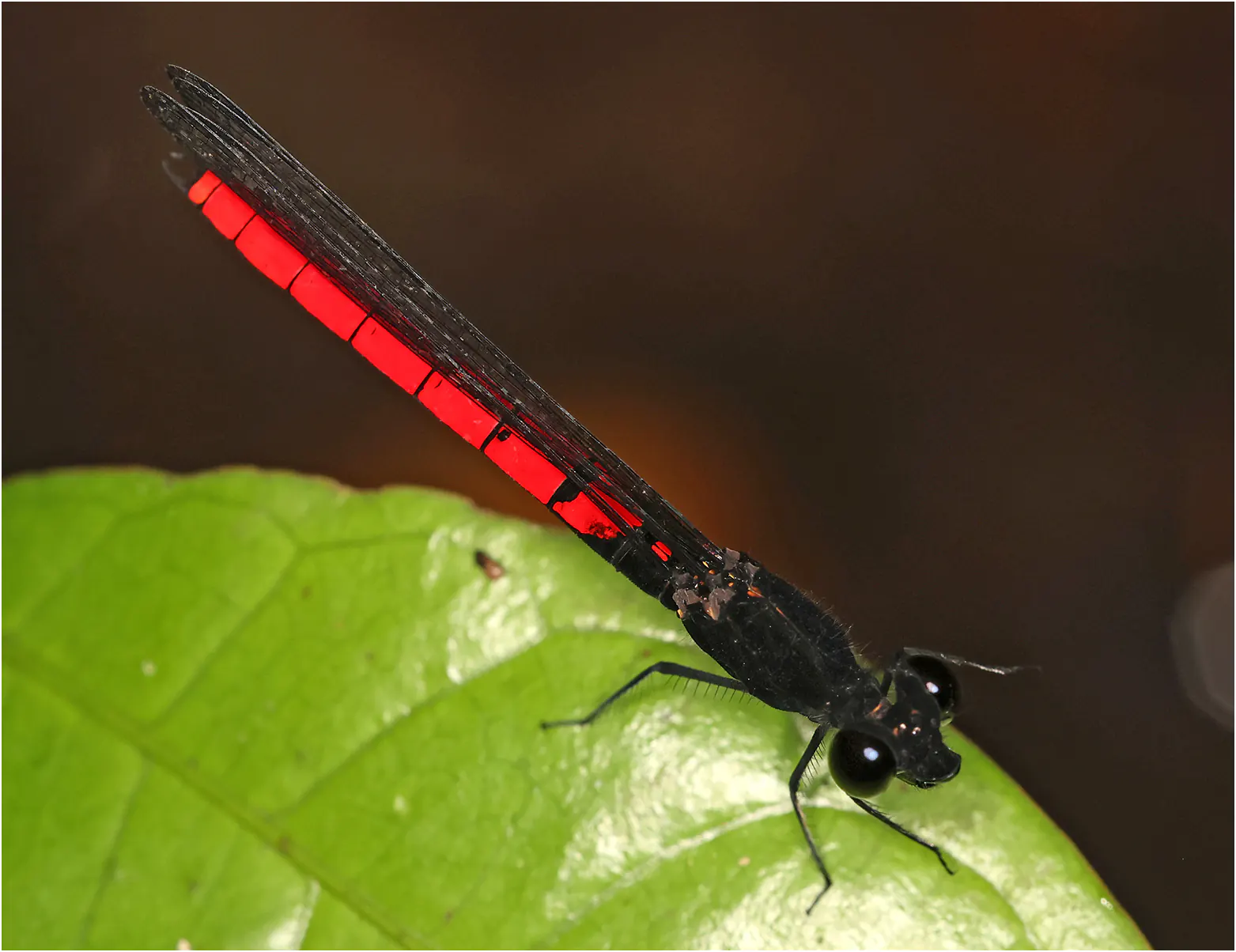
Its distribution extends from Senegal and southern Mali to Cameroon, and possibly Gabon.
IUCN Red List.
My series of photos of the male is interrupted by those of this female, which is almost certainly of the same species and seems to match Fraser's drawing shown above very well. Sexual dimorphism is very pronounced, but the small round mark on the dorsal side of S2 is still present.
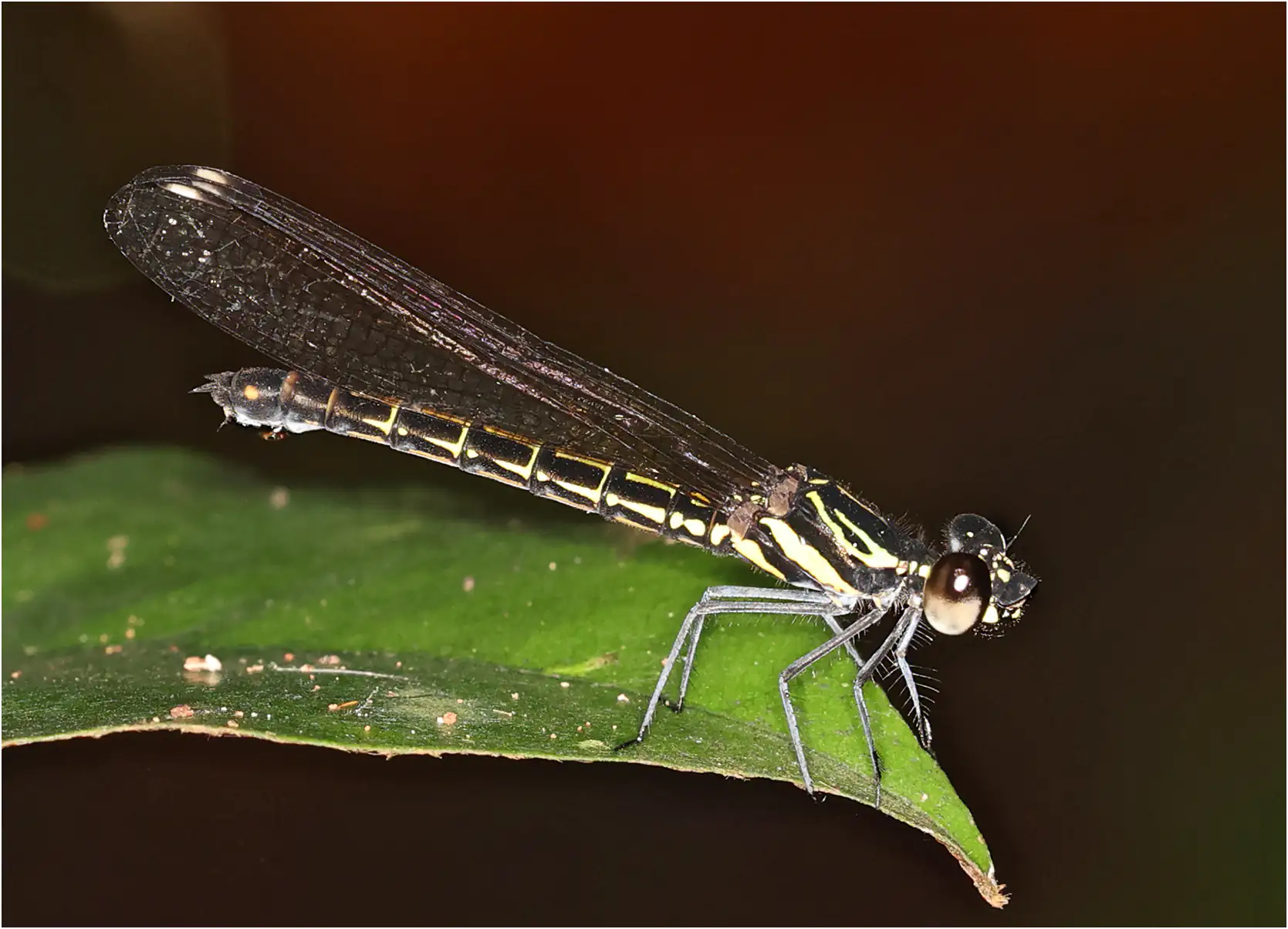
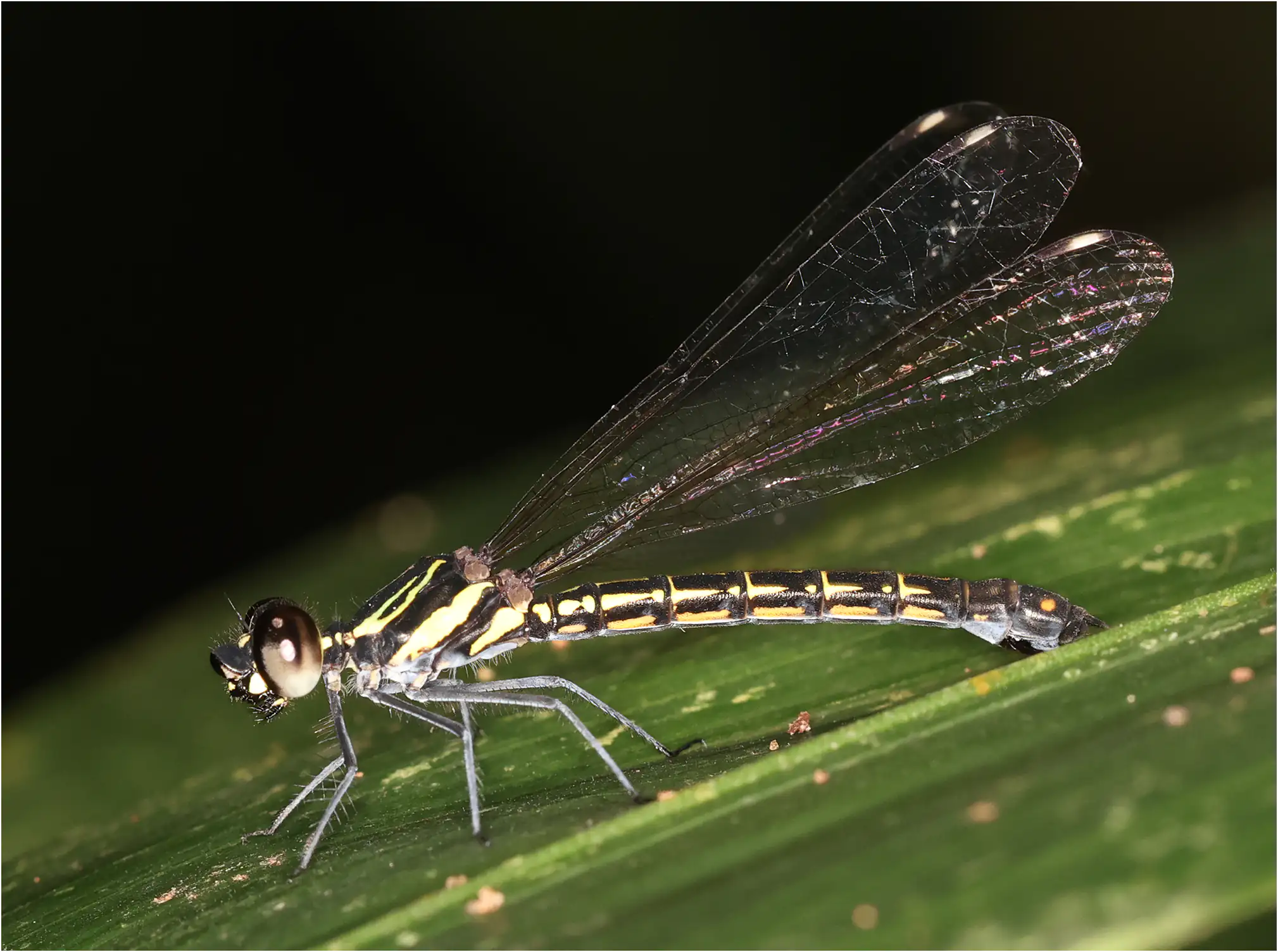
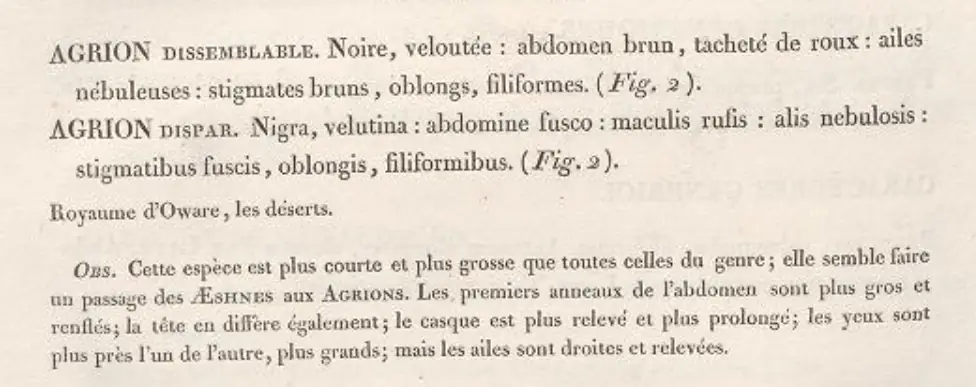
We can appreciate how much descriptions have progressed since that of Palisot de Beauvois, which is succinct to say the least, and hats off to anyone who could identify a specimen by referring to it; fortunately, holotypes are mostly well preserved and available for consultation. In this case, however, the holotype was lost very early on...
The illustration below, taken from Palisot de Beauvois' work and executed by Jean-Gabriel Prêtre, is surprising to say the least; the wings seem to attach not to the thorax, but to strange abdominal segments. This is all the more curious given that Prêtre was a renowned naturalist painter, attached to the Muséum national d'histoire naturelle in Paris, and one of the most prolific illustrators of his era. I do not know whether Jean-Gabriel Prêtre made this drawing from a specimen or from a sketch by Palisot de Beauvois.
I am always amazed by how "historical" odonatologists were able to make progress with such reproductions!
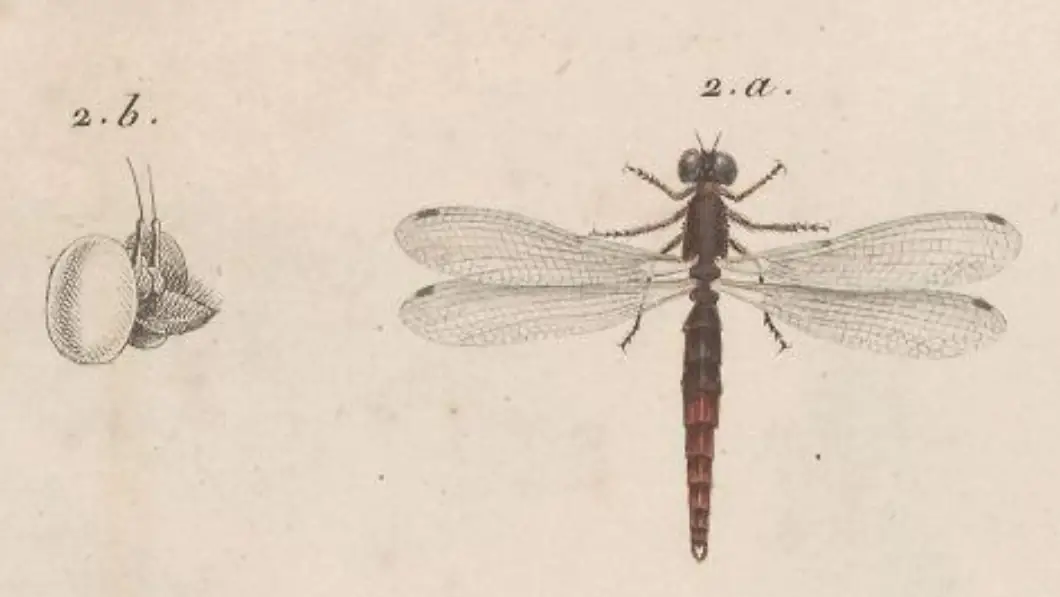
Etymology: Chlorocypha dispar
Fraser (1928) erected the genus Chlorocypha for this Agrion dispar of Palisot de Beauvois.
Chlorocypha, from the Greek chloro, for yellow or green, and cyphos, meaning humpbacked or hump, referring to the color of the species' curious clypeus, certainly in an immature specimen. Fraser wrote, "I have chosen the name Chlorocypha for this genus, based on the specific character mentioned by Palisot de Beauvois for the type species dispar: "le chaperon [Clypeus] est d'un jaune-verdâtre" [the clypeus is of a greenish-yellow]."
I am certain that Palisot de Beauvois never wrote these words in his description, nor did Selys in his Synopsis des Caloptérygines, nor in his Monographie des Caloptérygines. The origin of Fraser's quote remains a mystery to me.
Dispar, meaning "unlike" or "different" in Latin, and Palisot de Beauvois, noting numerous differences, wrote, "Cette espèce est plus courte et plus grosse que toutes celles du genre; elle semble faire un passage des Æshnes aux Agrions. Les premiers anneaux de l'abdomen sont plus gros et renflés ; la tête en diffère également ; le casque est plus relevé et plus prolongé ; les yeux sont plus près l'un de l'autre, plus grands ; mais les ailes sont droites et relevées." ["This species is shorter and stouter than all those of the genus; it seems to form a transition from Aeshnas to Agrions. The first abdominal segments are larger and swollen; the head also differs; the cap is more raised and extended; the eyes are closer to one another, larger; but the wings are straight and raised."]
Dijkstra, 2003 - Problems in Chlorocypha classification: four cases from West Africa and a discussion of the taxonomic pitfalls (Odonata: hlorocyphidae) - International Journal of Odonatology, Volume 6, Issue 2, Pages 109-125, 2003.
Fraser, 1928 - "A revision of the Fiers-winged Damselflies (Family Chlorocyphidae) of Africa". Annals and Magazine of Natural History, Série 10, Vol. 2.
Fraser, 1949 – A revision of the Chlorocyphidae (Odonata) with notes on the differentiation of the Selysian species, rubida, glauca, cyanifrons and curta. Bulletin de l’Institut Royal des Sciences Naturelles de Belgique. 25(6) 1-50. P. 16.
Palisot de Beauvois, 1805 - Insectes recueillis en Afrique et en Amérique, dans les royaumes d'Oware et de Bénin, à Saint-Domingue et dans les États-Unis, pendant les années 1786-1797. Imprimerie de Fain et Compagnie, Paris. Livraison 2, p. 85, pl. VII.
Pinhey, 1967 - African Chlorocyphidae (Odonata), Journal Ent. Soc. S. Africa: Vol. 29, p. 182.