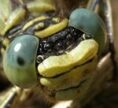
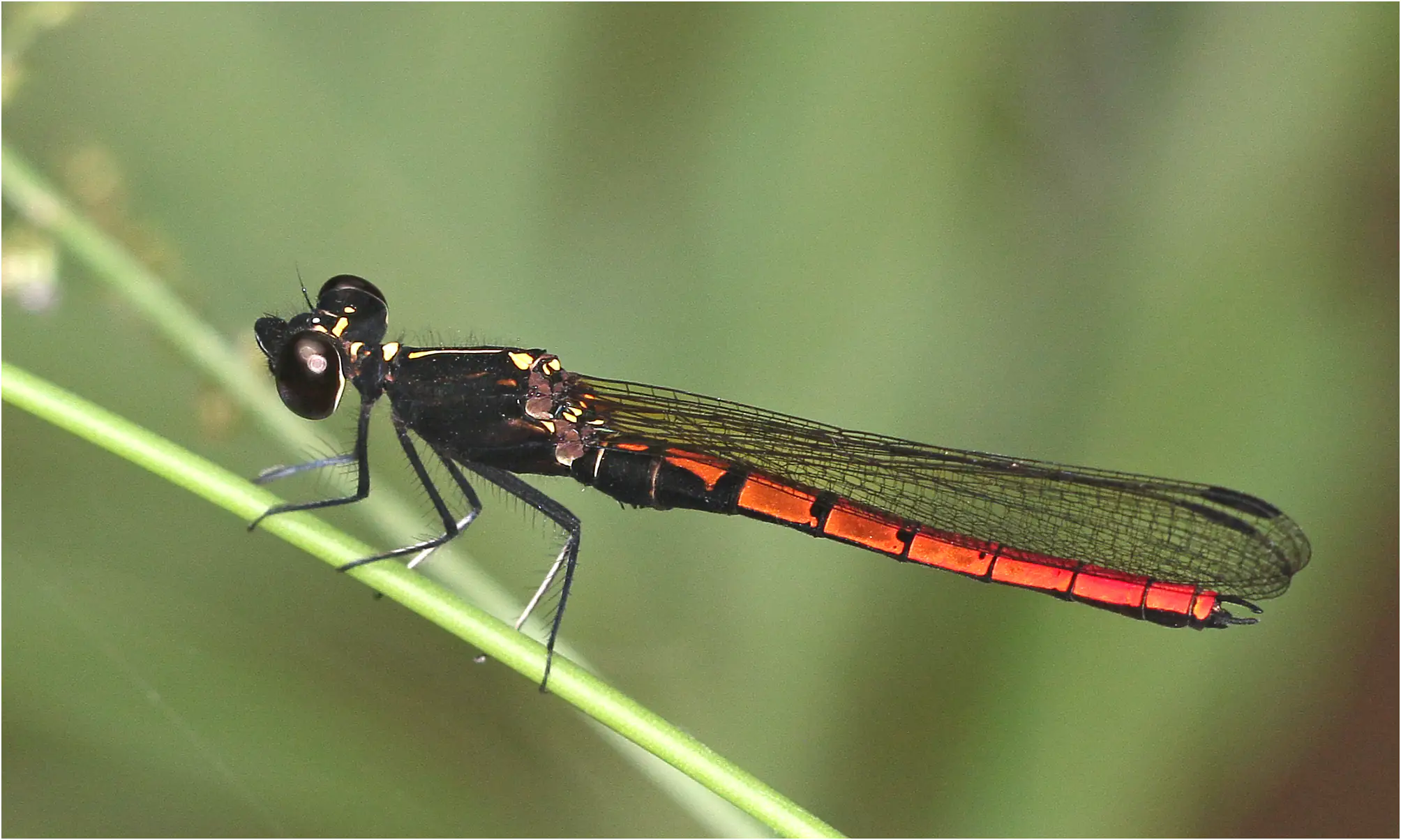
Chlorocypha pyriformosa is one of seven Chlorocypha (Chlorocyphidae) species found in Ghana, and we were fortunate enough to encounter them all. They are all spectacular, with their faces modified by a prominent clypeus, wings as long as the abdomen, and vivid colors.
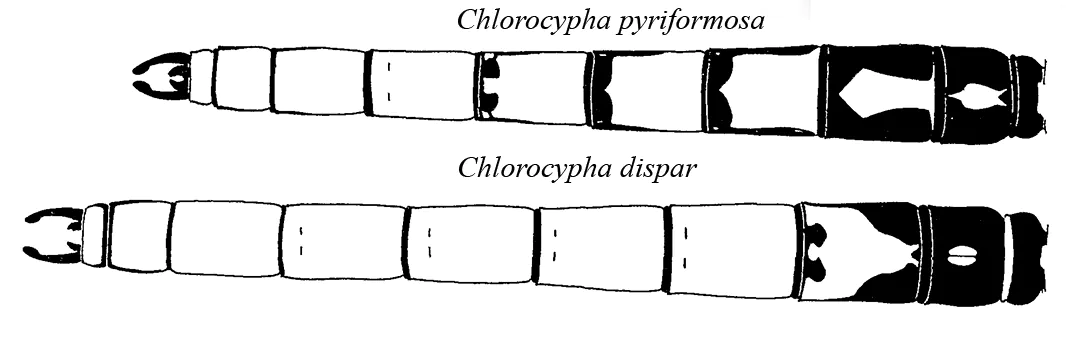
Fraser (1947) described this species as a subspecies of Chlorocypha dispar, which is hardly surprising given how closely related they are; he had only noted the different shape of the pale (red) mark on S2. The specimens he examined likely did not show the yellow markings present in mature individuals, in particular the line along the dorsal thoracic carina, which, according to K.-D. Dijkstra (2013), is always present even if sometimes faint. It was this great specialist of African odonates who eventually raised it to full species status.
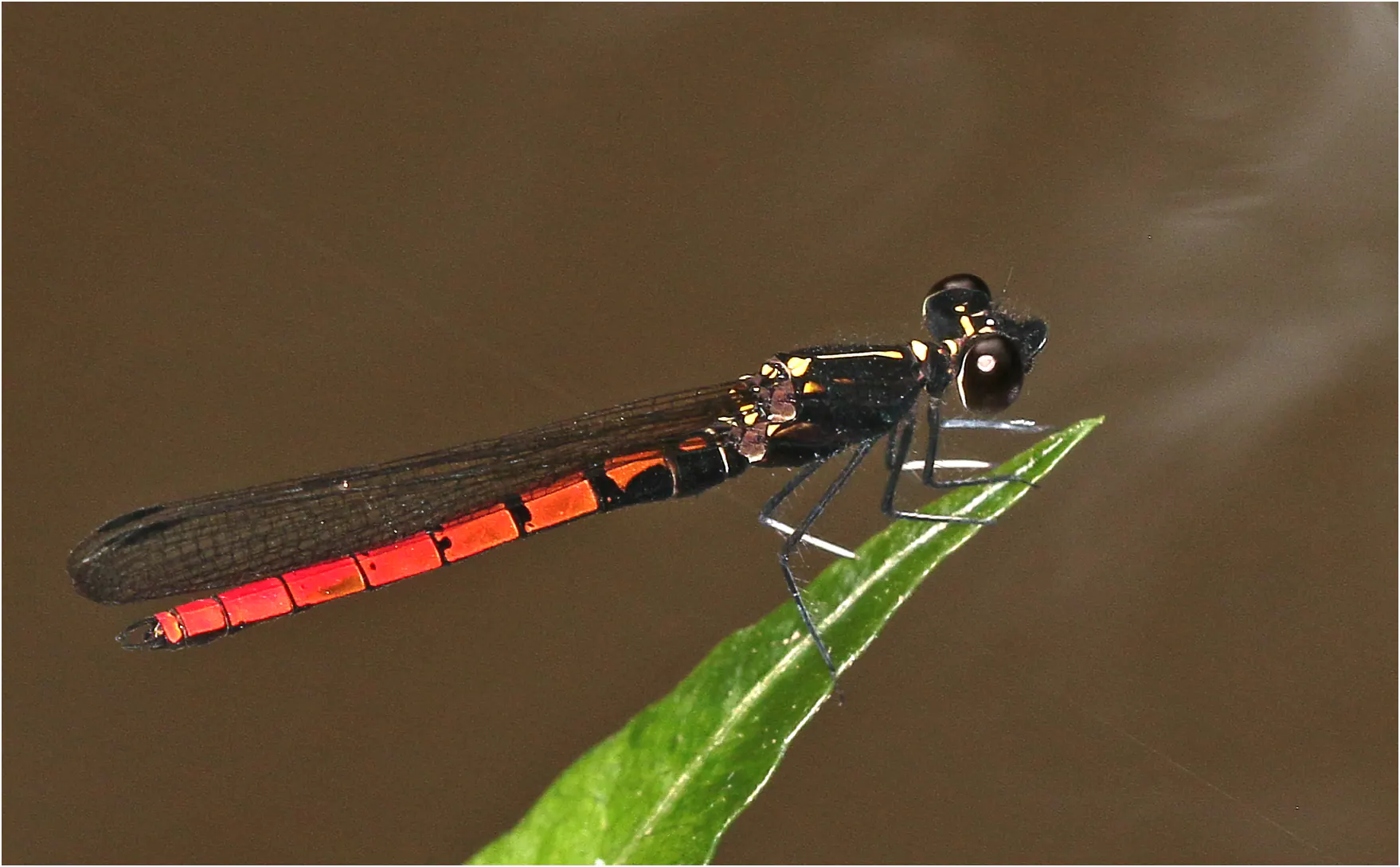
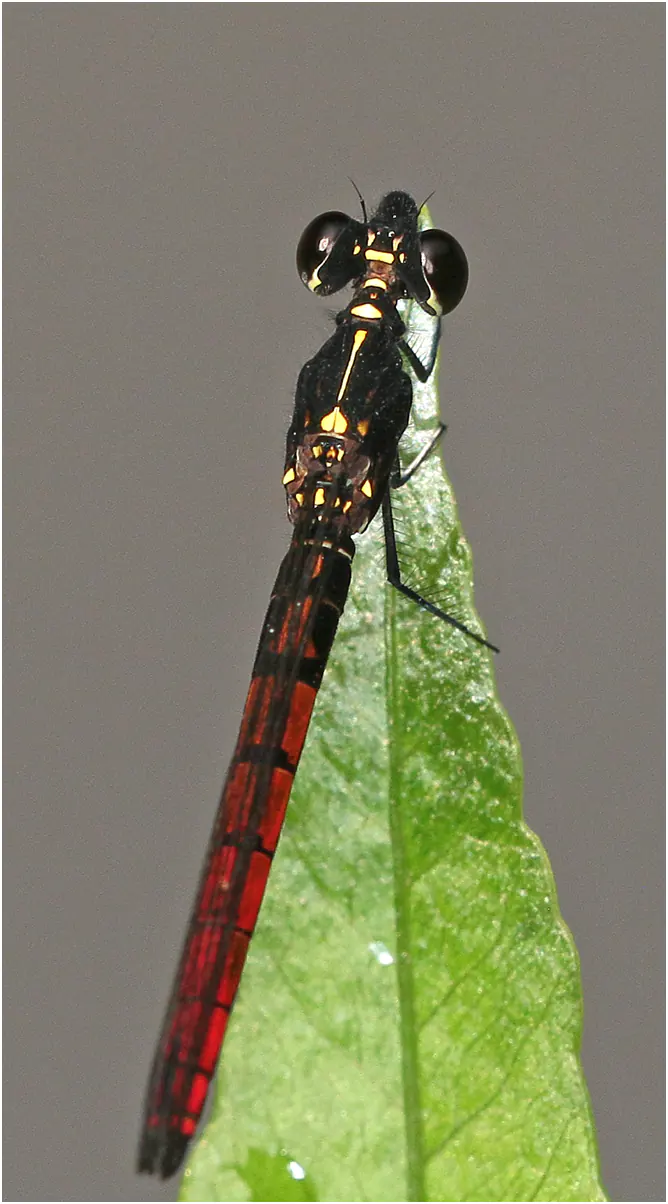
Legrand and Couturier (1985) inadvertently redescribed this species, believing they were dealing with a new one, C. mutans, which they explicitly compared to C. dispar. They noted that the mark on S2 of C. dispar is shaped like a coffee bean (divided in two), whereas that of Chlorocypha pyriformosa (mutans...) resembles a wolf's head. This is not clearly visible on my photos, where one can instead observe the truly peculiar shape of the red coloration on the third segment.
One also notes the difference in size; the hindwing of C. pyriformosa measures 18-19 mm, while that of its cousin measures 20-21 mm (Dijkstra, 2003).
Fraser, who thought he was describing merely a form of C. dispar, did not provide its size; K.-D. Dijkstra, when elevating it from subspecies to valid species status, did not give the abdominal length either. It measures a few millimeters less than C. dispar (which is 28 to 29 mm), making them small zygopterans.
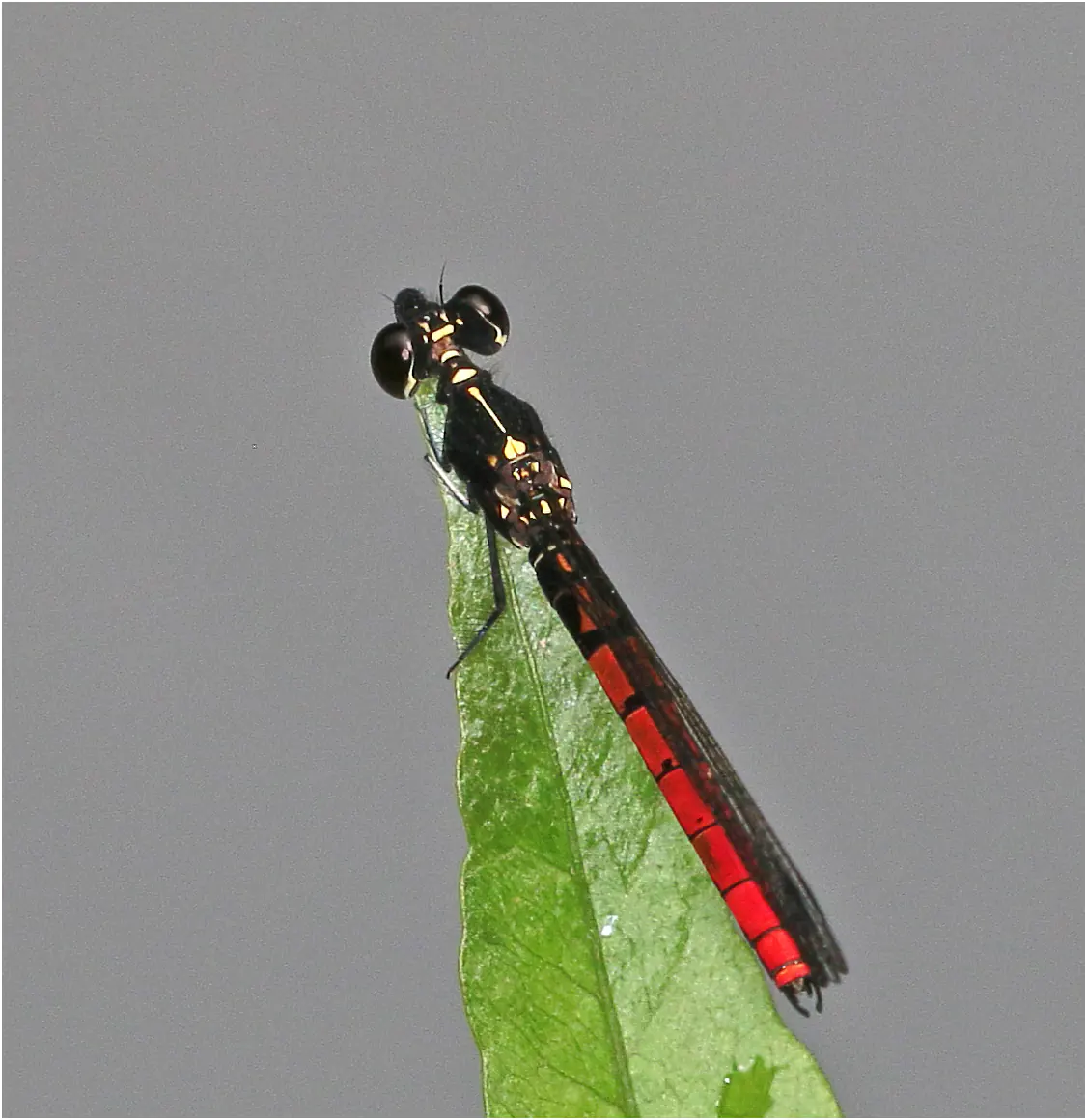
It was on the bank of a fairly wide river, the Ankasa River, which runs through the park of the same name, that we encountered it; it made two very brief appearances in an open area that was difficult to access.
It is also known by the English common name River Jewel.
Its distribution extends from Guinea-Bissau to the Democratic Republic of the Congo and Gabon.
IUCN Red List.
Chlorocypha pyriformosa male, Ghana, Ankasa Forest Reserve, 18/01/2026
Etymology: Chlorocypha pyriformosa
Chlorocypha, from the Greek chloro, for yellow or green, and cyphos, meaning humpbacked or hump, referring to the color of the species' curious clypeus, certainly in an immature specimen. Fraser wrote, "I have chosen the name Chlorocypha for this genus, based on the specific character mentioned by Palisot de Beauvois for the type species dispar: "le chaperon [Clypeus] est d’un jaune-verdâtre" [the clypeus is of a greenish-yellow]." I am certain that Palisot de Beauvois never wrote these words in his description, nor did Selys in his Synopsis des Caloptérygines, nor in his Monographie des Caloptérygines. The origin of Fraser's quote remains a mystery to me.
Pyriformosa, from the Latin pirum, for pear, and formosus, meaning beautiful or beautifully shaped, referring to the red mark on S2 which, to Fraser, looked more like a pear than a wolf's head: "In the present specimens, this spot is much larger, extending the whole length of the segment and bilobate in shape, one lobe occupying the basal three-fourths of the segment, the other, very much smaller and narrower, is a mere stalk connecting the larger lobe to the apical border of the segment."
Dijkstra, 2003 – Problems in Chlorocypha classification: four cases from West Africa and a discussion of the taxonomic pitfalls (Odonata: Chlorocyphidae) – International Journal of Odonatology, Volume 6, Issue 2, Pages 109-125, 2003.
Fraser, 1947 – THE ODONATA OF THE IVORY COAST BASED ON THE MISSION OF DR. R. PAULIAN AND P. LEPESME – Transactions of the Royal Entomological Society of London, 1947. P. 28.
Legrand, J. & G. Couturier, 1985 - Les Odonates de la forêt de Taï (Côte d’Ivoire). Premières approches: faunistique, répartition écologique et association d’espèces. Revue d’Hydrobiologie Tropicale 18: 133-158.