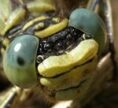
Pseudagrion hemicolon (Coenagrionidae) is part of a massive genus currently comprising 172 species across Africa, Asia, and Oceania. There are 71 species in Africa divided into 2 groups, and P. hemicolon belongs to group A. We read on ADDO (Dijkstra editor): "The A-group species of Pseudagrion are mainly slender, fairly small to fairly large (hindwing 17-29 mm), black damselflies with colourful accents on head, thorax, and abdominal segments 7-10."
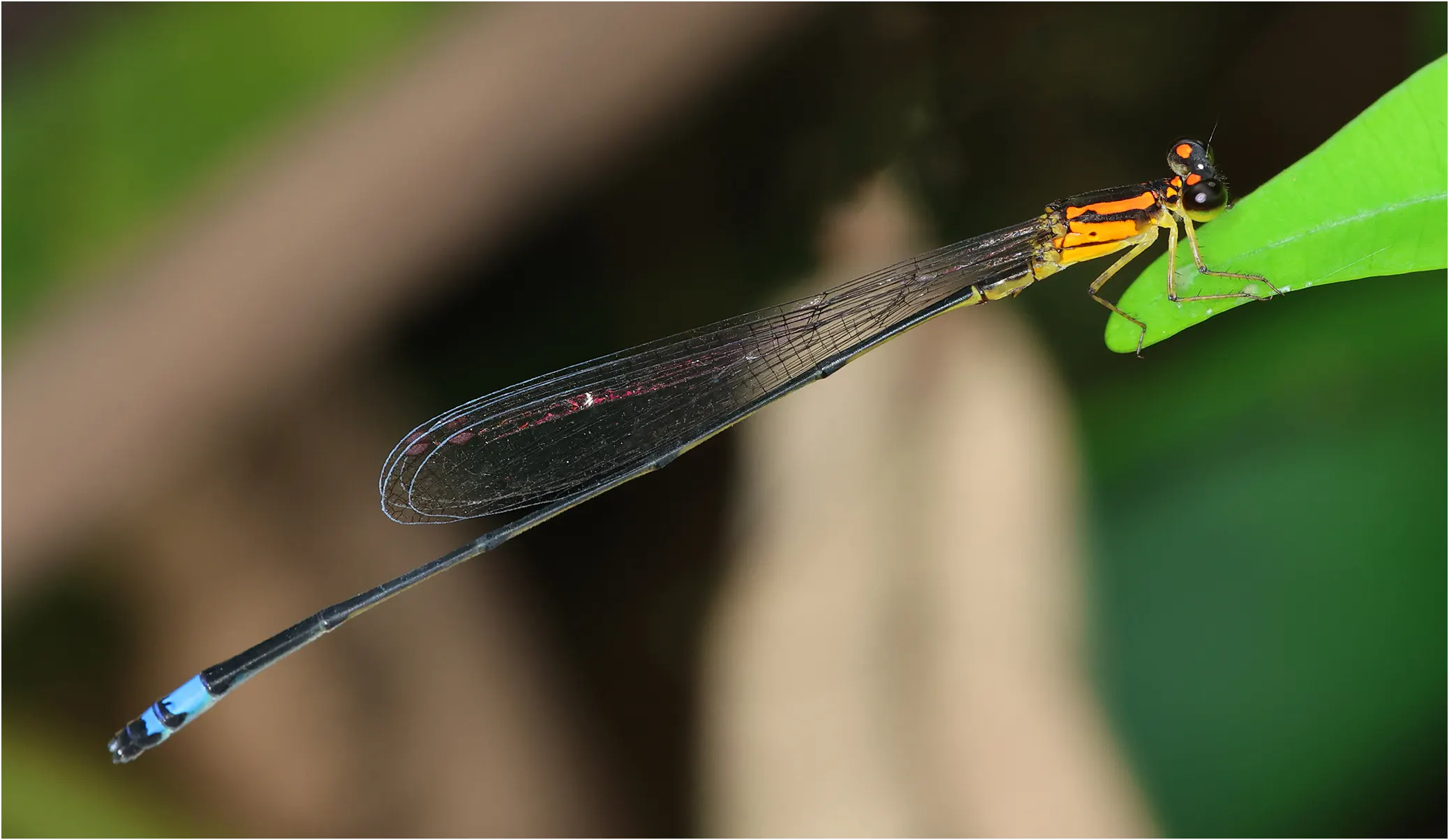
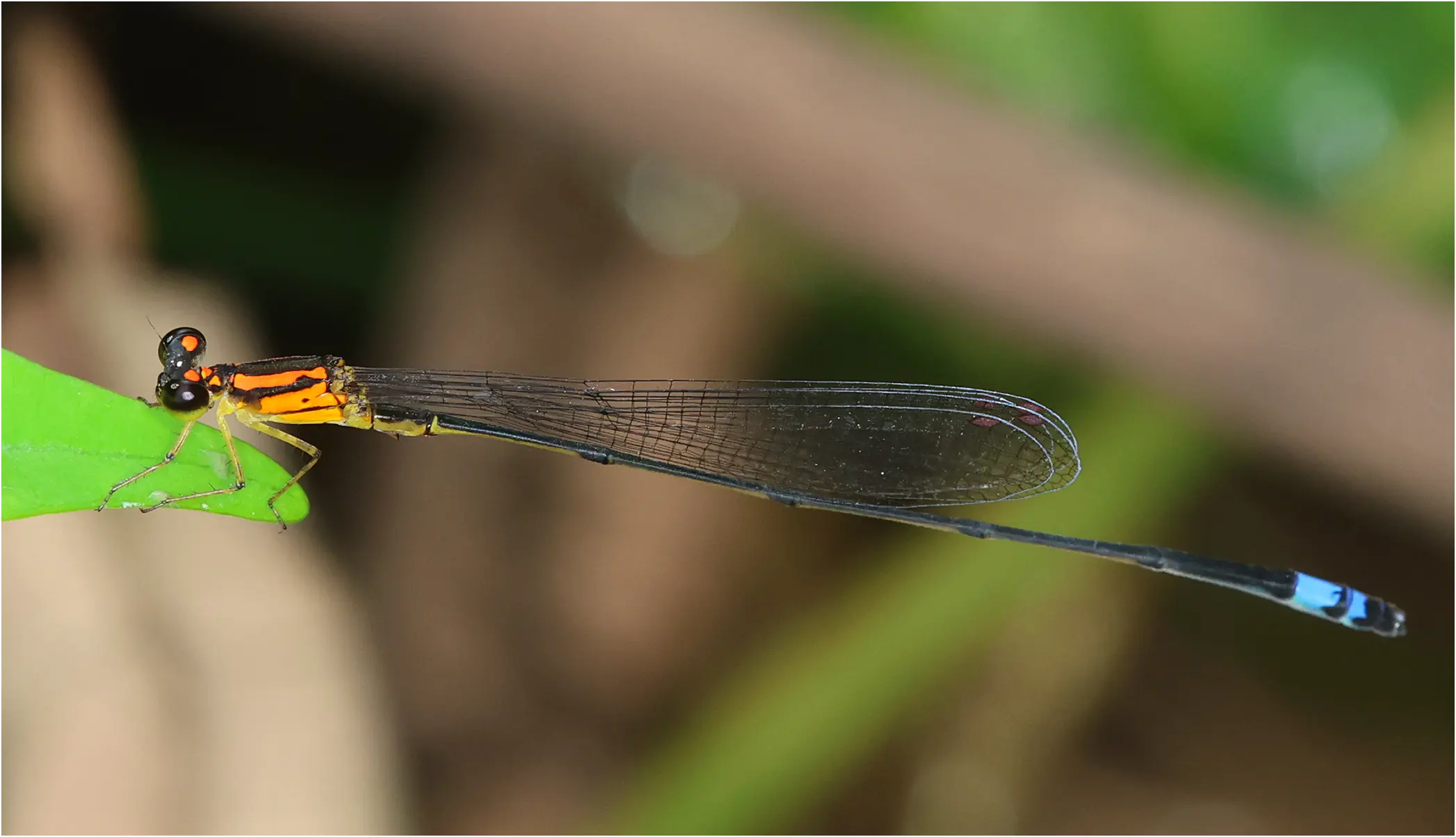
Seventeen Pseudagrion are currently known in Ghana, but it is really close only to P. epiphomenaticum (which we did not encounter). Yet it is truly very similar, to the point that we initially thought it was just a single species, but eventually, and even without the anal appendages, differences in coloration allow them to be separated:
- The face and vertex of P. epiphomenaticum bear broad light yellow spots; only the clypeus, labrum, and above all labium of P. hemicolon are dirty yellow.
- The legs of P. hemicolon are yellow (it was moreover described later by Sjöstedt under the name P. flavipes), whereas those of its lookalike are black.
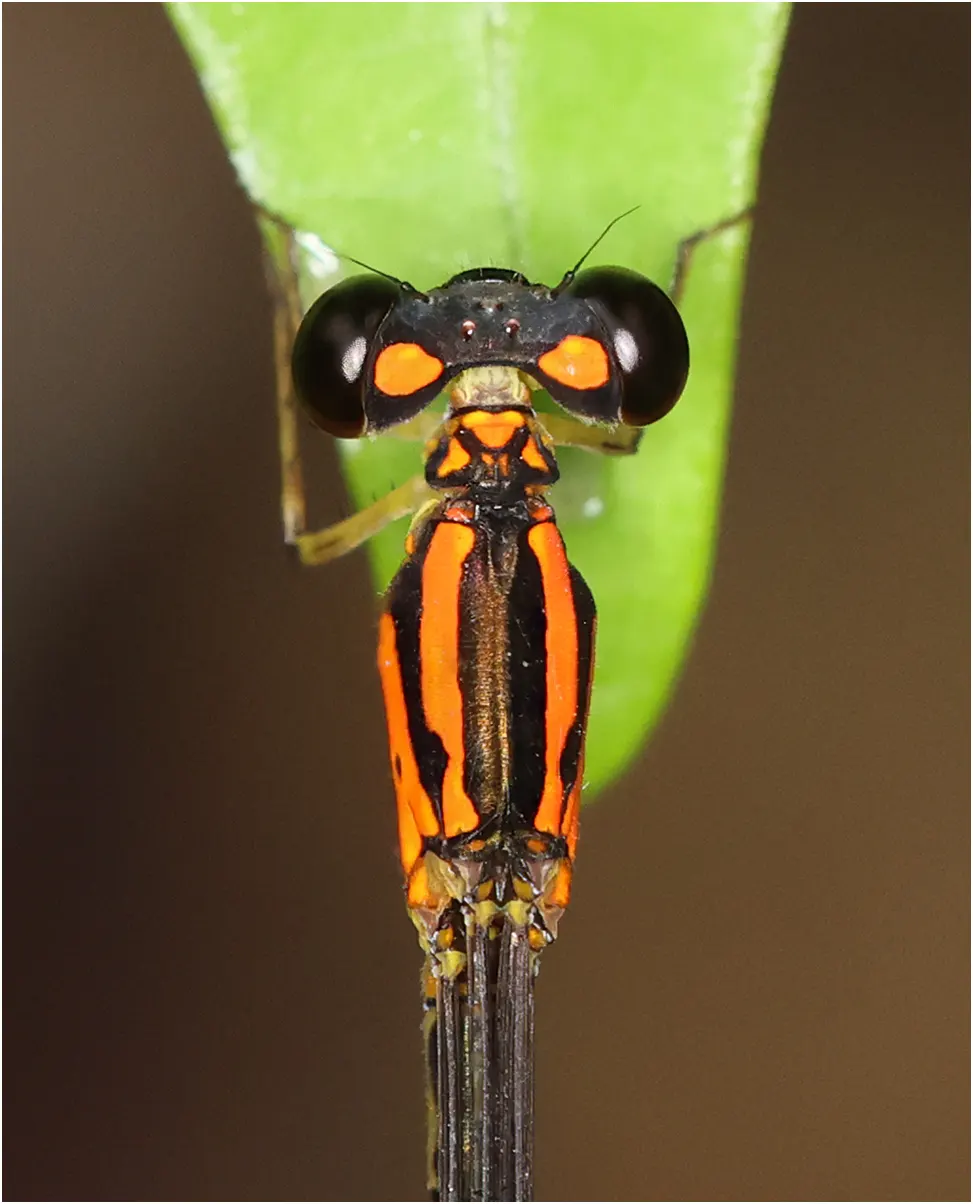
- The antehumeral stripe of our species is complete, slightly constricted in its distal part, while that of its cousin is often very constricted or even shaped like an exclamation mark (I suppose Karsch, when making his description, had a somewhat variable specimen in hand, as can be encountered, with an interrupted antehumeral stripe).
- Finally, S8 is largely blue, curiously notched for P. hemicolon, whereas the coloration is less extensive in P. epiphomenaticum.
It can barely be guessed in my photo, on the left cercus (superior anal appendage), the inward-pointing hook formed by its tip. But the cerci of its cousin, which are bifid, are very different with a long internal branch.
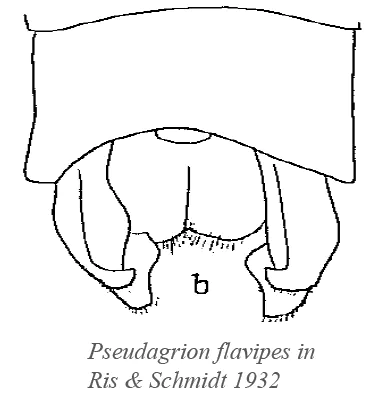
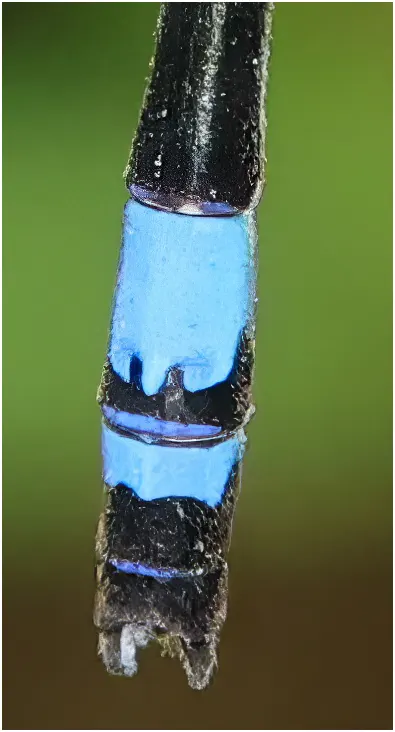
Karsch tells us that its abdomen measures 34.3 mm, which gives a total length of about 40 mm.
We encountered it in the forest, not far from a pond. However, it is said to prefer forest streams, seeps, and springs, while not turning away from stagnant waters.
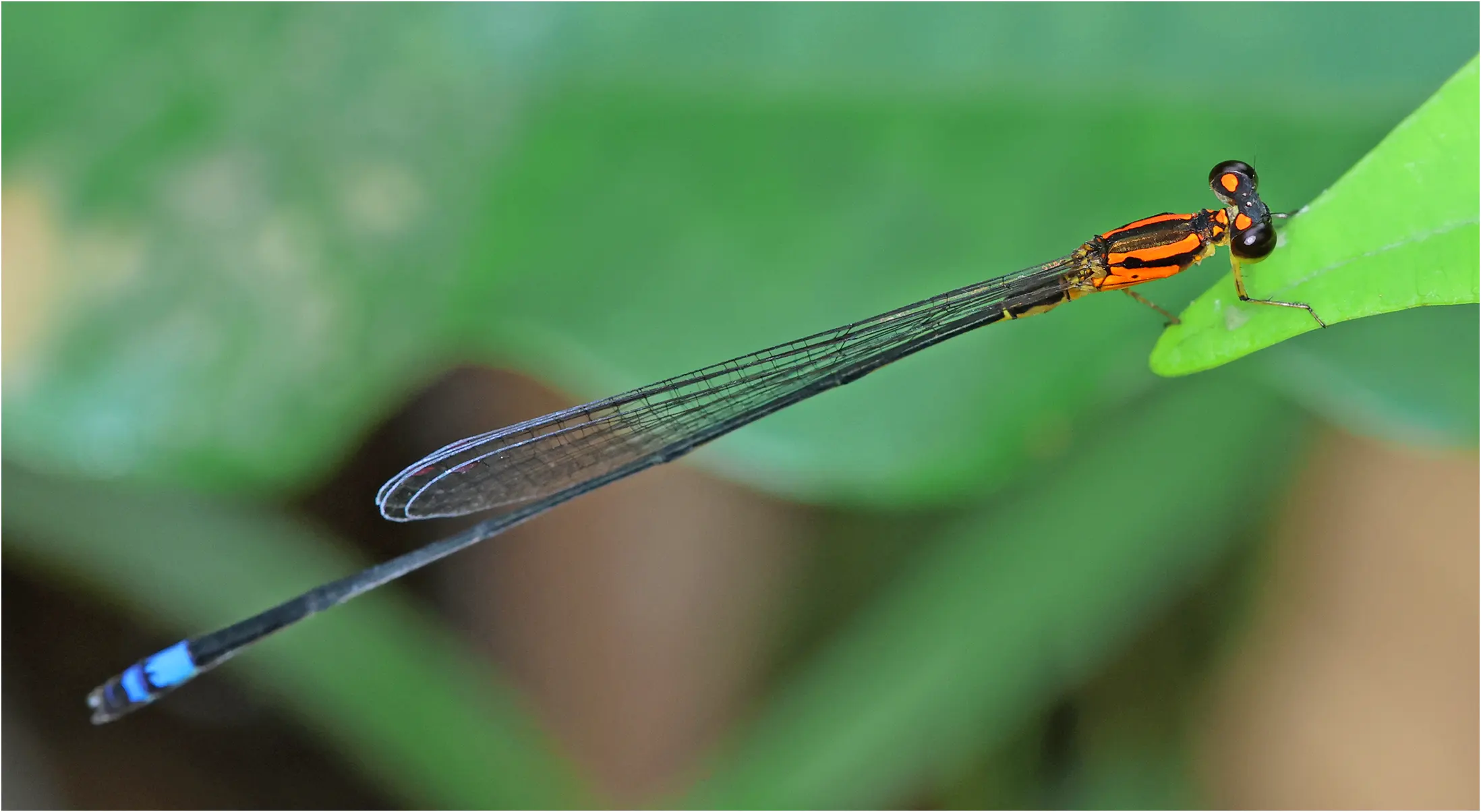
It is found from Guinea and Sierra Leone to Cameroon and Congo-Brazzaville, and it should be present in Togo and Benin where it has not yet been discovered.
IUCN Red List.
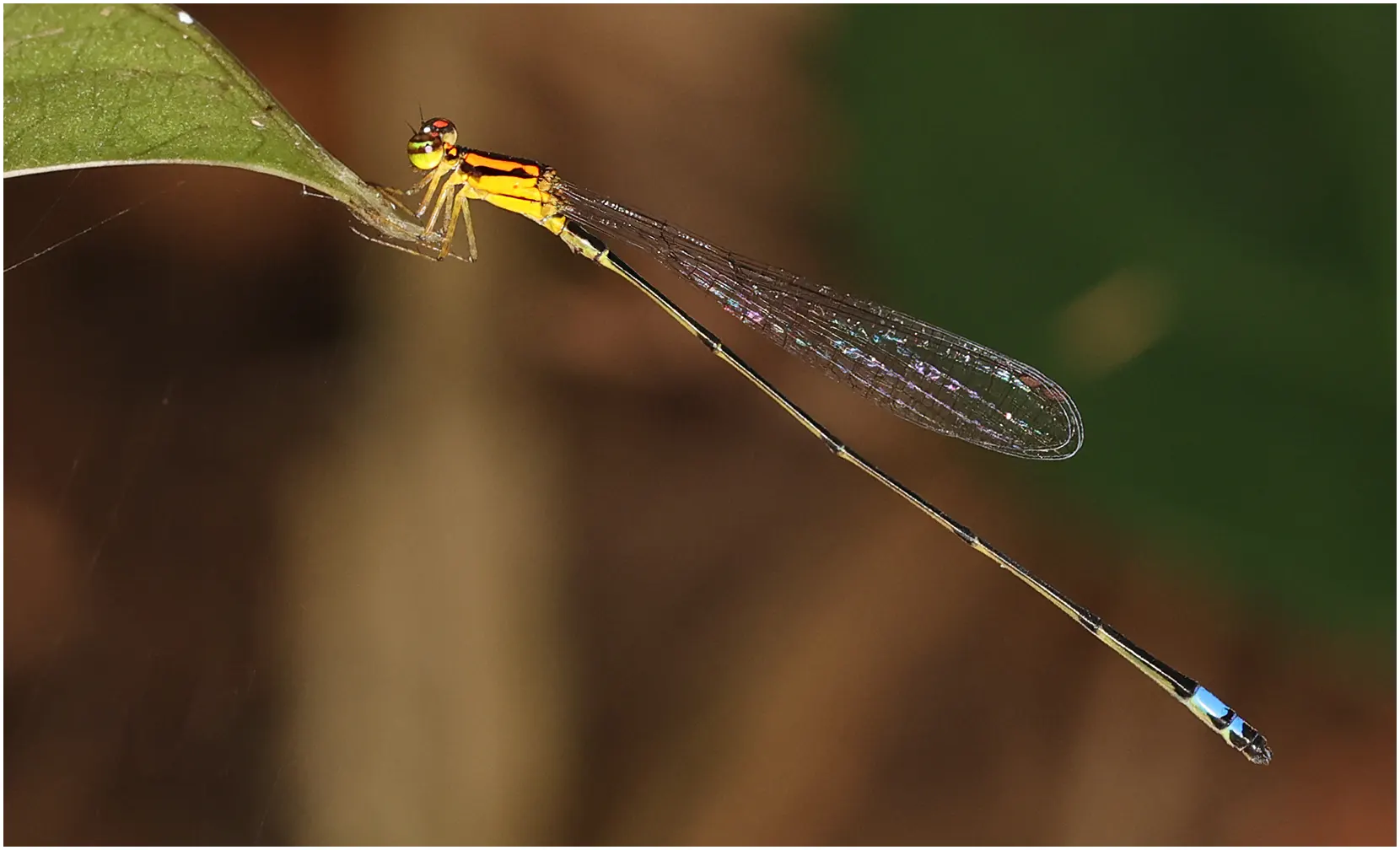
English speakers give it two names: Yellow-legged Sprite for its yellow legs, as already noted, and Semicolon Slim Sprite, which emphasizes the remarkable slenderness of its abdomen (for a Pseudagrion).
Also note the ratio between the respective lengths of the thorax and the abdomen, which is unusual for a Pseudagrion: about 35 mm for the abdomen and 5 mm for the thorax and head.
Etymology of Pseudagrion hemicolon
Pseudagrion (Endersby & Fliedner, 2015) from the Ancient Greek, pseudo—false, erroneous, and agrion—this, as Selys (1876) wrote, to bear witness to the difficulty in separating this genus from Agrion; "the Pseudagrions seem very close to the true Agrions." Agrion, from the Greek agrios—wild, living in the fields.
Hemicolon from the Greek hemi for half and kolon, which originally designated a limb of the body, then a part of a sentence. But this word in scientific Latin is the technical term for the semicolon. Karsch writes, "On each side a light yellow humeral [antéhumeral] stripe of fairly uniform width throughout, which is briefly interrupted after the middle, more widely so on the outside than on the inside." This semicolon is therefore used to recall the shape of the orange antehumeral stripe.
Pseudagrion hemicolon male, Ghana, Kakum National Park, 14/01/2026
Endersby Ian & Fliedner Heinrich, (2015) . The Naming of Australia’s Dragonflies, Ian Endersby & Heinrich Fliedner, Busybird publishing.
Karsch, F. (1899). Odonaten von Johann-Albrecht-Höhe (Nord- Kamerun), gesammelt von Herrn Leopold Conradt. Entomologische Nachrichten, 25, 161-176, p. 168.
Ris, F., et Schmidt, E. (1936). Die Pseudagrion-Arten des kontinentalen Afrika. (Insecta, Odonata). [posthumous, Schmidt based on Ris' notes - sp authorship Schmidt] Abhandlungen Senckenbergischen Naturforschenden Gesellschaft, 433, 1-68.
Selys (1876) – Synopsis des Agrionines, 5° Légion, Agrion (Suite), p.490.