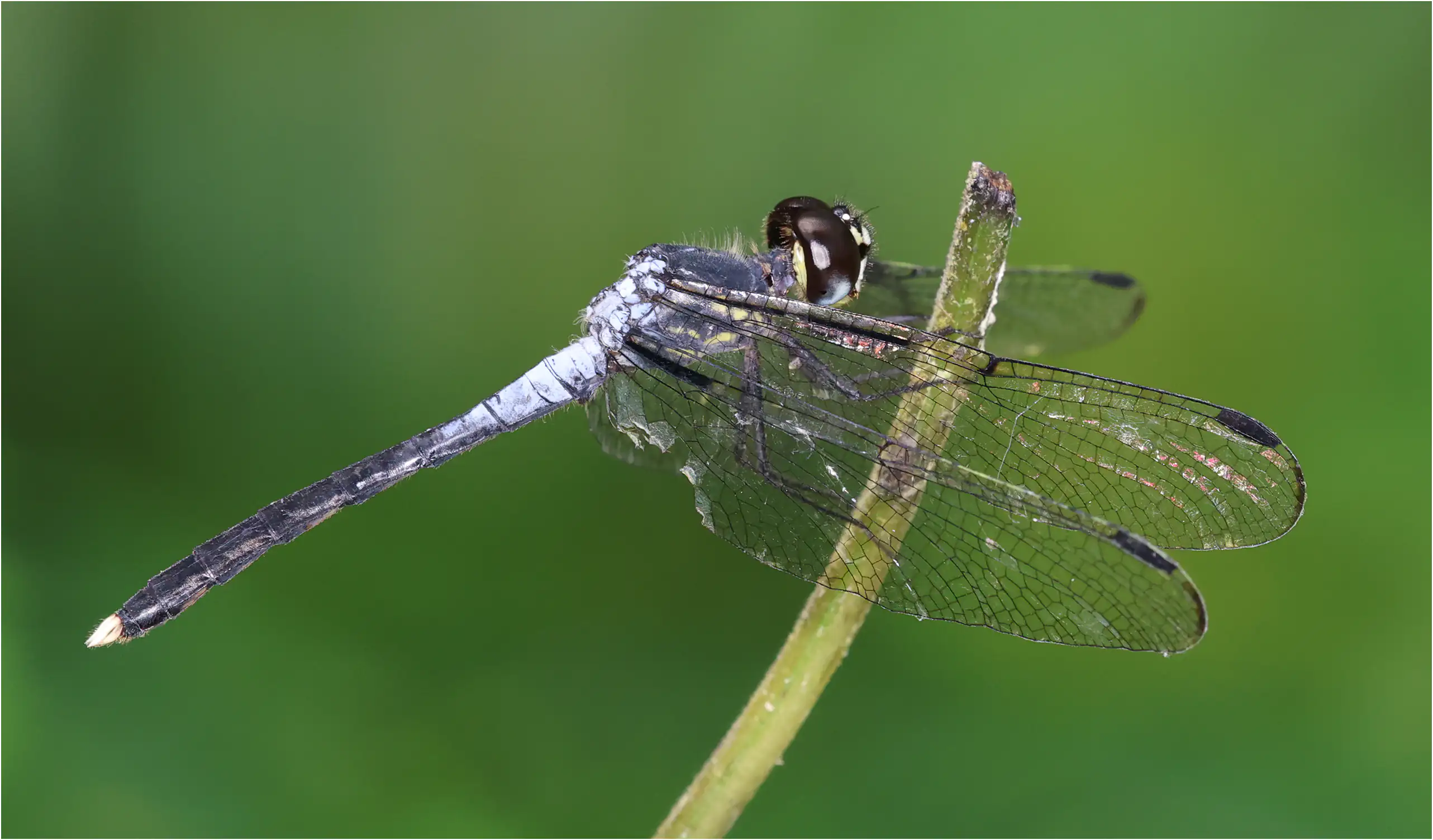
Thermochoria equivocata, Libellulidae, belongs to an endemic genus of tropical Africa, which includes only two very closely related species, themselves close to the genus Hemistigma (here Hemistigma albipunctum in Namibia).
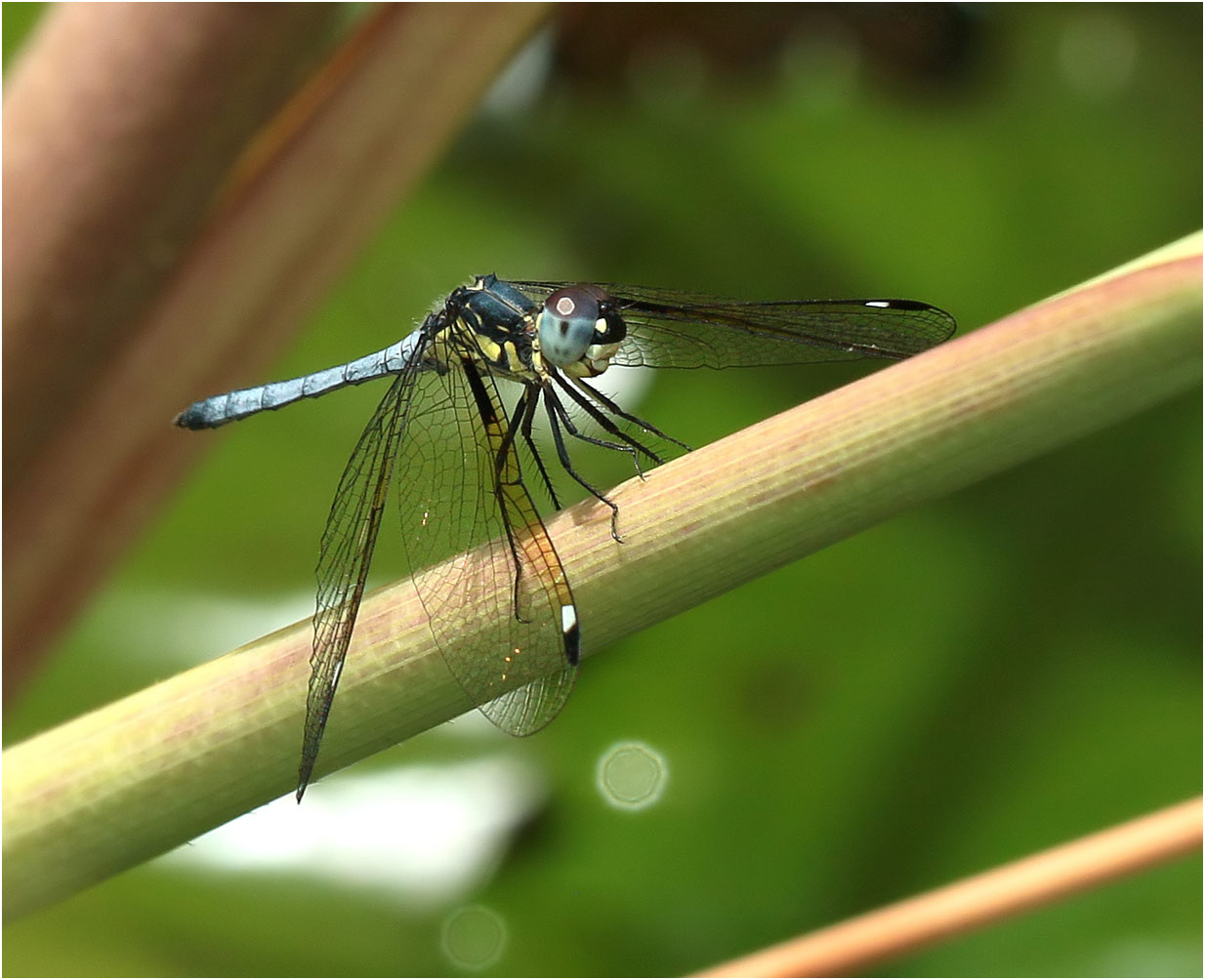
Thermochoria equivocata differs from T. jeanneli by the presence of subcostal dark bands (like Hemistigma albipunctum), smaller size, and geographical distribution in western Africa. We could therefore not encounter this second species.
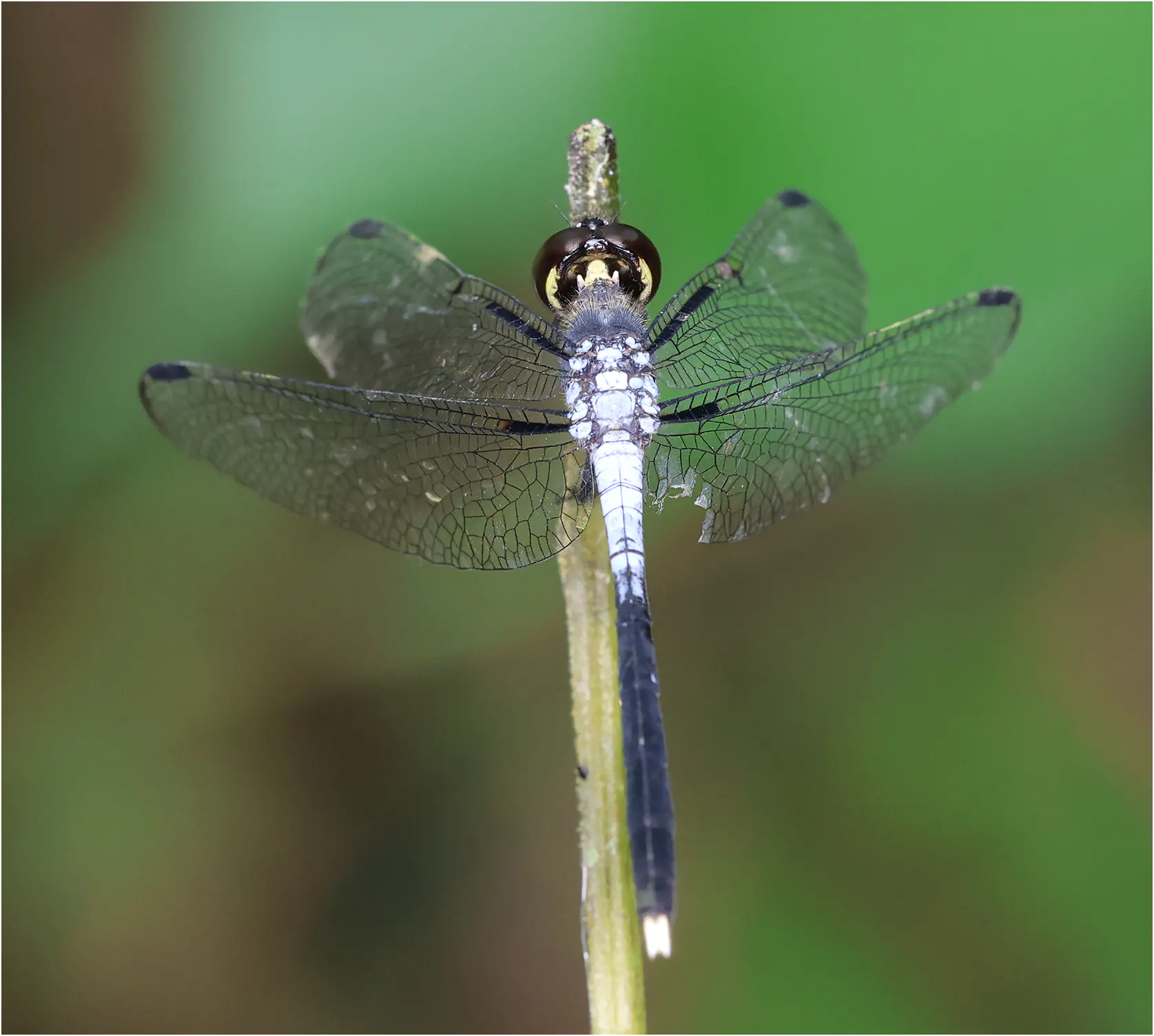
According to Legrand (2023), its total length is 34 mm, whereas Dijkstra (2021) gives a wingspan of 21 to 27 mm.
It is found in stagnant and temporary waters, particularly pools in riverbeds, generally with coarse debris and often a soft bottom. According to Legrand, "elle affectionne, sous couvert forestier dense, les diverticules plus ou moins stagnants des cours d’eau petits à grands" - "under a dense forest canopy, it favors the more or less stagnant backwaters of small to large streams."
We encountered only a single specimen in a forested swamp, possibly adjacent to a river (difficult to tell in the dry season), accompanied by an abundant assemblage of odonates, including Ceriagrion rubellocerinum, Agriocnemis maclachlani, and Tetrathemis camerunensis.
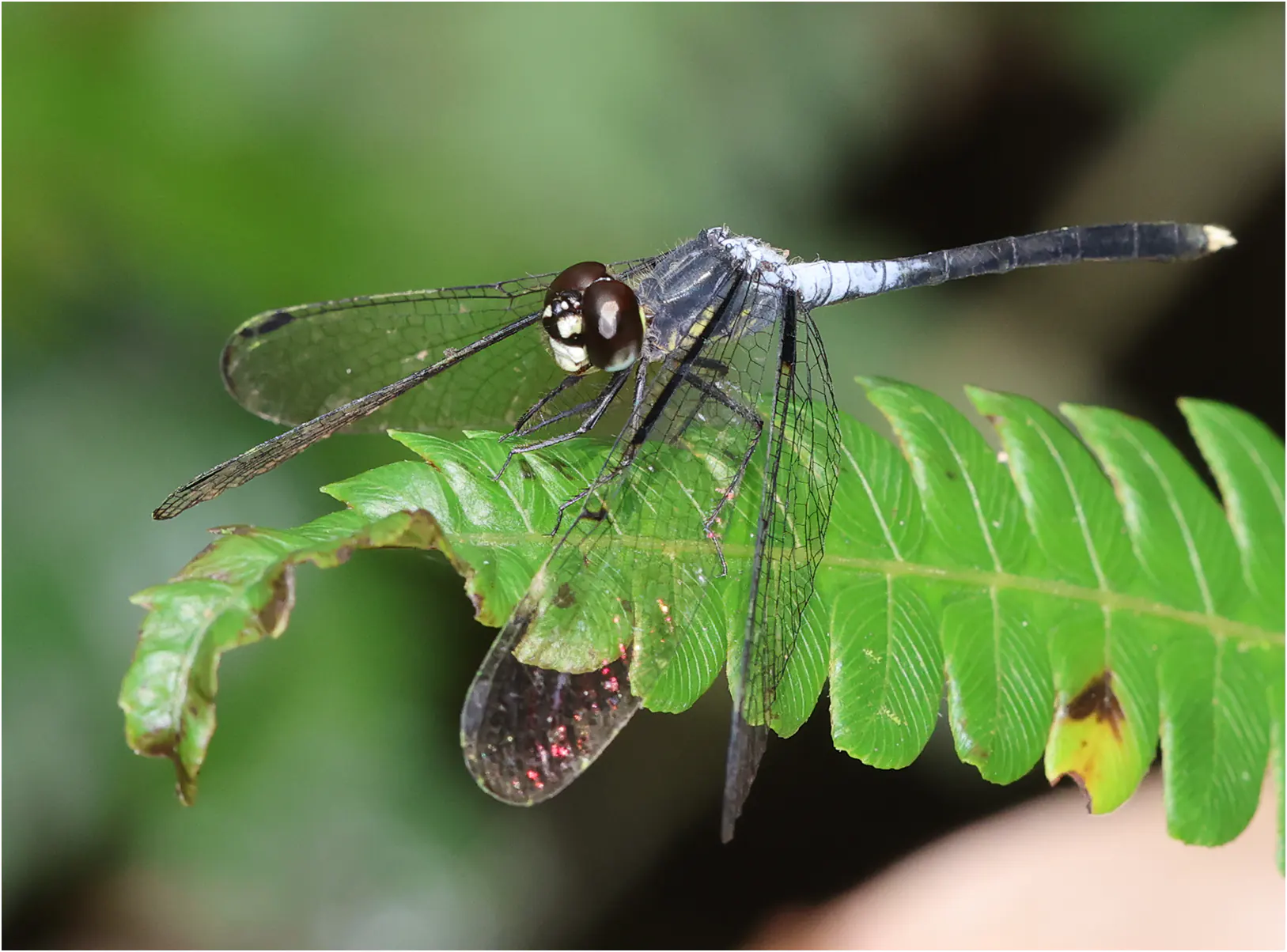
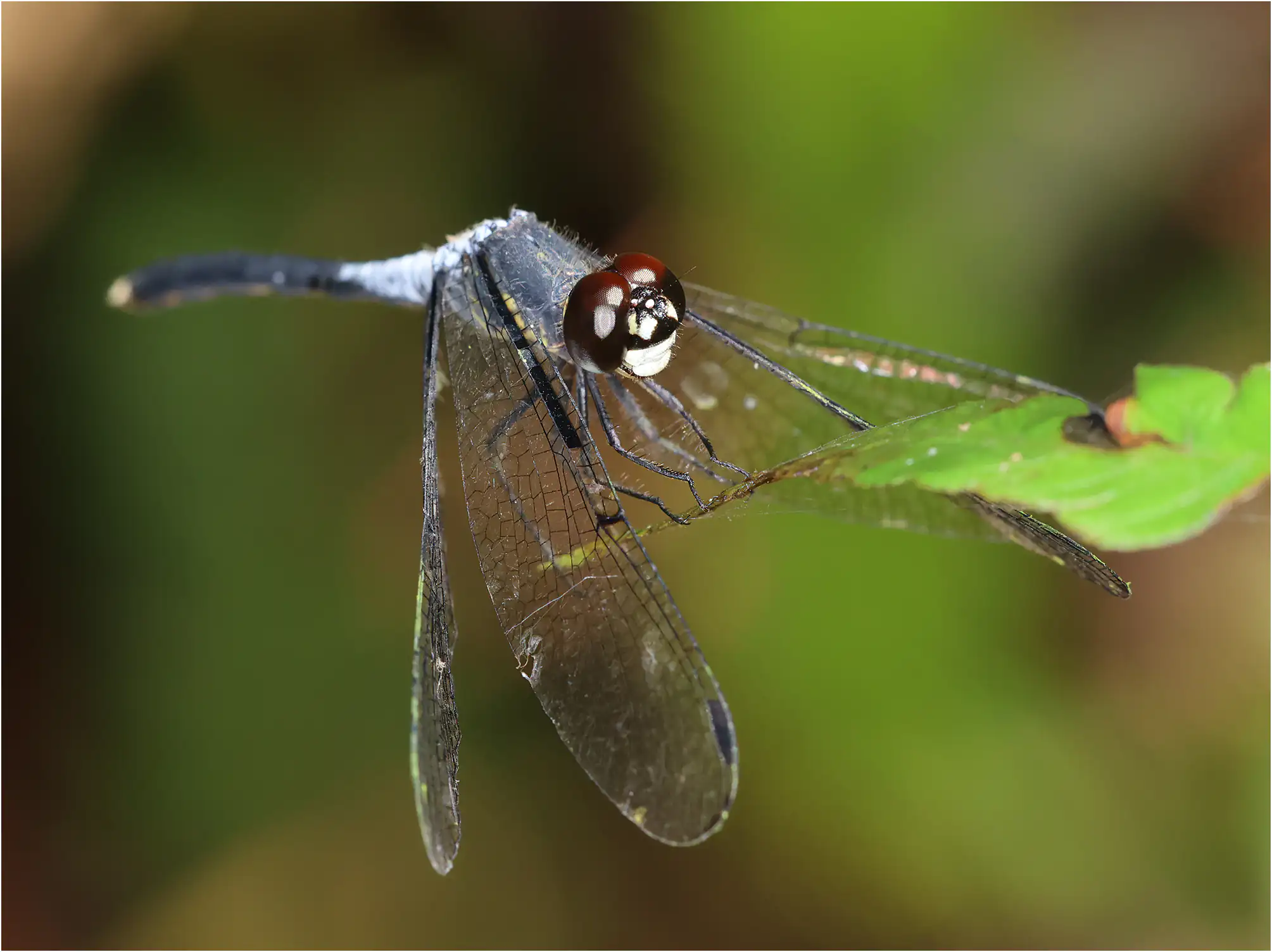
The English vernacular name, Dash-winged Piedface, highlights both the coloration of the subcostal venation and its face, which is black and white. In contrast, T. jeanneli is named Clear-winged Piedface.
It is found from Guinea and Sierra Leone in the west to Uganda in the east. It reaches Equatorial Guinea and the two Congos to the south and the Central African Republic to the north.
IUCN Red List.
Etymology of Thermochoria equivocata
Thermochoria, from the Greek thermos for "warm" and chora (and its diminutive chorion) meaning "country" or "region", to emphasize that this genus inhabits warm, tropical lands.
Equivocata, from the Latin aequivocatus, past participle of the verb aequivocare meaning "to speak ambiguously". In the same work, Kirby successively created the genera Hemistigma and Thermochoria, and for the latter, he began by writing "Characters of Hemistigma." Thus, through the term "equivocata," he chose to emphasize the close proximity and the uncertainty of the systematic position of this odonate.
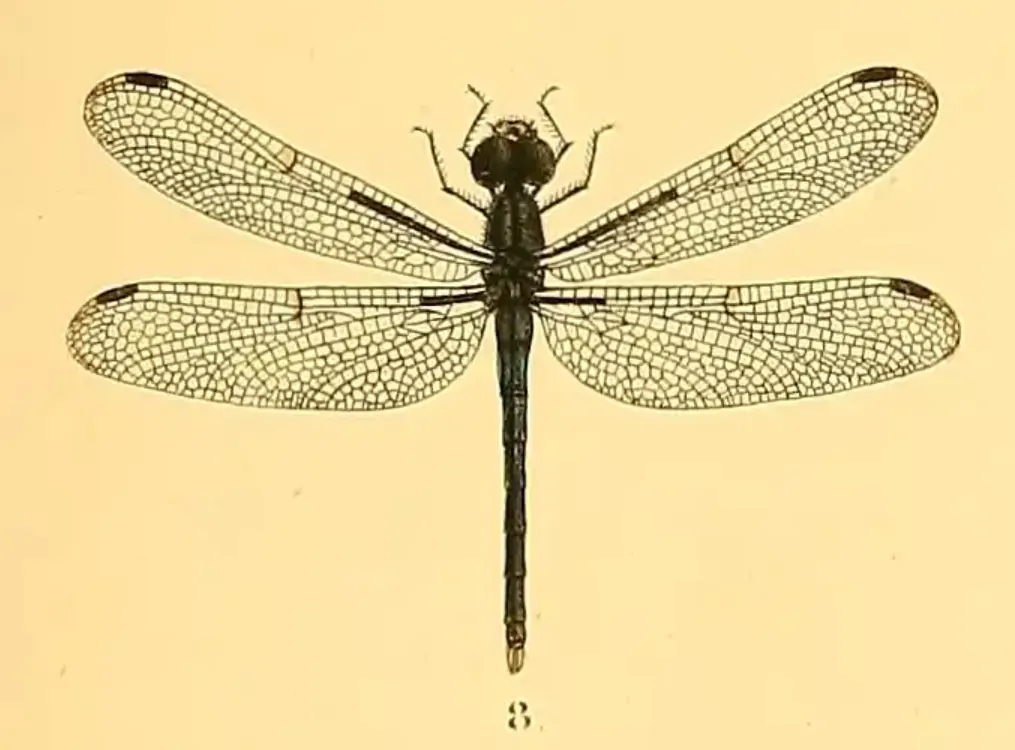
Dijkstra, K.-D.B (editor), 2021. African Dragonflies and Damselflies (ADDO).
Kirby, 1889 – A revision of the subfamily Libellulinae, with descriptions of new genera and species, p. 339.
Legrand, 2003 – Les Odonates du Nimba et de sa région in LAMOTTE M. & ROY R. (eds), Le peuplement animal du mont Nimba (Guinée, Côte d’Ivoire, Liberia). Mémoires du Muséum national d’Histoire naturelle 190 : 231-310, p. 290.
Thermochoria equivocata male Kirby, 1889