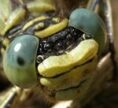
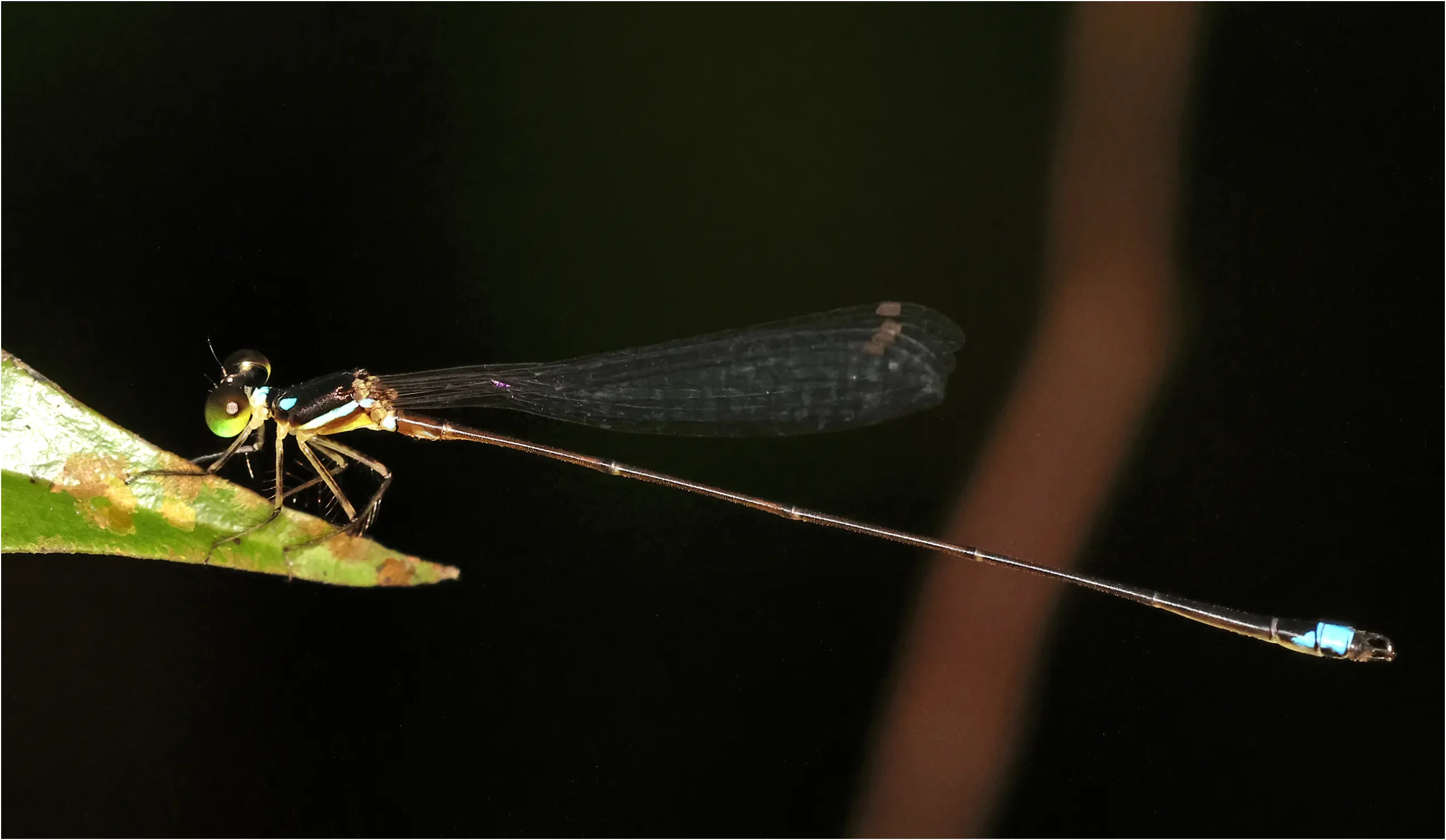
The genus Telosticta (Platystictidae) was created in 2012 (1) and Telosticta dupophila (Drepanosticta dupophila for Lieftinck (2)) is part of the T. feronia group, which is its type species (Drepanosticta feronia for the same author). According to Lieftinck, it is very close to it, but still shows notable coloration differences on the last segments. Furthermore, it is not present in Sarawak and is only known from a small area in neighboring Kalimantan.
Of course, Lieftinck was unaware at that time of the great diversity of species that would lead to the creation of the genus Telosticta within the Platystictidae.
The genus currently includes 17 species, 14 of which are present in Sarawak and 6 in the west, that is to say, the region we surveyed. We will only encounter four of them.
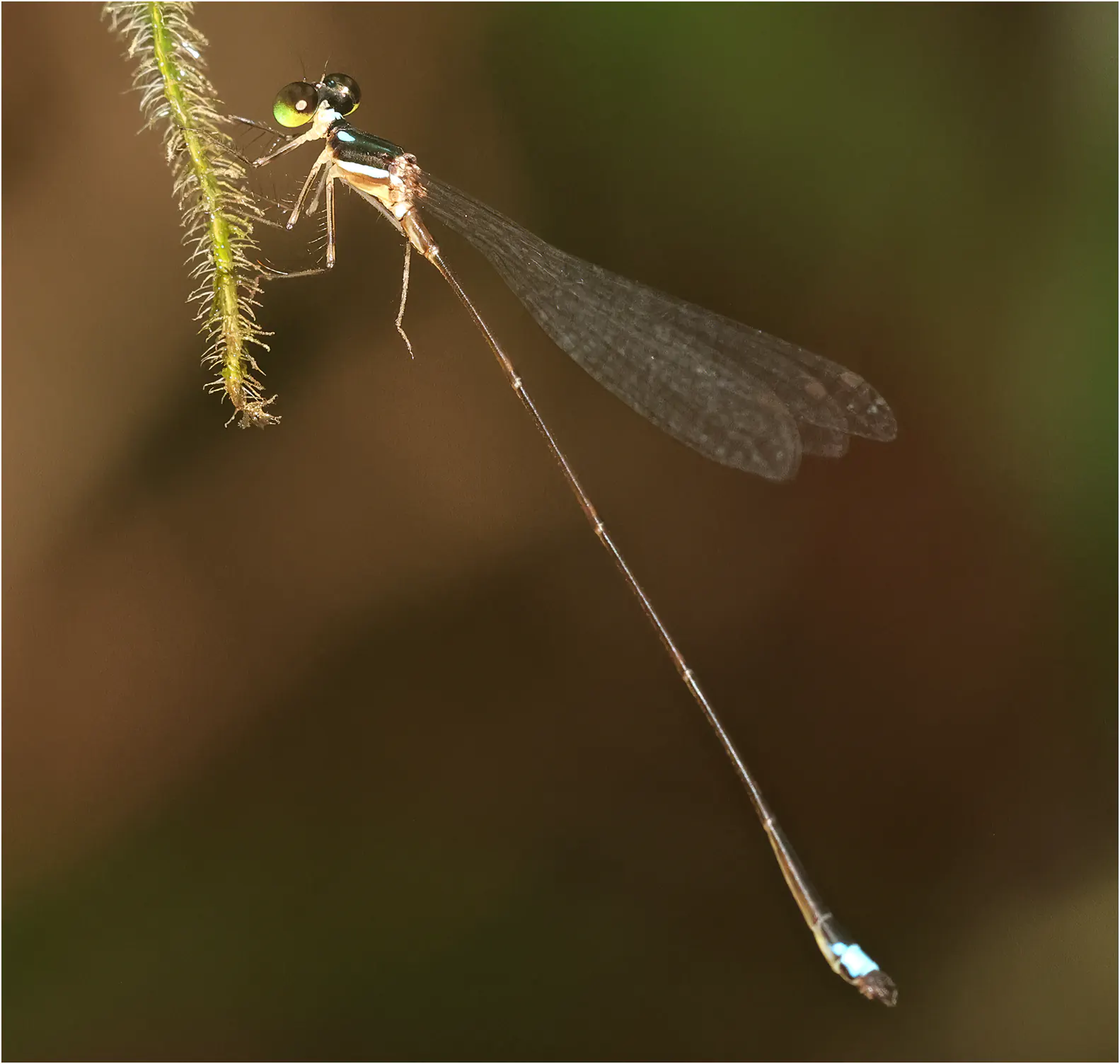
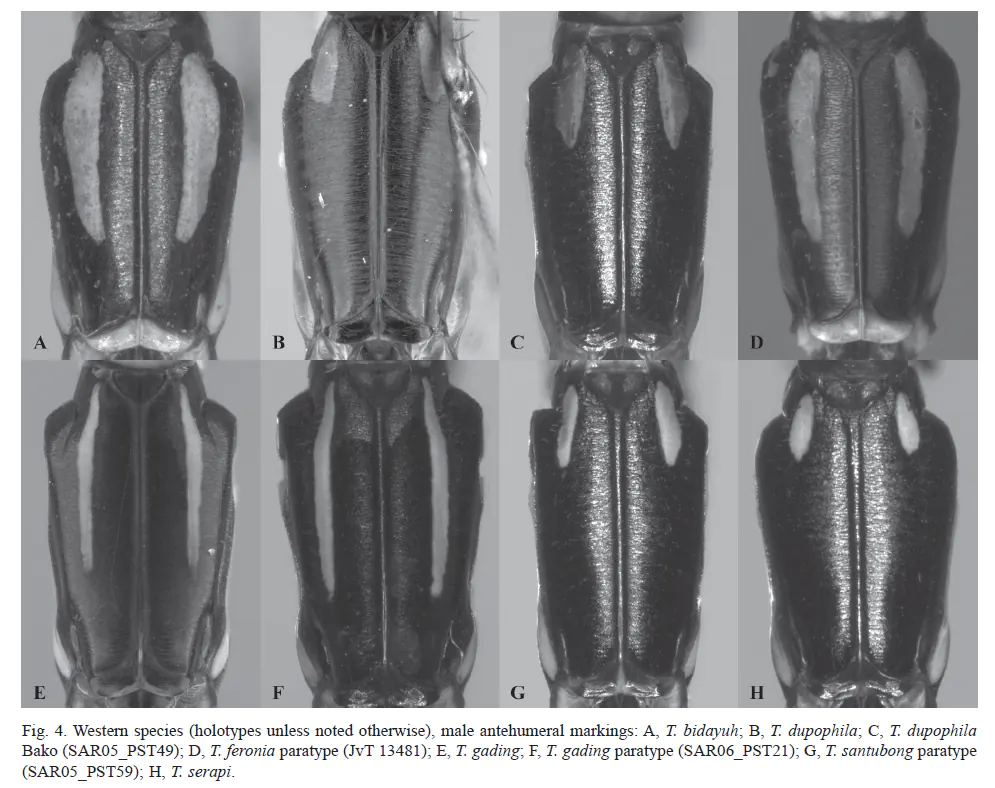
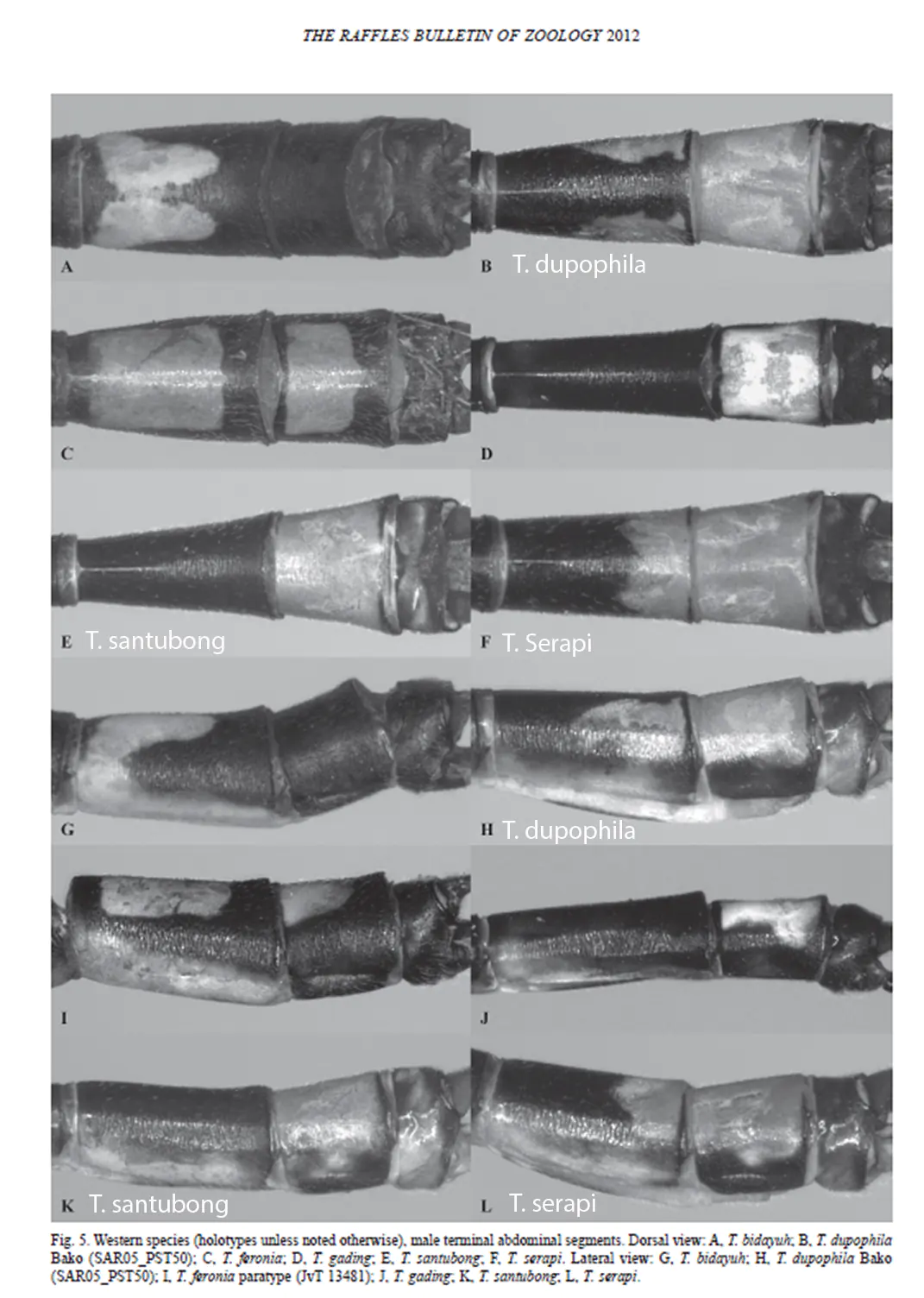
It belongs to the Telosticta with a very short antehumeral stripe (which is not the case for T. feronia), like T. serapi or T. santubong. However, while its S9 is bright blue on its upper surface like its two cousins, its S8 is only partially colored on the lateral and distal parts of its upper surface; for T. santubong, it is entirely black; for T. serapi, the entire distal third of the upper surface is blue.
The terminalia, or anal appendages, are of course different but require very good photographs for comparison, and all these subjects proved to be very skittish and impossible to approach.
Dow and Orr, 2012, took the photographs below of collection specimens:
Its abdomen measures 36.5 mm, so it reaches about 45 mm in total length. It is found in swamp forest areas or along low-gradient streams that traverse these habitats.
Endemic to Borneo, it is known from two distribution areas: northwestern Kalimantan and western Sarawak.
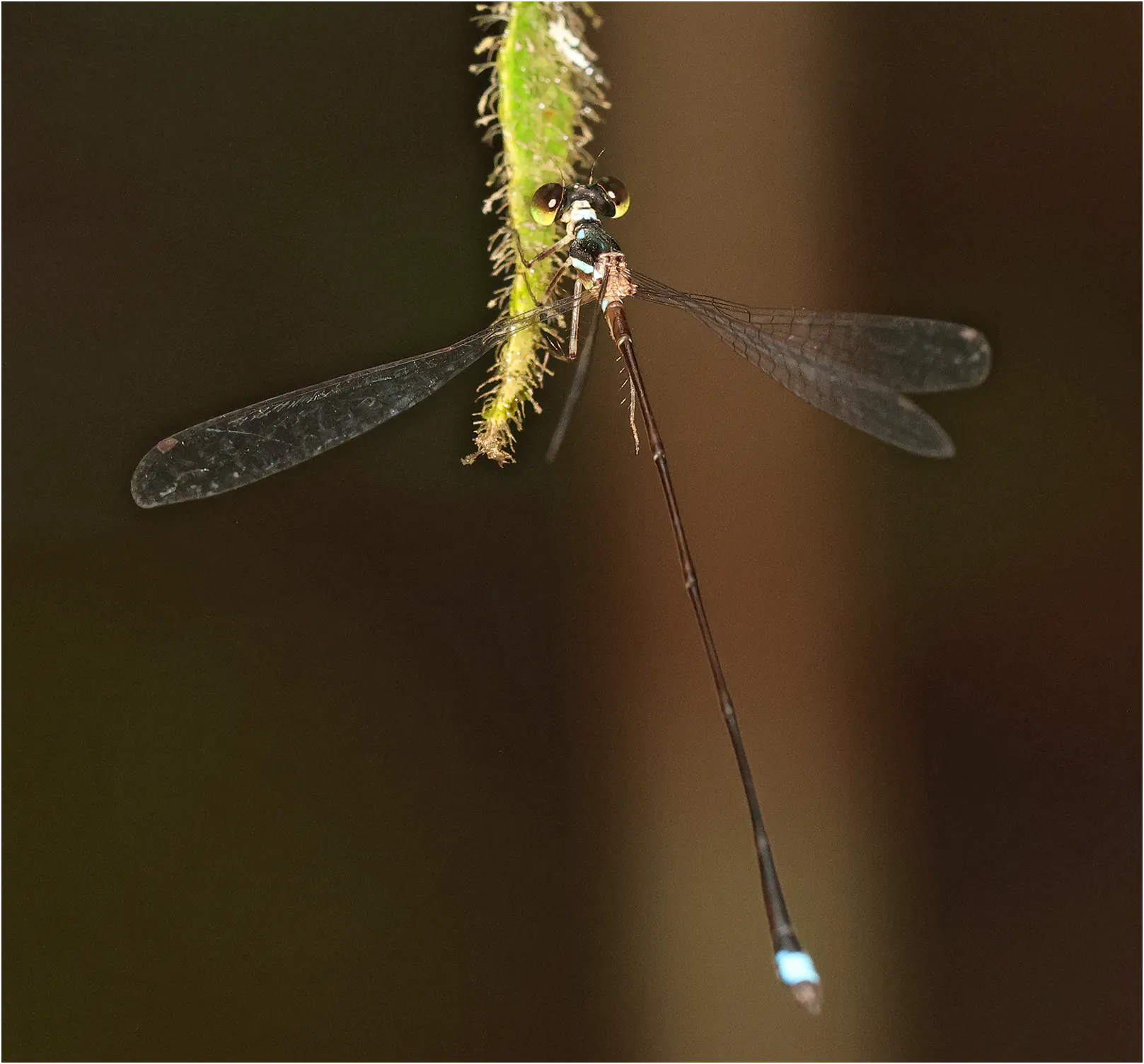
The photograph below is relatively typical; these shade-dwelling odonates are very sensitive to light flashes, and the pre-flash emitted to gauge the required light output for the main flash often triggers, several times over, an instantaneous take-off and landing…
Étymologie Telosticta dupophila
Telosticta is a feminine name, composed of the Greek telos (τέλος), meaning "toll," from the name of Jan van Tol, whose surname comes from the Dutch word of the same meaning, in tribute to his contributions to our knowledge of the Platystictidae, and the suffix -sticta, a common generic ending in the family [Platystictidae]. Sticta comes from the Greek stiktos, which means "spotted, tattooed", and refers to the South Asian genus Platysticta, the wingtips of which bear a dark spot.
Dupophila: with much reservation, "dupo" could come from the Greek "dupein," "to hide," and "phila," which means "lover of" or "friend of." Lieftinck writes, "Those very inconspicuous and rare insects as the tropical Platystictinae really are..." which might suggest that this species likes to hide or be hidden.
1- Dow & Orr, 2012 – Telosticta, a new damselfly genus from Borneo and Palawan (Odonata: Zygoptera: Platystictidae) – The Raffles Bulletin of Zoology 60(2):365-401.
2- Lieftinck, 1933 - A synopsis of the Bornean Platystictinae, with Descriptions of three new species (Odon.) - Konowia 11(4): 281–296.