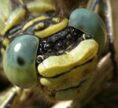

Pseudagrion crenatum, which I had described here under the name Pseudagrion microcephalum, was created following the revision of the Pseudagrion microcephalum species complex published in Zootaxa by Malte Seehausen and Milen Marinov (2026). The taxon Pseudagrion microcephalum was restricted to populations in the Indian subcontinent and Sri Lanka; the species present in Australia should be called Pseudagrion crenatum.
I had written then that "I had already encountered this "Pseudagrion microcephalum" in Laos and later, in Malaysia [in reality, it was Pseudagrion siamense !], and while there are a few minimal differences, they are fortunately very similar even though these are a few thousand kilometers apart. They bear a black mark on the 2nd segment, more or less quadrilateral, with the 2 anterior angles more or less stretched anteriorly, in the shape of a chalice or a thistle head. But this pattern does not belong solely to this species."
And this description remains valid!


In Australia, it can only be confused with Pseudagrion cingillum, which is very close and from which it is easily separated by the appearance of the black line that underlines the dorsal thoracic carina: this line consists of 3 thin stripes for the latter, whereas it is single and thick for the Blue sprite or Blue grass dart, as Australians call it. If you look closer, you notice the presence of an incomplete ring or a black crescent at the junction of the 8th and 9th segments, and sometimes the 9th and 10th (absent in P. cingillum). The coloration of the 10th segment is variable, from a very thick black "x", the dark coloration can be almost absent.


Size and habitat
The superior and inferior anal appendages are roughly the same length and as long as the 10th segment. It measures from 29.5 to 39.8 mm.
It is abundant and tolerates all kinds of environments, from standing waters to slow-moving streams or rivers, in lowlands, but in open habitats or forests, and it accepts habitats disturbed or modified by human activity.
Pseudagrion crenatum male, Australia (NT), Edith Falls, 20/04/22.
Leur période d'émergence était largement terminée et je n'ai rencontré qu'un seul sujet très jeune. Son identification ne pose pas de problème, car on retrouve les taches caractéristiques à la jonction des derniers segments.

Geographical distribution of Pseudagrion crenatum
Of course, its distribution is severely restricted compared to its former status, and Pseudagrion crenatum is present only in Australia and New Guinea. The IUCN website does not yet list this species.
In Australia, it is common from the north to the south of the east coast, and much more sparsely distributed across the north to Western Australia.
Atlas of Living Australia

Tandems are always welcome to observe, as they allow one to confirm the identity of females encountered in isolation. Whether they are perched, or in flight if you are lucky.

They actually allowed me to confirm the identity of the female below and to rule out 2 other individuals that I nevertheless thought belonged to the same species.

Etymology of Pseudagrion crenatum
Pseudagrion (see Endersby Ian & Fliedner Heinrich, 2015) from the Ancient Greek pseudo—false, erroneous, and agrion, this, as Selys wrote, to reflect the difficulty of separating this genus from Agrion; "the Pseudagrions seem very close to the true Agrions". Agrion, from the Greek agrios—wild, living in the fields.
Crenatum, from the Latin crena ("notch", "incision", "score") and the suffix -atum meaning "equipped with". The authors state: "Named in reference to the deeply bifid (crenated) apex of the male cercus, particularly visible in lateral view."
Endersby Ian & Fliedner Heinrich (2015). The Naming of Australia’s Dragonflies. Busybird publishing.
Seehausen, M. & Marinov, M. (2026). Pseudagrion microcephalum (Rambur, 1842)—sifting through a putative familiar species, with erection of two new species (Odonata: Coenagrionidae). Zootaxa, 5810 (1), 1–48.