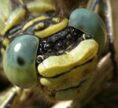

Teinobasis suavis is a very rare Coenagrionidae, and while there are a few photos of females on the web, the first ones were taken by our team during this survey. No male can be found in photos.


Both males and females have a pale green background, with the dorsal surface of the abdomen and thorax dark metallic green, but what easily differentiates them from all other Teinobasis—whose dorsal thorax is dark—is the colouration of the 9th segment, which is slightly orange to frankly orange-red ("ground-colour of 9th segment deep xanthine-orange" (1)). This species stands apart among the Teinobasis of Sundaland for this detail, its small size, and also for a venation detail that it alone possesses (very reduced 1A vein) (2).
We encountered two females in the forest peat swamp of a Kuching university campus, in the presence of Rory Dow, an odonate expert for Borneo and the wider region, who identified them. Both were very close to the ground (mud, water, or leaf litter, more precisely); one was ovipositing.


Lieftinck tells us that the female measures 27 mm with anal appendages and Rory Dow, 26 mm without anal appendages. It must reach 32 mm in total.
Female Teinobasis suavis also differ in their pronotum from all other Sundaland species


Its distribution is still problematic; it is certain that this species is endemic to Borneo, but while Rory Dow seems almost certain that our species is indeed Teinobasis suavis, he leaves some doubt until a male is discovered in this peat swamp, as it is the only place outside Kalimantan where it is known! Extremely rare, in 2017 it was known from only two locations in Kalimantan.
IUCN Red List.

Etymology of Teinobasis suavis
Teinobasis (3); Selys had described this species as belonging to Telebasis, which is an exclusively American genus. Kirby, when he created this new genus in 1890, replaced the Greek word tele, meaning "distant", with teino, for "to extend", to emphasise the fact that the wing is very petiolate and that this narrowing extends, in Selys's own words, "jusqu’à l’origine du quadrilatère après la nervure post-costale - as far as the origin of the quadrilateral after the postcostal vein."
Suavis, from the Latin suavis, meaning "sweet", "pleasant", "aesthetically appealing", "charming". Lieftinck gives no indication, making no remark to signal that he found this species especially appealing, but we can safely wager that he was nevertheless captivated by its habitus and small size.
Teinobasis suavis female, Sarawak, Kuching, 25/03/2025

1- Lieftinck, 1953 – ADDITIONS TO THE ODONATE FAUNA OF THE INDO-AUSTRALIAN ARCHIPELAGO – Treubia, 22(1), 233-269. P. 244.
2- Dow, 2010 - A review of the Teinobasis of Sundaland, with the description of Teinobasis cryptica sp. nov. from Malaysia (Odonata: Coenagrionidae)- International Journal of Odonatology 13 (2) 2010: 205-230.
3- The Naming of Australia’s Dragonflies, Ian Endersby & Heinrich Fliedner, Busybird publishing.