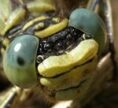
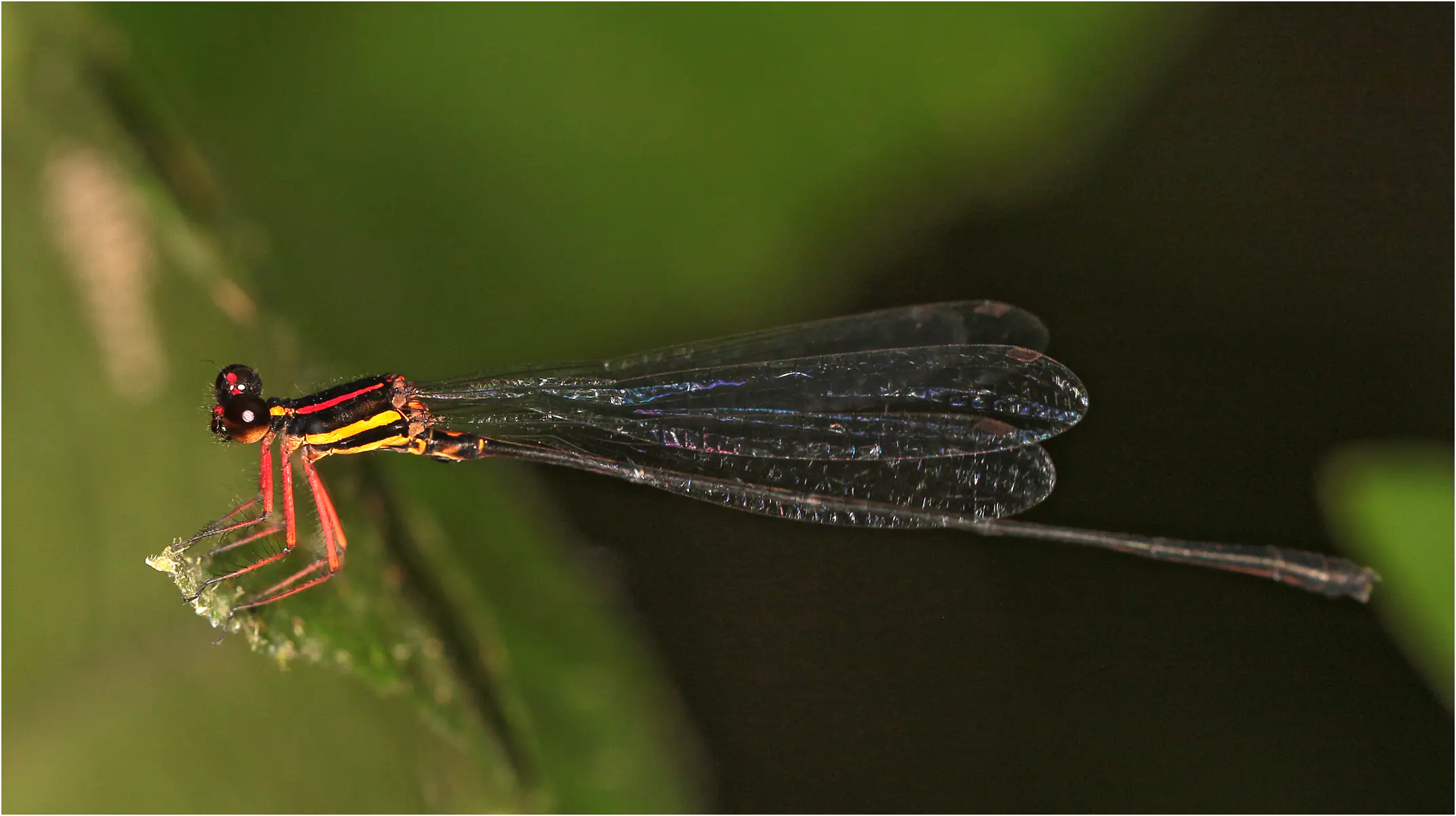
Elattoneura girardi, Platycnemididae, belongs to a genus found in Africa (with around thirty species) and in Asia—for now, at least, as the species I encountered in Borneo, for example, almost certainly belong to a different genus.
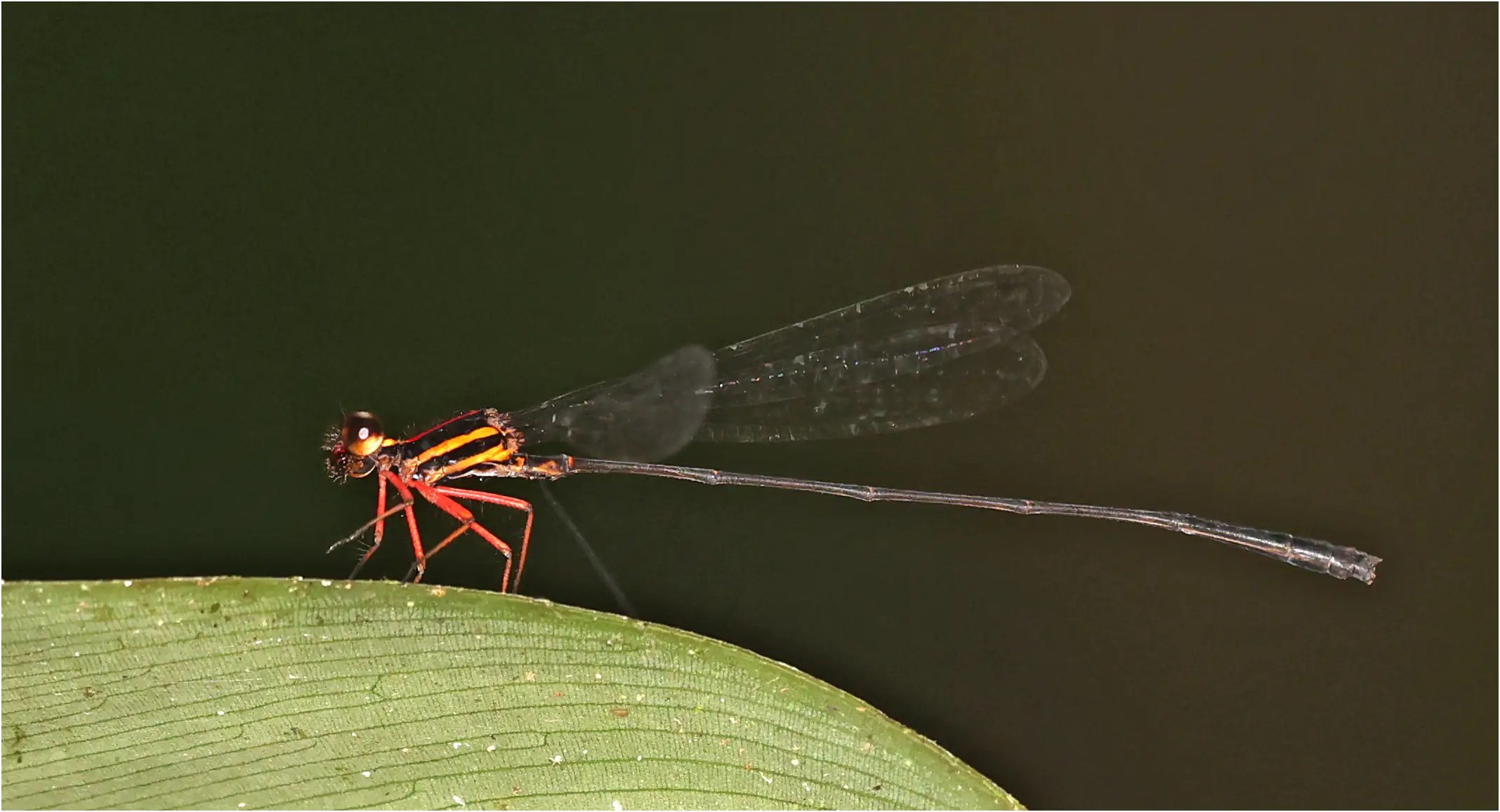
We photographed the four species known in Ghana, but there is no risk of confusing it with any other, or even with another zygopteran, as its coloration is so distinct; of course, its legs are reminiscent of the colorful legs of Copera (Copera sikassoensis, for example), but the red stripes on its face and thorax, along with its dark anal appendages, easily distinguish it.
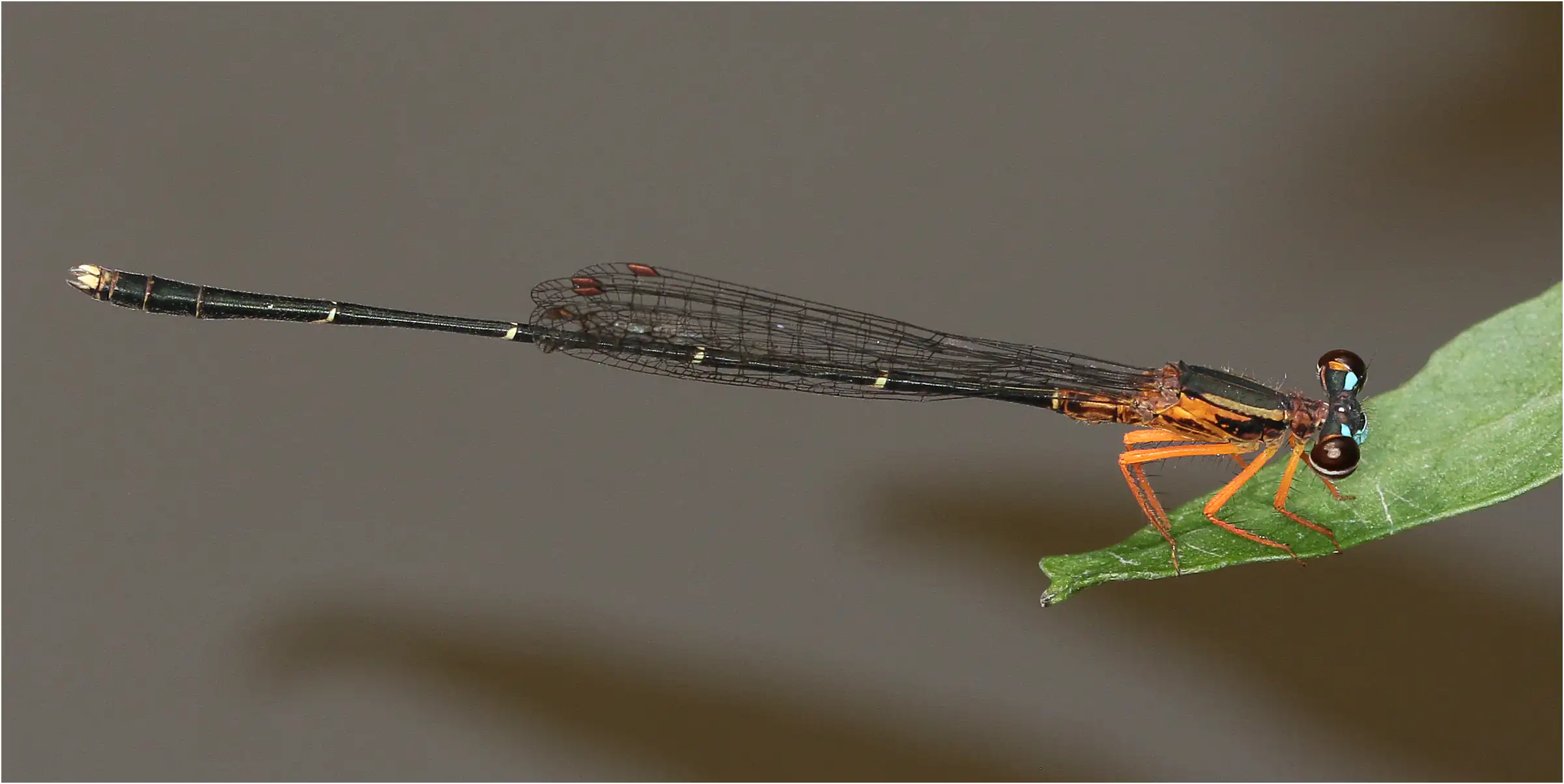
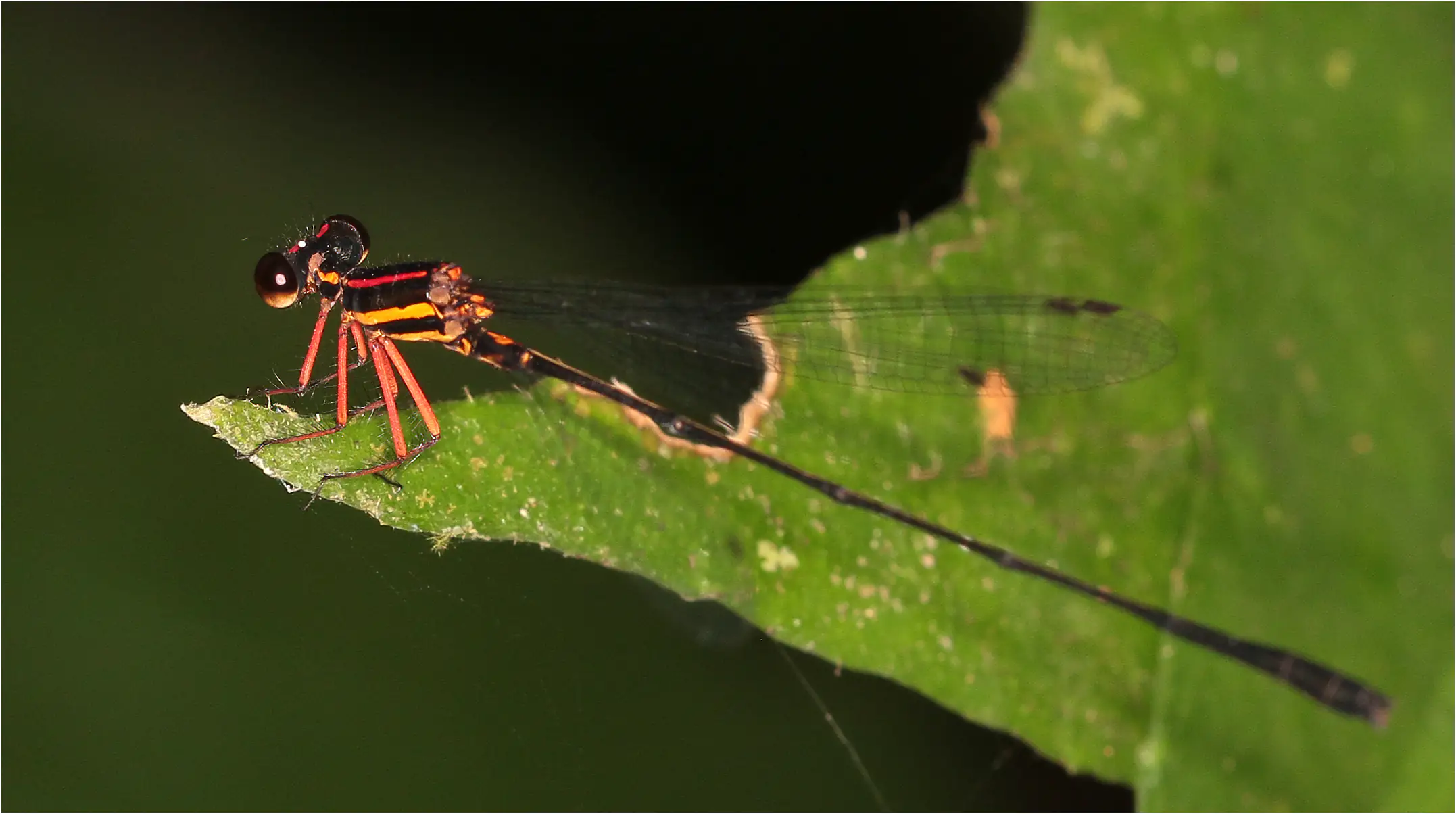
We encountered it only twice; the first time on a small forest stream, in a dark environment, perched over two meters high in a shrub above the water. Then along the Ankasa River, a fairly large watercourse, on a path running along the bank at the edge of the forest, near a tiny clearing.
Legrand tells us that its abdomen measures 27 mm and that it reaches a total length of 33 mm.
It is certainly a discreet and uncommon species.
The species occurs from Sierra Leone and Guinea in the west to Nigeria in the east; however, it has not yet been recorded in Benin.
IUCN Red List
Etymology of Elattoneura girardi
Elattoneura comes from the Greek ellaton, meaning smaller, and neuron, which in entomological contexts is translated as a wing vein. This refers to the reduced length of a vein that serves as a key diagnostic feature in zygopteran systematics. See Suhling & Martens (2007).
Girardi honors Claude Girard, a French entomologist specialized in Coleoptera, who conducted numerous collection missions in West Africa and collected the specimens described here by Legrand.
Legrand, 1980 - Nouvelles additions aux représentants afro-tropicaux du genre Elattoneura ; groupe acuta - vrijdaghi [Odonata, Protoneuridae] - Revue française d'entomologie, nouvelle série, 2, 2,153-161. [Lien webarchive sur ADDO].
Suhling & Martens, 2007 - Dragonflies and Damselflies of Namibia, Gamsberg Macmillan.