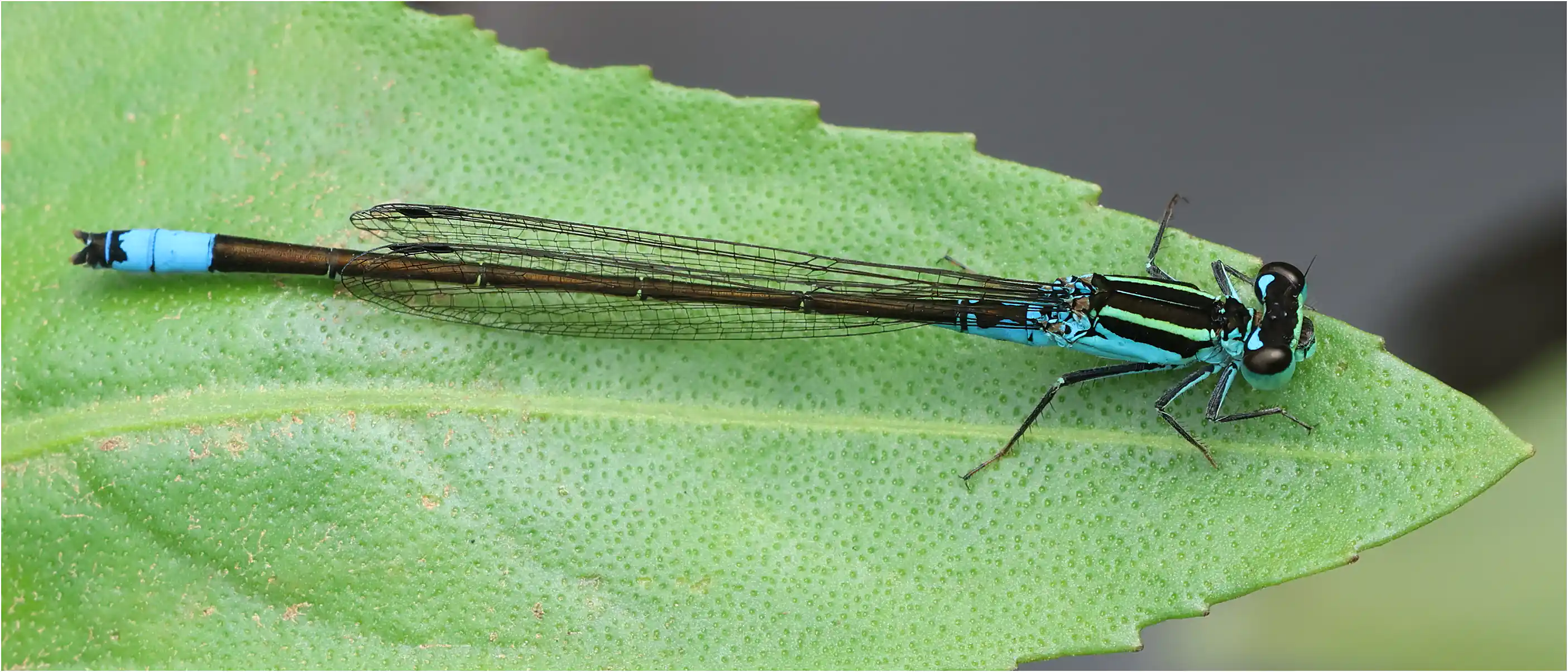
I only had a very brief encounter with Proischnura subfurcata, just long enough to take a few nearly identical photos on the same perches; it proved difficult to approach and quickly chose to settle on the opposite bank of the small stream, out of reach, even for my 500 mm lens.
It belongs to a genus comprising three species, only one of which is present in Kenya.
Identification of Proischnura subfurcata
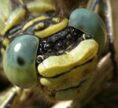
It is small, with an abdomen of 25 mm according to Selys (1876) and reaching 27 to 30 mm in total length according to W. & M. Tarboton (2015); it should be noted that these authors specify that the species is no longer found in South Africa and that their photo (and their measurement?) was taken in Zimbabwe. It is distinguished from other blue damselflies by its crescent-shaped postocular spots. Its abdomen is dark, but it bears a black dumbbell-shaped marking on a blue background on S2; S8 is entirely blue, as are the proximal 2/3 of S9.
It resembles an Ischnura, but Selys placed it (with a question mark, incidentally) in Enallagma, due to the absence of a black line on its interpleural thoracic suture, its dark, unicoloured pterostigmas, and its anal appendages very different from those of Ischnura, with long, strongly divergent cerci and small, acute paraprocts. Pinhey (1951), who still describes the species under the name Enallagma subfurcatum, finds it close to Enallagma [Africallagma] glaucum, which is not really obvious when seen side by side. Perhaps it should be read as the closest among Enallagma.
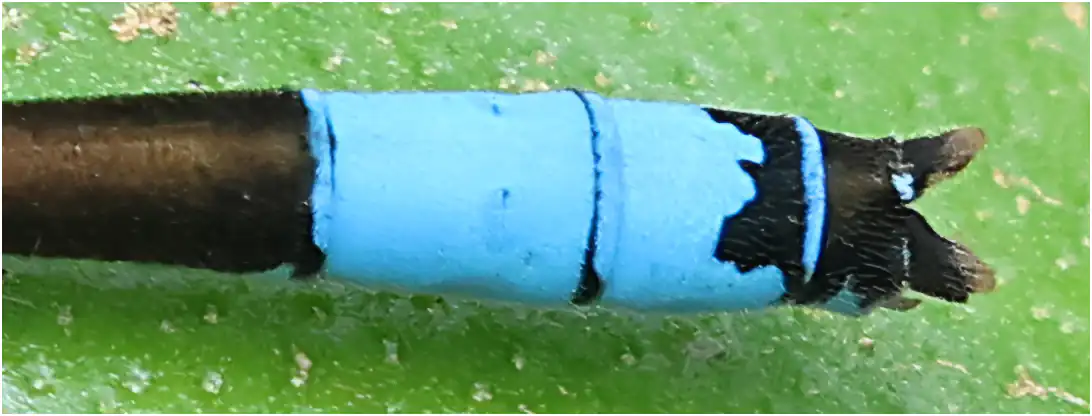
A small pale spot can be seen on the distal margin of the 10th segment; it corresponds to the apex of a truncated, bifid tubercle, barely raised, a structural detail found in many Ischnura.
Habitat and georaphical distribution
It frequents stagnant waters, sometimes temporary, in open habitats or gallery forest according to ADDO. However, in the section dedicated to the genus Proischnura, Dijkstra and Clausnitzer are broader and note that it inhabits sites that warm up quickly but also have a slight current with dense mats of floating vegetation.
Personally, I "glimpsed" it along the edge of a small river (Burguret River) bordering a wooded area, in its very shallow, well-vegetated stretch, at an elevation of 1,900 m.
It was found there alongside Pseudagrion bicoerulans, Pseudagrion commoniae, and Pseudagrion spernatum, among others. It is certainly common at high elevation, as ADDO notes: "...the numerous blue damselflies seen in marshy areas in most highland regions of tropical Africa are generally P. subfurcata."
Its distribution extends from Eritrea and Ethiopia to southern Mozambique. More isolated populations in South Darfur, Nigeria, and Cameroon, leaving major gaps, suggest that it may be overlooked.
IUCN Red List.

Etymology of Proischnura furcata
Selys described the species under the name Enallagma subfurcatum.
Proischnura (Kennedy, 1920) uses the Greek prefix pro for "before", "anterior", indicating that this species is earlier, in his view, evolutionarily speaking, than Ischnura. Ischnura (Charpentier, 1840), from Ancient Greek ischnos meaning "thin, slender, tapering", and oura meaning "tail", highlighting that these odonates have a slender abdomen. Kennedy removed the type species Enallagma subfurcatum from the genus Enallagma, considering that the structure of its penis and appendages showed direct affinities with the genus Ischnura, being intermediate between Ischnura and Enallagma, while remaining more primitive or evolutionarily earlier, hence the idea of a "pre-Ischnura" (Proischnura).
Subfurcata, from the Latin prefix sub meaning "under, below", but rather "almost, imperfectly" in entomological or scientific language, and from Latin furcata for "fork" or "little fork". This relates to the tubercle on the 10th segment, which is barely forked because it is truncated.

Dijkstra, K.-D.B. (editor, 2019). African Dragonflies and Damselflies (ADDO).
Kennedy, Clarence Hamilton, 1920. Forty-two hitherto unrecognized genera and subgenera of Zygoptera. The Ohio Journal of Science, 21, 83--88.
Pinhey E. C. G., 1951. The Dragonflies of Southern Africa. Transval Museum Memoir n°5.
SELYS-LONGCHAMPS, Edmond de, 1876. Synopsis des Agrionines, 5ᵐᵉ légion : Agrion (suite). Le grand genre Agrion. Bulletins de l'Académie royale des sciences, des lettres et des beaux-arts de Belgique, série 2, t. 42, p. 490–531, 952–991 [p. 534].
Warwick et Michèle Tarboton (2015). A Guide to the Dragonflies & Damselflies of South Africa. Struik Nature.