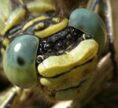
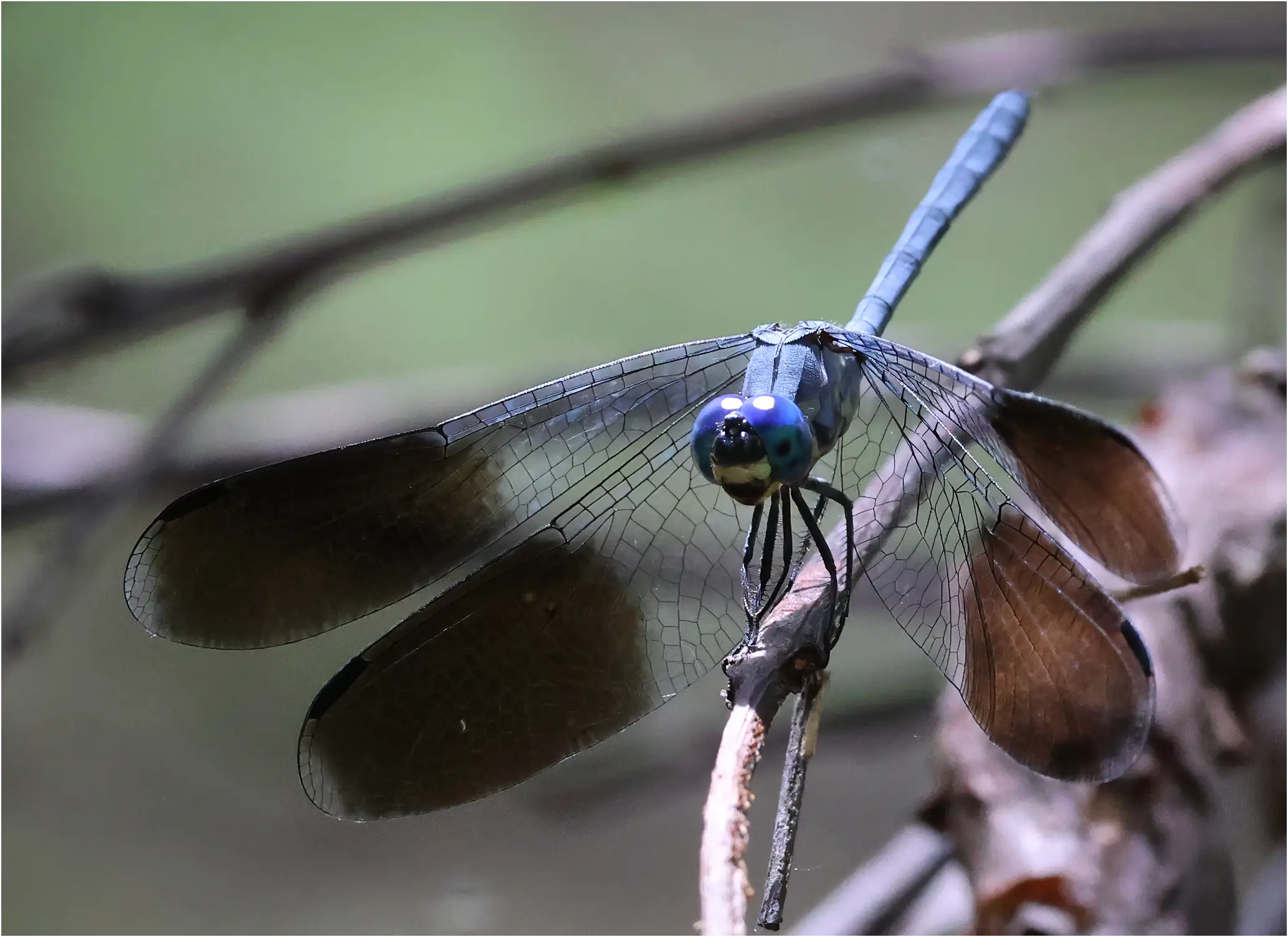
Tetrathemis polleni is a new species for me and a real stroke of luck, as it was discovered by someone else above a table in the shade of vegetation near the restaurant at Ikweta Camp.
It belongs to a genus of 14 species worldwide, 8 in Africa, but only 2 in Kenya; I have not seen and do not know the other species, T. corduliformis.
Identification of Tetrathemis polleni
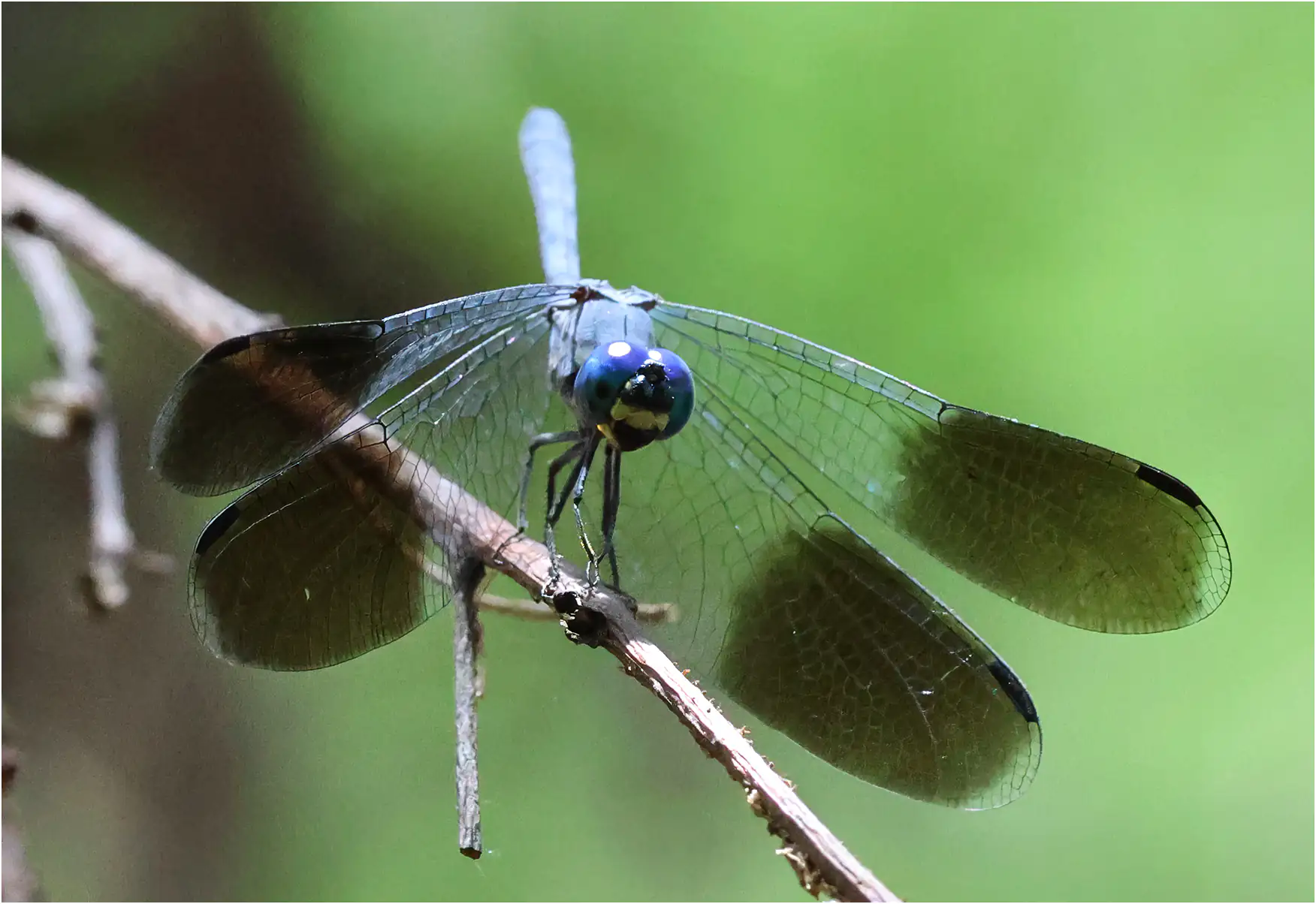
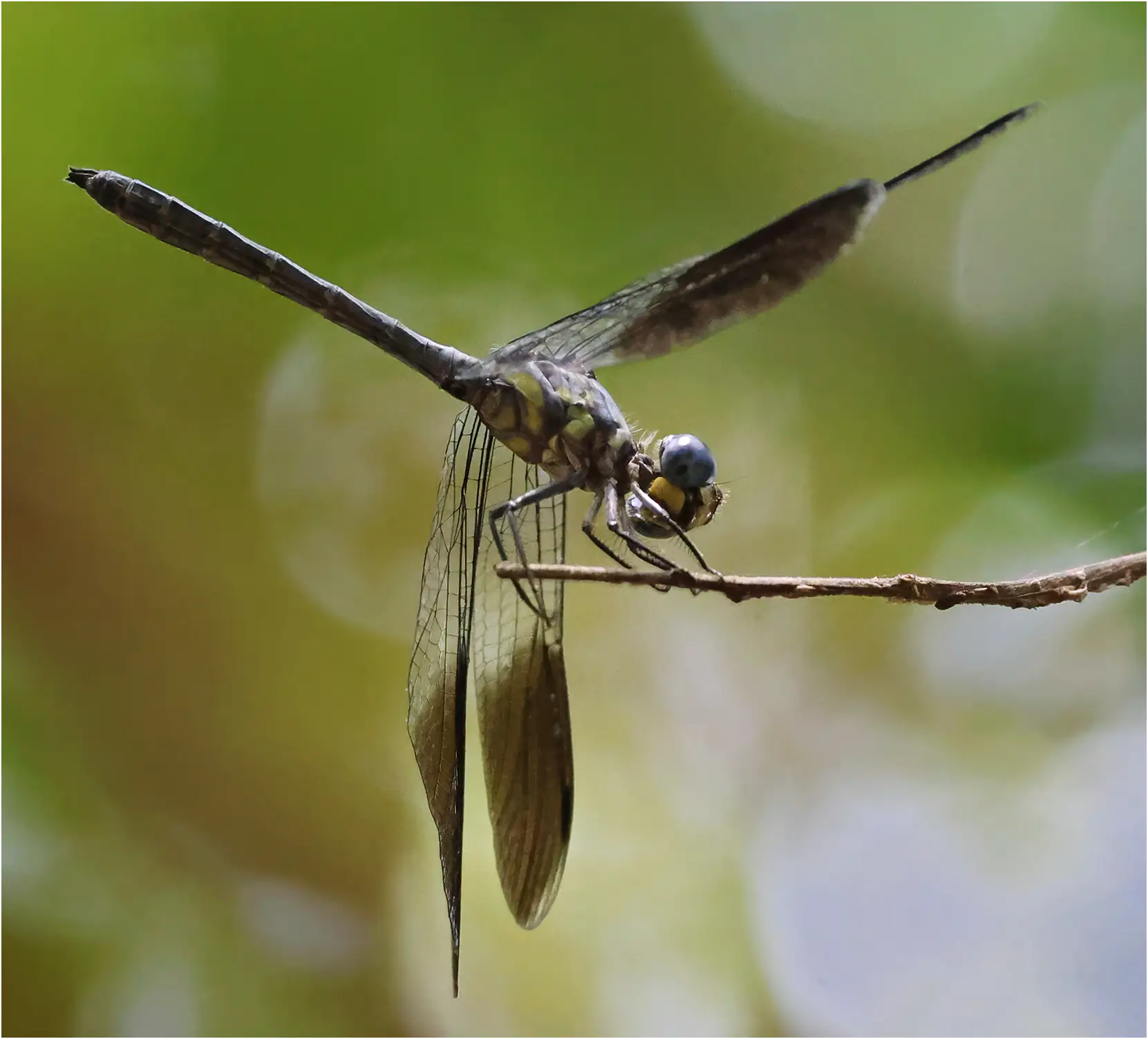
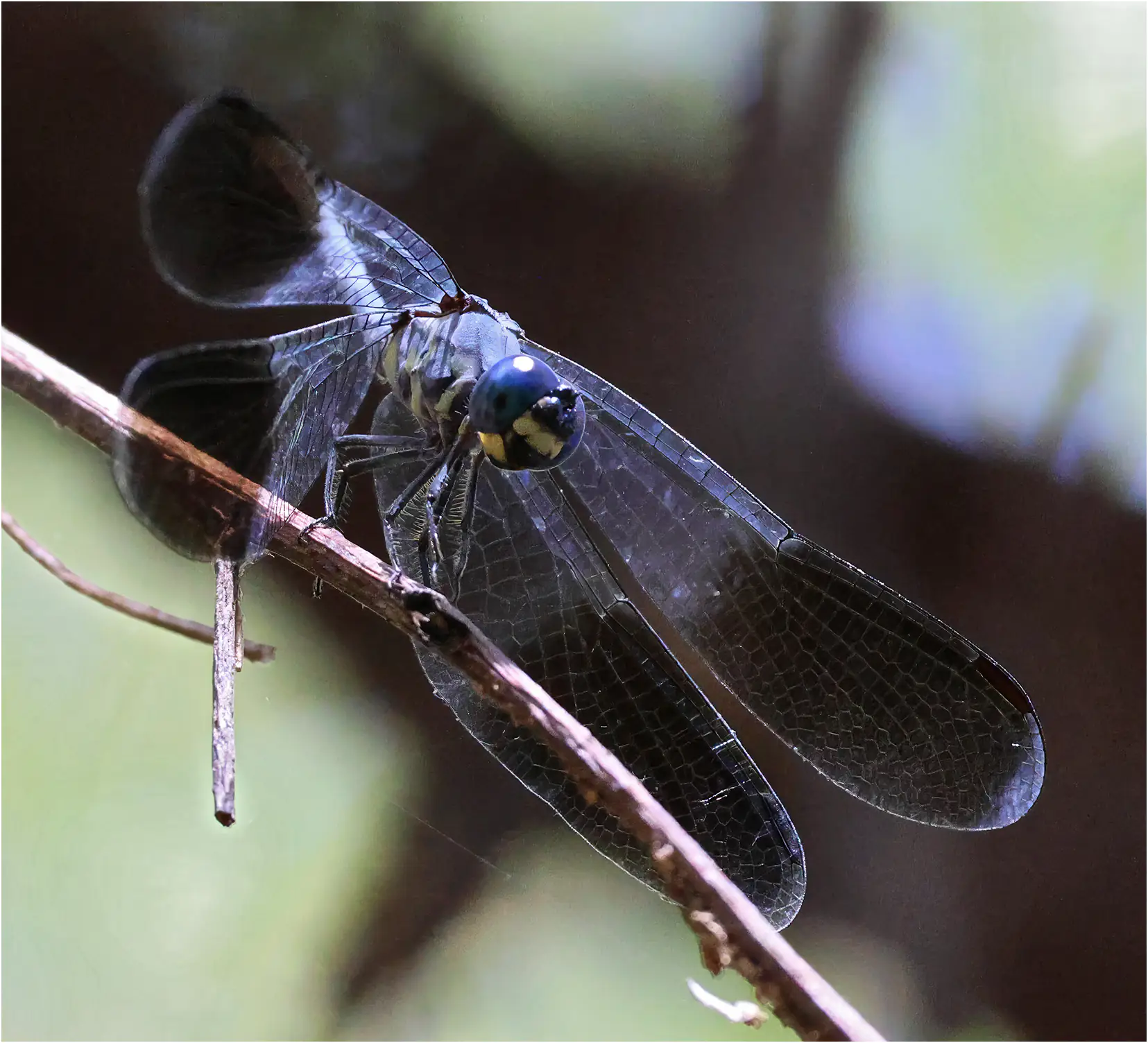
In Africa, it is simply impossible to confuse it with any other species due to the extent and intensity of the wing coloration shown by nearly all mature individuals. Its face is barred with a pale band; its eyes are an uncommon blue. Its thorax on a powdery blue ground is marked with pale markings; the abdomen is also blue.
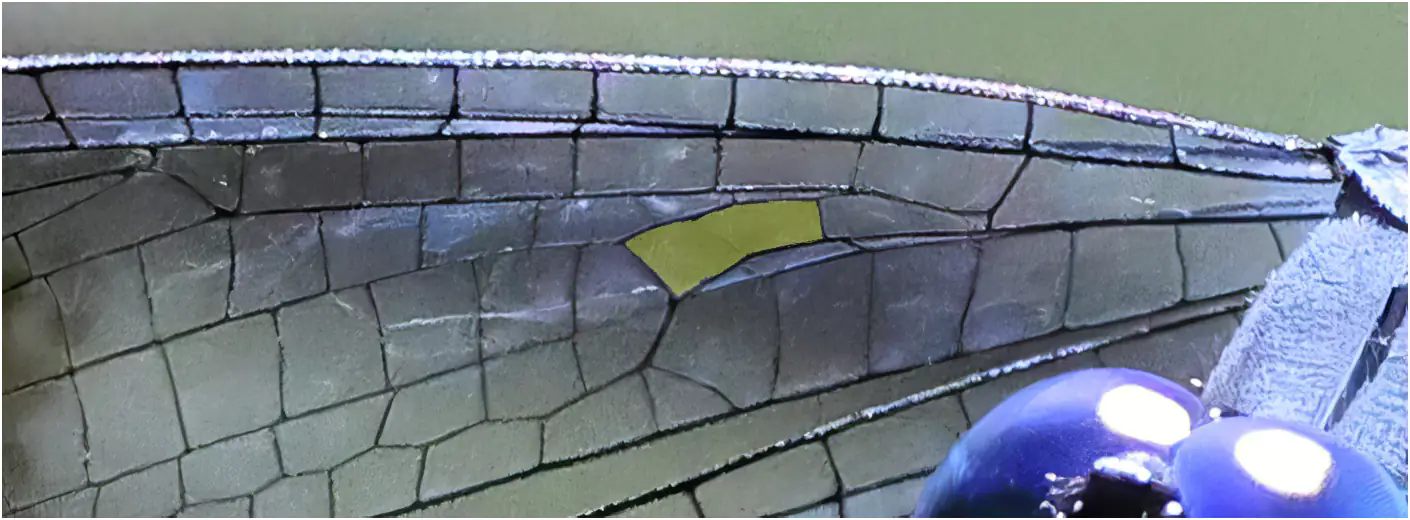
Selys, who describes the species under the (now defunct) genus name Neophlebia, notes the diamond-shaped forewing triangle.
Selys also notes anecdotally its resemblance to Uracis infumata (Rambur, 1842) and Uracis tripartita (Erythrodiplax umbrata (Linné, 1758)), two American species.


Size, habitat et geographical distribution
In South Africa, it measures 30 to 35 mm (Tarboton, 2015), in Madagascar (Selys, 1869), it reaches 30 mm.
I therefore observed it in a tree, within a small wood, quite far from any body of water (a liner-lined reservoir about a hundred metres away), at an elevation of roughly 780 m.
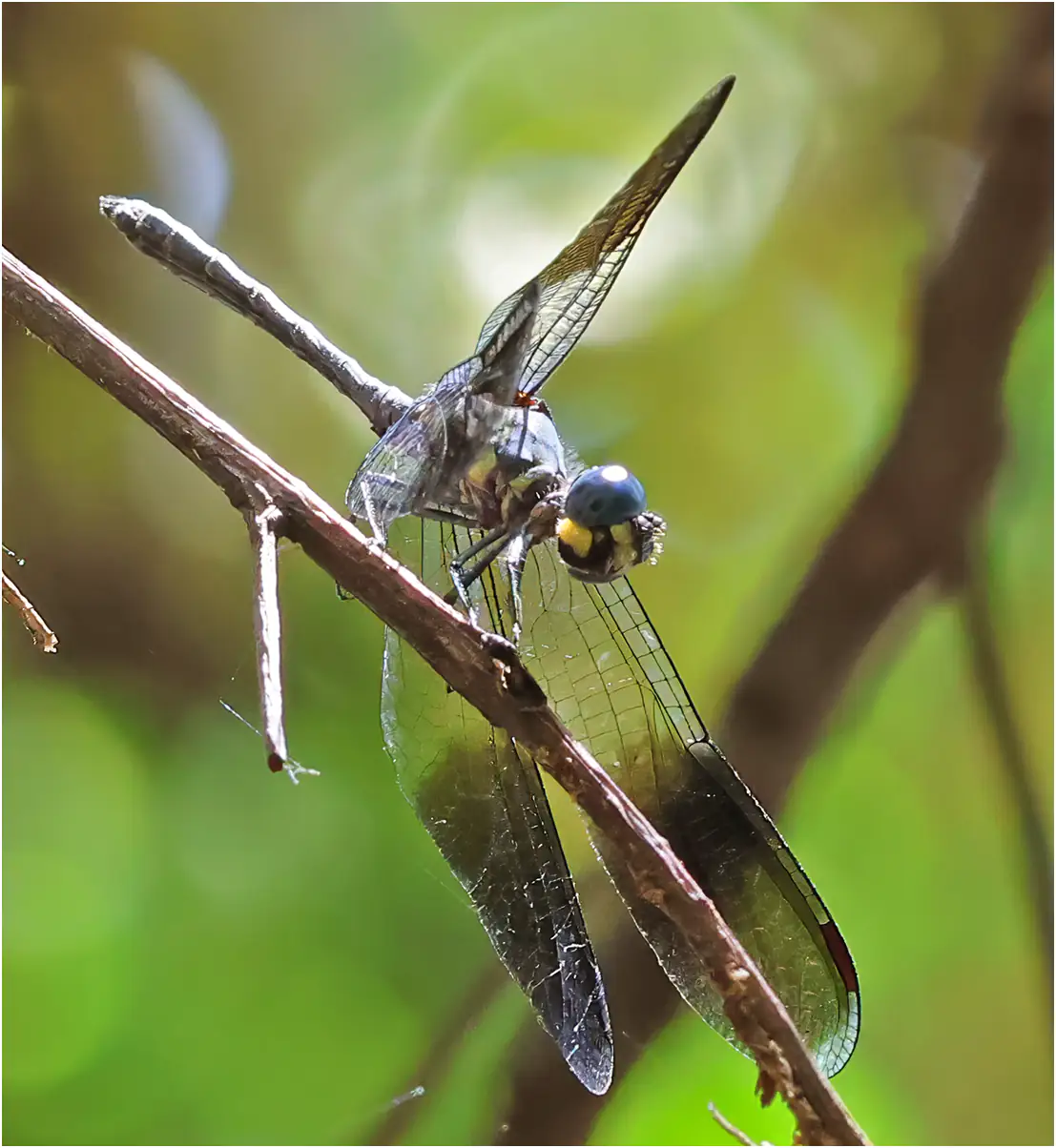
It frequents stagnant waters, often temporary, pools in stream beds, often in the shade of gallery forests, sometimes in more open areas in forest (ADDO). It apparently likes to perch on branches, high up, which explains why my photos are all backlit...
It has a curious distribution in Africa, absent from central Africa.
In the west, it is found from The Gambia to Nigeria, rather patchily. In the east, it occurs across a broad band, from southern Ethiopia in the north to eastern South Africa and Madagascar.
IUCN Red List.
Etymology of Tetrathemis polleni
Tetrathemis (Brauer, 1868), from tetra- for 'four' and Themis – Greek goddess of order, of justice. The name of the goddess of order is particularly well suited to taxonomy, the science that aims to describe and order families, genera and species. The number 4 refers, as described by Brauer, to the shape of the cardinal cell, which we loosely call a triangle, which is four-sided for this genus. This etymology is provided by Endersby & Fliedner, 2015.
Polleni : Let Selys explain this name: "Je m'empresse de dédier cette espèce remarquable au savant et zélé voyageur M. François Pollen à qui j'en dois la connaissance." "I hasten to dedicate this remarkable species to the learned and zealous traveller Mr François Pollen, to whom I owe my knowledge of it."
François Pierre Louis Pollen (1842–1886) was a Dutch naturalist, explorer and collector, best known for his research on the fauna of Madagascar and neighbouring islands in the 19th century.
Dijkstra, K.-D.B. (editor, 2023). African Dragonflies and Damselflies (ADDO).
Ian Endersby & Heinrich Fliedner, 2015 – The Naming of Australia’s Dragonflies, Ian Endersby & Heinrich Fliedner, Busybird publishing.
Sélys-Longchamps, 1869. Énumération des odonates de Madagascar et des îles Comores et Mascareignes (in Pollen, F.P.L. & D.C. van Dam "Recherches sur la faune de Madagascar et de ses dépendances". Partie 5 (Insectes), livraison 1, pages 15–25), p. 18.
Warwick et Michèle Tarboton (2015). A Guide to the Dragonflies & Damselflies of South Africa. Struik Nature.
Tetrathemis polleni male, Kenya, Ikweta camp (Meru N. P.), 07/11/2026