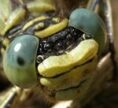
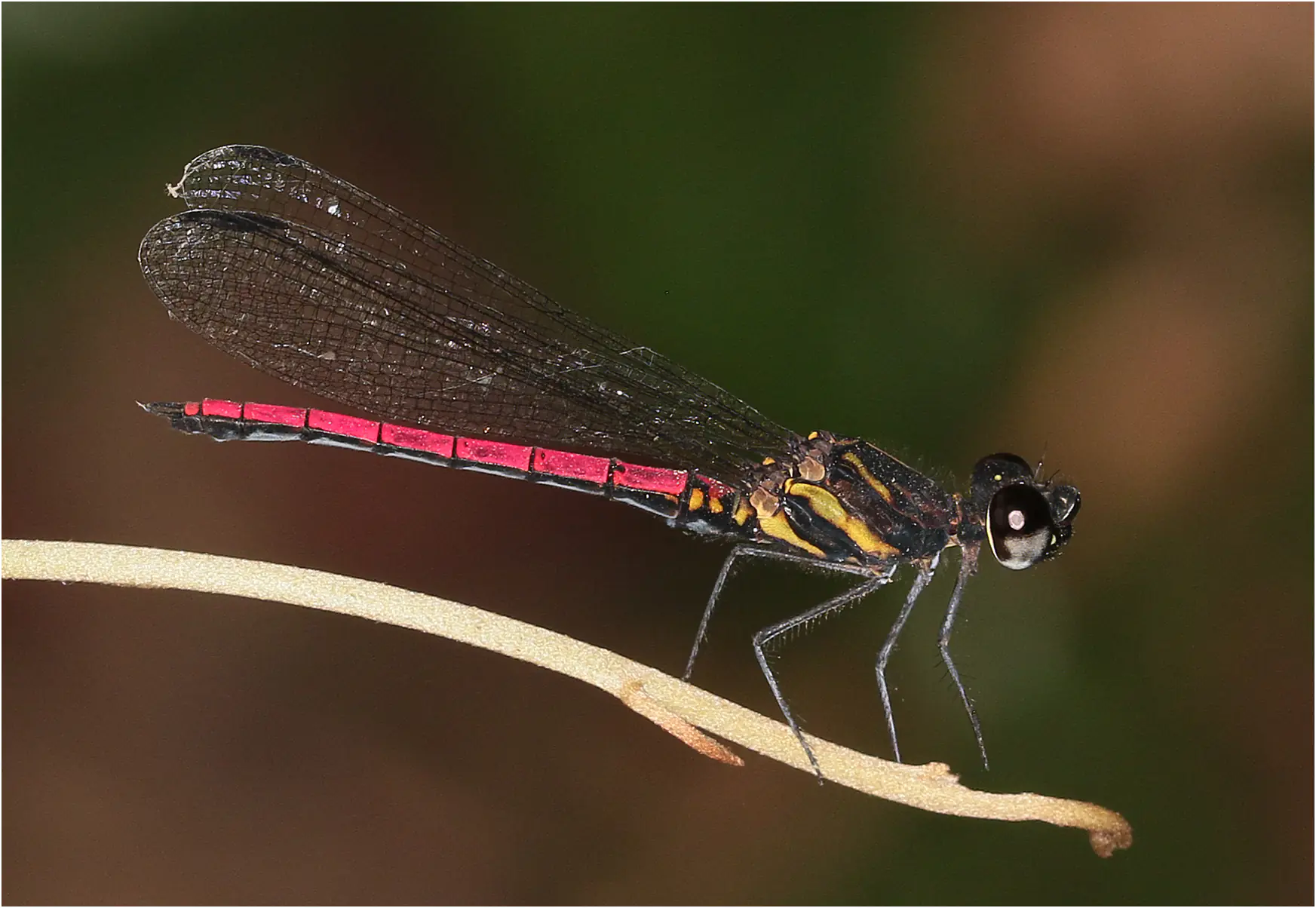
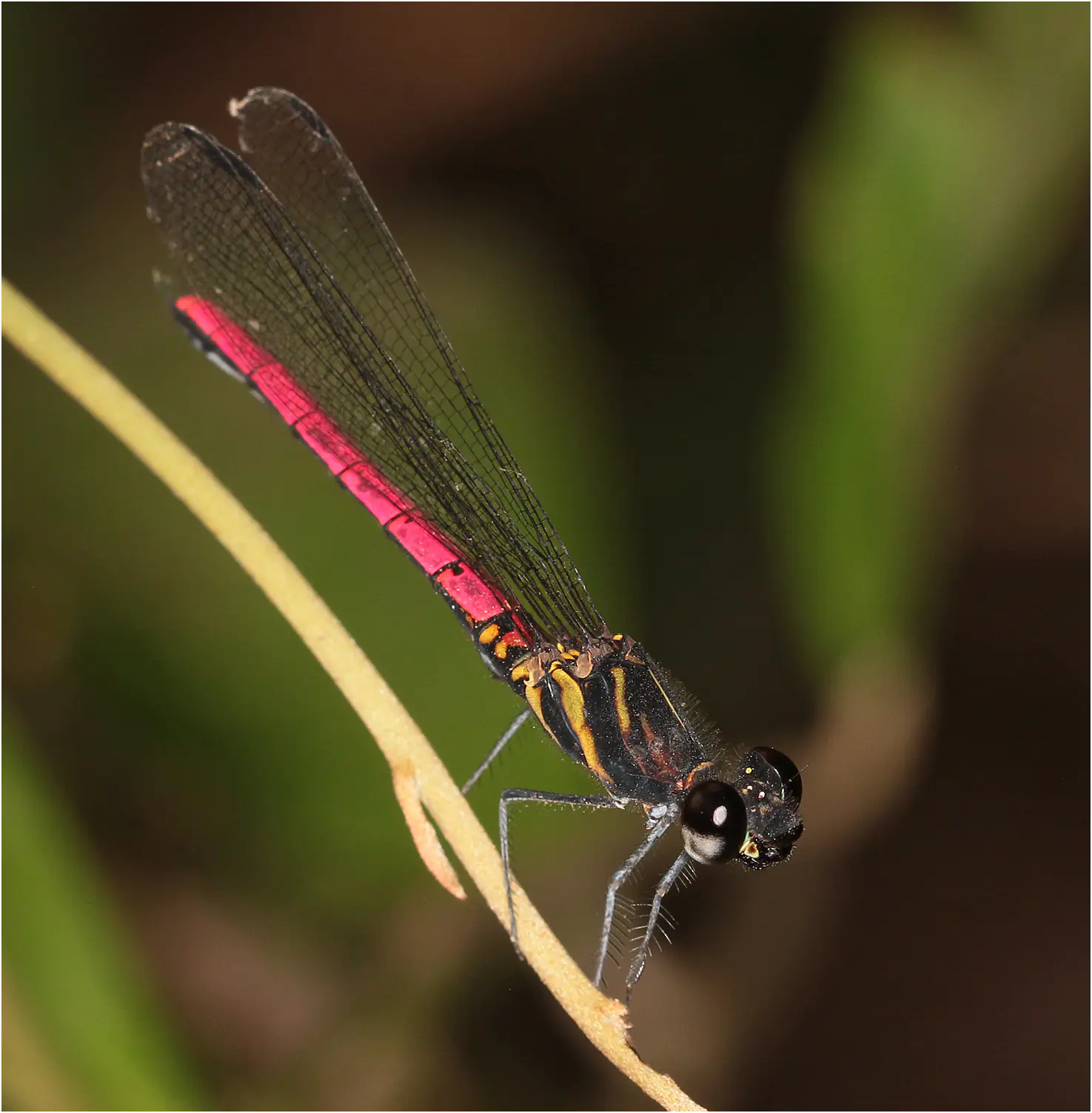
Chlorocypha rubida is fairly easily distinguished from all other members of its genus (30 species endemic to tropical Africa, including 7 in Ghana) by a combination of characteristics that are easy to highlight: the face is entirely black, the tibiae are completely dark (without "white"), and the abdomen is rosy-red (hence its English name, Rosy Jewel). On the middle and lower parts of the thorax, it exhibits 2 broad yellowish stripes, and 2 thin ones on the upper part, which are more or less obscured in mature individuals.
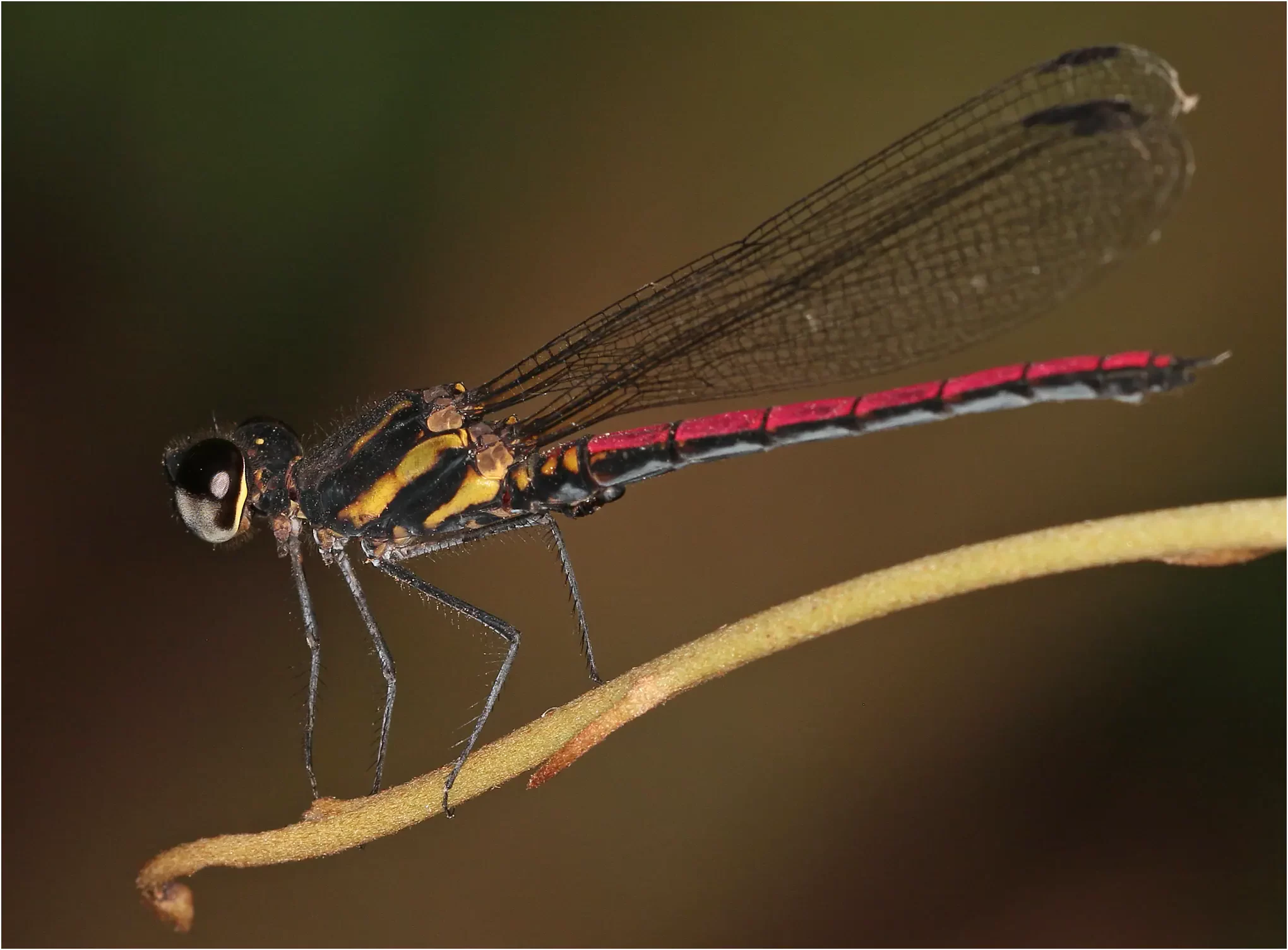
As already mentioned above, as individuals age, the pale markings fade, and they can then be confused with C. selysi, whose face, however, bears pale markings. The 2 yellow dots on the lateral side of the 2nd segment appear to be diagnostic for the species, in Ghana at least.
I only encountered this species once, very briefly, which explains why all my photos were taken from roughly the same angle on the same perch.
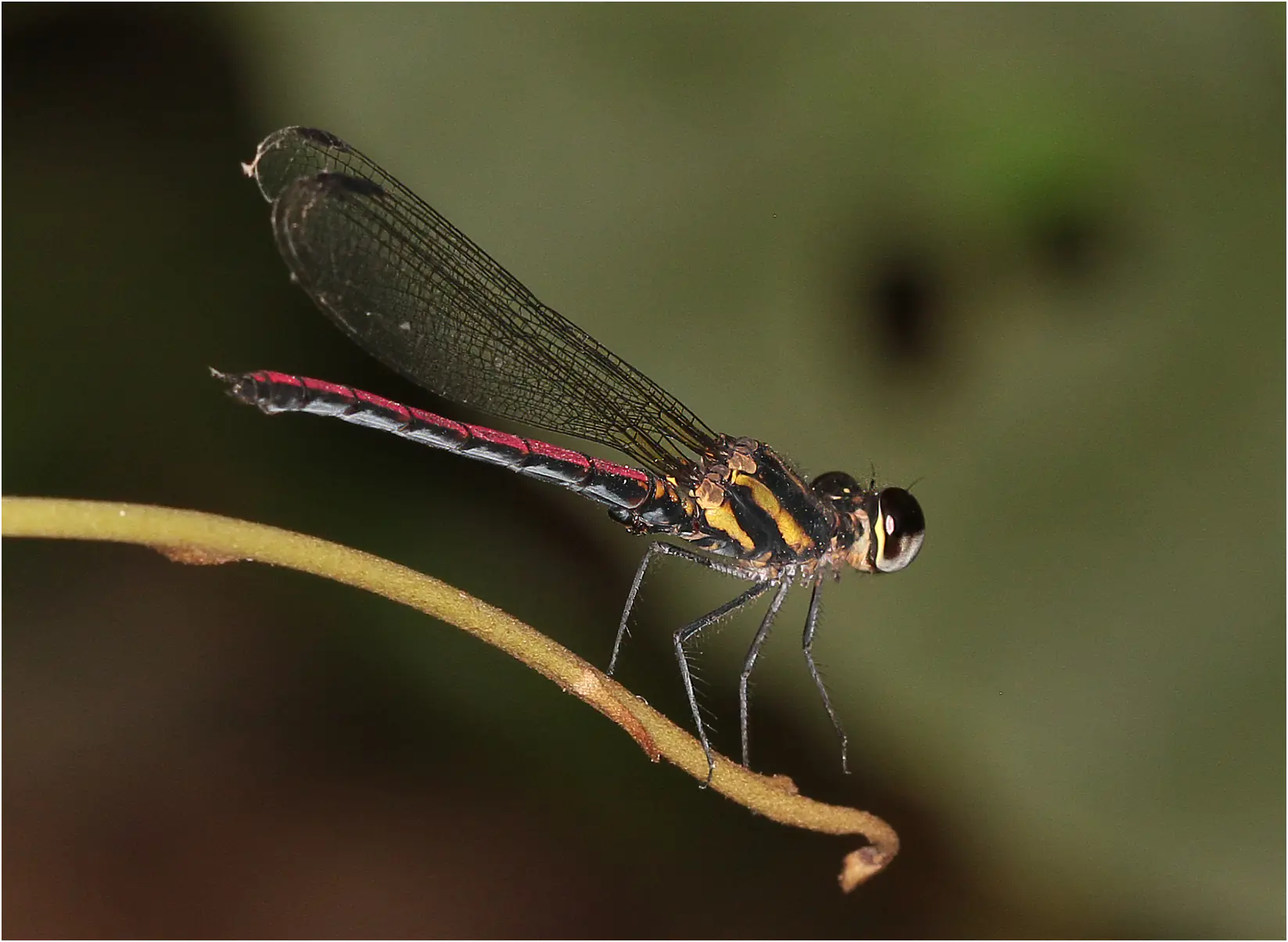
Hagen, who described it under the genus Libellago, measured its abdomen at 22 mm and its hindwing at 24 mm. Its total length is therefore about 33 mm.
We encountered this male, accompanied by the female further below, along a forest trail without noticing any stream or body of water nearby; however, it is easy to miss a stream down below in the shade of the forest. Indeed, ADDO states, "Mainly springs and headwaters, but also broader streams, shaded by forest."
The identification of the female is difficult to prove; we did not see any other Chlorocypha that day, and this female was in the company of the male. It would therefore be very surprising if it belonged to another species.
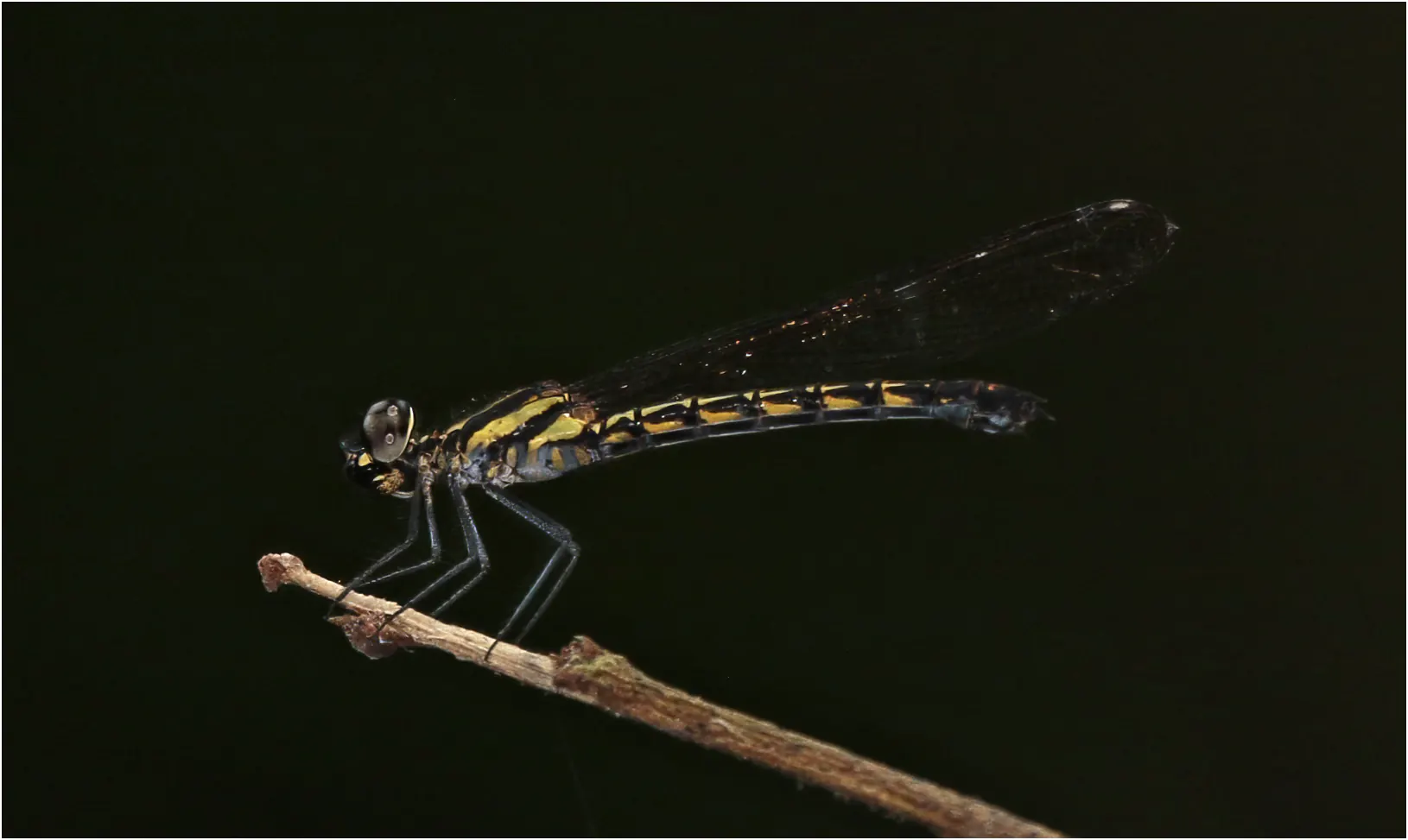
Its distribution extends from Liberia and Sierra Leone to Nigeria, passing through Côte d'Ivoire, Ghana, Togo, and Benin.
IUCN Red List.
Étymology of Chlorocypha rubida
Chlorocypha, from the Greek chloro, for yellow or green, and cyphos, meaning humpbacked or hump, referring to the color of the curious clypeus of the species, certainly in an immature specimen. Fraser wrote, "I have chosen the name Chlorocypha for this genus, based on the specific character mentioned by Palisot de Beauvois for the type species dispar: "le chaperon [Clypeus] est d’un jaune-verdâtre" [the clypeus is of a greenish-yellow]. " I am certain that Palisot de Beauvois never wrote these words in his description, nor did Selys in his Synopsis des Caloptérygines, nor in his Monographie des Caloptérygines. The origin of Fraser's quote remains a mystery to me.
Rubida, from the Latin rubidus, meaning dark red or reddish; Hagen wrote, "thorax noir avec deux raies rougeâtres… / abdomen entièrement rouge en-dessus" [thorax black with two reddish stripes… / abdomen entirely red above].
Dijkstra, K.-D.B (editor ADDO), 2019 – African Dragonflies and Damselflies (ADDO) – Chlorocypha rubida – [The link may not work; web.archive link from the ADDO website, which is now offline.]
Hagen in Selys, 1853 – Synopsis des Caloptérygines. Bulletins de l’Académie Royale Des Sciences, Des Lettres et Des Beaux-Arts de Belgique, 20 (Appendix), 1–73, p. 58..