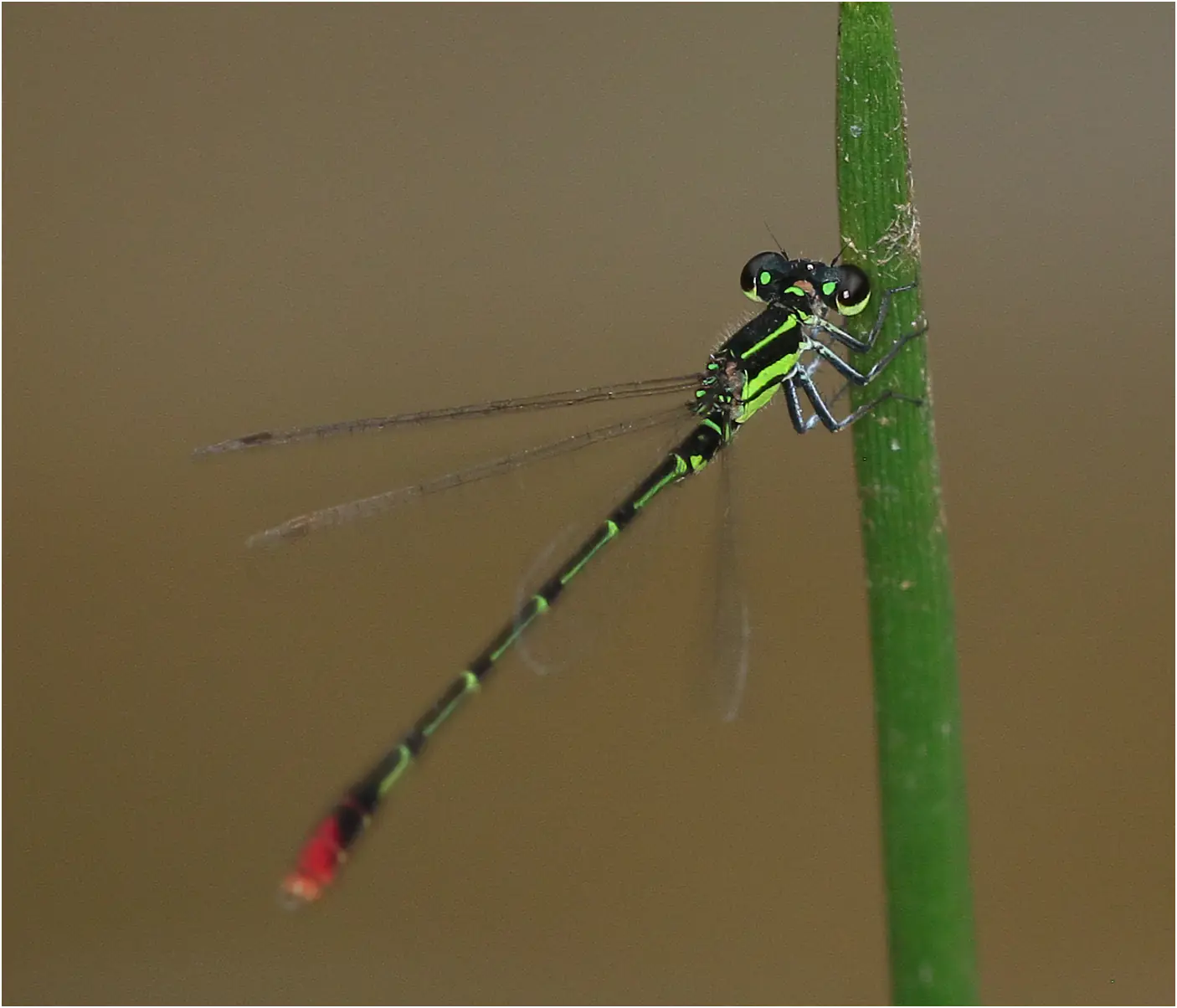
It was at a very rich pond that we encountered Orthetrum africanum, from afar, and the only one of the trip for me (until proven otherwise). An extraordinary pond indeed, since we observed there three species recorded for the first time in Ghana, such as Agriocnemis victoria, Trithemis aenea, and the very rare Urothemis venata.
Orthetrum africanum is one of the 36 African Orthetrum species, and one of the 15 found in Ghana.
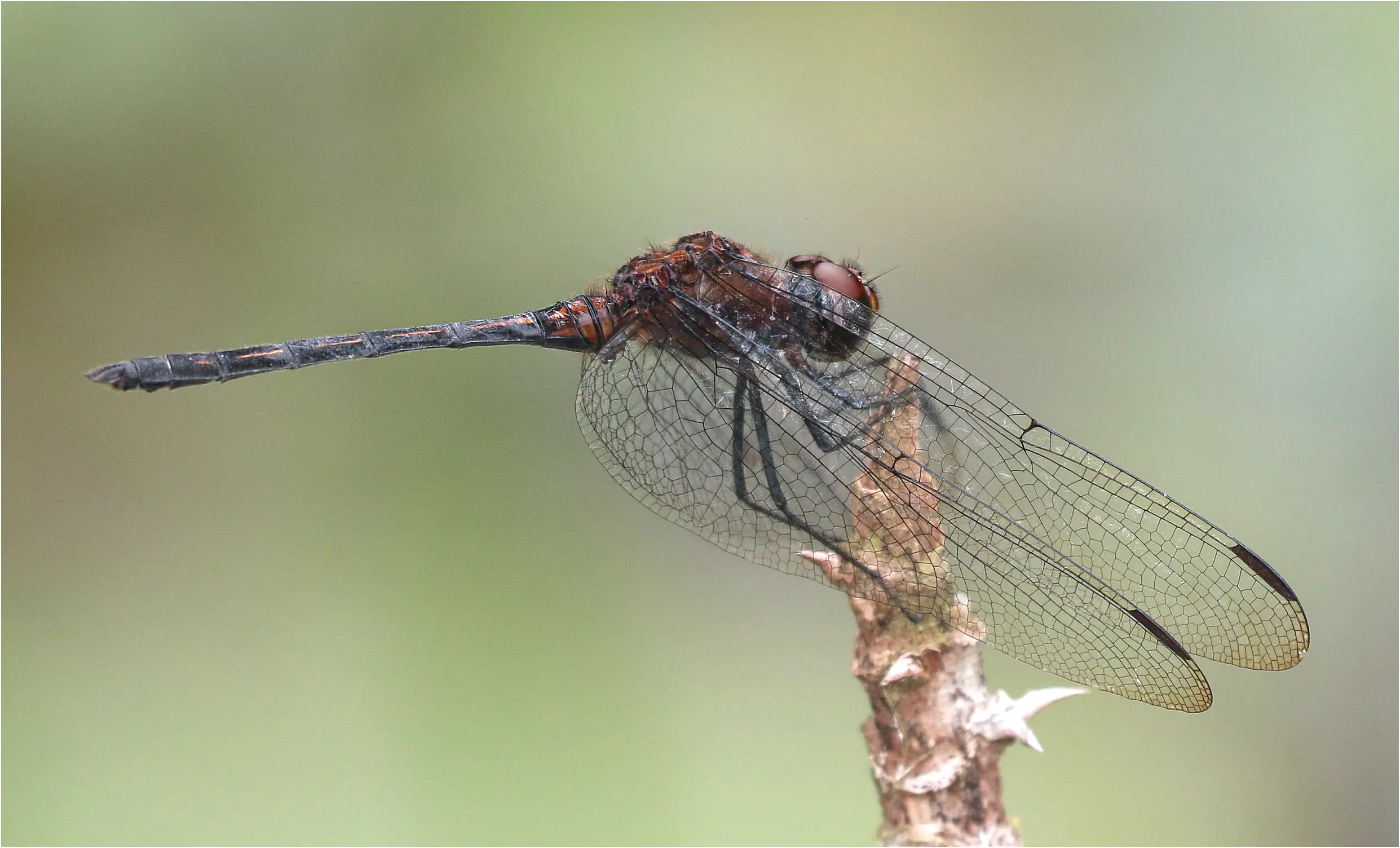
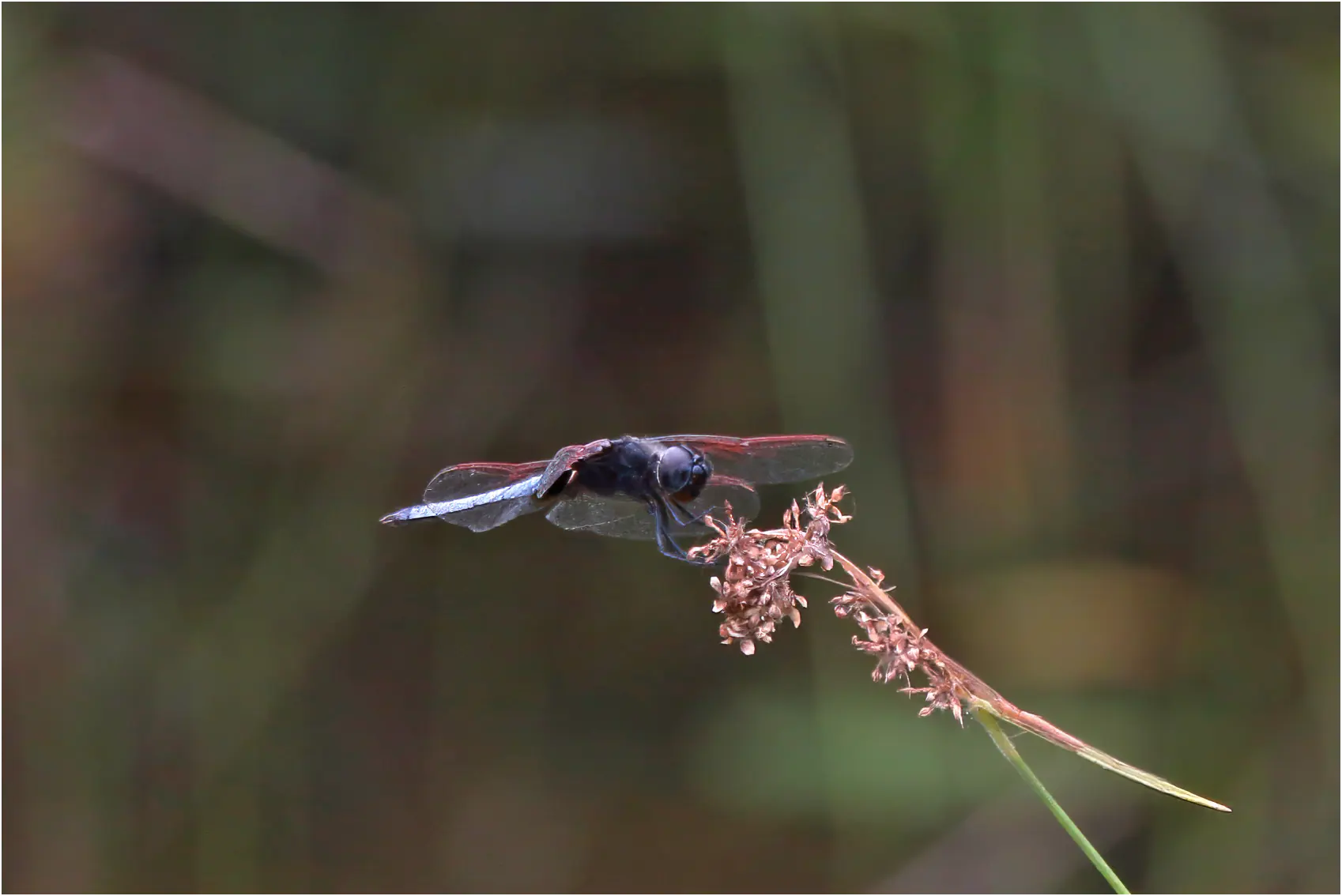
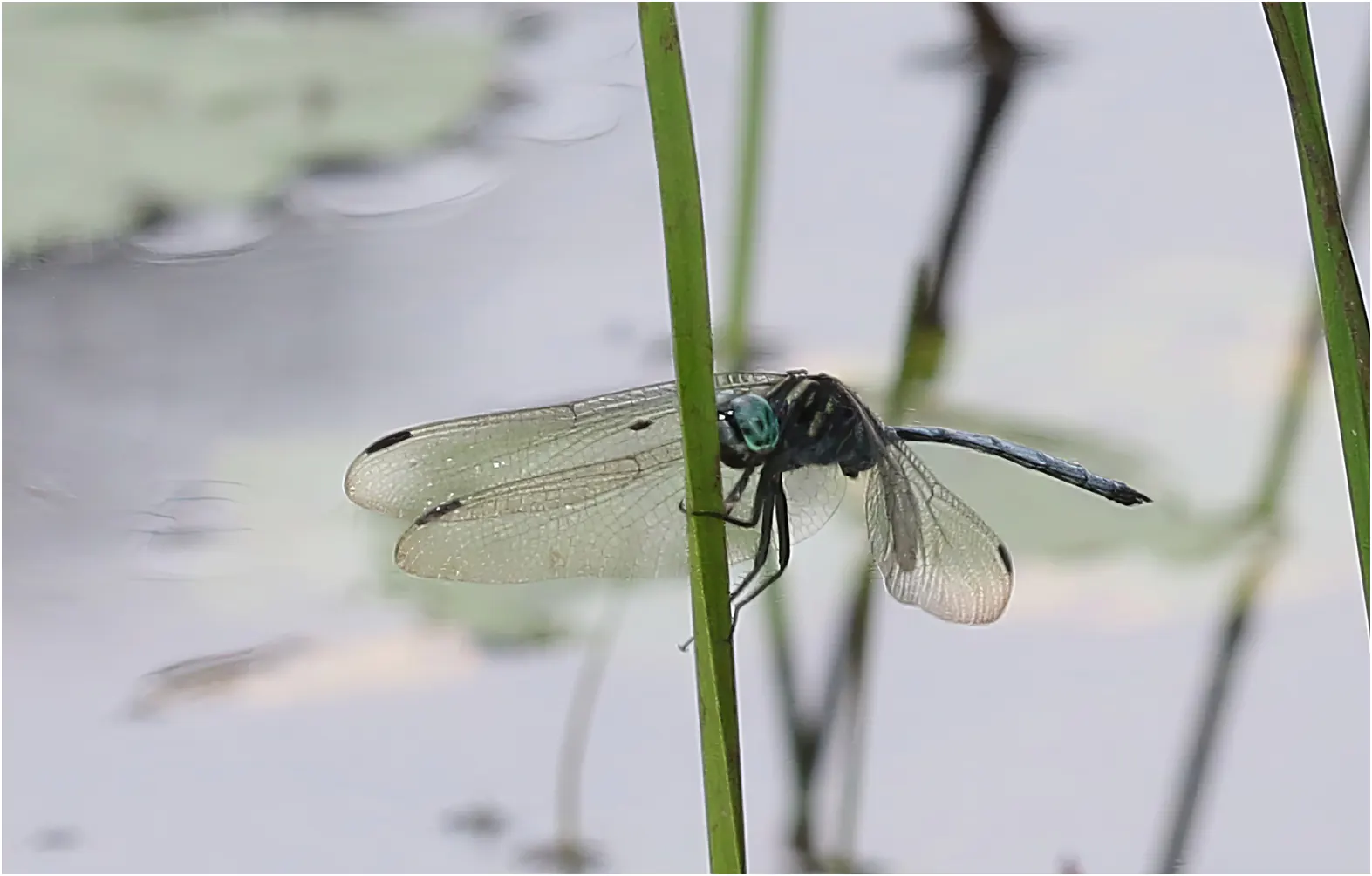
Although Selys, who described it, considered it a variety or race of Lepthemis sabina ("our" Orthetrum sabina, which in fact does not venture beyond Chad, Sudan, and Ethiopia) because he noted few differences from that species, identification poses no problem.
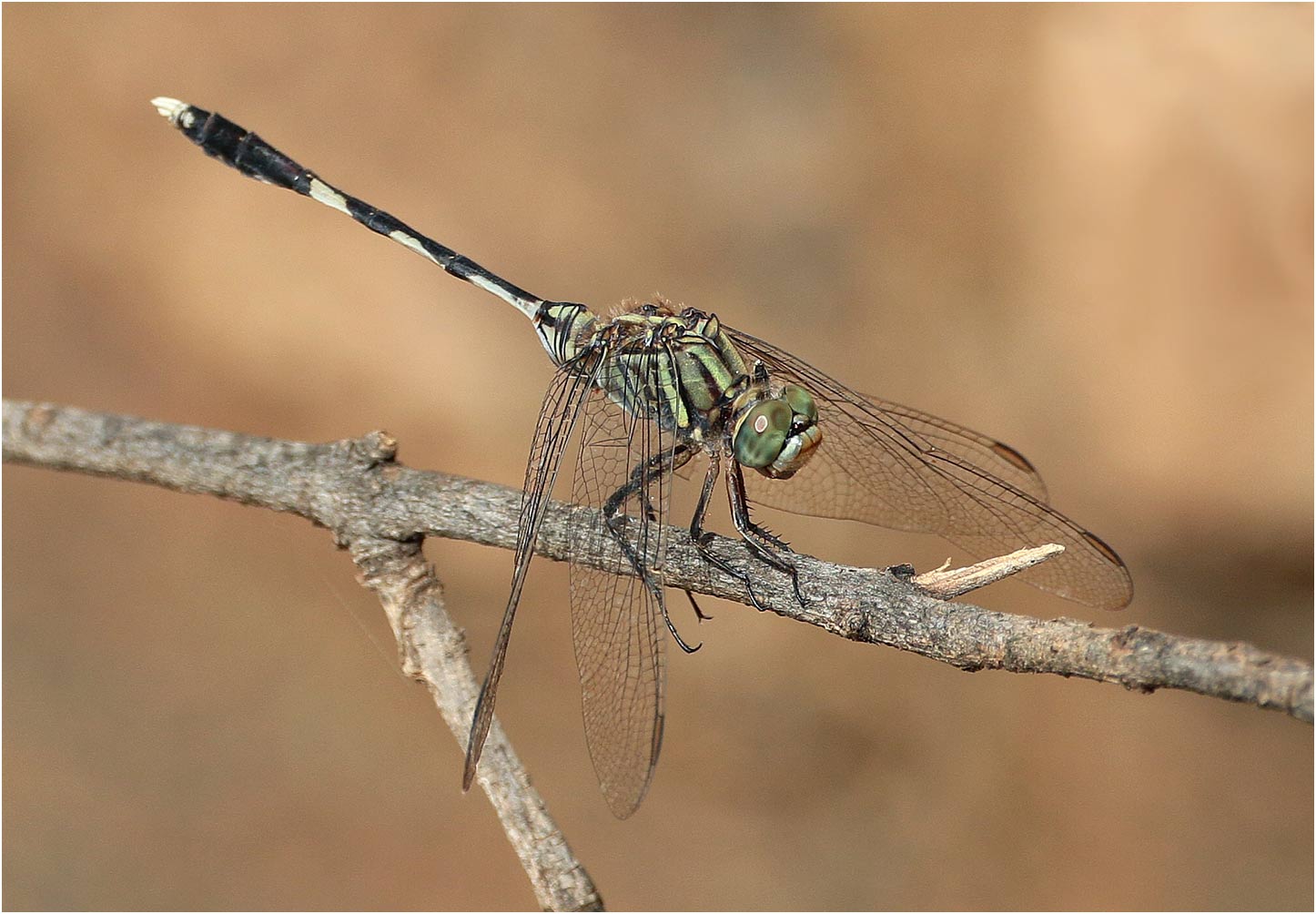
Its abdomen is extremely slender (not dilated at its tip) and 2 or 3 millimeters longer than its wings. It could be confused with O. angustiventre (which I have never seen) or O. trinacria; however, neither of these exhibits that spectacular narrowing of the abdomen at segment S3 (Longfield, 1955).
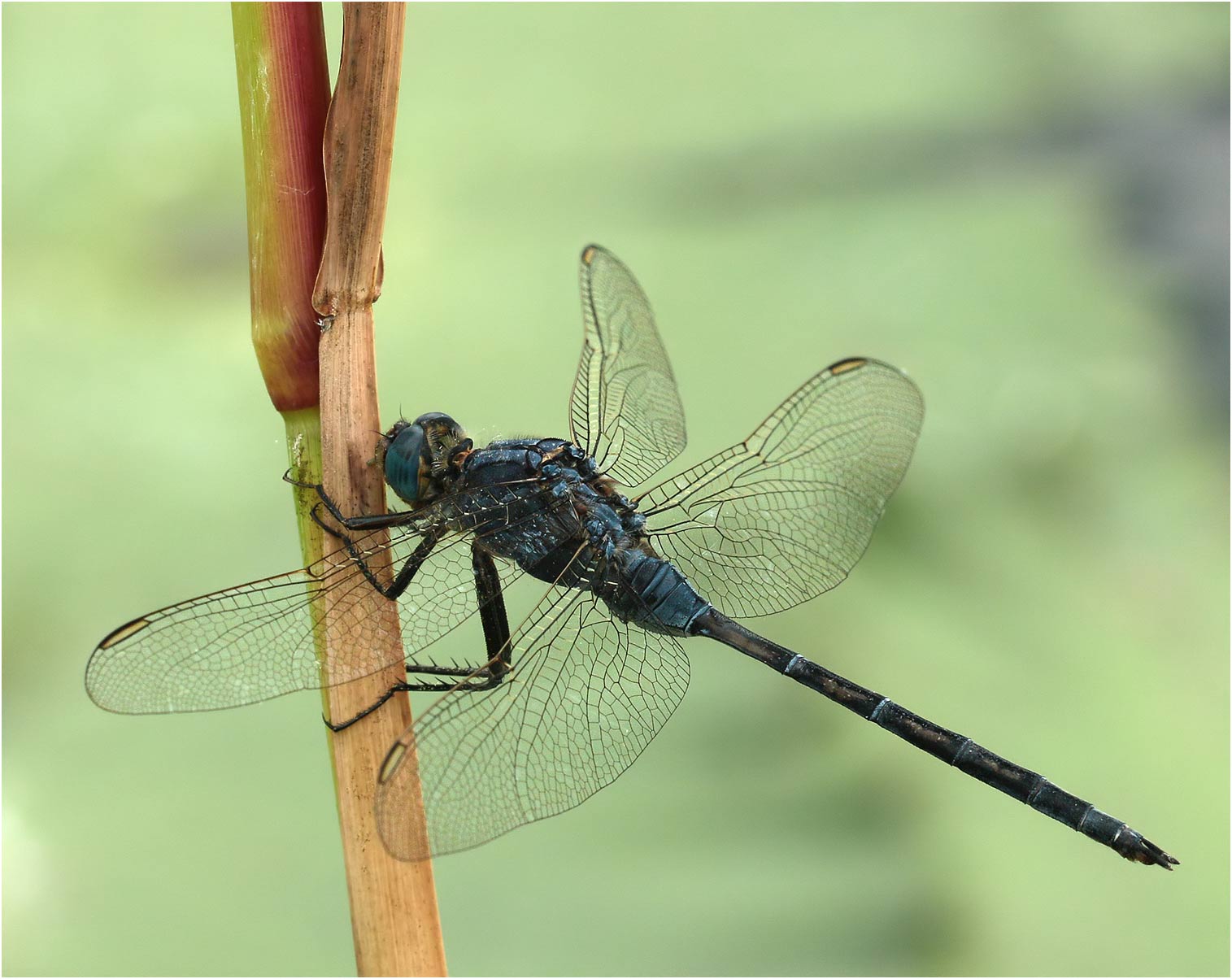
According to Longfield (1955), its closest relative is O. sagitta, a very rare species whose photographs can only be found on observation.org but which is absent from Ghana.

For Dijkstra, on ADDO, it can also be confused with O. saegeri (which I have never seen) or with O. julia. The main differences are the narrowing of the abdomen at S3—a constriction relative to the bulbous S2-S3 and even compared to the subsequent segments—and the black labrum (upper "lip").
The two pale thoracic stripes remain present despite aging, and the thorax does not appear to become pruinescent.
According to D'Andrea & Carfi (1997), the length of its abdomen reaches 38 mm, compared to 28 to 30.5 mm according to Schmidt (1951)—a surprising variation, though I would tend to believe the former authors.
We observed it on a pond enclosed on three sides by forest, in an area where long dry stems emerged.
ADDO specifies "standing and often temporary waters, mainly in open areas within forests."
Its distribution covers all of West Africa and extends from Senegal to eastern Uganda. Further south, it reaches the extreme north of the Democratic Republic of the Congo and Angola.
IUCN Red List.
Etymology of Orthetrum africanum
Originally named Lepthemis africana by Selys, Kirby (1889) transferred this complex to the genus Orthetrum, which he clarified. It was Ris in 1909 who clearly established it as a species distinct from Asian and northeastern African subjects, establishing the combination Orthetrum africanum.
Orthetrum (see Endersby & Fliedner, 2015) comes from two Greek words: orthos, meaning straight, and etron, meaning abdomen, signifying that the sides of the abdomen are parallel. This generic name (neuter), created by Newman in 1833, lost its relevance with the discovery of new species (whose abdomen sides are not parallel), but the name has stuck.
Africanum emphasizes the African origin—specifically Cameroonian—of the specimen held by Selys, who wrote, "Je possède des exemplaires de la côte occidentale d’Afrique (Camaroons)." - "I possess specimens from the western coast of Africa (Camaroons)."
D' Andrea, M., & Carfi, S. (1997). Nuove raccolte di odonati del Camerun con note su Agriocnemis maclachlani Selys, 1877 edescrizione di Agriocnemis dissimilis sp. nov. e Trithemis osvaldae sp. nov. Atti Societa italiana Scienze naturali, 136, 157-190.
Endersby Ian & Fliedner Heinrich (2015). The Naming of Australia’s Dragonflies. Busybird publishing.
Schmidt, E. (1951). Libellen aus Portugiesisch Guinea, mit Bemerkungen über andere aethiopische Odonaten. Arquivos Museu Bocage, 20, 125-200.
Selys (1887). Odonates de l'Asie Mineure et révision de ceux des autres parties de la faune dite européenne. Première partie. Odonates de l'Asie Mineure. Annales Société entomologique de Belgique, 31, 1-49.