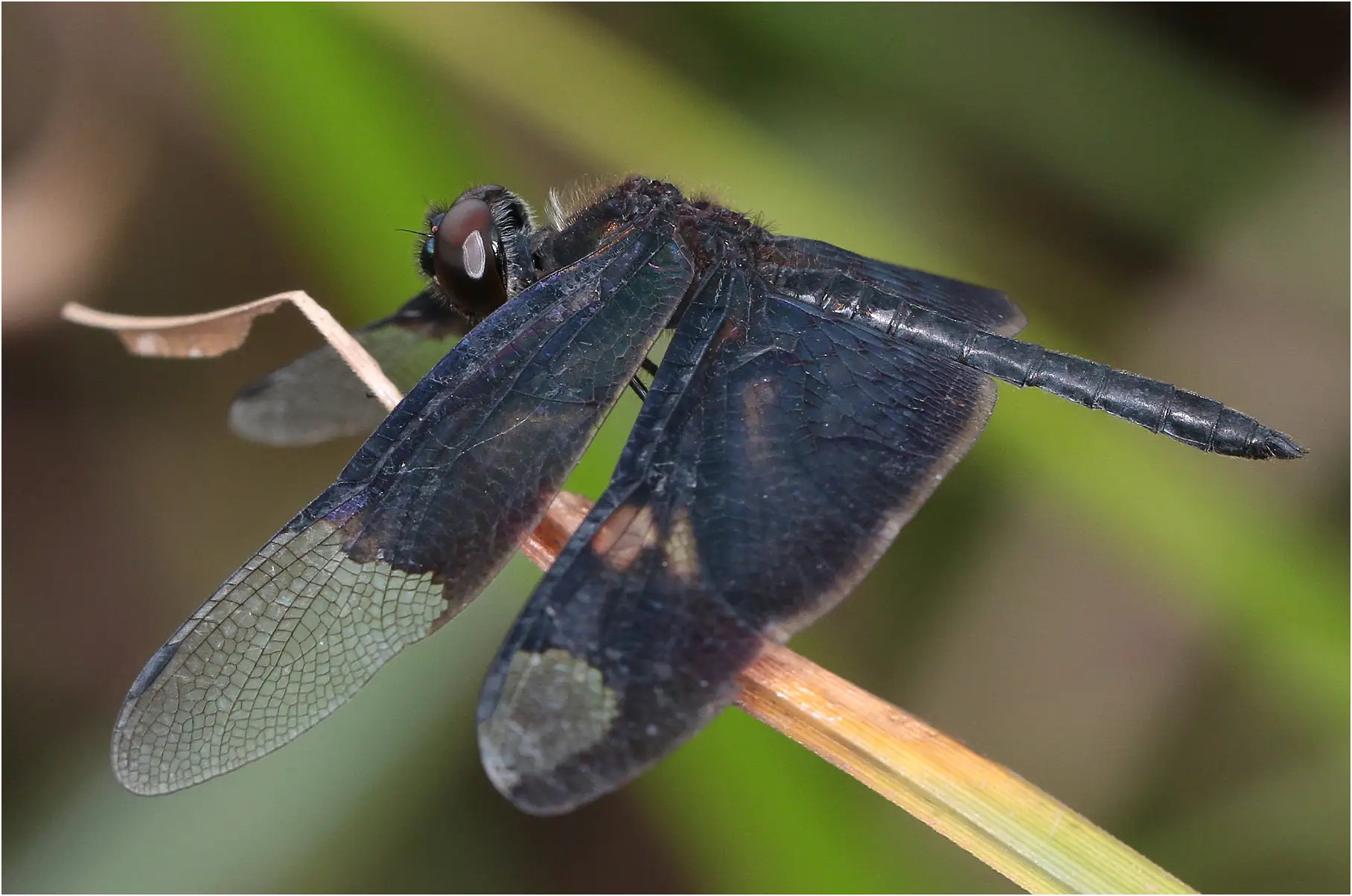
Rhyothemis notata belongs to a genus that is particularly dear to odonatophiles due to the spectacular coloration of their wings. I have actually grouped all the ones I have encountered around the world on this page.
The genus counts 22 species, with a new one soon to be described. They are generally not easy to approach, and this one is no exception, especially since the terrain made walking difficult, amidst very tall, dense grass that had completely invaded a large pond.
Two other Rhyothemis are present in Ghana: R. fenestrina (here in Namibia), which we will encounter several times, and R. semihyalina (also in Namibia), which we did not record.
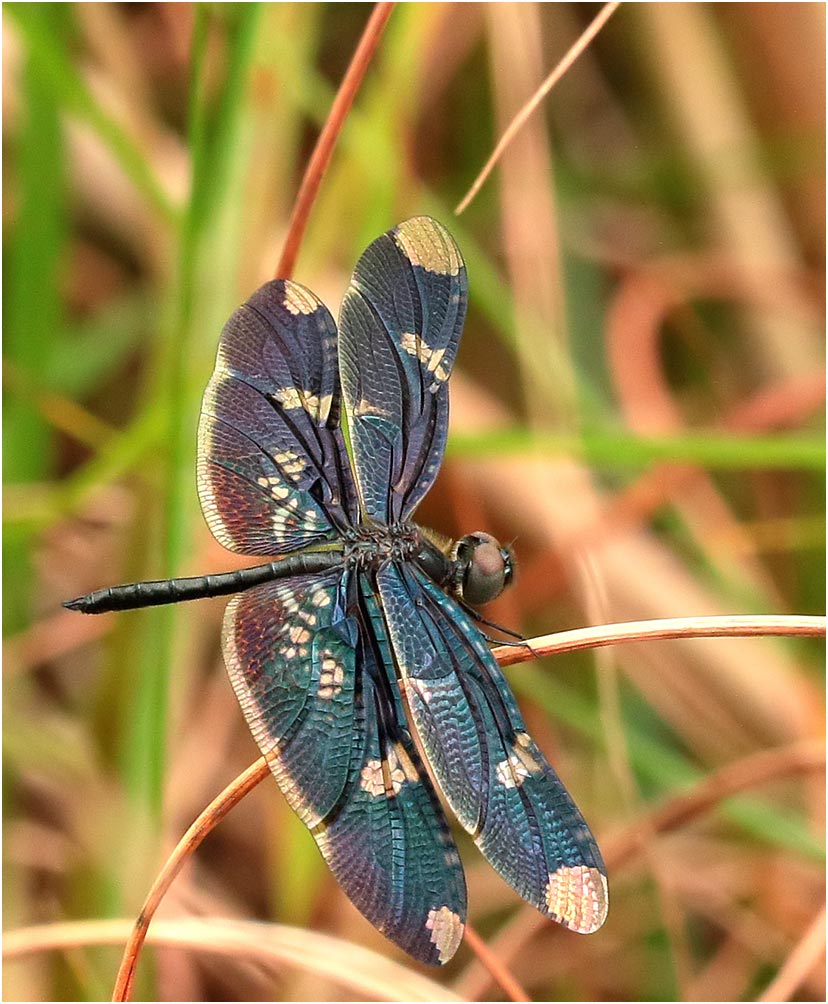
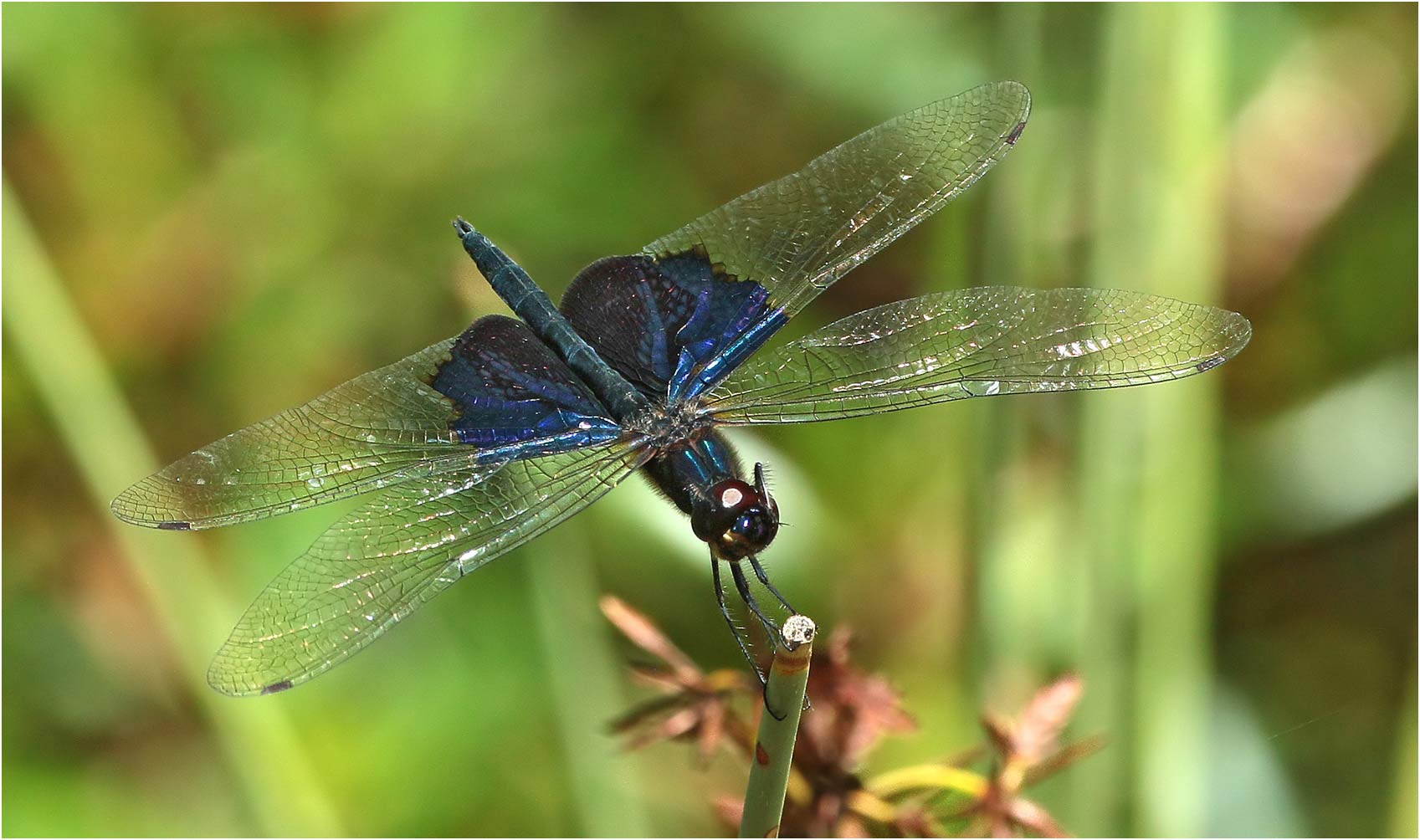
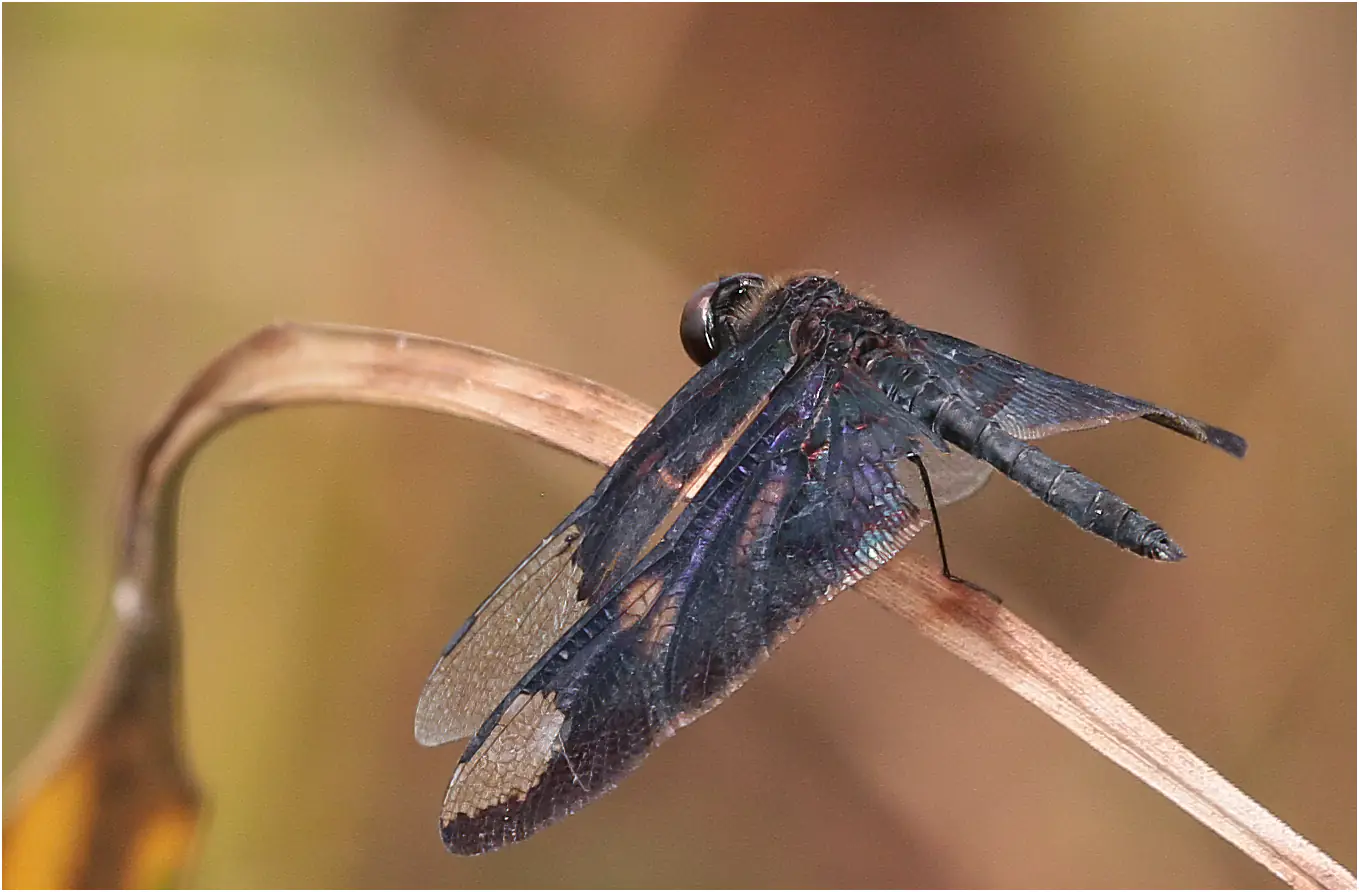
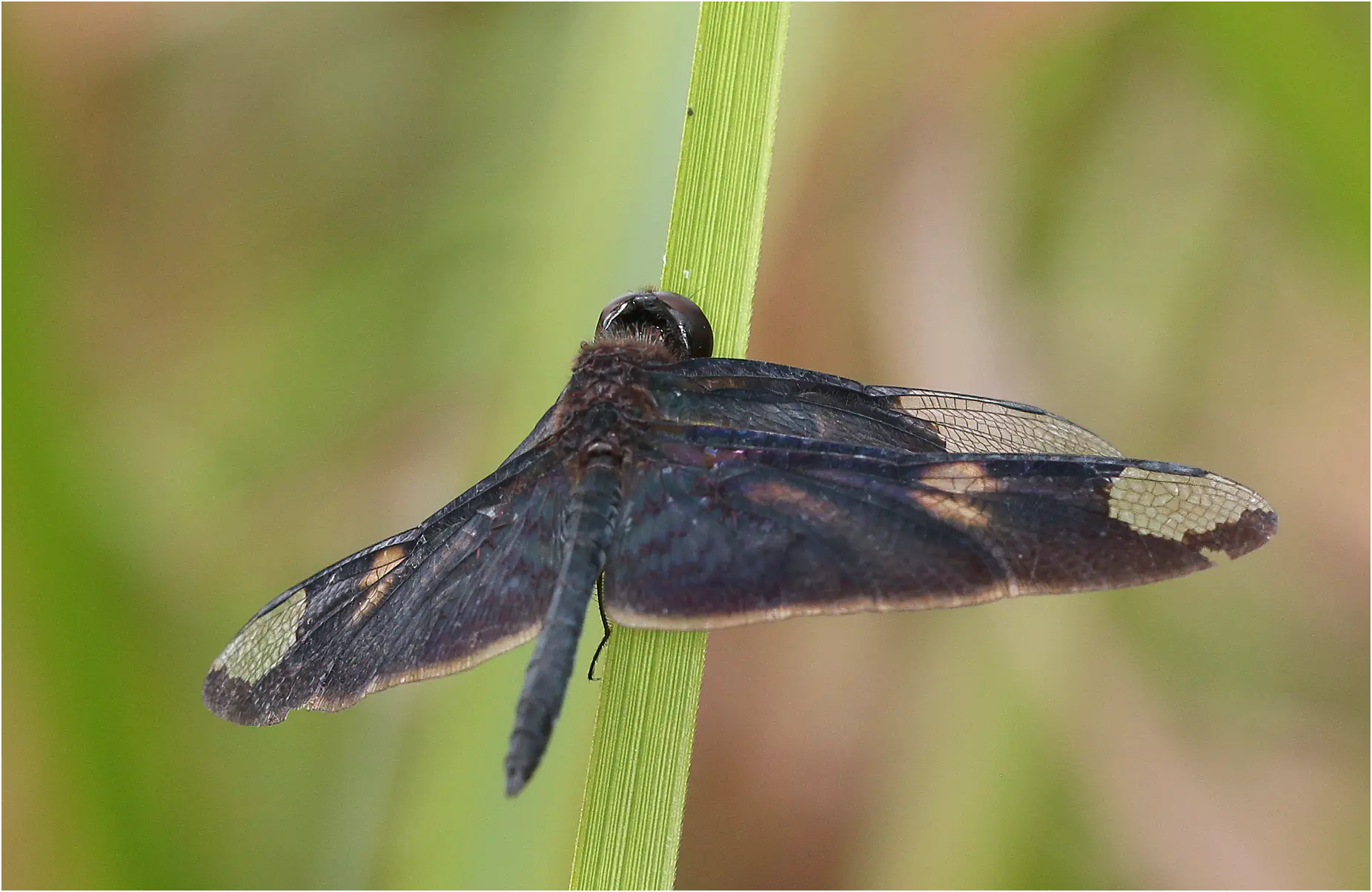
Rhyothemis notata is identified among African Rhyothemis by the extent of its wing coloration: on the forewing, it stops just beyond the nodus; on the hindwing, it stops before the pterostigma. Note that the hindwing is windowed beyond the nodus. To be precise, it is the only African Rhyothemis to feature a double row of cells in the radial field, between the IR3 and Rspl veins.
In the English-speaking world, it is called the Veiled Flutterer.
Karsch tells us that its total length reaches 28 mm.
It is found on standing waters in open forest habitats, sometimes with light shade.
Its distribution ranges from Senegal to Gabon and the Democratic Republic of the Congo.
IUCN Red List.
Etymology: Rhyothemis notata
In Rhyothemis (Hagen, 1867), we recognize the name of the goddess of Order and Justice, Themis, frequently used even after Hagen to name Libellulidae, mimicking the ancients who used names from mythology. The first part of the name probably comes, according to Endersby & Fliedner (2015), from a rock, rhyolite, discovered in 1861 and whose name is composed of two Greek words meaning "to flow" and "stone," this magmatic rock displaying bands or layers that appear to have flowed over one another. When looking at rhyolite, this explanation is... surprising.
Notata is the past participle of the Latin verb notare, meaning "marked" or "spotted." It was certainly unusual for Fabricius to encounter a Libellulidae with such colorful wings, and he was struck by the spotted wing coloration of this dry pinned specimen from the collection of Sir Joseph Banks, originating from Sierra Leone.
Endersby Ian & Fliedner Heinrich , 2015. The Naming of Australia’s Dragonflies, Ian Endersby & Heinrich Fliedner, Busybird publishing.
Fabricius, 1793. Entomologia systematica emandata et aucta. Secundum classes, ordines, genera, species adjectis synonimis, locis, observationibus descriptionibus (Vol. 2, p. 379).
Karsch, 1890. Beiträge zur Kenntniss der Arten und Gattungen der Libellulinen. Berliner entomologische Zeitschrift / herausgegeben von dem Entomologischen Verein in Berlin, 33, 347--392. P. 353.
Papazian, Filippi, Coache et Deffontaines, 2022. Contribution à la connaissance des Odonates de l’archipel de Sāo Tomé-et-Príncipe 3. Présence d’Ischnura senegalensis (Rambur, 1842), de Tramea limbata (Desjardins, 1835) et de Rhyothemis notata (F., 1787) (Odonata Coenagrionidae, Libellulidae). L’Entomologiste, tome 78, 2022, n° 2 : 115 – 119.