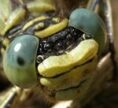
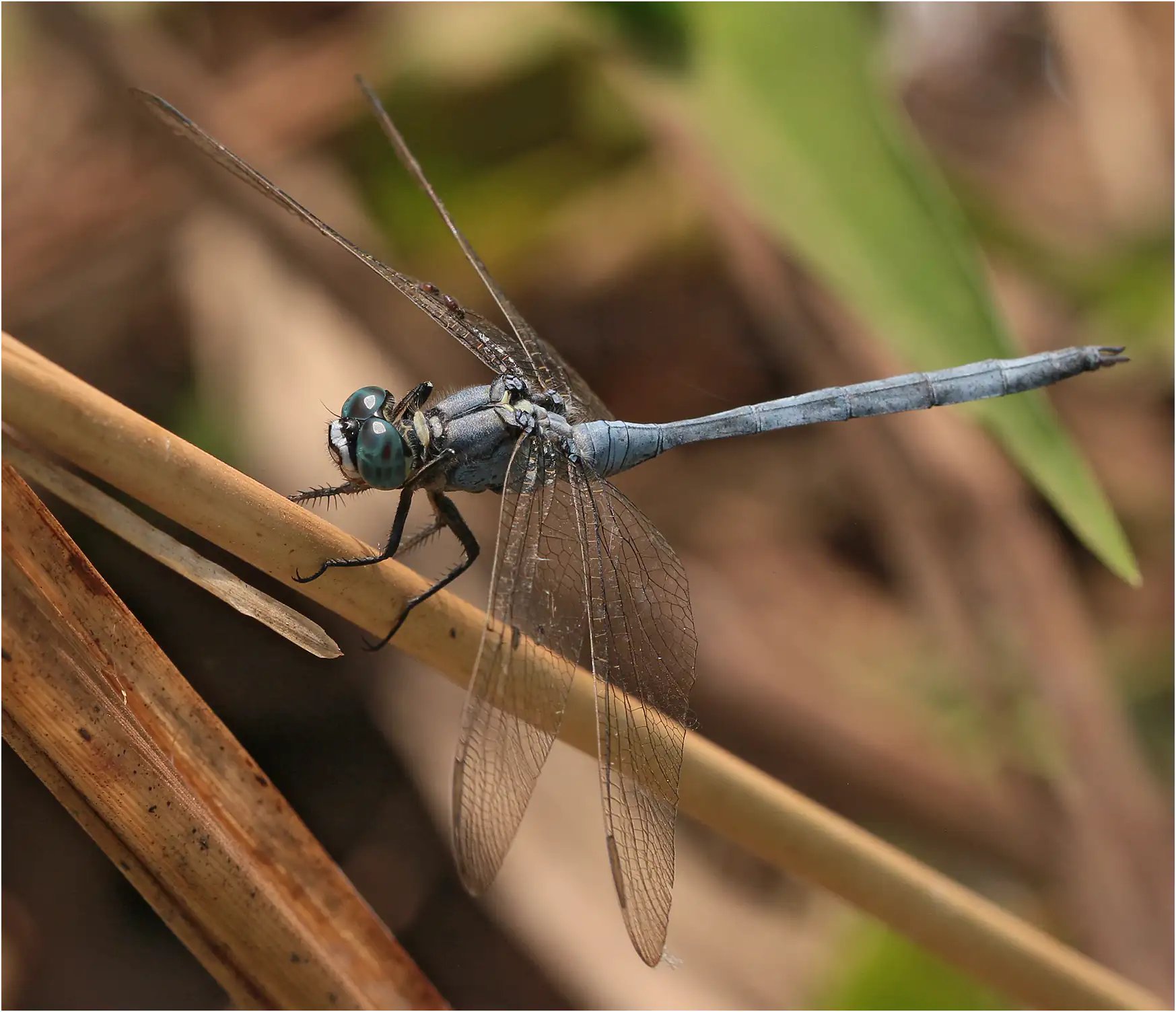
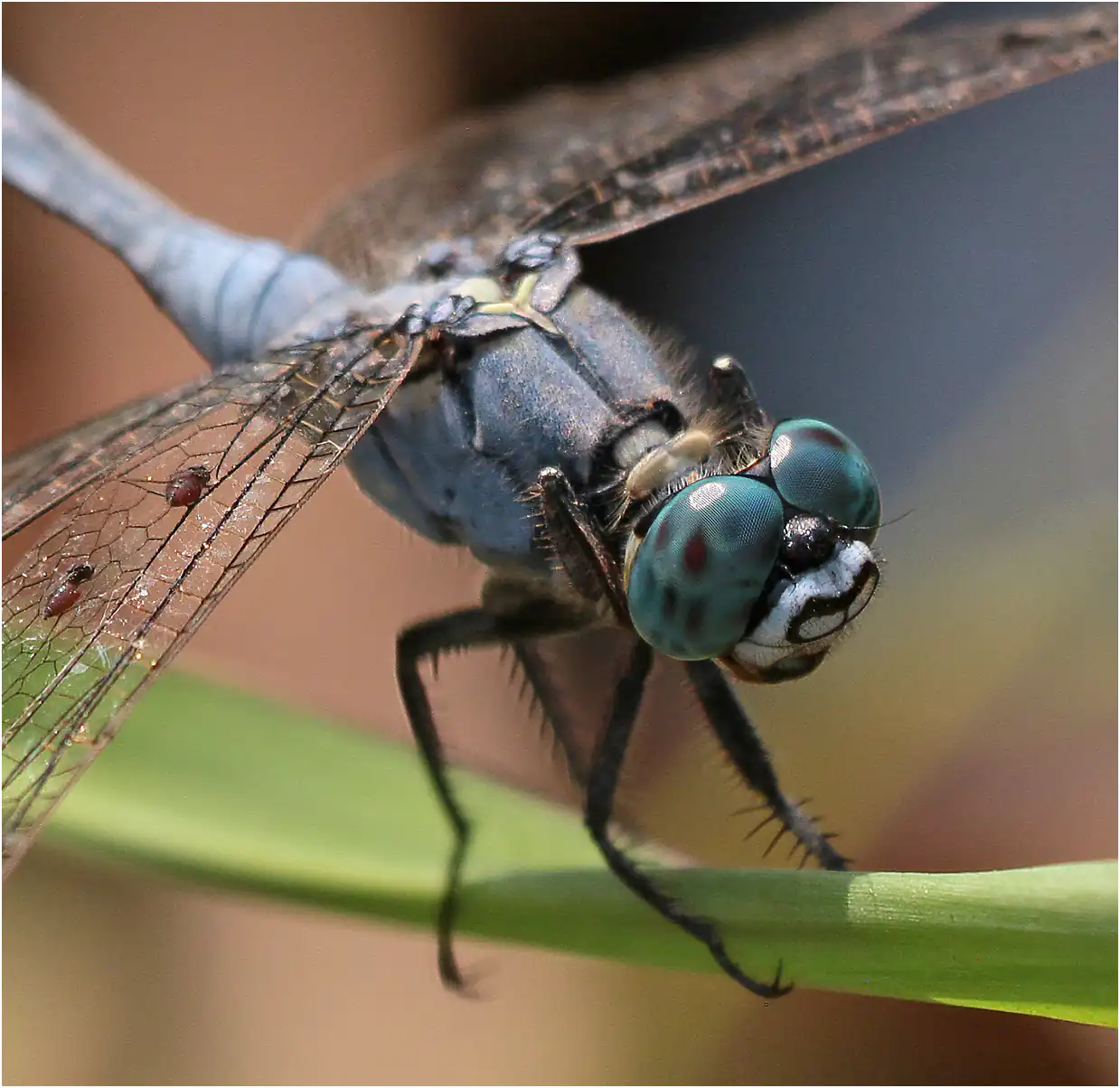
I had already caught a glimpse of Orthetrum icteromelas in Namibia; I only realized it after my return when enlarging my photo, which barely showed the single detail distinguishing it from other blue Orthetrum, its face marked with a horizontal "8" or a "pair of glasses", earning it its English name "Spectacled Skimmer".
Apart from this convenient criterion, adults are covered with a blue pruinescence, the abdomen is moderately constricted at S3 and then very slender. The pterostigmas are long and yellow, with a black anterior margin. There are numerous doubled cells, referred to as two rows of cells, above the radial wyne or supplementary radial vein ("radial planate"). But nothing really allows for a definitive identification.
Fortunately, the mark on the face extends laterally and is often visible, as on the specimen on the left.
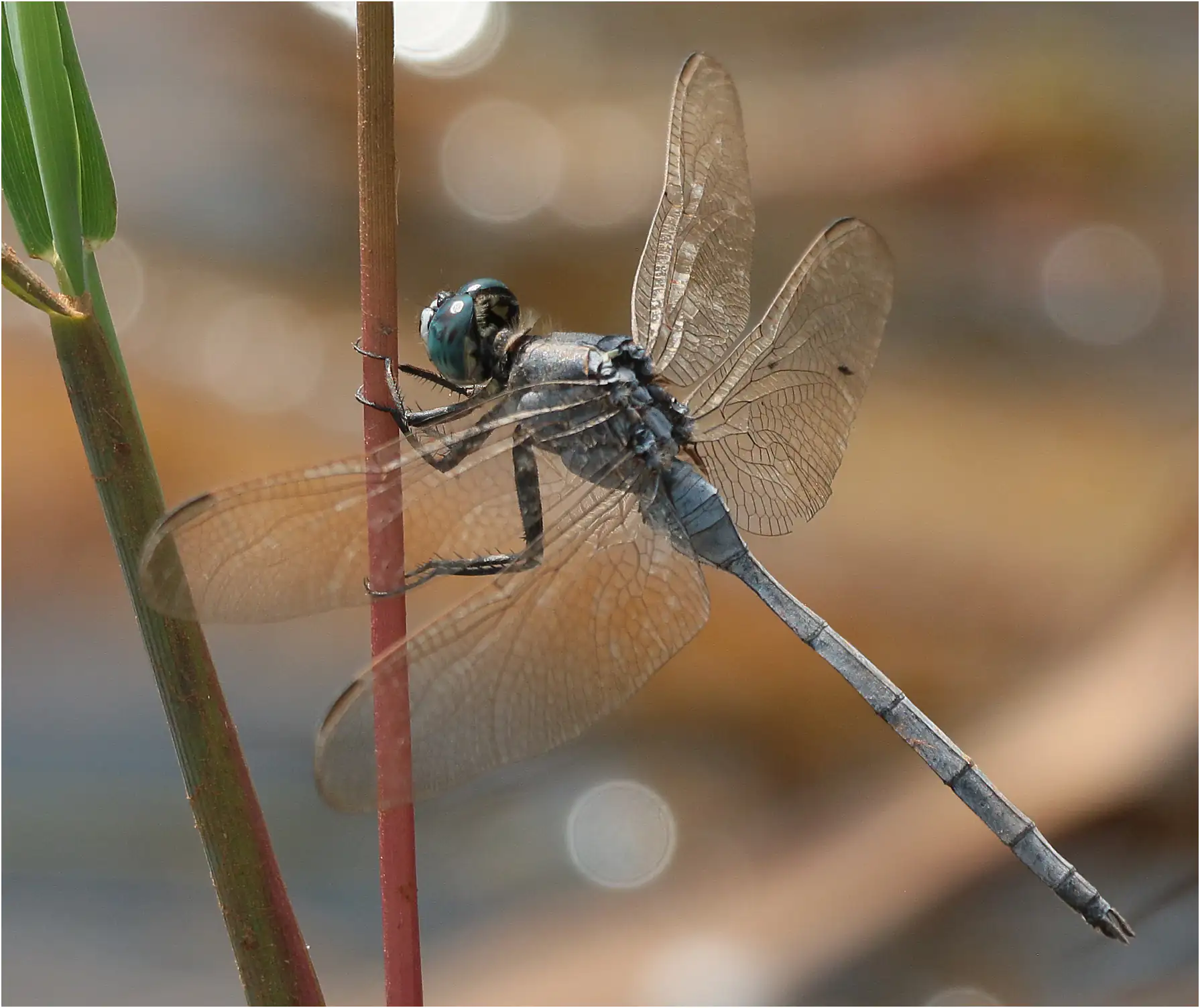
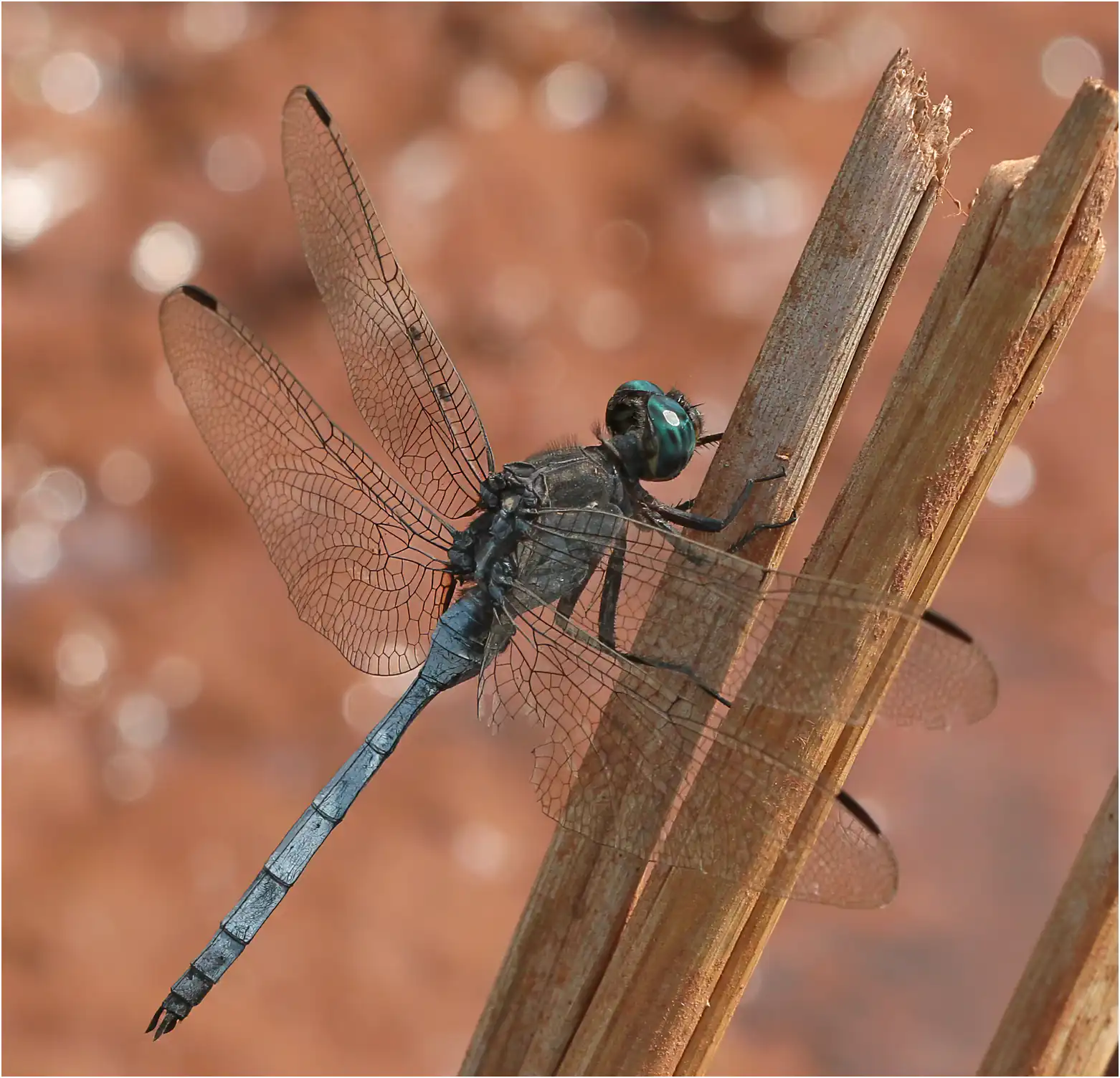
All the specimens on this page were photographed at the same site, and several of them show the presence of parasitic flies, possibly of the genus Forcipomyia (Ceratopogonidae). These insects pierce the cuticle of the wing veins in order to feed on haemolymph.
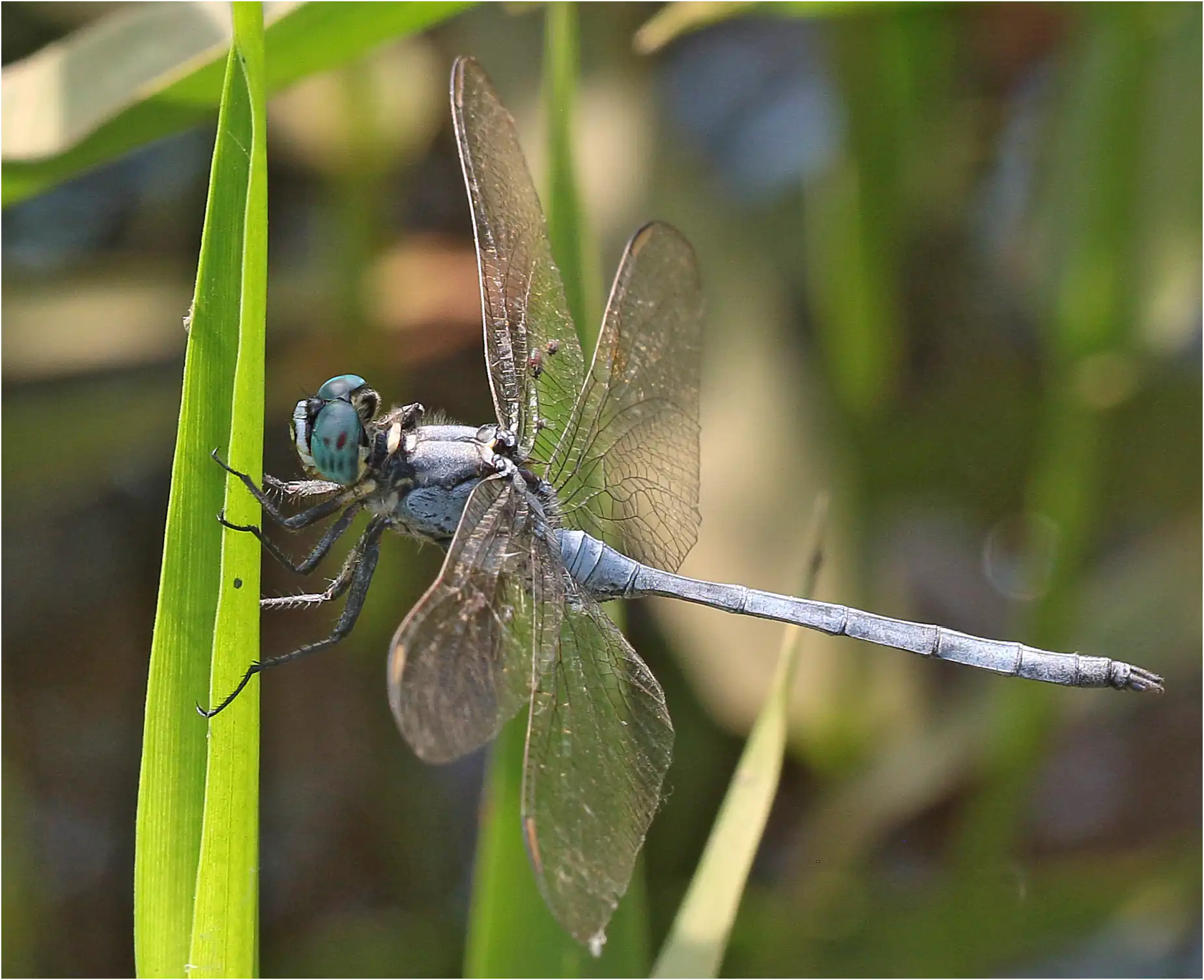
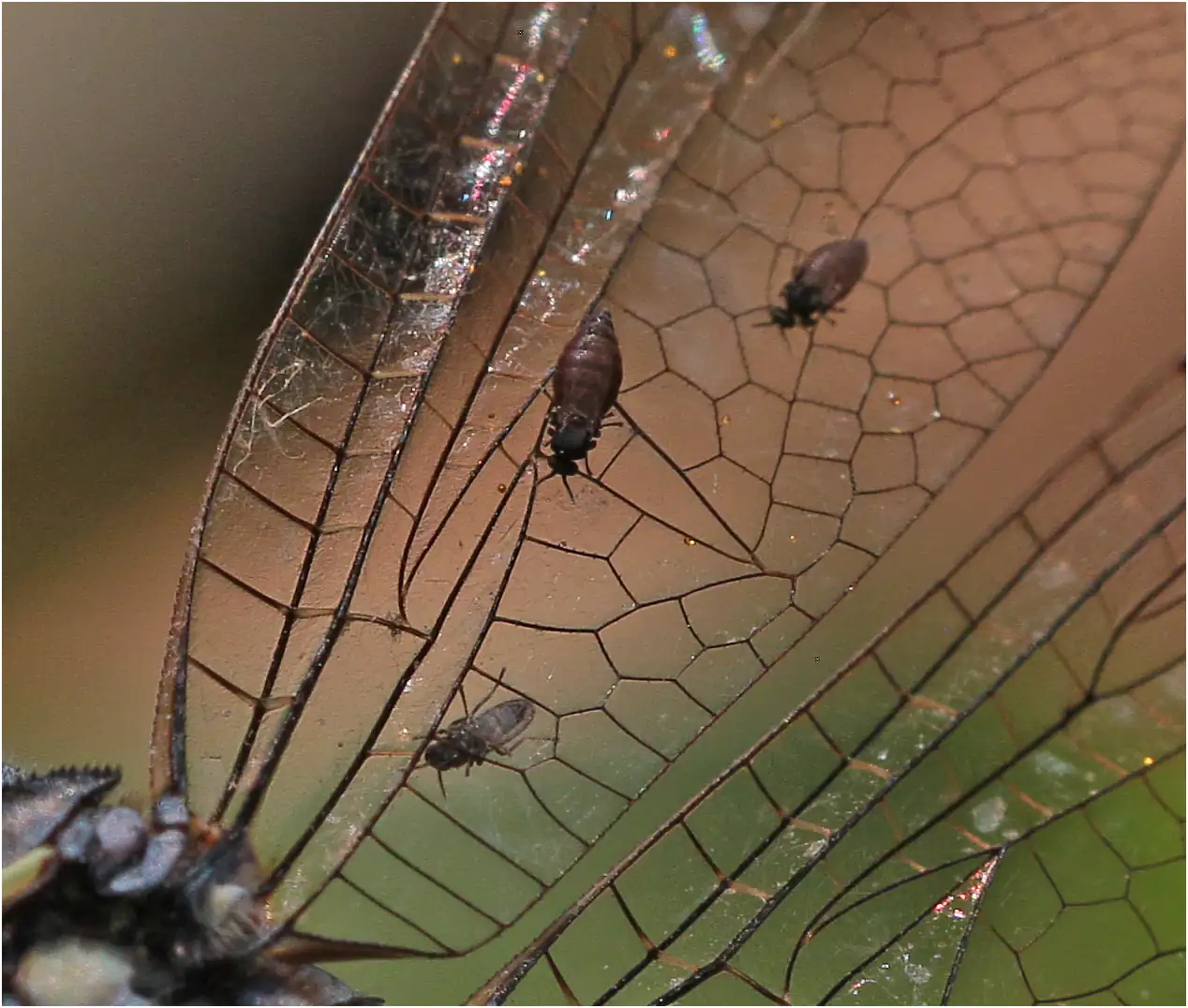
Tarboton W. & M. (2015) indicate that it measures between 39 and 45 mm.
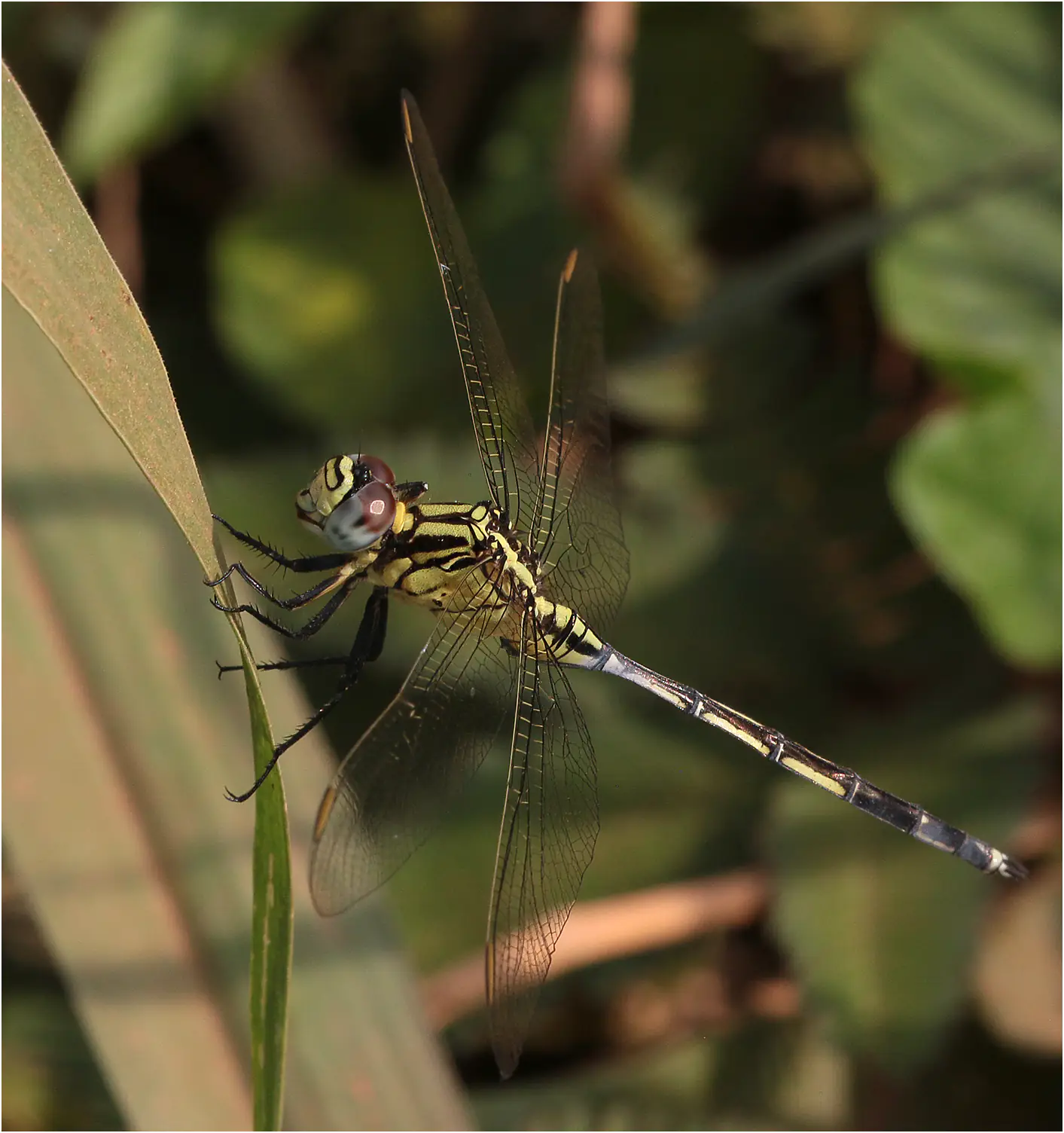
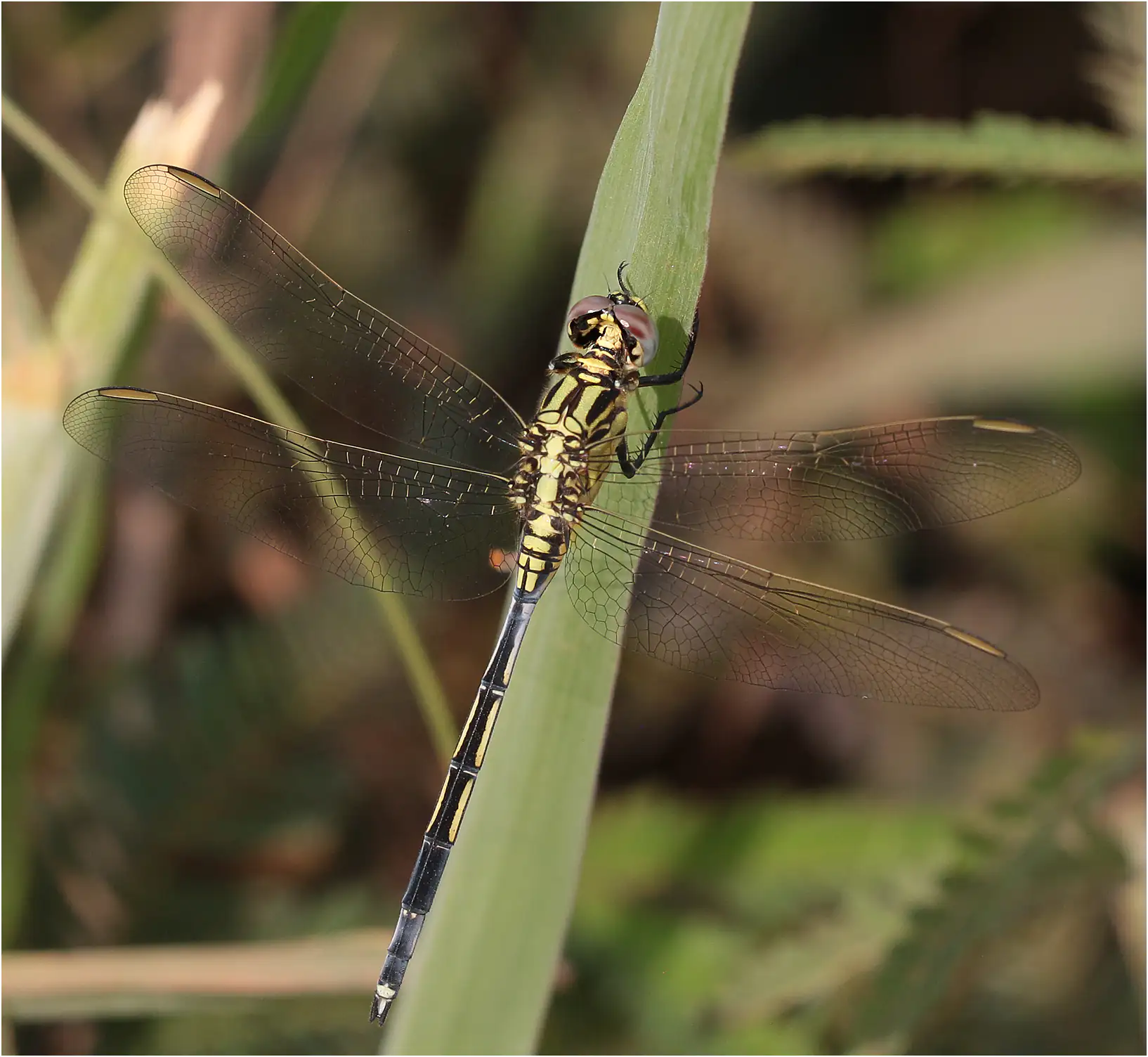
Immature males are spectacularly different, but they bear the same pattern on the face.
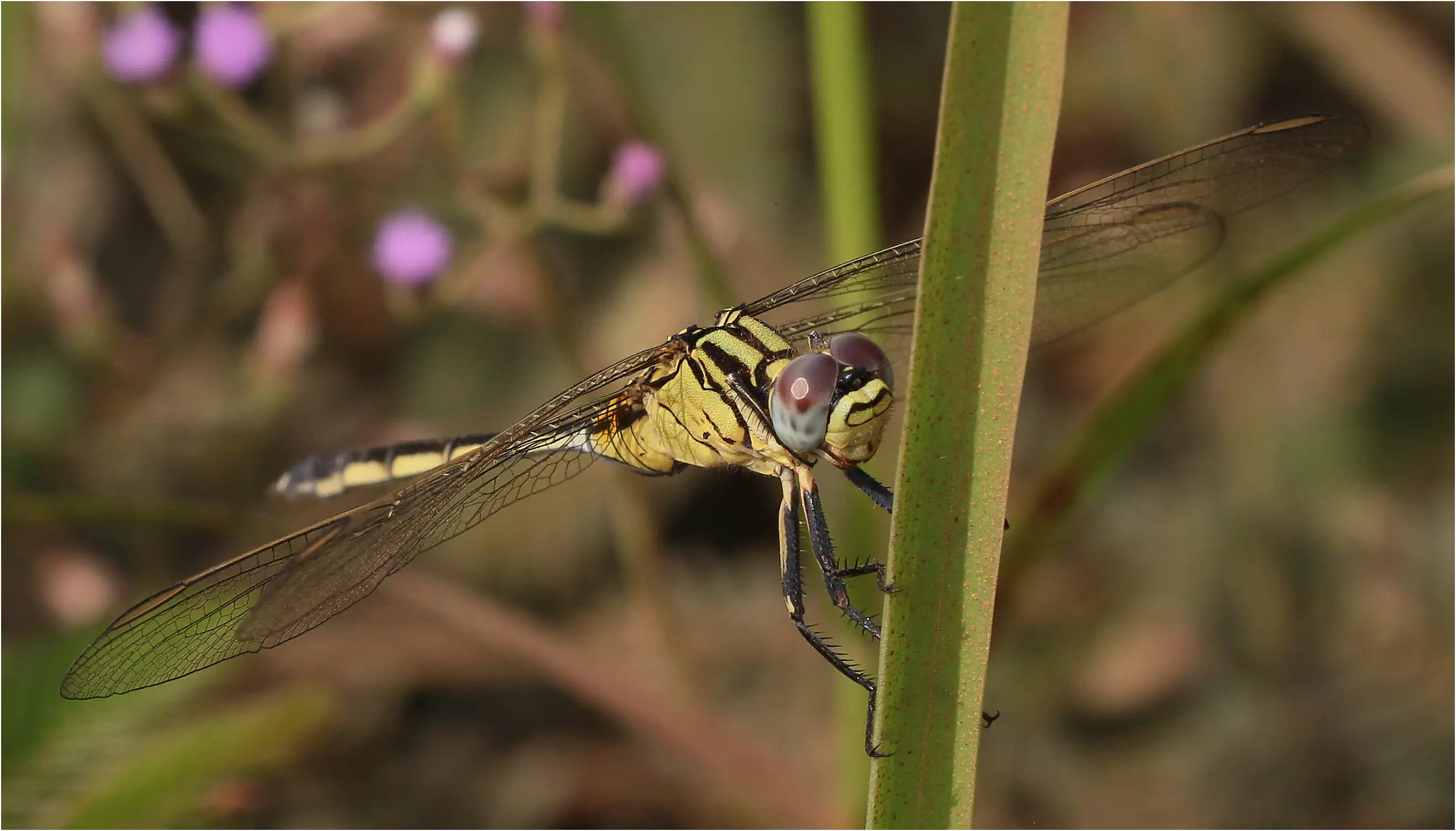
Immature males and females bear a black stripe, characteristic of the species, on the dorsal abdominal carina.
We observed them near a shallow river where overflowing areas had formed small marshy patches and a few ponds, sometimes adorned with water lilies. ADDO (2023) notes: "Standing and probably often temporary waters in open landscapes. Generally with aquatic and emergent vegetation."
It is found in almost all of subtropical Africa except the south, where it only reaches northern Namibia and northeastern South Africa; it is absent from Botswana. It is also found in Madagascar, from where the holotype described by Ris originates.
IUCN Red List.
Etymology of Orthetrum icteromelas
Orthetrum (see Endersby & Fliedner, 2015) comes from two Greek words, "orthos", meaning "straight", and "etron", for "abdomen", to indicate that the sides of the abdomen are parallel. This (neuter) genus name created by Newman in 1833 lost its relevance with the discovery of new species (whose abdominal sides are not parallel), but the genus name remained.
Icteromelas from "ikteros" for "jaundice" and "melas" for "dark" or "black". The holotype is indeed a subjuvenile, yellow and black.
Dijkstra, K.-D.B. (editor, 2023). African Dragonflies and Damselflies (ADDO).
Endersby Ian & Fliedner Heinrich (2015). The Naming of Australia’s Dragonflies. Busybird publishing.
Ris, F. (1909). Libellulinen. Vol. 1, fasc. 10, p. 197.
Warwick et Michèle Tarboton (2015). A Guide to the Dragonflies & Damselflies of South Africa. Struik Nature.