
Selys first described Podolestes orientalis (1) as a subgenus of his Legion Podagrion, before noting that the term Podagrion was preoccupied by a Hymenopteran (2).
In any case, it is a magnificent Argiolestidae that perches, as is the rule for this family, with its hindwings fully open and its forewings slightly less so. The blue markings contrast with the chocolate (or dark metallic green, though there is little light in its environment) colouration of its thorax and abdomen.


However, both the thoracic and abdominal markings are variable in size and colour intensity.
Its hindwing measures 26 to 28 mm, and the entire insect measures 42 to 46 mm. Note the tuft of setae that can be discerned under the 10th segment.

There are 9 Podolestes, including 6 in Borneo, and only four in the area we surveyed. This one is the most common and adapts to many habitats. We only encountered P. harrissoni in a forested peat swamp, without coloured spots and pruinose.
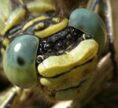
However, in this region, one also encounters P. chrysopus, which is much rarer and very close to P. orientalis, but its labrum (upper lip) is dark, whereas that of our species is yellow (clearly visible in the photos showing the face, even in profile). Finally, a last species was described in 2019 and is said to be present only in the Maludam National Park region, P. parvus.

It is found in forests, on peat bogs, small ponds, and marshy streams, always in shaded areas. It generally perches quite low, flies little, and can thus easily go unnoticed. It seems that if disturbed, it remains faithful to its perch, like many Libellulidae.
The larvae, which have long legs like the imagos, are rarely found and hide in the leaf litter of these very shallow bodies of water. Their caudal lamellae are very broad (4).


Accepting diverse habitats, it is the most widespread of the genus, and its distribution extends across the Malay Peninsula, Sumatra, and Borneo. I had already been fortunate enough to encounter it in central Malaysia in 2013.
IUCN Red List
In Malaysia, I had not encountered any females; this gap has now been filled. They closely resemble the males, but their abdomen and especially their ovipositor are massive.


Etymology of Podolestes orientalis
Podolestes, from the Greek pous–podos meaning foot or leg, and lestes. Lestes was created by Leach (1815) and comes from the Greek word ληστησ, meaning 'robber' or 'pirate', most likely due to the shape of the anal appendages evoking the curved, serrated cutlass of pirates (5). Selys writes, "Legs long, with long cilia, and simple tarsal claws". Selys is therefore almost certainly referring to the peculiar "feet" of this genus, whether regarding their length, their specific tarsal claws mentioned in italics, or both.
Orientalis is a Latin adjective meaning 'oriental' or 'eastern'. In his publication on the "Podagrion", Selys first describes many New World species, followed by African ones, then Oceanian species, and finally genres 8 and 9, Podolestes and Amphilestes, native to Eastern Asia (it should be remembered that Selys erected this genus for this species, the only one known at the time, from a single female).
In English, it's called the Blue-sided Flatwing.
1- Selys, 1862 - Synopsis des Agrionines : 3° Légion : Podagrion. P. 42
2- Selys, 1886 - Révision du synopsis des Agrionines - P. 89
3- Robin Ngiam & Marcus Ng - A photographic guide to the Dragonflies and Damselflies of Singapore - John Beaufoy Publishing – 2022
4- Chee Yen Choong & Albert George Orr, 2010 - The larva of Podolestes orientalis from West Malaysia, with notes on its habitat and biology (Odonata: Megapodagrionidae) - International Journal of Odonatology 13(1)
5- Matti Hämäläinen & Heinrich Fliedner, Notulae odonatologicae 10(1) 2023:8-16 - Why did William Elford Leach call a small damselfly a « pirate » ? – Revisiting the etymology of the genus Lestes (Odonata: Lestidae)