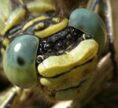

We only had two very brief encounters with Teinobasis ruficollis, a very secretive Coenagrionidae, on the first morning of our stay while we were exploring a landscaped garden in the city of Kuching. As can be seen from the presence of a water droplet on the second subject, the weather quickly deteriorated.
It was described by Selys under the genus name Telebasis, a genus now confined to the Neotropics (American tropical regions).
The color distribution on its thorax and the lower part of its green eyes make it difficult to confuse with any other zygopteran.

Size, biotope and geographical ditribution
Selys tells us that its abdomen reaches 34 mm, which gives it a total length of 40 mm. Robin Ngiam & Marcus Ng (2) give it a total size of 36 to 38 mm.
We encountered it in a swampy undergrowth, in a very dark area, all the more so as a tropical downpour was brewing. In this environment, it is very difficult to spot and we lost it very quickly at each encounter.
Its confirmed geographical distribution is limited to Borneo, the Malay Peninsula, and Singapore. Some old data mention other locations where it has presumably disappeared.
IUCN Red List.
Etymology of Teinobasis ruficollis
Teinobasis (3); Selys had described this species as belonging to Telebasis, which is an exclusively American genus. Kirby, when he created this new genus in 1890, replaced the Greek word tele, meaning "at a distance", with teino, meaning "to extend", to emphasise the fact that the wing is very petiolate and that this narrowing extends, in Selys's own words, "up to the origin of the quadrilateral after the postcostal vein."
Ruficollis, from the Latin rufus, meaning "red", and collum, meaning "neck", certainly to highlight the very visible red pronotum of this insect.
1- Selys-Longchamps, E. de 1877 – Synopsis des Agrionines, 5ème légion : Agrion (suite et fin). Les genres Telebasis, Argiocnemis et Hemiphlebia. Bulletin de la Classe des Sciences, Académie Royale de Belgique 43: 97-159. P. 119.
2- Robin Ngiam & Marcus Ng - A photographic guide to the Dragonflies and Damselflies of Singapore - John Beaufoy Publishing – 2022
3- The Naming of Australia’s Dragonflies, Ian Endersby & Heinrich Fliedner, Busybird publishing.