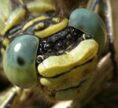

I was very surprised that this small libellulid, Brachygonia puella, belongs to the same genus where we much more frequently observed B. oculata; indeed, while it retains the large eyes and short, stocky thorax typical of the genus, the abdomen is totally different, much thinner and slightly arched. It is much closer to Chalybeothemis fluviatilis, which we observed at the same site, than to its cousin, which is truly surprising.
It was only while writing these pages and reading Lieftinck (1) that I realised he made the exact same observation: "Abdomen comparatively long and extremely slender, quite different in shape from the two other known species." These other two species are B. oculata and B. ophelia.


There is therefore little risk of confusion with other species, apart from the one mentioned; the other Brachygonia are very different and much more colourful (we did not encounter B. ophelia, which is as uncommon as B. puella).
Its abdomen measures only 14 to 15 mm and overall, it barely exceeds 22 mm in total length.

We only encountered it on the black, peaty waters of Maludam National Park; after three hours by boat, our progress up the river was halted by the flooded forest, and we got out to explore the undergrowth. A few minutes after these photos, my camera equipment and I would briefly go underwater, which brought my photography for the day to an end...

Brachygonia puella could be endemic to Borneo (Kalimantan and Sarawak), as a historical population on Belitung Island may have become extinct.
IUCN Red List.
In any case, it is very rare, with only about fifteen photos on iNaturalist.

Étymologie de Brachygonia puella
Brachygonia (Kirby, 1889), from the Greek brachy, for "short", and from Ancient Greek gonia for "generation" (from which we get gonad), certainly in reference to the secondary genitalia being not very prominent beneath the second segment. Kirby writes: "appendages of the second segment distinct, not very prominent."
Puella, from the Latin puella, meaning "girl", "young woman", or "damsel", was the second name given to an odonate in the new Linnaean nomenclature for Coenagrion puella. Lieftinck does not give an explanation for this choice, but one can assume he found the species delicate, particularly due to the slenderness of the abdomen that he emphasises.
1- Lieftinck, 1937 - Descriptions and records of South–east Asiatic Odonata. Treubia 16: 55–119. P. 105.