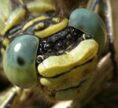

Identification of Chalybeothemis fluviatilis
It was only in 2006 that Chalybeothemis fluviatilis (1) was discovered in Sarawak, and in 2007 (though already known from Brunei and Kalimantan) it found two other companions (2) to populate its hitherto monotypic genus. It is a small libellulid with green eyes, measuring 29 to 30 mm in total length (3), whose thorax displays dark vertical traces and a slight whitish pruinosity; it immediately made me think of the American genus Oligoclada (here Oligoclada laetitia in Brazil).


In Borneo and Sarawak, it can only be confused with C. pruinosa (rare), which is heavily pruinose and has a yellow labrum (black here), dark brown pterostigmas (pale here), and anal appendages longer than S9 (shorter in C. fluviatilis). Many other differences, particularly regarding venation and secondary genitalia, are listed in the previously cited document (2).

Habitat and geographical distribution
We encountered it on a river in Maludam National Park, sometimes a simple canal between Pandanus where it was abundant in certain areas; unfortunately, I have few decent photos, as taking pictures from a moving dugout canoe is very difficult and frustrating. The specimens previously collected in Sarawak in 2007 were found in "a small blackwater lagoon in an open, apparently natural swamp, unusual in Sarawak, within extensive secondary swamp forest." While the water was indeed dark and peaty, we were rather on a river with fluctuating water levels driven by the tides of the South China Sea.


In Singapore (3), Chalybeothemis fluviatilis is found on both vegetated riverbanks, open ponds, and lakes, always close to the forest; it is considered difficult to approach.
It is found in Borneo (Brunei, Kalimantan, and Sarawak), Sumatra, Singapore, Peninsular Malaysia, southern Thailand, and extreme southern Cambodia.
IUCN Red List.

Etymology of Chalybeothemis fluviatilis
Chalybeothemis, from the Latin chalybeius (Gaffiot), meaning "of steel", and Themis. Themis is the Greek goddess of order and justice, whose name has been used numerous times to create libellulid names. The name of the goddess of order is particularly well suited to taxonomy, a science that aims to describe and organise families, genera, and species. It is likely that the metallic colour of the thorax and abdomen inspired Lieftinck.
Fluviatilis, from the Latin fluviatilis, meaning "fluvial", "of rivers", "of streams", undoubtedly in reference to the collection site of the holotype in Kalimantan. I must mention, however, that I have been unable to access Lieftinck's original description (1) and do not know which specific river it was.
In Singapore and elsewhere, English speakers call it the Green-Eyed Percher.
1- Lieftinck M.A., 1933 - A new genus and species of Libellulinae from western Borneo (Odonata). Sarawak Museum journal 4: 131-137, pis 13-15.
2- Dow, Choong & Orr, 2007 - Two new species of Chalybeothemis from Malaysia, with a redefinition of the genus (Odonata: Libellulidae) - International Journal of Odonatology 10 (2) 2007: 171-184
3- Robin Ngiam & Marcus Ng - A photographic guide to the Dragonflies and Damselflies of Singapore - John Beaufoy Publishing – 2022