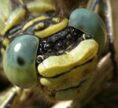

A member of our team found this dead female, Heliaeschna crassa or Heliaeschna idae, on the ground outside our hotel in the city of Kuching. The males of these two species are not easy to separate and their anal appendages are very similar, as shown by Tang & al. 2010. But females cannot be separated, assuming they really are two different species...
Among the eleven Heliaeschna described worldwide (Africa and Asia), five are present in Sarawak, and three in the Kuching region, but female H. simplicia does not appear to feature these amber bands and patches on the wings.

Belonging to the genus Heliaeschna was confirmed by the presence of four teeth or spines on the ventral dentigerous plate of the tenth segment, as seen below, which separate the genus from Gynacantha (2 spines) where some of them were initially classified (Heliaeschna idae, for example). These spines perhaps play a role during oviposition to grip the substrate, often rotting wood.
Heliaeschna species are essentially crepuscular and inhabit forest swamps. They are large in size; the female H. idae described by Brauer (1866) reaches 78 mm, while Tang & al. (2010) measure male H. crassa at 72–77 mm

Both species are present in Borneo, Sumatra, and the Malay Peninsula, but only H. crassa reportedly reaches Thailand.
IUCN Red list : Heliaeschna idae - Heliaeschna crassa.

Etymology of Heliaeschna crassa
Etymology of Heliaeschna idae
Heliaeschna (Selys, 1882)combines the Greek ἕλιξ, helix for "spiral", "coil" and the genus Aeshna, according to Fliedner (2020), who quotes Selys' text: "The 10th segment prolonged underneath into a forked, procumbent plate, with slender, long, acute, widely spaced branches."
Even though this interpretation may seem uncertain, it is certainly the best; helios, "the sun", can be ruled out for these species whose crepuscular tendency Selys might have inferred from their very large eyes, like our European Aeshnidae. Helos, which means marsh in Greek, is more appealing, but firstly, I doubt Selys knew the actual and precise habitat of the species he was describing, and secondly, the shift from helo to heli implies a euphonic gymnastics that is probably exaggerated.
Crassa, from the Latin crassus, means "thick", "heavy", "robust", "massive". Fliedner (2021) cites Krüger, who writes when comparing the species to H. simplicia: "Der ganze Körper ist massiger. Der Kopf ist größer, 10 mm breit (simplicia 9 mm nach den hiesigen Stücken)", meaning "The entire body is more massive. The head is larger, 10 mm wide (9 mm for simplicia according to the local specimens)."
Idae, Brauer (1866) specifies that the female he describes was captured by the famous Austrian explorer Ida Pfeiffer in Borneo.
- Brauer, 1866 - Reise der österreichischen Fregatte Novara um die Erde en den Jahren 1857, 1858, 1859. P. 908.
- Fliedner Heinrich, 2020 - The scientific names of Brauer's odonate taxa - Journal of the International Dragonfly Fund – 148
- Fliedner Heinrich, 2021 - The scientific names of Krüger’s odonate taxa with annotations about his contribution to neuropterological taxonomy - IDF Report - 167.
- Tang H. B., L. K. Wand and M. Hämäläinen, 2010 - A photographic guide to the dragonflies of Singapore. Raffles Museum of Biodiversity Research.
- Selys, 1882. Sur la distribution des Insectes Odonates en Afrique. Association française pour l’avancement des Sciences, Congrès d’Alger: Compte rendu de la 10ᵉ session, Alger 1881: 663669.