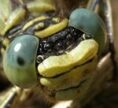
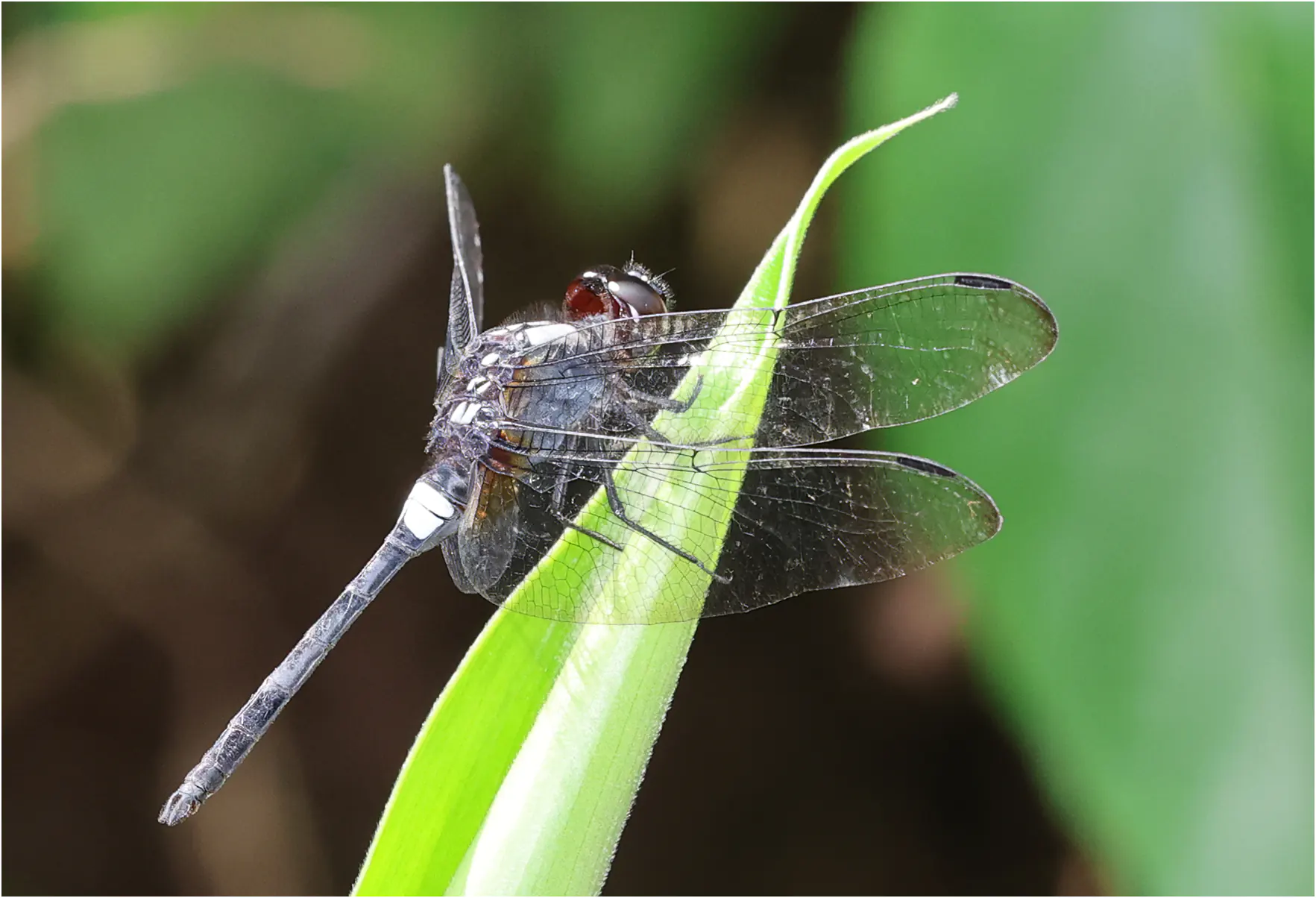
Hadrothemis camarensis, Libellulidae, was described by Kirby (1889) under the name Orthetrum camarense, and it was Karsch (1891) who placed it into his new genus Hadrothemis, which he created for the occasion.
It is worth noting that in the same publication, right after the redescription of Hadrothemis camarensis, Karsch created the new genus Archiclops for a new species, Archiclops infestus, which in turn would join Hadrothemis with Fraser (1951) under the name Hadrothemis infesta ! If there were any doubt, African taxonomy is highly volatile and very complex for closely related genera.
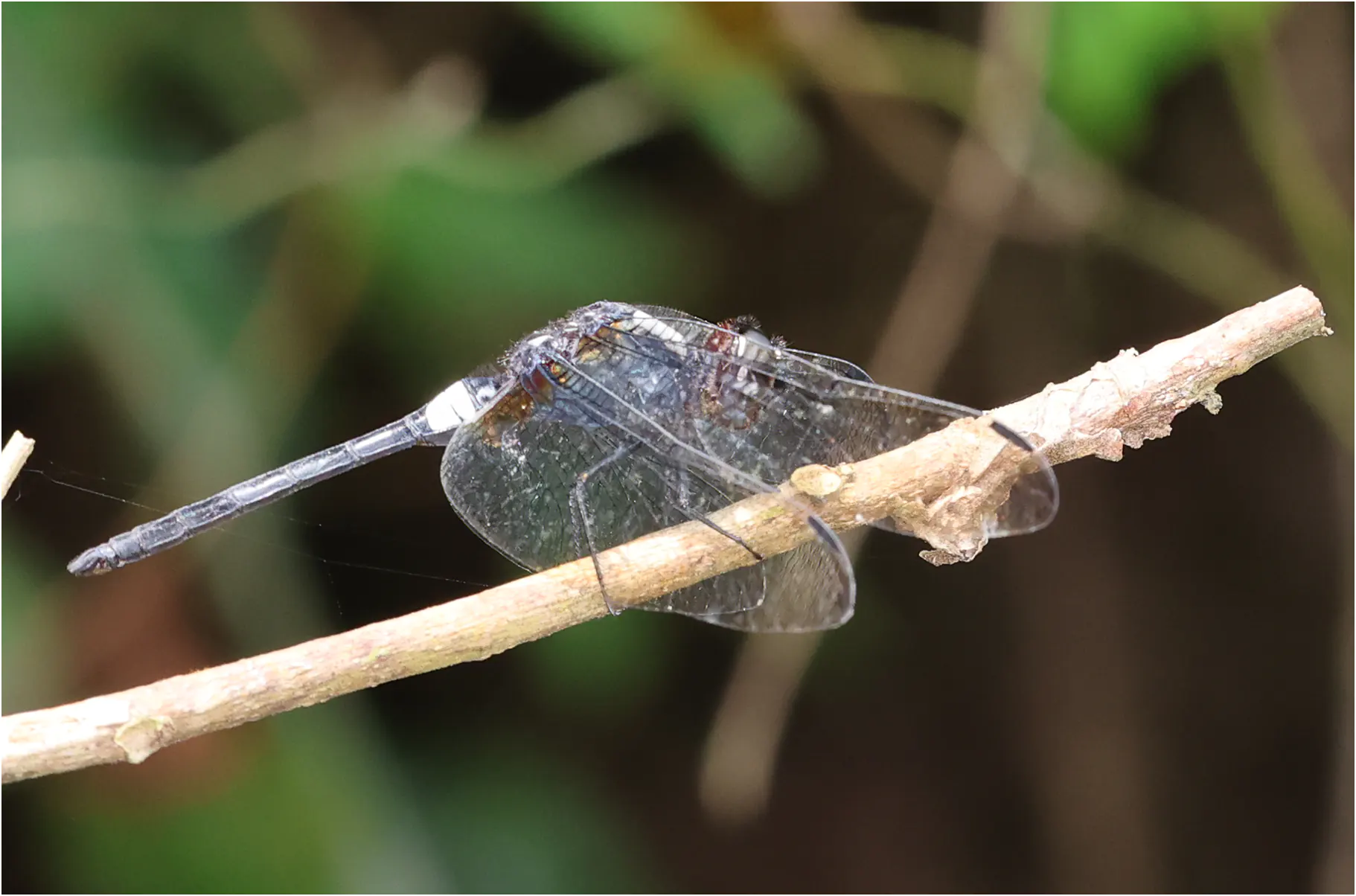
I unfortunately only have the two photos above of the single male we encountered along a logging skid trail, which does not allow for a clear view of the dorsal surface of its thorax, which features two broad white bands. Yet Kirby found it close to Orthetrum albistylum ("Allied to O. albistyla, Selys..."), noting that it is distinguished by its dark wings (slightly amber at the base and smoky at the apex) and black anal appendages. These details, combined with the abdominal pruinosity limited to its white "saddle," make it impossible to confuse with any other Libellulidae.
According to Kirby, the male measures 49 mm; according to Legrand (2003), 47 mm; and according to Karsch, 50 mm for the male and 51 mm for the female.
Hadrothemis camarensis is closely tied to the forest because the females, which are highly specialized, are the only ones known in Africa to oviposit in phytotelmata, particularly in tree holes (up to more than 22 meters high), along with possibly H. vrijdaghi and H. scabrifrons (Copeland, Okeka & Corbet, 1996).
For this reason, English speakers call it the Tree-hole Jungle-skimmer. Because of its white saddle, they also refer to it as the Saddle Jungleskimmer.
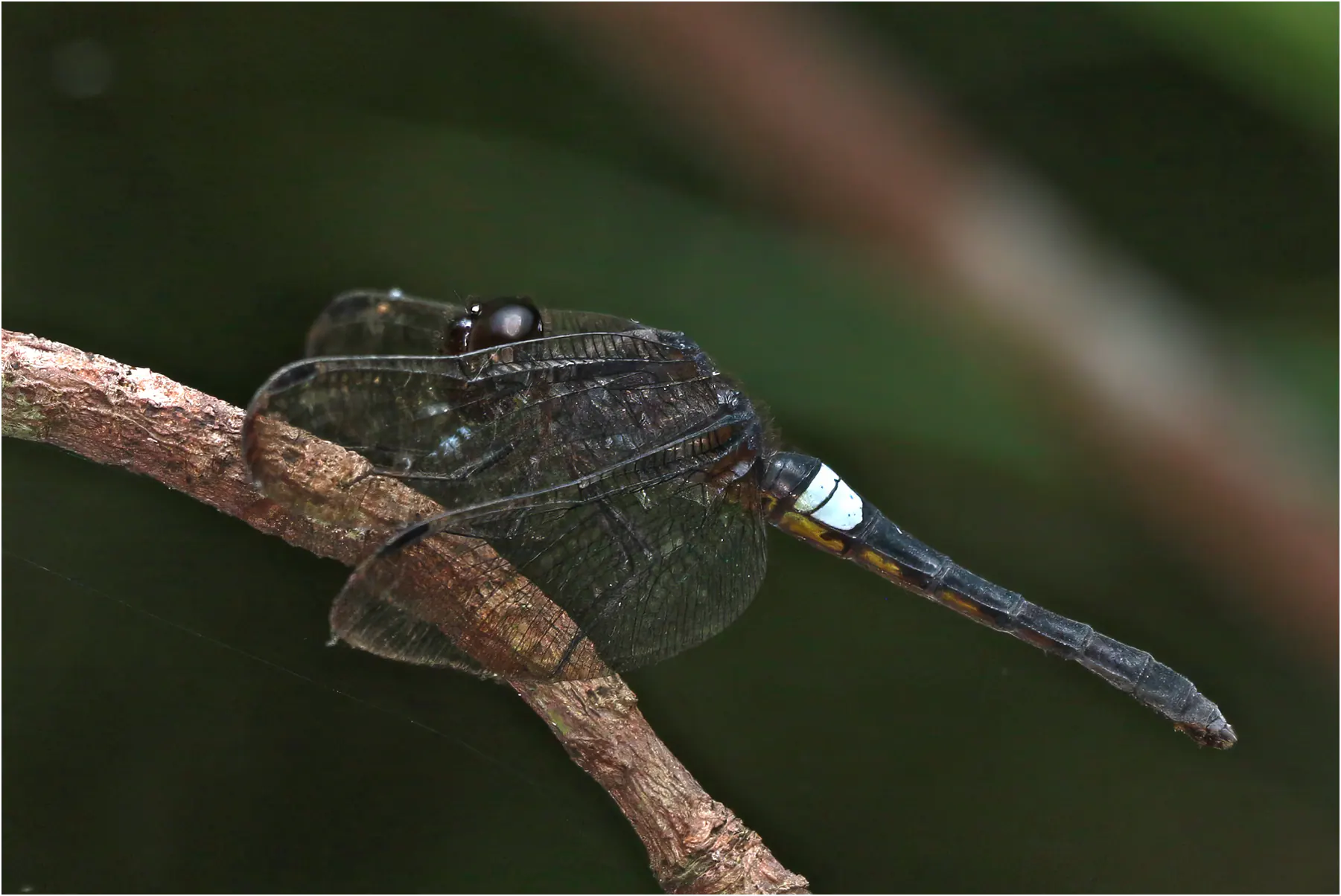
Its distribution extends from Guinea and the Ivory Coast to Kenya, and to the south, it reaches Angola.
IUCN Red List.
Etymology of Hadrothemis camarensis
Hadrothemis, from the Greek hadros, meaning strong, robust, well-developed, and Themis, the Greek goddess of order and justice, which has been used numerous times since Hagen (1861). The name of the goddess of order is particularly well suited to taxonomy, the science that aims to describe and order families, genera, and species. This suffix -themis has effectively become a signal of affinity to the Libellulidae. In describing the genus Hadrothemis, Karsch wrote: "Kurz, plump und dick" ("Short, heavy, and thick"), referring to its massive thorax.
Camarensis, meaning originating from Cameroon. Historically, the term Cameroon originates from the "River of Prawns", Rio dos Camarões in Portuguese, called Wouri by the indigenous people. Scientific names have retained the prefix camar-, to which the suffix -ensis is added to indicate origin. And naturally, Kirby mentions "Hab. Cameroons" [for habitat Cameroon].
Robert S. Copeland, Wilberforce Okeka & Philip S. Corbet, 1996. Treeholes as larval habitat of the dragonfly Hadrothemis camarensis (Odonata: Libellulidae) in Kakamega forest, Kenya, Aquatic Insects: International Journal of Freshwater Entomology, 18:3, 129-147
Fraser, 1951. Notes on Odonata in the Museum National d'Histoire Naturelle - Revue Française d’Entomologie (Tome 18, Fascicule 2, pp. 93-101).
Karsch, 1891. Übersicht der von Herrn Dr. Paul Preuss in Deutsch-Westafrika 1890 gesammelten Odonaten. Entomologische Nachrichten, (Vol. 17, Issue 5, 65–81), p. 77.
Kirby, 1889. Kirby, W. F. (1889). Descriptions of new genera and species of Odonata in the collection of the British Museum, chiefly from Africa. Proceedings of the Zoological Society of London, 1889, 297--303, p. 298.
Legrand, 2003. Les Odonates du Nimba et de sa région in LAMOTTE M. & ROY R. (eds), Le peuplement animal du mont Nimba (Guinée, Côte d’Ivoire, Liberia). Mémoires du Muséum national d’Histoire naturelle 190 : 231-310, p. 281.