Elattoneura villiersi belongs to the Platycnemididae family and is part of a genus found in Africa—comprising about thirty species—and in Asia; at least for now, as the species I encountered in Borneo, for example, almost certainly belong to another genus.
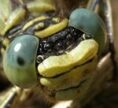
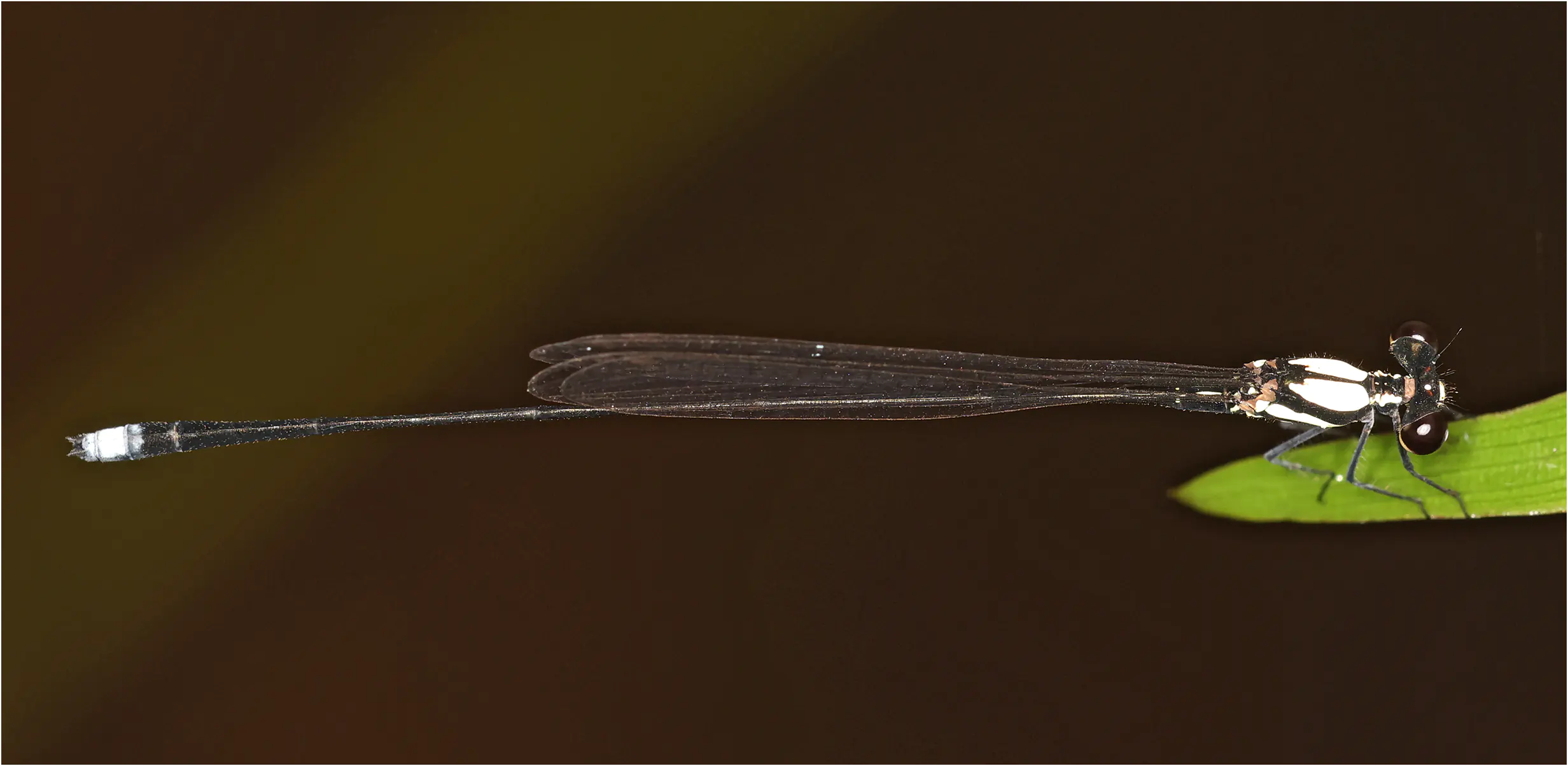
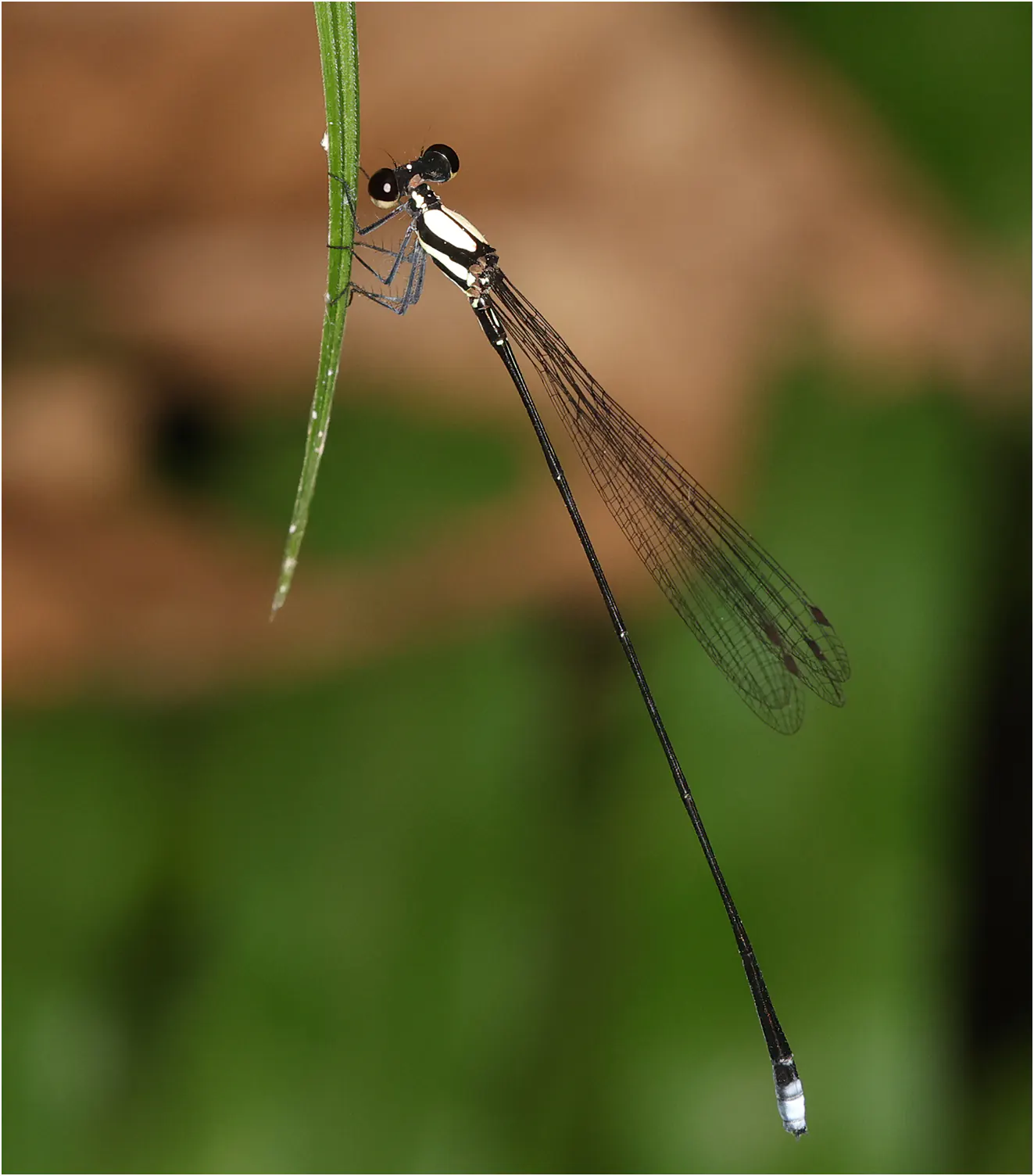
We photographed the four species known in Ghana, but Elattoneura villiersi displays unique and distinctive features that make its identification straightforward; the dorsal side of its thorax is white, bearing an ellipse shape on each side (its English name is White-shouldered Threadtail), and the last two segments as well as the end of the eighth are covered with white pruinescence.
It is nevertheless close to E. balli, which is also whitish on the back of the thorax, but without well-defined markings, appearing coated with pruinescence instead. Furthermore, the pruinescence on the terminal segments is strictly limited to S9 and S10, without extending onto the distal part of S8.
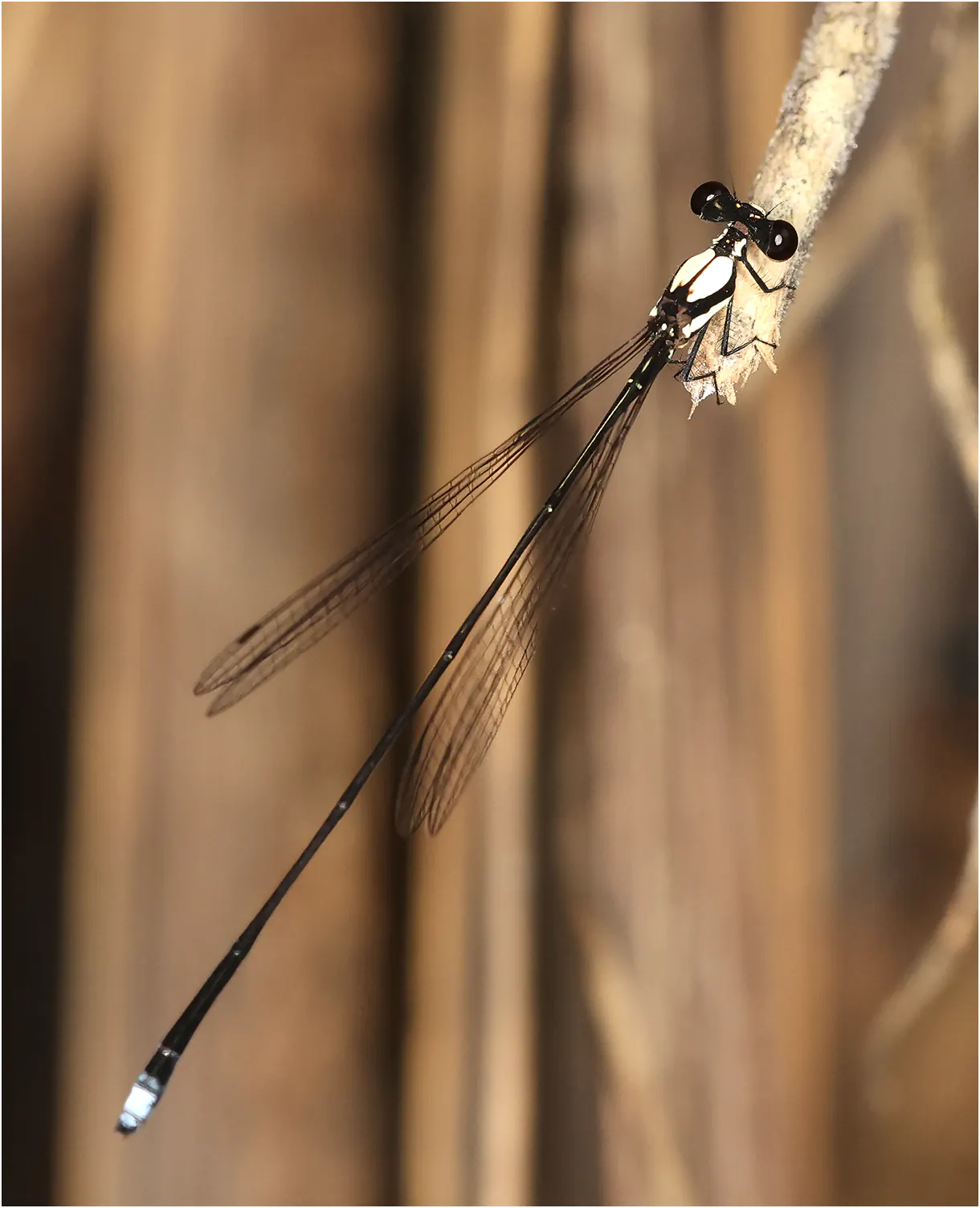
They belong to those damselflies that are sensitive to the flash's pre-flash, which we humans cannot detect. The first few times you photograph them, they tend to fly off, usually landing again right away. This sometimes results in series of blurry photos taken in mid-flight, and much more rarely, sharp ones.
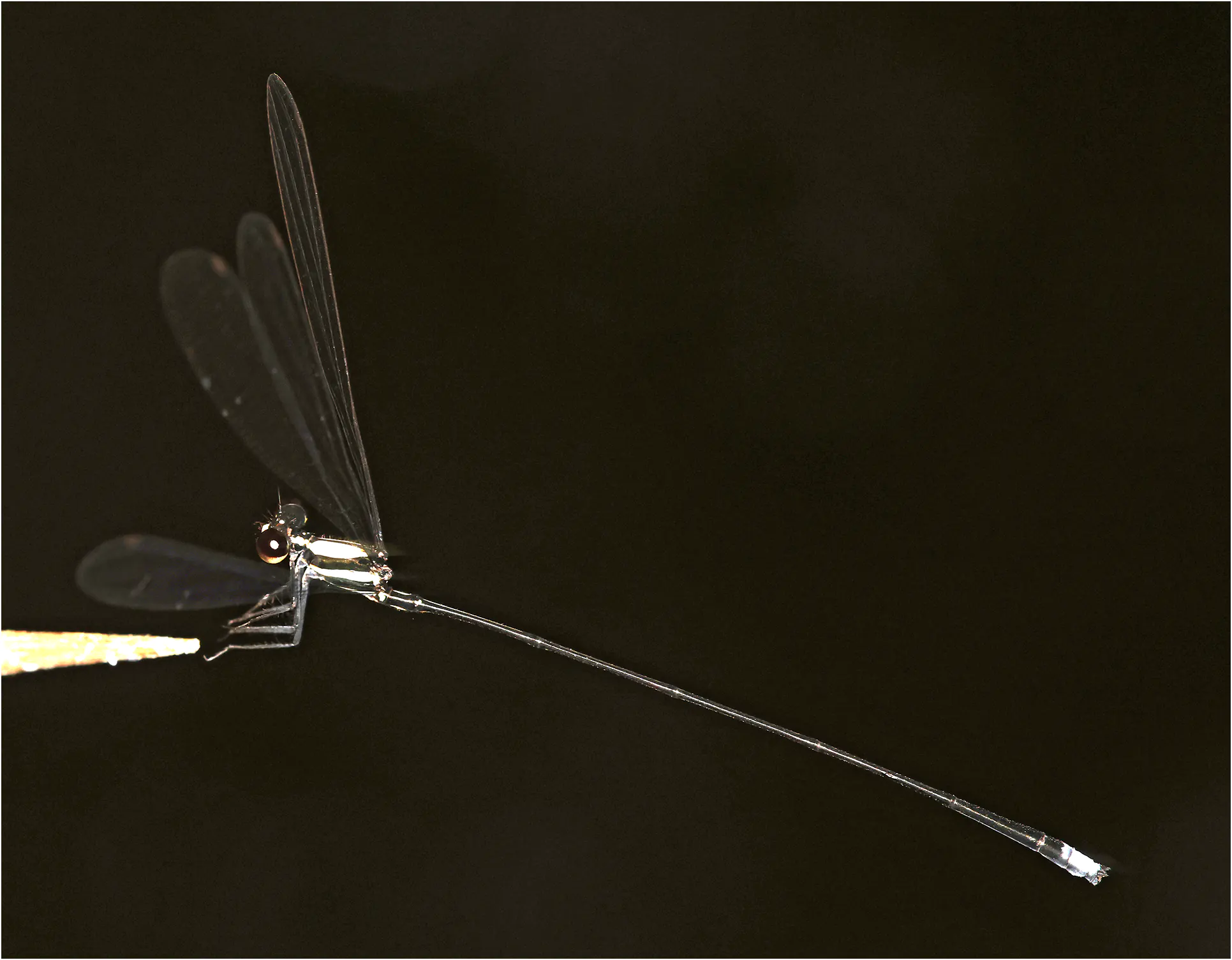
According to Fraser, its abdomen measures 33 mm, bringing its total length to 38 mm.
It lives on streams shaded by the forest, and we sometimes encountered it in really dark spots.

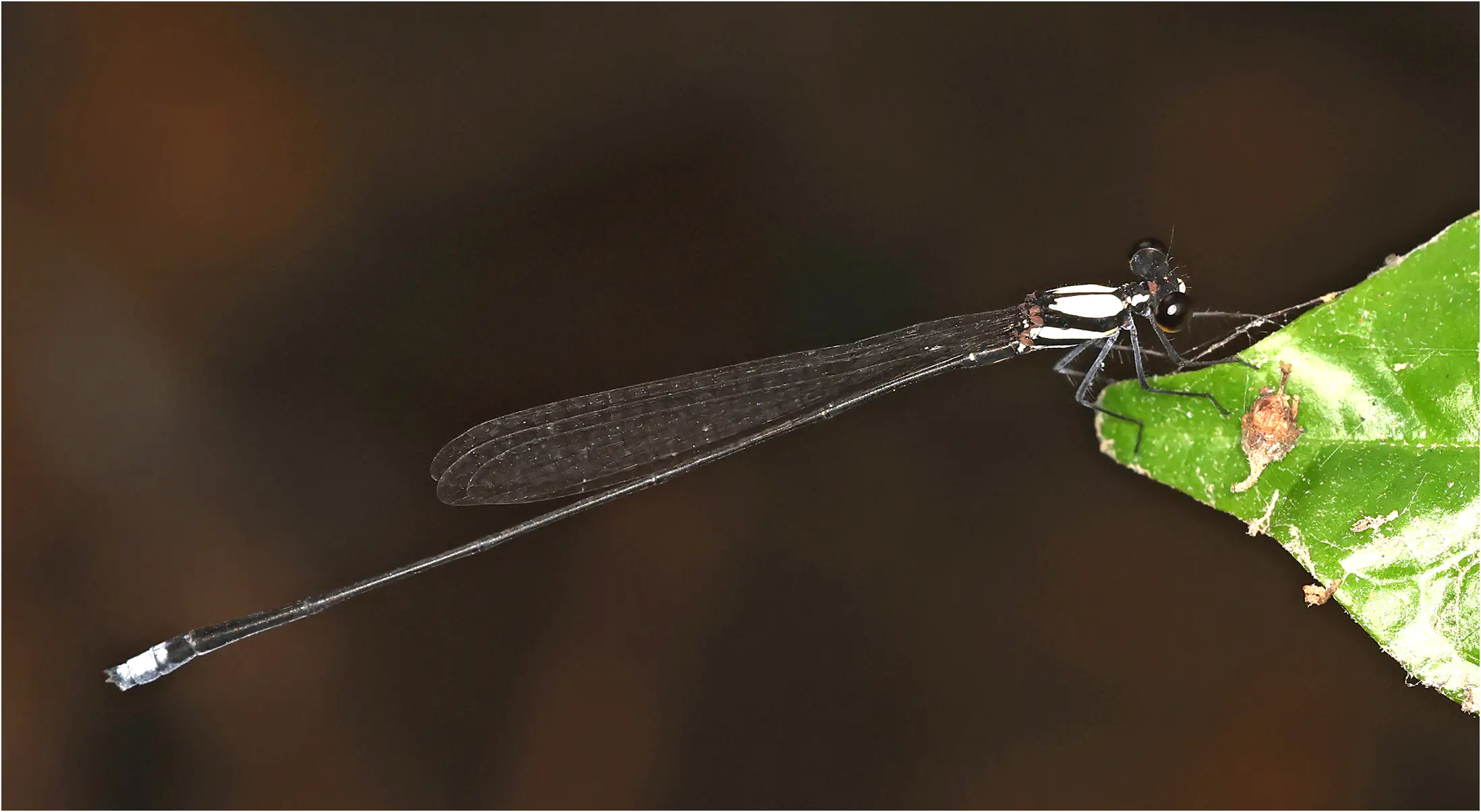
Elattoneura villiersi has a fairly restricted distribution: Liberia, Guinea, Ivory Coast, and Ghana.
IUCN Red List.
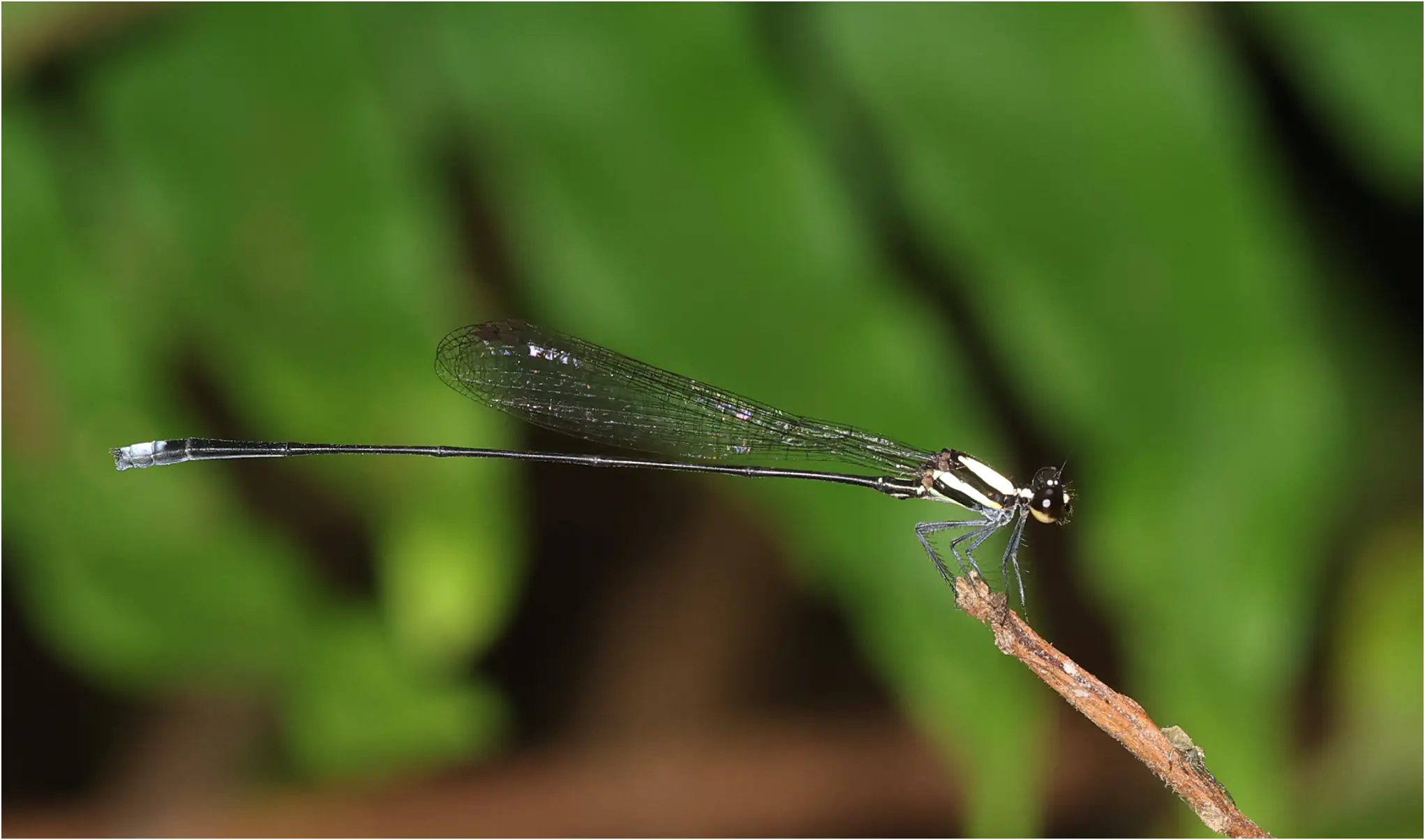
Etymology: Elattoneura villiersi
Fraser described the species in the genus Prodasineura, but Dijkstra et al. (2014) placed the African Prodasineura into Elattoneura. One should not be surprised by the title of Fraser's publication, as I was, since the species is of course absent from Ethiopia; in 1948, the term "Ethiopian region" referred to all of Sub-Saharan Africa, as well as part of the Arabian Peninsula and Madagascar. It is now called the Afrotropical realm.
Elattoneura comes from the Greek ellaton, meaning smaller, and neuron, which in entomology is translated as wing vein. This refers to the reduced length of a key vein used in damselfly systematics. See Suhling & Martens (2007).
Villiersi, quoting Fraser: "coll. A . Villiers, after whom this new species has been named in recognition of much valuable material placed at my disposal." André Villiers (1915–1983) was a renowned French entomologist, a specialist in Coleoptera and Hemiptera, and in 1948 was the head of the zoology department at IFAN (Institut français d'Afrique noire), based in Dakar, Senegal. He regularly sent the odonates he collected to Fraser, who paid tribute to him in this way.
Dijkstra, K.-D. B., Kalkman, V. J., Dow, R. A., Stokvis, F. R., & van Tol, J. (2014) – Redefining the damselfly families: a full-lineage molecular phylogeny of Zygoptera (Odonata). Systematic Entomology, 39(1), 68–96.
Fraser, 1948 - Three new species of Ethiopian Odonates - Proceedings of the Royal Entomological Society of London (Series B), Vol. 17, P. 5-10.
Suhling & Martens, 2007 – Dragonflies and Damselflies of Namibia, Gamsberg Macmillan.