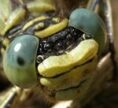
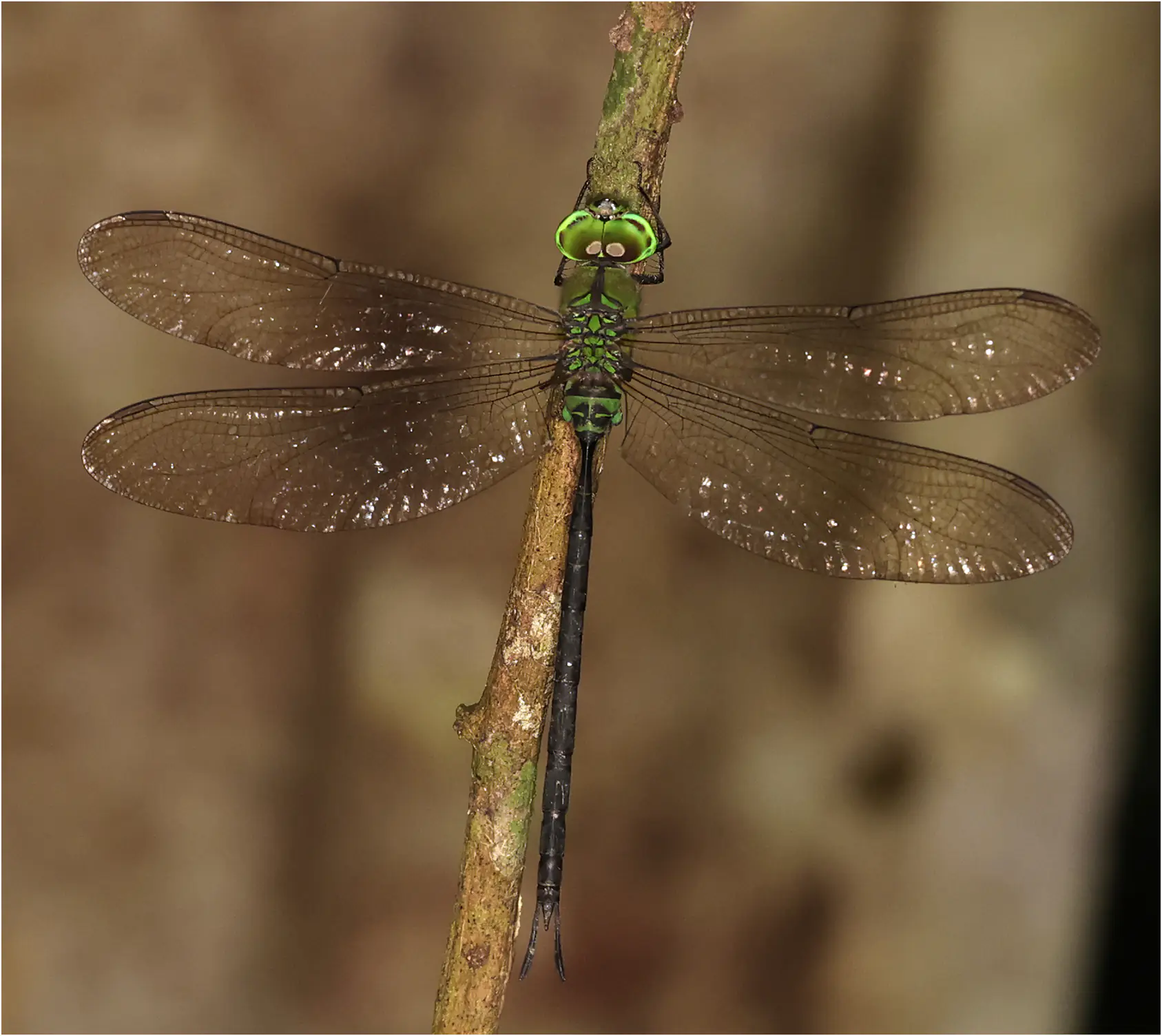
Gynacantha bullata, Aeshnidae, is part of a genus comprising more than 80 species worldwide (Africa, America, Asia, and Oceania), including 13 species in Africa and 7 in Ghana, but we will encounter only this species, on multiple occasions, and G. cylindrata.
Fortunately, it exhibits various characteristics that allow for its identification.
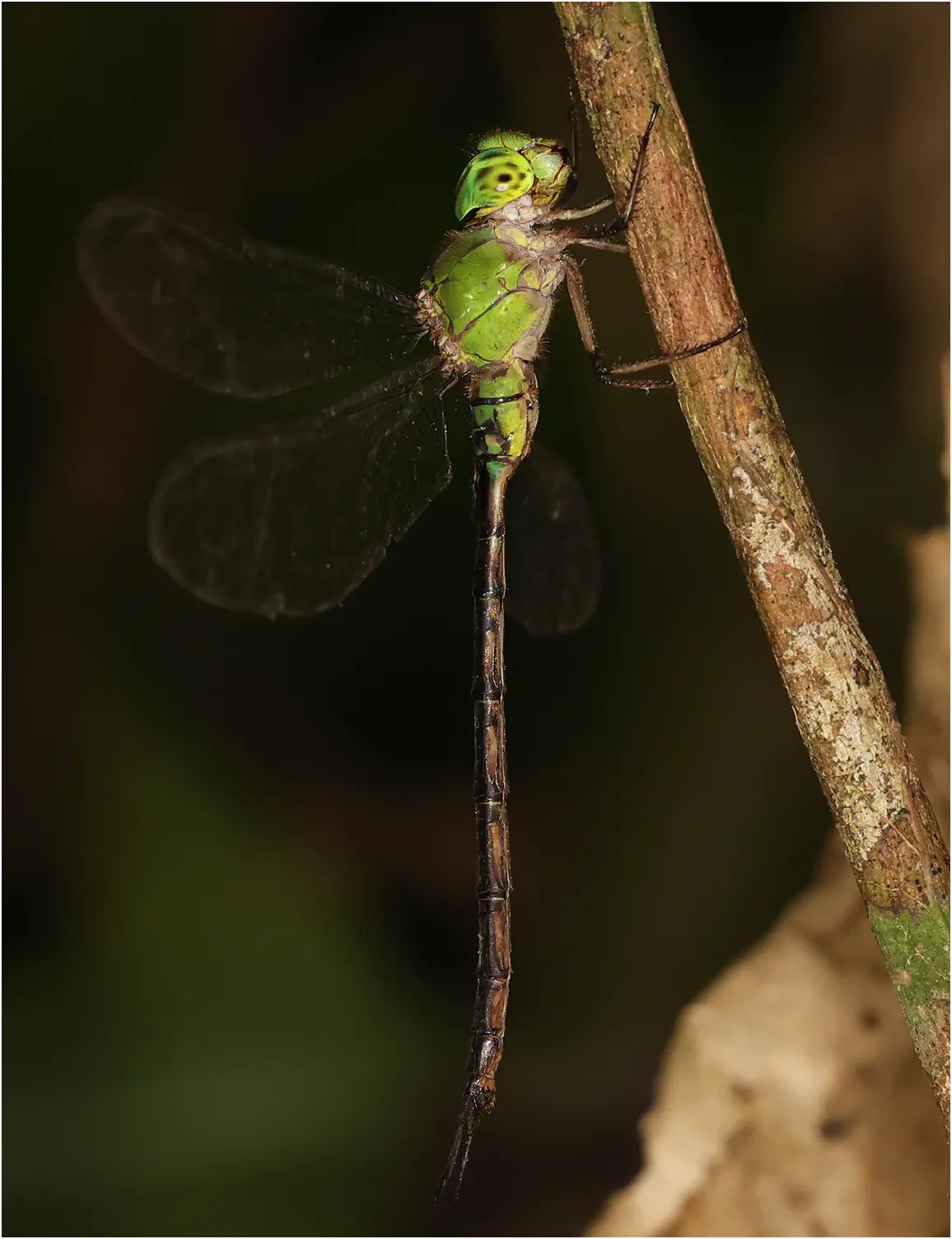

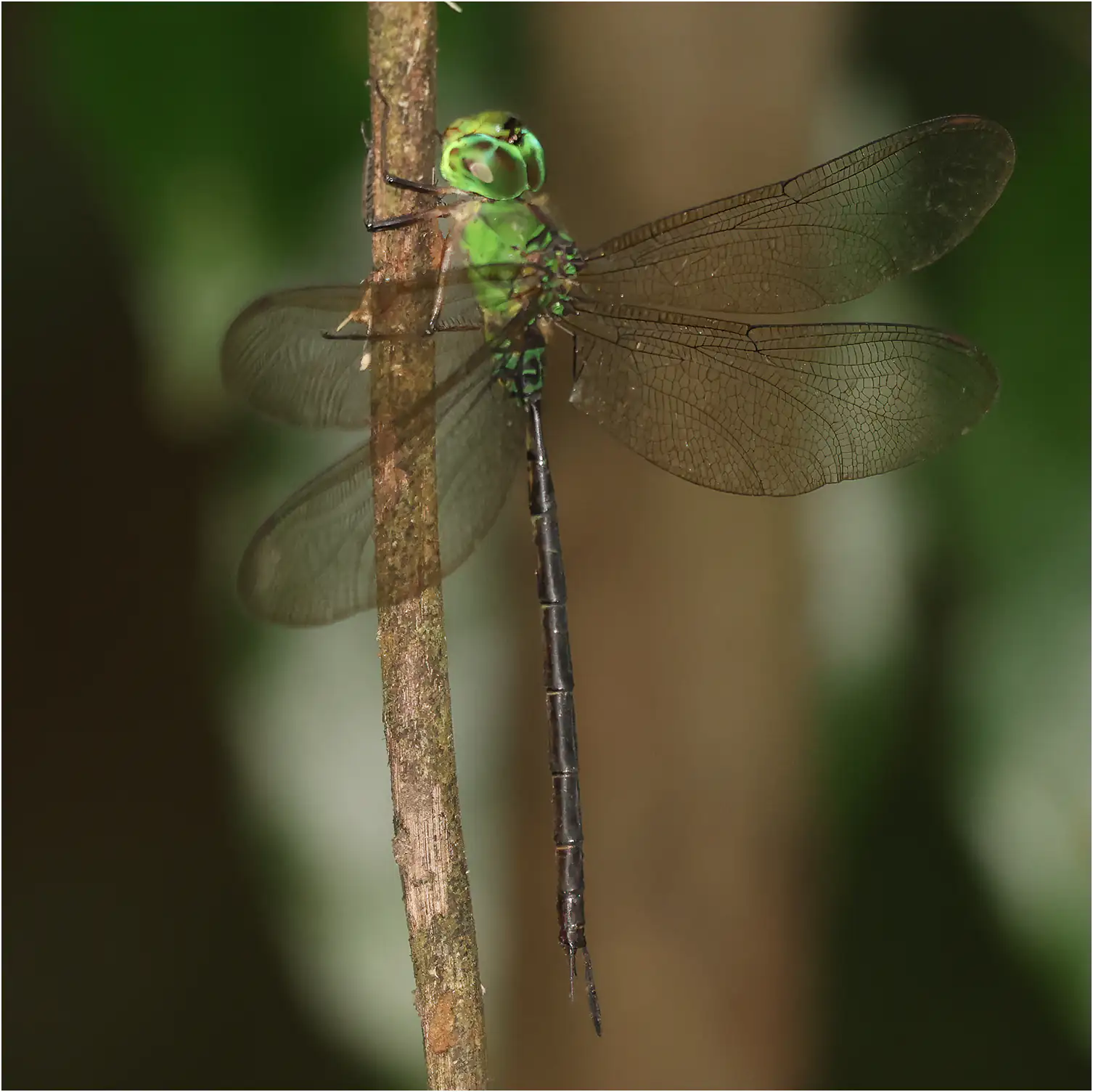
Besides the first two strongly dilated segments, certain details are particularly visible in a lateral view, such as the black "knees" on pale legs, which earns it its English name, Black-kneed Duskhawker.
Its green thorax features very discreet sutures, barely marked with black.
Note in the photo on the right above the presence of another individual partially hidden by the foliage! In the field, I only noticed them when they took off, which speaks volumes about their camouflage in these dark places.
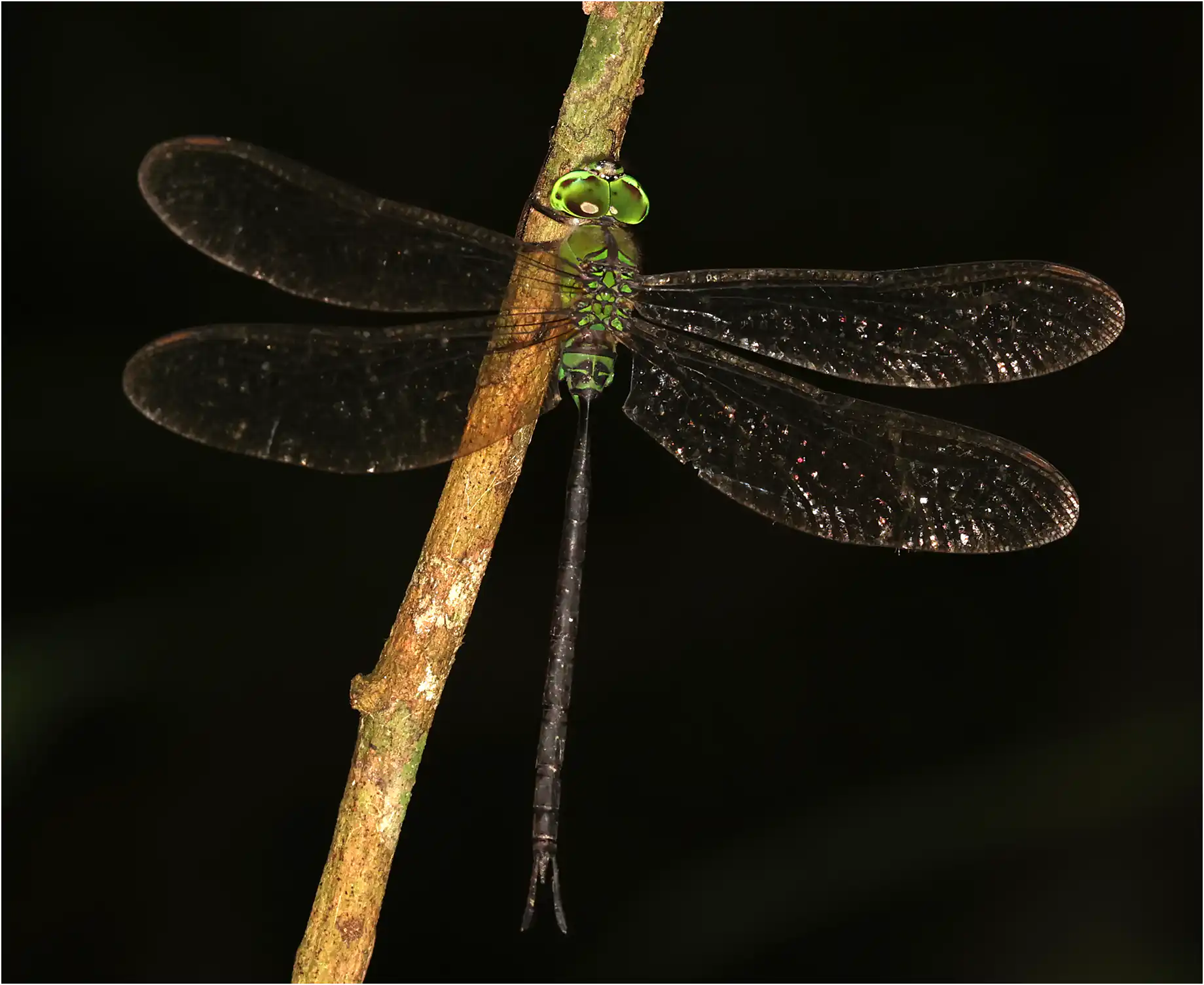
Finally, the cerci are very long (6 to 7 mm), 3 times as long as the epiproct, reaching the length of the last three abdominal segments (ADDO, 2023).
These are forest odonates, active at dawn and dusk, taking advantage of low-light conditions thanks to their huge eyes; they spend the day hidden in the forest, inactive, hanging vertically from a twig or leaf. We looked for them in the morning along forest paths. They are said to be content with temporary ponds.
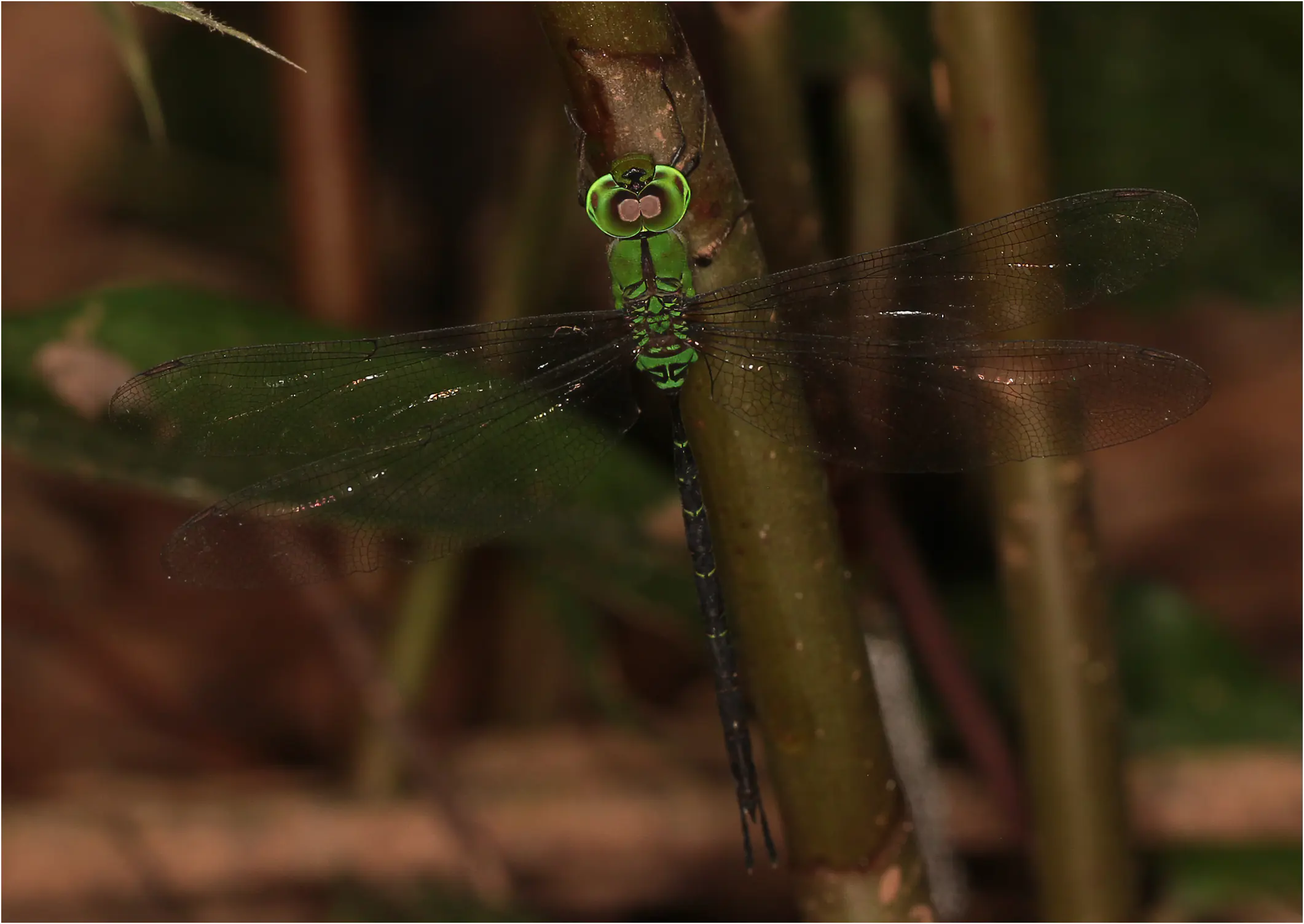
Karsch measures its abdomen, excluding the anal appendages, at 42 mm; it reaches a total length of over 63 mm.
Its distribution extends from Guinea and Sierra Leone to Uganda, Tanzania, and Malawi in the east (it is not confirmed in Benin).
IUCN Red List.
Étymology of Gynacantha bullata
The term Gynacantha (see Endersby & Fliedner) was coined by Rambur from two Greek words: "gyne" for female and "acantha" for thorn, because the females of this genus bear 2 spines beneath the 10th segment. Rambur writes: "… dernier segment chez les femelles, saillant et prolongé inférieurement, garni d’épines longues (2 à 3 seulement dans les espèces que je connais) __... last segment in females, prominent and prolonged underneath, furnished with long spines (only 2 to 3 in the species I know)".
Bullata, from the Latin adjective bullatus, which means swollen like a bubble, vesicular, and Karsch writes (in German): "Abdomen very strongly vesicular at the base."
Dijkstra, K.-D.B (editor), 2023. African Dragonflies and Damselflies Online (ADDO).
Karsch, 1891. Kritik des Systems der Aeschniden. Entomologische Nachrichten (Vol. 17, Issue 18, p. 282).
Karsch, 1891. Entomologische Nachrichten (Vol. 17, Issue 20, p. 306).
Rambur, Jules, 1842 – Histoire naturelle des insectes. Névroptères – Librairie Encyclopédique de Roret. P. 209.