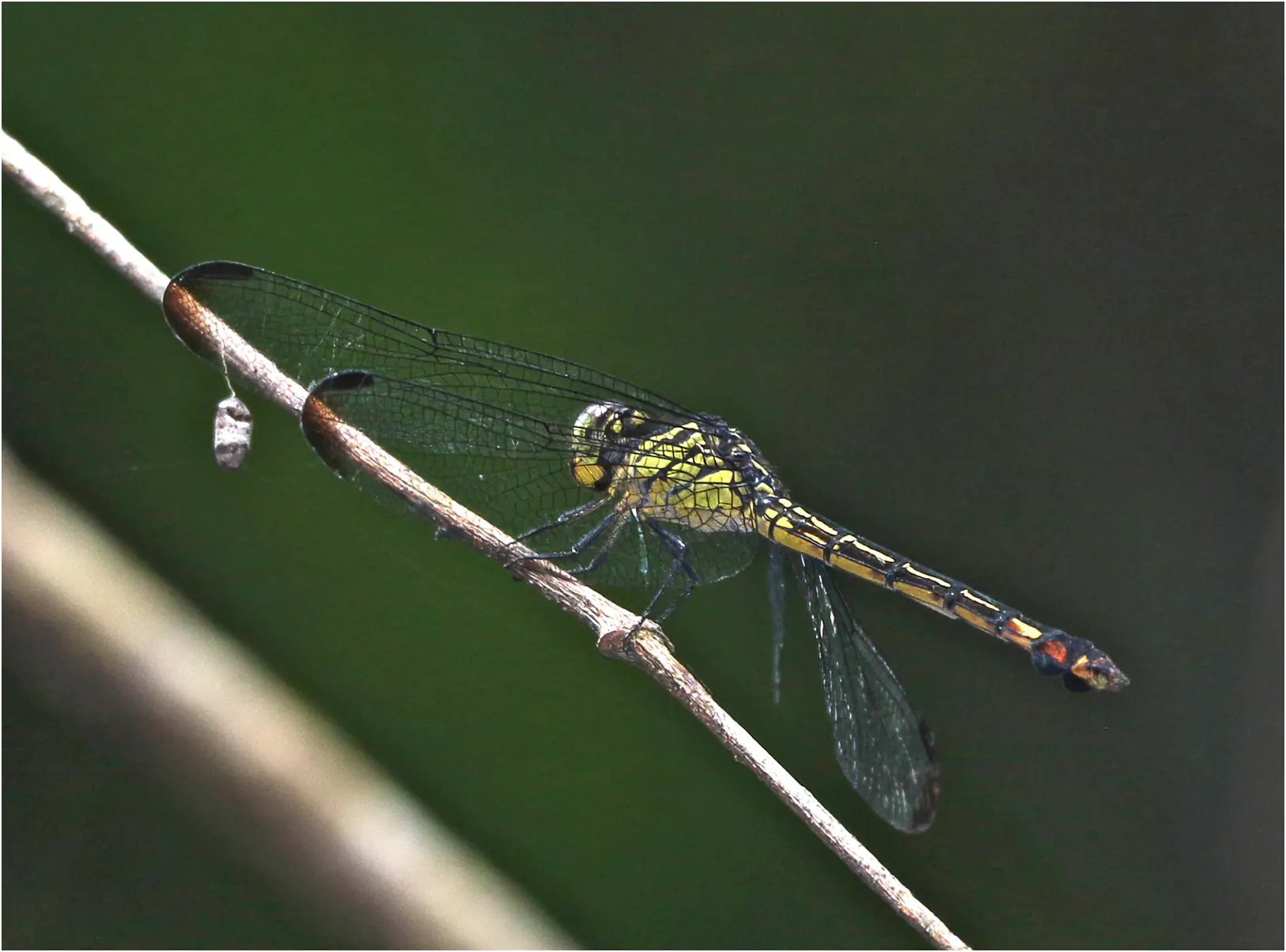
We only had a single brief encounter with this female Hadrothemis infesta, Libellulidae. Karsch (1891 a) described several Hadrothemis under the genus Thermothemis the same year, but created a new genus for this one, Archiclops (1891 b). However, in the very same document, and just before, he created the genus Hadrothemis for Kirby's Orthetrum camarense. This highlights the increasing complexity of taxonomy as new species are discovered and require a higher level of criteria refinement. The genus Hadrothemis has seven endemic species in the forests of tropical Africa, with Hadrothemis infesta being the largest.
The male resembles a dark Orthetrum with an amber wing apex beyond the pterostigma, the frons is metallic black, the dark thorax features lateral yellow bands, the first three segments are covered with pruinescence, and the rest is black, more or less marked with paired lateral yellow lines that disappear with maturation.
The female is yellow, with black thoracic sutures and a black abdomen broadly marked with yellow lines on both sides; the wings are also marked at the apex. They bear a strong ventral expansion at the eighth segment, the lateral face of which is sometimes partially red.
Karsch gives the size of the male as 48 mm, and that of the female as 47.5 mm.
In English, it is called the Slender Jungleskimmer.
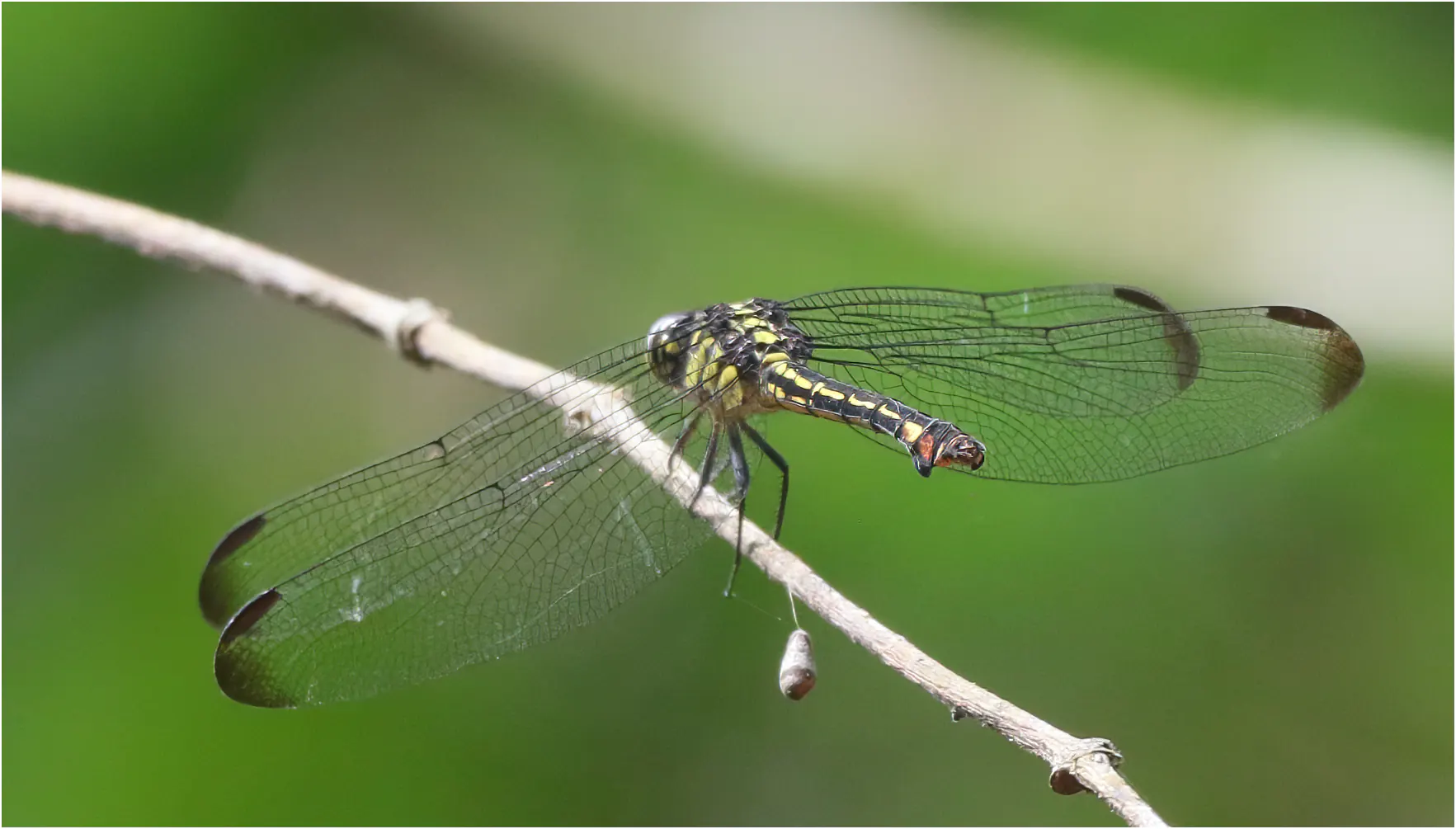
It thrives in stagnant waters well sheltered by the forest. We encountered it along a wide forest path, where deep ruts created large puddles of water.
Its distribution extends from Guinea and Sierra Leone, reaching Uganda to the east, across Cameroon and the two Congos.
IUCN Red List.
Etymology of Hadrothemis infesta
Hadrothemis, from the Greek hadros meaning strong, robust, well-developed, and Themis, the Greek goddess of order and justice, has been used numerous times since Hagen (1861). The name of the goddess of order is particularly well-suited to taxonomy, the science aimed at describing and ordering families, genera, and species. This –themis has actually become a signal of belonging to the Libellulidae. Karsch, describing the genus Hadrothemis, writes, "Kurz, plump und dick"—"Short, heavy, and thick," which refers to its massive thorax.
Infesta, from the Latin infestus, meaning menacing, formidable. Karsch, in his description, emphasizes its dark coloration and the numerous spines on its legs, which would make it threatening and formidable...
Karsch, 1891 a - Entomologische Nachrichten (Vol. 17, Issue 4, p. 60). (1875).
Karsch, 1891 b – Übersicht der von Herrn Dr. Paul Preuss in Deutsch-Westafrika 1890 gesammelten Odonaten. Entomologische Nachrichten, (Vol. 17, Issue 5, 65–81).