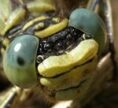
Identifying Orthetrum monardi among African Orthetrum is tricky: there are 36 of them in Africa and at least 15 in Ghana. It is considered uncommon and local (Lieftinck, 1969), and prior to our survey there were very few photos for Ghana on Observation.org or iNaturalist.
It is often recognized that Orthetrum can only be validly identified using their external genitalia under the second abdominal segment, so I was very fortunate to find an identification key based on other criteria in Longfield (1955). This was thanks to the ADDO website, edited by K.-D. Dijkstra, unfortunately offline now but accessible via web.archive.org: the bibliography accompanying each species is an essential source of documents.
Unfortunately, I only have a single photo of this still young specimen, which luckily clearly shows the particular (though not unique) pattern of its thorax.
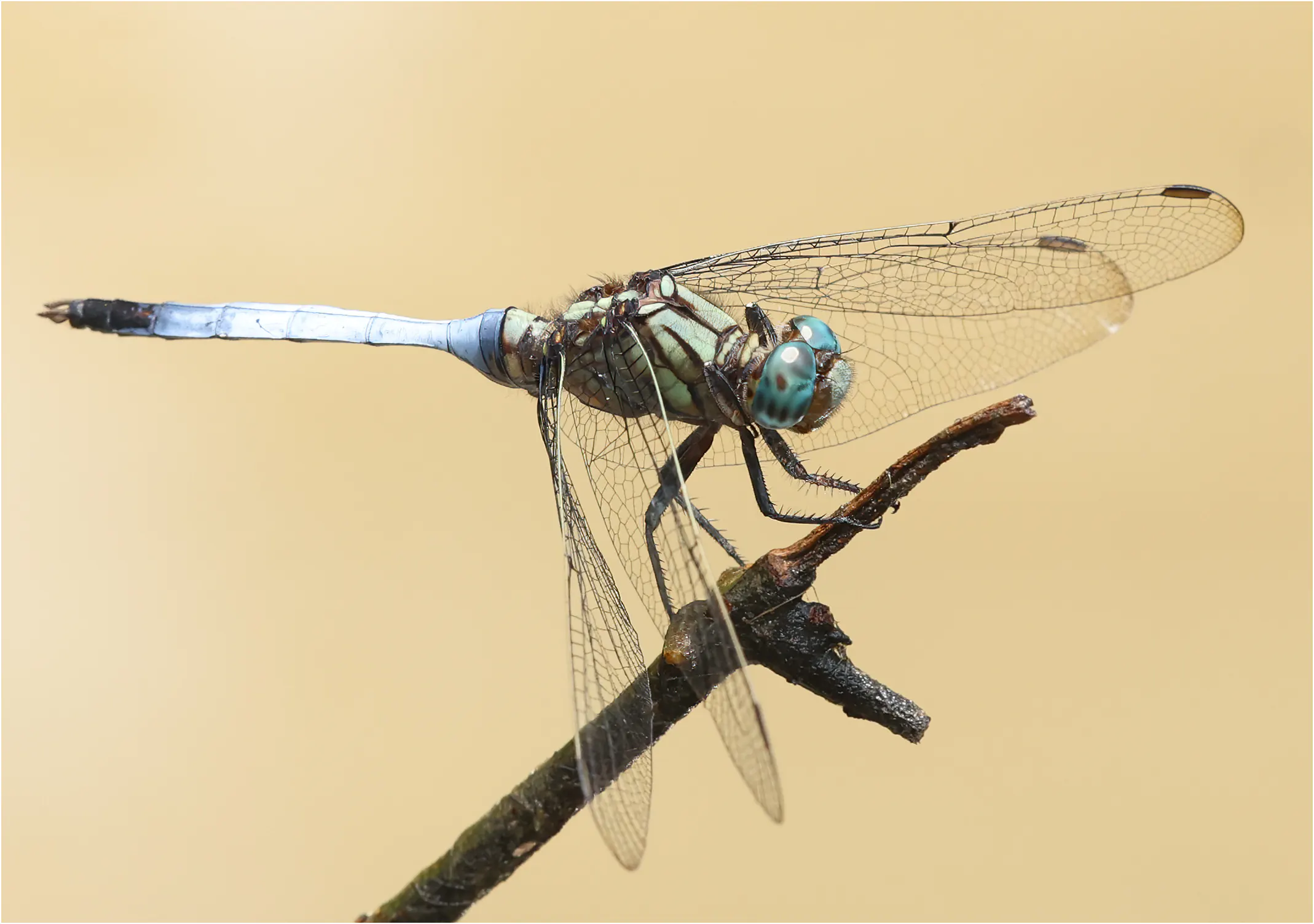
The face is pale (light labrum and labium), dark beige or brown on the sides, and the frons bears no black.
It is one of those Orthetrum that lack pale stripes on the thorax; the thorax is weakly marked and bears an incomplete, arched antehumeral black stripe that tapers toward the rear. Behind this stripe, the humeral suture is partially outlined in black, along with a curious sinuous black shape branching off from it (unfortunately, it is not unique among Orthetrum).
Only the abdomen becomes pruinose.
It features only a single row of cells in the supplementary radial field (radial loop or radial planate depending on the authors), the subcostal crossveins are yellow, and the pterostigmas are small.
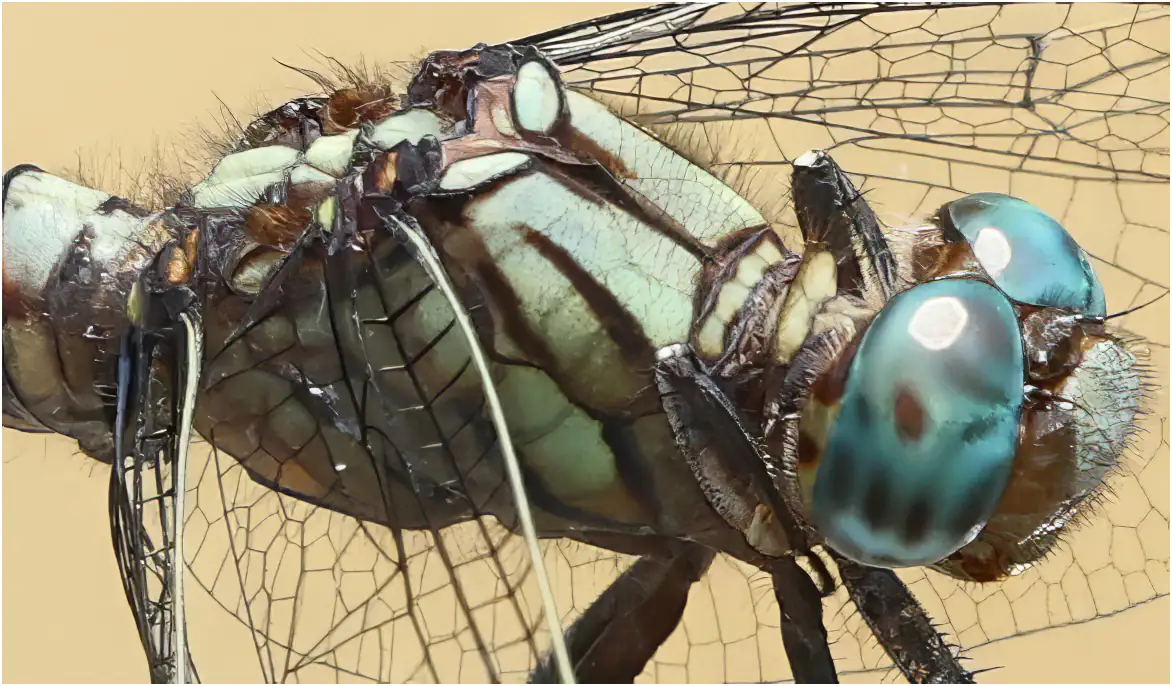
Orthetrum monardi measures 37 to 45 mm (Tarboton, 2015).
It favors stagnant, sometimes temporary waters, springs, and seepages in open environments. However, it is certainly found in or very close to forests, as recalled by its common name, Woodland Skimmer. We encountered it in a forest clearing, in the company of Trithemis arteriosa and T. grouti, and Orthetrum austeni, among others.
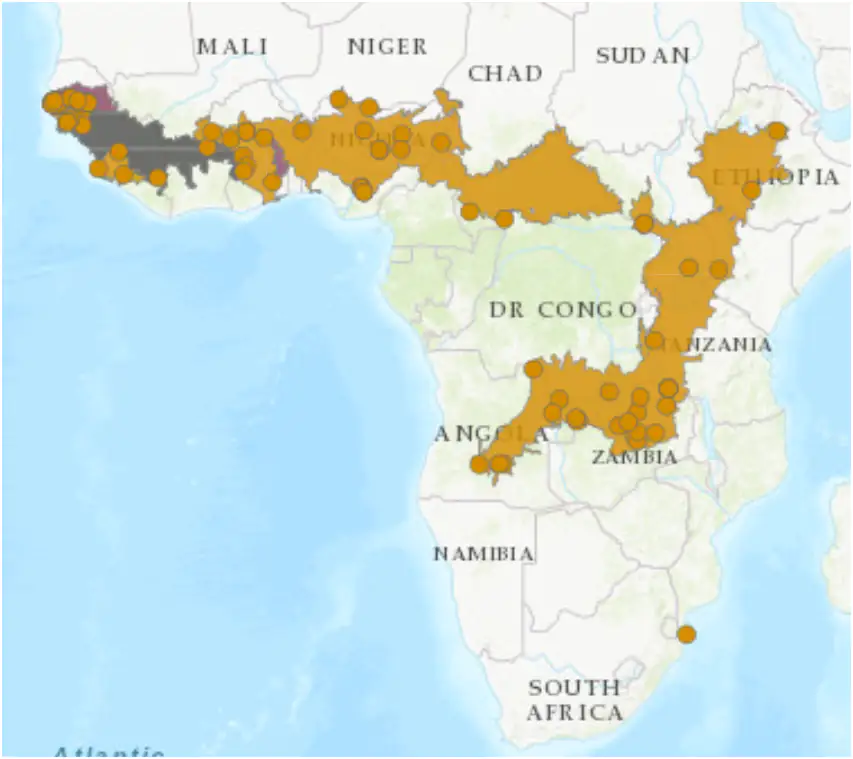
Its distribution is surprising towards southern Africa; in the northern part of its range, it extends from Senegal to Ethiopia. Then southward through Tanzania and Zambia, it reaches Angola.
An isolated population, discovered in 2014 in KwaZulu-Natal, is present in the far east of South Africa.
Distribution map of Orthetrum monardi, IUCN Red List
Etymology of Orthetrum monardi
Orthetrum (see Endersby & Fliedner, 2015) comes from two Greek words, "orthos," meaning straight, and "etron," for abdomen, signifying that the sides of the abdomen are parallel. This generic name (neuter), created by Newman in 1833, lost its relevance with the discovery of new species (whose sides of the abdomen are not parallel), but the name remained.
Monardi is a tribute to Dr. Albert Monnard (1886–1952), a Swiss zoologist, botanist, explorer, and museum curator, and Schmidt writes, "Art wurde benannt zu Ehren des Sammlers Dr. ALBERT MONARD in La Chaux-de-Fonds, Schweiz."
Dijkstra, K.-D.B. (editor, 2024). African Dragonflies and Damselflies (ADDO).
Endersby Ian & Fliedner Heinrich (2015). The Naming of Australia’s Dragonflies. Busybird publishing.
Lieftinck, M.A. (1969). Odonates anisoptères – Odonata Anisoptera. Explor. hydrob. Lac Bangweolo and Luapula, 14, 1-64.
Longfield, C. (1955). The Odonata of N. Angola. Part I. Publicacoes culturais Companhia Diamantes Angola, 27, 11-63.
Schmidt, E. (1951). Libellen aus Portugiesisch Guinea, mit Bemerkungen über andere aethiopische Odonaten. Arquivos Museu Bocage, 20, 125-200
Warwick et Michèle Tarboton (2015). A Guide to the Dragonflies & Damselflies of South Africa.