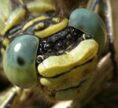

Heliocypha biseriata, Chlorocyphidae, is part of a genus containing nine spectacular species that, on their own, are worth the trip! This is the third one I have encountered after H. perforata and H. biforata (very similar...), but other members of the Chlorocyphidae family are also closely related and equally spectacular, such as Aristocypha fenestrella, here in Thailand.


The intensity of the pink thoracic colouration—and especially the fuchsia on the pronotum and the anterior part of the thorax—is astonishing. The triangular shape with its rounded base is perfectly defined. They even sport tiny postocular spots of the same colour.
This colour pattern makes it impossible to confuse with any other species in Borneo.


In the photos above, one can clearly notice the characteristic face of the Chlorocyphidae, equipped with a curious nose-like appendage that explains why Selys (1859) placed them in Rhinocypha (rhino meaning 'nose' in Greek).
They thrive on open, wide, and sometimes fast-flowing forest rivers with stony or sandy bottoms. They like to perch on rocks to watch over their territory and chase away intruders. It is indeed in this habitat that we encountered them, stationed on rocks surrounded by water.
It measures approximately 39 mm in total length.

Almost all data regarding this species comes from Borneo, where it is fairly common. It has been reported on two island groups near Indonesia, but it is not impossible that there was a confusion with H. biforata in one of these cases.
IUCN Red List.
Indeed, the two species are almost twins, and Rory Dow (2021) writes that "Heliocypha biseriata is likely to prove to be the same species as the widespread H. biforata (Selys, 1859)". Selys, moreover, describes the two species successively and notes a more extensive wing colouration for Heliocypha biseriata; for the rest—in particular those iridescent purple or almost hyaline spots depending on the angle of light—the description is virtually identical. Curiously, he writes that the only difference between the two species is the length of the wings, yet he gives the same hindwing length for both species: 23 mm.

It is therefore very likely that these two Heliocypha are the same species. As I have already written, the descriptions follow one another on the same page (for better display, I have placed them side by side (above) and I suppose that the first one described will later retain precedence, and biforata will be reduced to the status of a synonym.

On the Timuoh River, a wide river with a gravel bed and a noticeable current in places but shallow, the individuals were perched in the sun on rocks or more or less rotted trunks where females were trying to lay eggs.

But when they want peace and quiet and do not wish to be harassed by males, they take refuge in the branches near the riverbank. Even though they look very different from the males, it is amusing to note that the pattern on the lateral side of the thorax is similar, except of course for the upper antehumeral line, which is much thinner and not pink. The shape of the abdominal spots also matches.
Note the parasitic dipteran in the center of the wing; it feeds by sucking haemolymph from a vein it pierces. It may belong to the genus Forcipomyia.


Etymology of Helocypha biseriata
Heliocypha: the genus was created by Fraser (1949), and this species, previously named Rhinocypha biseriata by Selys, joined the genus. Fraser gives as a criterion for males of this genus the pink triangle ("peach-blossom pink in colour") of these species on the anterior part of the mesothorax. We can suppose (since Fraser gives no indication) that Helio, from the Greek "Helios", "sun", is a reference to the way sunlight enhances the wings by making them iridescent. "Cypha " comes from "cyphos", meaning "hunchbacked", to evoke the curious appendage on their face, which is a constant feature for the genera belonging to Chlorocyphidae.
Biseriata from "bi", for "two", and "seriata", which means "in a series", to recall the two series of stacked markings on the wings, which is probably better appreciated on the second photo of this page. Note that the etymology of biforata conveys exactly this same meaning.

Enfin, l'espèce est suffisamment rare et surtout localisée géographiquement pour ne pas avoir de nom vernaculaire anglais.
Les Chlorocyphidae sont souvent appelés Jewel Damselflies, ce qui est aisé à comprendre.
Dow, 2021 - AN ANNOTATED CHECKLIST OF THE ODONATA (INSECTA) KNOWN FROM SARAWAK WITH RECORDS TO DISTRICT LEVEL – Sarawak Museum Journal · January 2021
Fraser, 1949 - A revision of the Chlorocyphidae (Odonata) with notes on the differentiation of the Selysian species, rubida, glauca, cyanifrons and curta. Bulletin de l'Institut Royal des Sciences Naturelles de Belgique. 25(6) 1-50. P. 16.
Selys, 1859 – Additions au synopsis des Calopterygines. Bulletins de l’Académie royale des sciences, des lettres et
des beaux-arts de Belgique. P. 446.