
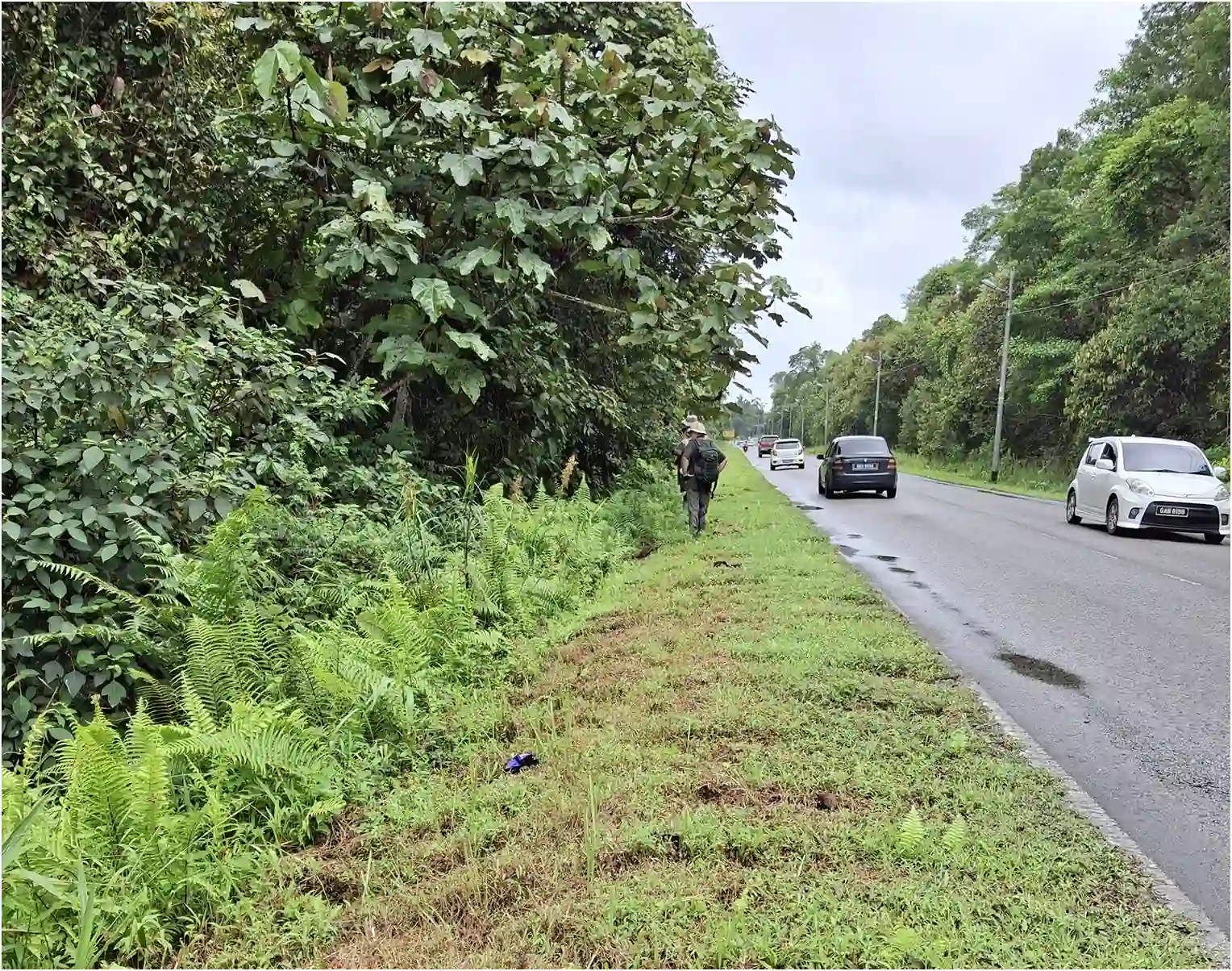
I had no more luck than in mainland Malaysia when it came to photographing the tiny Libellago hyalina; we were able to observe several along a very deep ditch beside a busy road near Kuching, but it was impossible to really get close to them. The slope was too steep, and they proved to be very shy, retreating as soon as we got within 2 metres. I thought I had seen old individuals in Malaysia; I had found the colour of the abdomen rather dull and expected to see them brighter in their youth.

But no, they have a very dark thorax, almost black, with deep green reflections and a purplish-red abdomen, a distinct and unusual shade. Selys, who described it under the name Micromerus hyalinus—a genus now extinct—even saw this abdomen as black (a specimen tarnished in a collection) and referred to the whole body as purplish-black.
One can clearly notice its hyaline wings, which is quite uncommon among Chlorocyphidae.

Whether in Borneo or elsewhere, its identification poses no problem if you combine hyaline wings and a purplish abdomen. Its total length is only 20 to 22 mm in Singapore (2).
During our canoe survey with Rory Dow in Maludam National Park, we were fortunate enough to encounter several females, but the quality of the photos is hit-and-miss from a small, moving vessel...
They are certainly young, as shown by their pale eyes and white pterostigmas, but the wing is still hyaline.


The Clearwing Gem prefers swamp forests or slow-flowing forest streams; however, we only encountered them at the edges of these areas, where the sun reaches them.
Its geographical distribution extends from southern Vietnam and Cambodia, through southern Thailand, the Malay Peninsula and Singapore, to Sumatra and Borneo.
IUCN Red List.
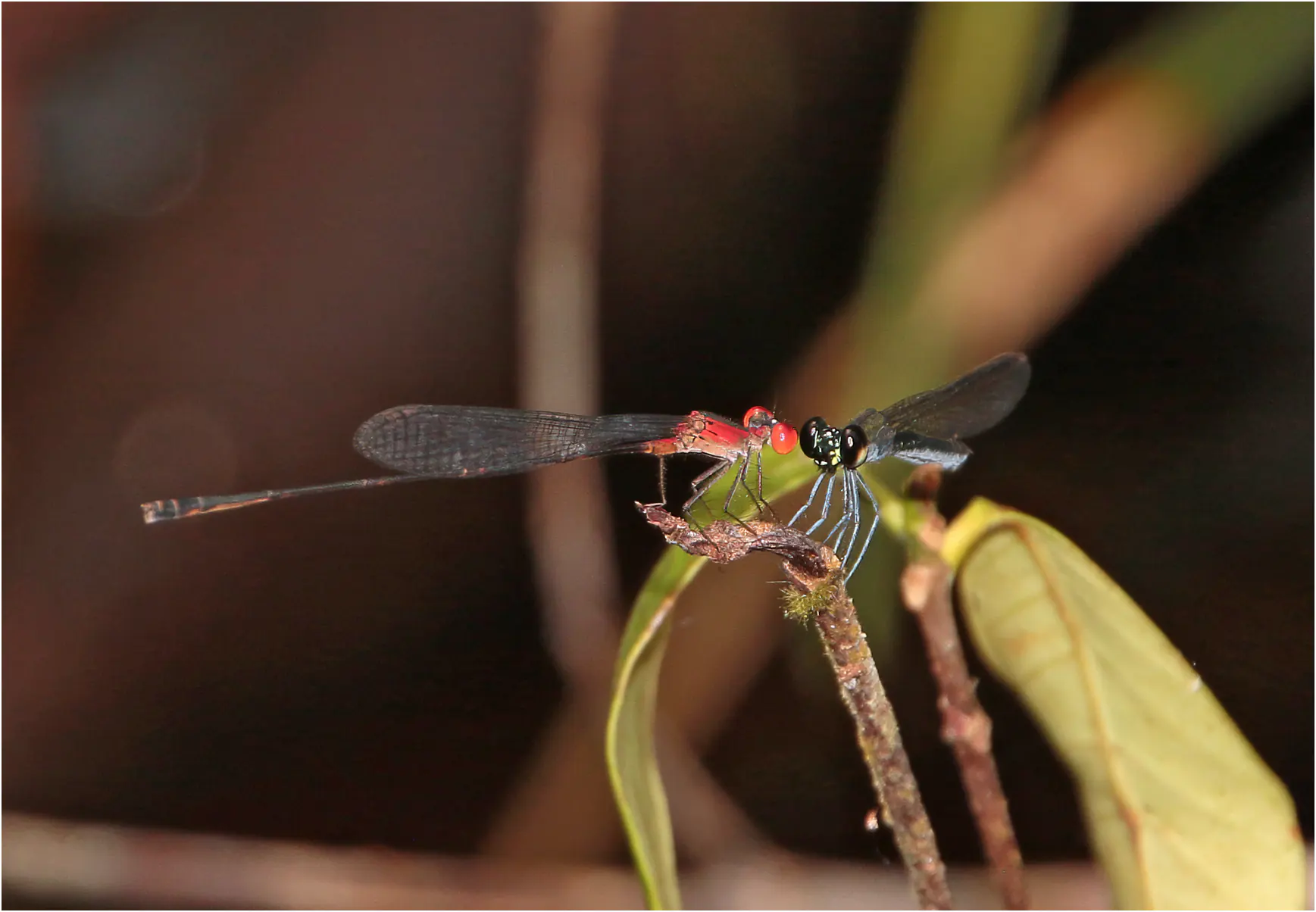
The two females below, caught in mid-conversation, look truly astonished to meet tourists in this area. The species is talkative, and we even met a male in conversation with a male Elattoneura aurantiaca!

Etymology of Libellago hyalina
Libellago: the genus was created by Selys in 1840, and it is thought to be formed from the Latin libellula for "dragonfly" and the suffix -ago, likely in imitation of the construction of the word virago, which in Latin means "strong and courageous woman, like a man" and thus potentially "heroine" (vir for man and -ago = ?). The suffix -ago, however, does not seem to have a meaning that would explain the construction of the very few French words that use it. This is the explanation very briefly advocated by Ngiam and Ng (4). And I spent many long hours trying to confirm this hypothesis; finally, Selys, in the Appendix of his "Monographie des libellulidées d'Europe" (5) and more precisely in his "Note sur le triangle discoïdal des Libellulidées", writes regarding the genus Libellago: "Ce genre, très-distinct sous tous les rapports, rappelle certaines Libellules. On peut, à la rigueur, y découvrir un triangle discoïdal, mais il ne diffère pas, par sa construction, des autres cellules carrées - This genus, highly distinct in all respects, recalls certain dragonflies. At a stretch, one can discern a discoidal triangle in it, but it does not differ in its construction from the other square cells". Libellago should therefore indeed be understood as "having similarities with dragonflies" in terms of wing venation. Later, I realised that this reference, which I had such a hard time finding, is in Wikipedia.
Hyalina, from the Ancient Greek hyalinos, meaning "transparent" (like crystal), refers, of course to its wings, which lack coloured markings; Selys writes, "The male is distinct from all others by its forewings without spots."
1- Selys, 1859 – Additions au synopsis des Calopterygines. Bulletins de l’Académie royale des sciences, des lettres et
des beaux-arts de Belgique. P. 447.
2- Robin Ngiam & Marcus Ng - A photographic guide to the Dragonflies and Damselflies of Singapore - John Beaufoy Publishing – 2022