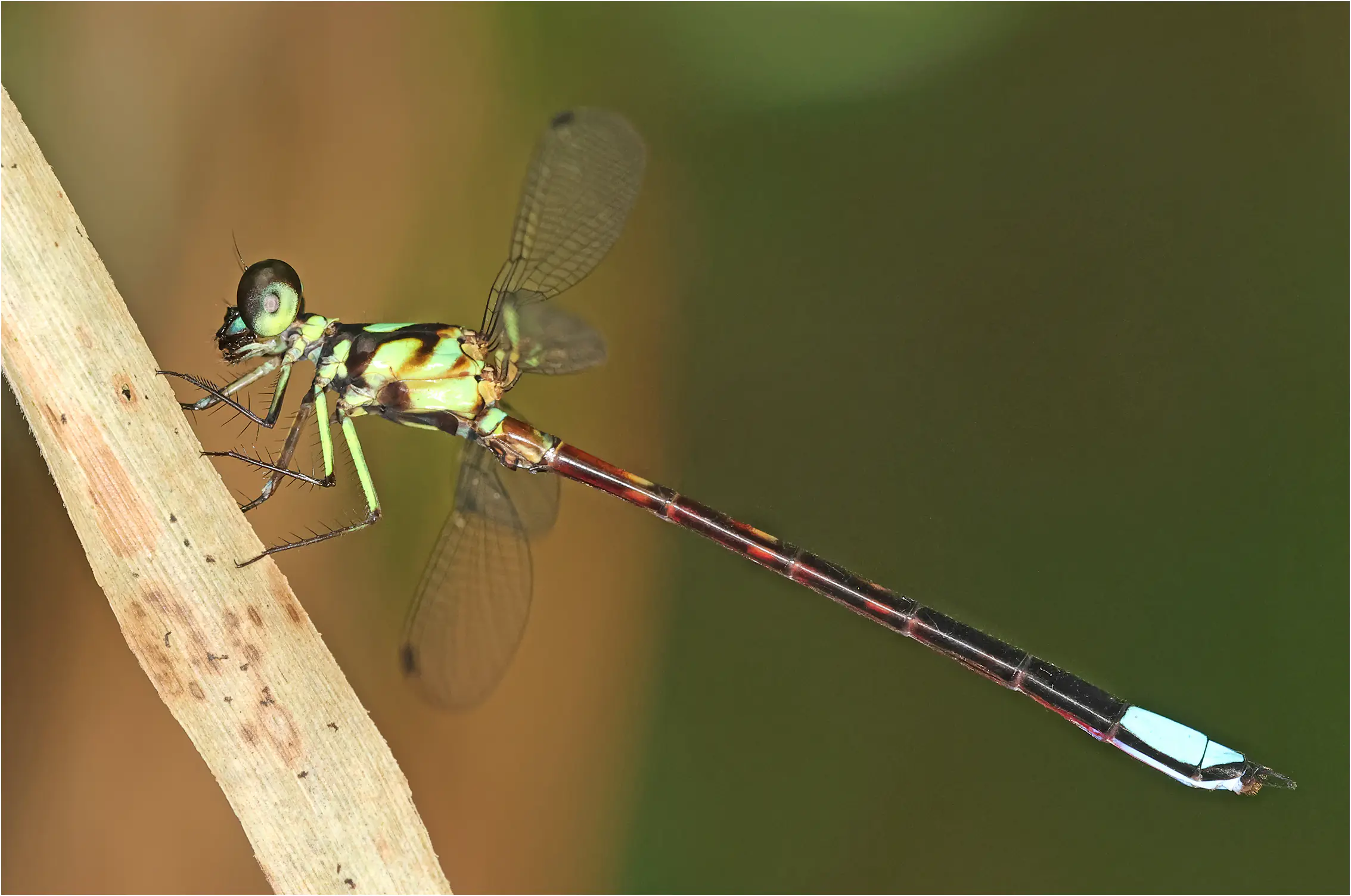
Rhinagrion borneense, a member of the Philosinidae family (formerly Megapodagrionidae), is the fourth member of the genus that I have encountered, and every time, I find them extraordinary due to their colouration and unique shape. See R. hainanense, R. mima, and R. macrocephalum.
The genus comprises 10 species, all found in Southeast Asia, Sundaland (or Sondaland), and the Philippines, with only 2 in Borneo, the second being R. elopurae. Even though the latter is very similar (I have never seen it, but here is a photo on iNaturalist), there is no risk of confusion, as the distal part of its S7 is blue; it is red, very dark red, or almost black depending on age, but never blue for Rhinagrion borneense (rarely, at most 2 small blue spots on the apical part of S7 (2)).


But as can be seen, it is very close to R. macrocephalum, and Selys wrote of our species (1): "♂ Extremely close to macrocephala from Malacca (Mount Ophir), which it replaces in Borneo." Indeed, Selys had classified his species in his feminine genus Amphilestes (because the venation is close to Lestes), and when Calvert created the genus Rhinagrion in 1913, macrocephala became macrocephalum.
And if Calvert saw fit to create a new genus, it was because the genus Amphilestes was preoccupied (3) by a single Middle Jurassic marsupial mammal, created by Owen in 1859, which therefore had priority.

Lieftinck (1956) (4) and Paulson (1981) (5) noted that Rhinagrion borneense was capable of flattening the last blue segments of its abdomen to make it wider. Almost all zygopterans have a cylindrical abdomen, which is not the case for this Philosinidae, whose last segments are triangular in cross-section, with a dorsal carina.
They do not tell us whether this curious function is involved in a courtship display, but it plays a role in territorial fights, as males fly facing each other with the tip of their abdomen raised and widened (R. Dow).
I must rely on Selys to know its size; he tells us that its abdomen measures 27–28 mm, which gives the insect a total length of just over 36 mm.

The typical habitat of Rhinagrion borneense is in lowlands, along tropical rainforest streams and rivers. Four of the photos on this page were taken on the Timuoh River, right on the bamboos sticking out in the middle of the picture. The third photo was taken on a fairly fast, large stream cluttered with rocks in a much darker, enclosed environment.
It is endemic to Borneo, where it is quite common, with about a hundred observation sites recorded as of 2019.
IUCN Red List.

Etymology of Rhinagrion borneense
Rhinagrion (Calvert, 1913), from the Greek "rhin-" for "nose", to emphasize the prominence of the face between the mouth cavity and the base of the antennae (a region more scientifically termed the epistome), and from "agrion". "Agrion" was created by Fabricius (1775) to designate all Zygoptera and comes from a Greek word meaning wild, undoubtedly to indicate, according to Fliedner (6), that these insects are found in fields and not in a domestic environment. Agrion serves as a reminder that the genus belonged, at the time of its creation, to the Megapodagrionidae family (now Philosinidae).Borneense from Borneo and the suffix -ense, used to indicate origin. Selys (1) writes that the "homeland" of this insect is the island of Borneo, in Labuan (Sabah). It seems likely, however, that Labuan was actually the port from which Mr. Van Lansberge's collection (2) was shipped to Selys.
1- Selys, 1886 - Révision du synopsis des Agrionines. Première partie comprenant les légions Pseudostigma – Podagrion – Platycnemis et Protoneura. Memoires couronnes Academie royale Belgique, 38, 1–233. P. 93.
2- Vincent J. Kalkmana, Reagan Joseph T. Villanueva, 2010 - A synopsis of the genus Rhinagrion with description of two new species from the Philippines (Odonata: Megapodagrionidae) - International Journal of Odonatology, Volume 14, Issue 1, Pages 11-31, 2011
3- Heinrich Fliedner, 2021 - The scientific names of Ris' odonate taxa - Journal of the International Dragonfly Fund. P. 98 [Amphicnemis].
4- Lieftinck, M.A.,1956 - Revision of the genus Argiolestes Selys (Odonata) in New Guinea and the Moluccas, with notes
on the larval forms of the family Megapodagrionidae. Nova Guinea (N.S.), 7, 59–121
5- Paulson D., 2011 - Anatomical modifications for displaying bright coloration in megapodagrionid and chlorocyphid
dragonflies (Zygoptera). Odonatologica, 10, 301–310.
6- Fliedner, 2006. The scientific names of the Odonata in Burmeister’s "Handbuch der Entomologie".