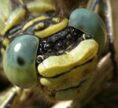

Amphicnemis annae is a (very) rare Coenagrionidae belonging to a genus currently comprising 22 species, 12 of which are found in Borneo. It is a difficult genus that requires very good photos of the pronotum and its spine (if present), as well as the very distinctive anal appendages. The best approach, as was the case for us, is to be guided by the specialist on Borneo's Odonata, Rory Dow.

The scene takes place in a woodland peat bog, relatively dark and treacherous due to the water holes that can lie hidden beneath the litter-covered ground, between roots, branches, and trunks decaying on the forest floor…
Males Amphicnemis annae
By getting close enough to this reasonably approachable odonate, one can clearly see the spine it bears, attached to the posterior lobe of its pronotum; it is very long and has a very distinctive shape, concave anteriorly, like a "banana".


It is therefore necessary to check the presence, shape, and size of the spine every time.
Lieftinck tells us that the abdomen and anal appendages measure 34 to 35 mm; it thus reaches a total length of 39.5 mm for a hindwing of 18.5–19 mm. The length of the abdomen relative to the thorax is truly spectacular.
The identification is, of course, confirmed by the anal appendages. My surprise was discovering that on my photo, the inferior anal appendages (paraprocts) are not visible, as they are tiny—as shown in Lieftinck's drawing. Only the two branches of the cerci (superior anal appendages) are visible, and the highly developed lower branch could easily be mistaken for the paraprocts!


Females
Females exist in two forms, with or without a spine on the posterior part of the pronotal lobe. While Lieftinck describes one identical to the male, Rory Dow writes (2): "Females from most parts of Sarawak (identified by association with the male and in one case taken in tandem) lack a long horn…"
Below are two immature females without a spine.


On the left, no spine; on the right, a spine identical to that of the male.
With or without a spine, the colouration of their thorax is spectacular.


This spine is much more clearly visible in the photo below:

I hesitated before presenting this mature female, but I am now convinced, by carefully studying the shape of the pronotum, that these are mature females without a spine. For instance, as seen in photo 2 (on the right side of the pronotum), we find this curious lateral expansion of the posterior lobe of the pronotum that Lieftinck describes in his key to females (1): "Lateral divisions of the prothoracic hind-lobe produced as a pair of long, acute-angulate, bluntly triangular, outwardly directed lamellae…"
Only the one on the right side is visible; the perspective flattens the view of the one on the left side.


Geographical distribution
It is endemic to Borneo, where it is known only from Brunei, Sarawak, and northwestern Kalimantan.
IUCN Red List.
Etymology Amphicnemis annae
Amphicnemis (Selys, 1863): Amphi- from the Greek ἀμφί, meaning "on both sides", and -cnemis, meaning "leg" or "tibia", which was used to create many genera starting with Platycnemis—genera that no longer have anything special regarding the width of their tibia but share common wing venation features.
Robin Ngiam & Marcus Ng (3) propose the following explanation regarding the word "amphi": Selys created the genus Amphicnemis to place A. wallacii, which he found similar to Amphilestes macrocephala (now Rhinagrion macrocephalum). This species features black dots on both sides of the thorax. I find this explanation rather hard to accept, having encountered R. macrocephalum myself… but I have no other explanation.Annae is almost certainly a tribute to a woman named Anne, perhaps a naturalist who collected Odonata—though in this case, not Amphicnemis annae, which was captured by Louis Coomans de Ruiter, an entomologist, conchologist, botanical collector, scientific collector, botanist, and even a civil servant!

1- Lieftinck, M.A., 1940 - Descriptions and records of South east Asiatic Odonata (II). Treubia 17: 3 37 390. P. 370.
2- Dow, Rory A. & Graham T. Reels, 2013 - Previously unpublished Odonata records from Sarawak, Borneo. Part I. Kuching Division excluding Kubah National Park, and Samarahan Division - Journal of the International Dragonfly Fund, 1-25, Vol. 3 2013. P. 15.
3- Robin Ngiam & Marcus Ng - A photographic guide to the Dragonflies and Damselflies of Singapore - John Beaufoy Publishing – 2022