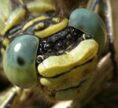

We encountered Amphicnemis wallacii (Coenagrionidae) on two occasions, but always in a peat bog environment. There are 22 Amphicnemis species in Asia; 10 were described in Borneo as of 2010, some are currently being described, and further discoveries are expected. At the site where I took all the photos on this page, we were accompanied by Rory Dow, the leading specialist on the odonates of this island: we encountered three species there—A. annae, wallacii, and cf. dactylostyla (an undescribed species).
Amphicnemis wallacii Males
Unfortunately, I was not able to take good photos, being too far away the first time, and during the second occurrence, the light was very dark. Its habitus is very similar to that of Amphicnemis annae, which was also present in this forest peat bog in Kuching; it differs, among other things, by the length of the spine arising from the middle section of the posterior lobe of its pronotum, which is longer in A. annae.


Its hindwing measures 20 mm, its abdomen 33 mm, including appendages, and its total length is approximately 38 mm: 33 mm for the abdomen and 5 mm for the thorax and head!

Furthermore, the trapezoidal pterostigmas are distinctive: dark, surrounded by a light grey margin—details highlighted by Selys (1) in his description and by Lieftinck (2) in his key.
Lieftinck also distinguishes it from A. annae by the colouration of the face, which I did not have the opportunity to observe…
Females
It is a very difficult genus for amateurs, and I must say that once in front of the computer screen, I was completely lost trying to sort through the females, which are so variable depending on their age. Note that in publications prior to 2021, Rory Dow seemed to consider the species well-defined, but in 2021 (1) he refers to it using the term "Amphicnemis wallacii Selys, 1863 complex".
Ultimately, it appears that females exhibit several stages regarding thoracic colouration but are never metallic green like the males. However, they share in common the pronotal spine of the same length, almost vertical and only slightly concave. The thorax is initially entirely red, as are the legs; below is a very young female.

Then the dorsal surface of the thorax gradually darkens.
Note the appearance of the spine depending on the angle of the shot…

Then the red parts of the thorax turn green, and the legs become rather white!

Always with this same characteristic spine, clearly visible below, as an extension of the posterior edge of the posterior lobe of the pronotum. Curiously, the upper part of the thorax no longer appears truly dark. I assume, however, that the ontogeny of this species mirrors that of A. annae, for which pale green females are found, but with a dark or black back.


Geographical distribution
The species is endemic to Borneo, present in Kalimantan, Brunei, and Sarawak.
IUCN Red List.


Étymologie Amphicnemis wallacii
Amphicnemis (Selys, 1863): Amphi— from the Greek ἀμφί, meaning "on both sides", and -cnemis, meaning "leg" or "tibia", which was used to create many genera starting with Platycnemis—genera that no longer have anything special regarding the width of their tibia but share common wing venation features.
Robin Ngiam & Marcus Ng (3) propose the following explanation regarding the word "amphi": Selys created the genus Amphicnemis to place A. wallacii, which he found similar to Amphilestes macrocephala (now Rhinagrion macrocephalum). This species features black dots on both sides of the thorax. I find this explanation rather hard to accept, having encountered R. macrocephalum myself… but I have no other explanation.Wallacii ; Selys wrote: "Patrie: Sarawak, à Bornéo, par M. Wallace. (Collect. Selys.) - Habitat: Sarawak, Borneo, by Mr. Wallace. (Selys Collect.) "It is therefore a tribute to the collector of the species, Alfred Russel Wallace (1823–1913), the famous ecologist and originator of the eponymous line.

1- Selys, 1863 – Synopsis des Agrionines, 4° Légion : Platycnemis - p. 153
2- Lieftinck, M.A., 1940 – Descriptions and records of South east Asiatic Odonata (II). Treubia 17: 3 37 390. P. 367 & 371
3- Dow, 2021 – AN ANNOTATED CHECKLIST OF THE ODONATA (INSECTA) KNOWN FROM SARAWAK WITH RECORDS TO DISTRICT LEVEL – Sarawak Museum Journal · January 2021 - P. 350.