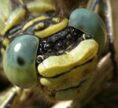


Coeliccia matok is a member of the Platycnemididae, a genus that currently includes 80 species distributed from India to Japan and Indonesia; around twenty species have been described in the last decade or so. It belongs to those odonates sensitive to the pre-flash of our Speedlites; flashes emit a minute pre-flash so the camera can analyze the reflected light and adjust the output to expose the scene correctly. While barely perceptible, it disturbs certain damselflies, which take off briefly, as shown in the two photos above (this behavior can repeat once or ten times before the subject either gets used to it or flies away).


Coeliccia matok is endemic to the extreme west of Borneo, and we encountered it in a forested peat swamp introduced to us by Rory Dow (1), a leading specialist in South Asian odonates and particularly those of Borneo, as he resides in Kuching (Sarawak). This very dark swamp, where one sometimes sinks quite deeply… is surprisingly located on the campus of the University of Kuching, and it was there that R. Dow identified it.
IUCN Red List


Rory Dow, who provides us with a wealth of valuable papers (1) on the odonates of Borneo, specifies that it had been identified as C. octogesima by Laidlaw, 1918 (2). This is easily understandable when looking at photos from Peninsular Malaysia, but it is not present in Borneo.
Its abdomen, excluding the anal appendages, measures 33 mm, so the complete insect reaches about 40 mm.
In Borneo, 3 other species are nevertheless very closely related and also display this old telephone handset thoracic pattern.


Voici la traduction en anglais, en respectant soigneusement la structure, les italiques et la mise en page originale :
These are C. paludensis, C. macrostigma, which we could not have encountered, and C. nigrohamata; we could not come into contact with the first two species, as C. macrostigma is only present in Brunei and C. paludensis in southern Kalimantan. Where C. nigrohamata and C. matok are both present, they seem to exclude each other, with C. matok remaining confined to peat swamps, while its cousin is found in more open areas. Once again, the genus Coeliccia is very difficult, and only a meticulous examination of the anal appendages allows for the confirmation of the identification of certain species.
Fortunately, in the peat swamp forest where we were surveying alongside the discoverer of the species, C. nigrohamata was never encountered.


Males are very rare (our photos are the first field photos on the Web), females even rarer, and we only encountered one! It differs from the males by the thoracic pattern, which is broken in the middle:

Le meilleur moyen de s'assurer de leur identité étant, comme toujours, de les trouver en accouplement.
Noter le fond très sombre qui accompagne la plupart de ces photos et témoigne de l'éclairage ambiant dans cette tourbière.


Etymology of Coeliccia matok
Voici la traduction en anglais, en respectant la mise en page et les italiques :
Selys described the first species of the genus in 1863 under the preoccupied generic name Trichocnemis (a longhorn beetle), and it was Kirby who corrected it and created the genus Coeliccia in 1890. This generic name, unexplained by the author to my knowledge, possibly comes from the Latin coelum (or caelum), meaning "sky" or "celestial", and a suffix or simple ending chosen for aesthetic or phonetic reasons. Indeed, the first species described by Selys, Trichocnemis membranipes, is sky-blue in all its non-black parts.
Matok is explained by R. Dow: "Matok, a noun in apposition, named for Marijan Matok in gratitude for his continued financial
support of the International Dragonfly Fund."


1- Rory A. Dow, 2016 - Revision of the genus Coeliccia Kirby in Borneo part II: Two new species from the membranipes-group, with a redescription of C. macrostigma Laidlaw (Odonata: Zygoptera: Platycnemididae) - November 2016- Zootaxa 4184(1):79
2- Laidlaw, 1918 - Some additions to the known dragonfly fauna of Borneo, with an account of new species of the genus Coeliccia. Proceedings of the Zoological Society of London 1918: 223–232.