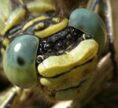
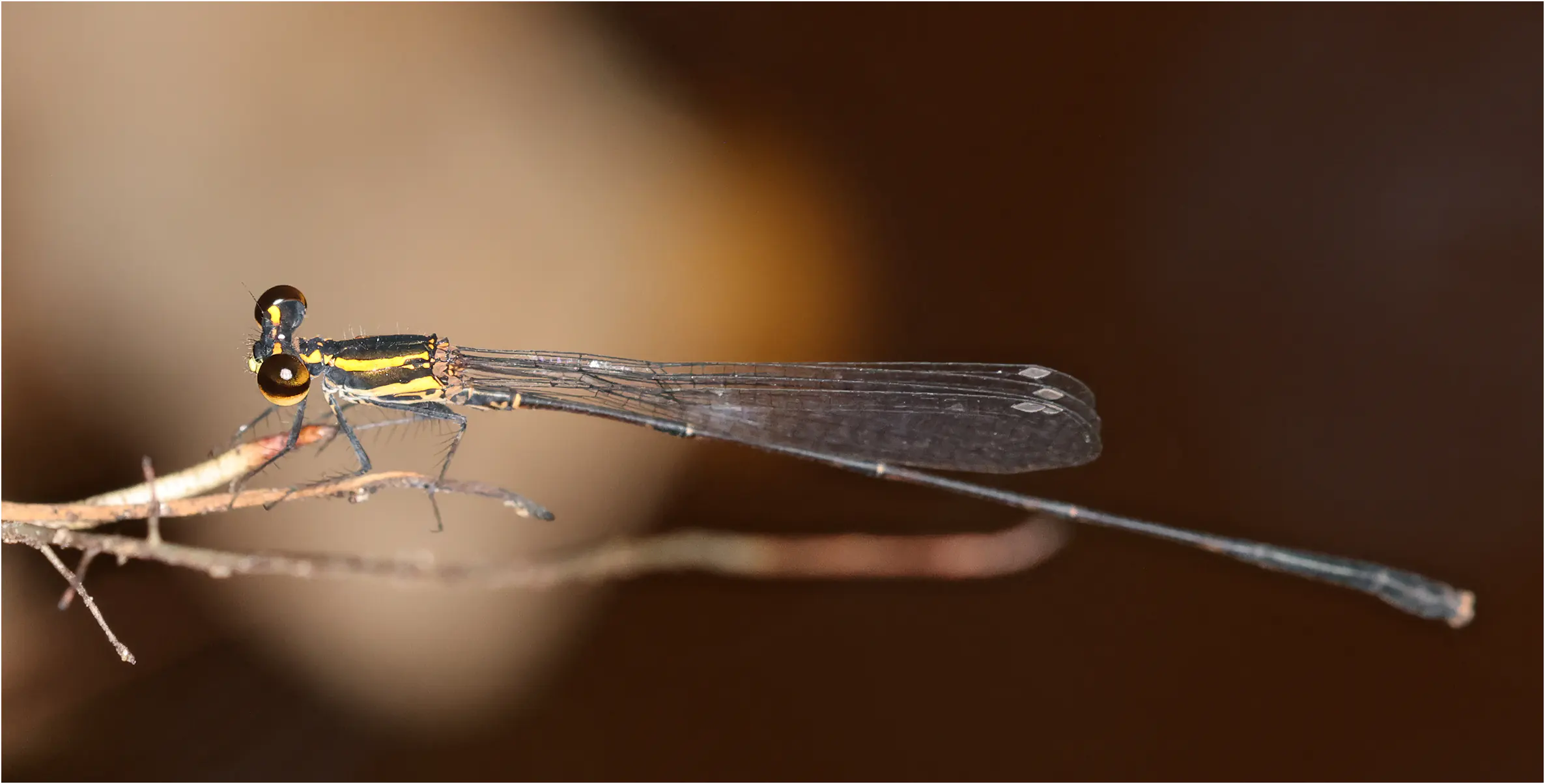
It is an understatement to say that this Platycnemididae, Elattoneura longispina, is rare. Prior to our photos, only two images by Marcel Sylvius from Kalimantan existed on iNaturalist. It is, moreover, the only individual we would encounter.
I was familiar with the genus Elattoneura, having encountered E. glauca in Namibia; I was therefore surprised to find other members of the genus in Sarawak. But, after all, Ischnura senegalensis, another damselfly, is just as present in Africa as it is in Asia (and Borneo). Which is to say I was not really surprised that Rory Dow (1) placed quotation marks around the genus name: "Note that the southeast Asian species currently placed in Elattoneura certainly do not belong there, but are left there until the issue of their true genus is resolved, so inverted commas are used around the genus name to emphasise this."
It was Rory Dow who found it as we were making our way on foot, after leaving the canoes, through the peat swamp forest of Maludam National Park. The forest is not very dense, and one must carefully pick a path through the vegetation, dead branches, and hidden holes beneath the dark water... This would not end well for me; an unexpected bath ruined my camera gear a quarter of an hour after these photos were taken.
Visually, it is extremely close to E. analis but differs from it by various details, including an incomplete interocular band, the near-total absence of markings (at most a very thin line) on the dorsal side of S2, and the last segments being dark (in adults), whereas the apical part of the dorsal side of S9 and S10 is light in E. analis.

Lieftinck tells us that its abdomen, including anal appendages, measures 28-29 mm, so it reaches about 34 mm in total length.
Its distribution is very localized, fragmented, and declining across Borneo, Belitung, and Peninsular Malaysia.
IUCN Red List.localised,
Etymology of Elattoneura longispina

Elattoneura (3) from the Greek "ellaton", meaning "smaller", and "neuron" which in entomology is translated as "vein in a wing". This refers to the reduced length of a vein that serves as a landmark in the systematics of damselflies.
Longispina, from the Latin "longus", meaning "long", and "spina", meaning "spine". Lieftinck never mentions the presence of a spine; nor does he describe the anal appendages, but he provides a comparative drawing showing a strong, well-defined spine on the inferior anal appendages, which is almost certainly the origin of the species name.
Ellatoneura longispina appendices anaux vs E. analis - Lieftinck, 1937 (2)
-1 Dow, Butler, Reels, Steinhoff, Stokvis & Unggang,2019 – Faunistic Studies in Southeast Asian and Pacific Island Odonata – Journal of the International Dragonfly Fund – No. 27.
2- Lieftinck, 1937 – Descriptions and records of South–east Asiatic Odonata. Treubia 16: 55–119. P. 86.
3- Dragonflies and Damselflies of Namibia, Frank Suhling & Andreas Martens, Gamsberg Macmillan, 2007