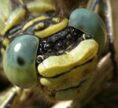

We encountered Archibasis viola twice in surprisingly different habitats. The photo below was taken in the suburbs of Kuching, a city of over 300,000 inhabitants, along a very busy road bordered by a very deep ditch, too steep to climb down into.
The other two were taken in Maludam National Park, from a pirogue on blackwater draining swampy peat swamp forests, along which the species was relatively common but almost impossible to approach and photograph from a boat constantly in motion. These two habitats seem so different that I carefully checked the finest details visible in my photos to verify that these subjects were indeed of the same species, and after some research, using the satellite view of the photos taken in Kuching and piecing together details from my memories, I think it is possible that we were at the edge of a peat bog, on an elevated road.

According to Ngiam and Ng (1), it measures 39 to 41 mm. In Singapore, therefore, it is found on small, shaded forest streams or in swampy areas, perched low in the vegetation.
Its identification poses, in principle, no problem due to its very distinct violet colouration.
Its distribution extends from southern Vietnam, Cambodia, and Thailand to Indonesia, Borneo, and the Philippines.
IUCN Red List.

Etymology of Archibasis viola
Archibasis: Let us give the floor to Ian Endersby & Heinrich Fliedner (2), whom I have quoted so often: "Selys in 1877 established 5 subgenera of Telebasis (Leptobasis, Stenobasis, Telebasis, Amphicnemis, and Pericnemis). Kirby (1890) replaced Stenobasis (then preoccupied by a dipteran) with Archibasis, as if it were a homonym and not a valid name. Stenobasis was derived from the Greek 'στενός' for 'narrow' and 'βάσις' meaning 'that on which one stands', 'pedestal', or 'base'. This referred to the petiolated base of the wings: 'Wings petiolated up to the basal postcostal nervule or even a little further, just before the origin of the quadrangle. ' Kirby retained the root 'βάσις', preceded by ἀρχή meaning 'beginning', 'origin'."
Viola simply stems from the Latin "viola", which means "violet." And I am glad that this species name relates so simply to the colour of this odonate, as I was unable to access Lieftinck's description (3).
1- Robin Ngiam & Marcus Ng - A photographic guide to the Dragonflies and Damselflies of Singapore - John Beaufoy Publishing – 2022
2- Ian Endersby & Heinrich Fliedner, The Naming of Australia’s Dragonflies, Busybird publishing, 2015.
3- Lieftinck, 1949 - The dragonflies (Odonata) of New Guinea and neighbouring islands. Part VII. Results of the Third Archbold expedition 1938–1939 and of the Le Roux Expedition 1939 to Netherlands New Guinea (II. Zygoptera). Nova guinea New Series 5: 1–271