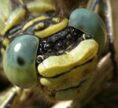
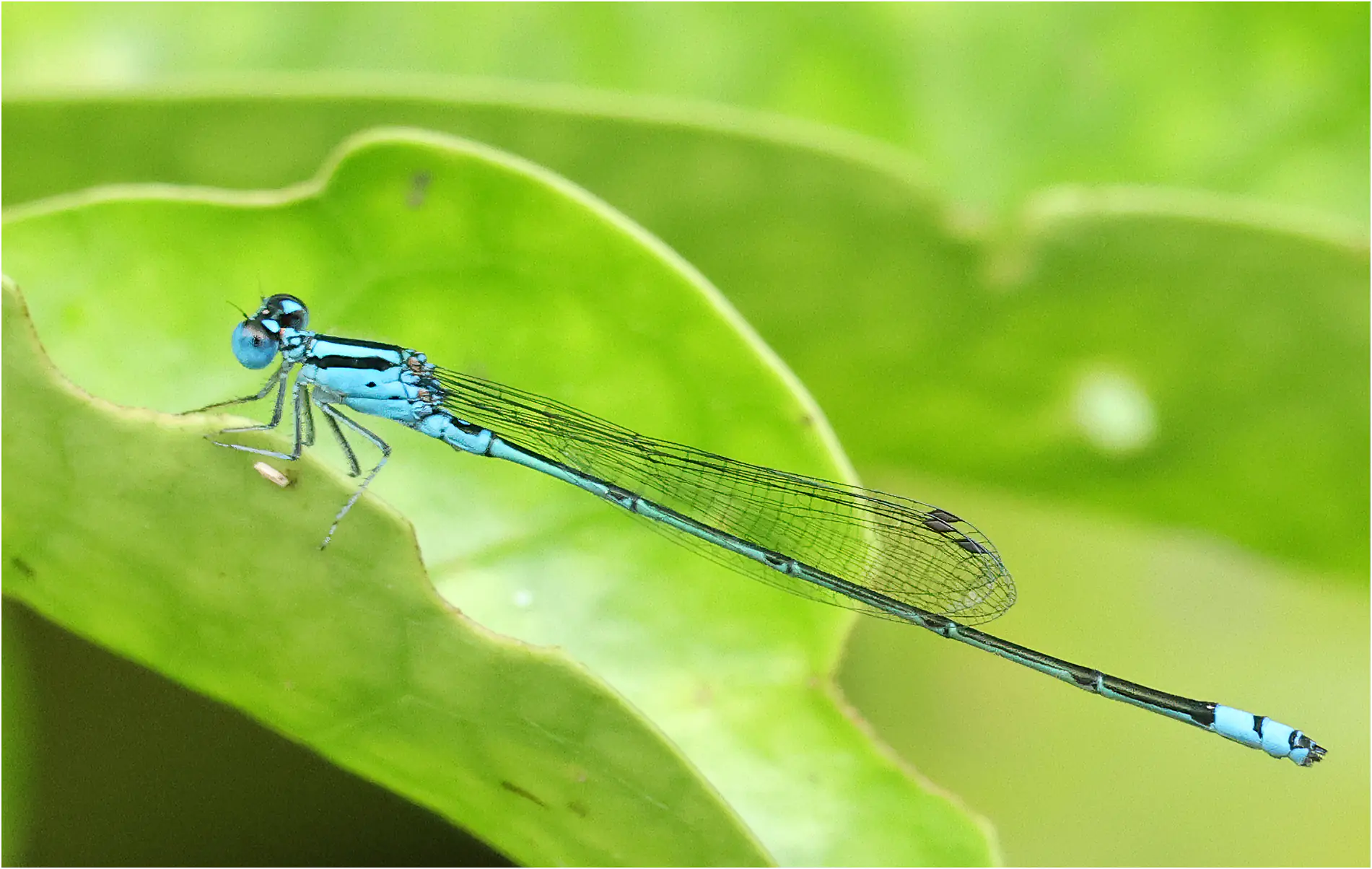
Pseudagrion coomansi was likely common during our navigation in Maludam National Park; indeed, we were able to observe quite a few Pseudagrion perched on the vegetation, often Pandanus, lining this canal-river. While it is probable that all were representatives of this species, a few P. siamense may have slipped in among them [it was only in 2026 that the species we then called P. microcephalum in Malaysia became Pseudagrion siamense], as the two species are very similar and it was only while writing this page that I learned to tell them apart.
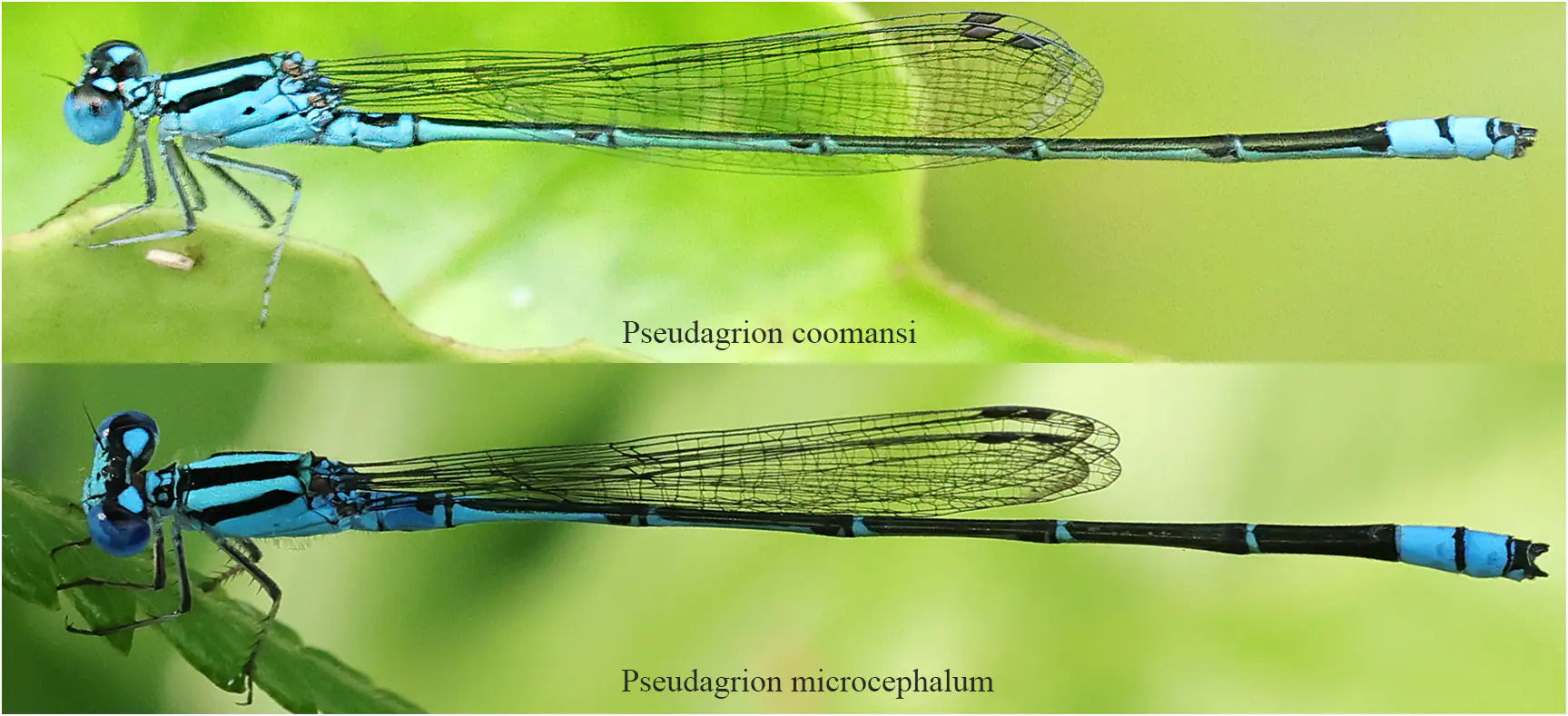
And it is virtually impossible to tell them apart from a moving pirogue. As seen above (even better by clicking on the photo), two "easily visible" details allow them to be distinguished: the size of the black spot on the anterior part of the interpleural suture (the spot on the lateral side of the thorax) and the shape of the black pattern on the second abdominal segment. Indeed, S2 bears a black mark shaped like a rectangle with a very short stem connecting to S3, more or less closed anteriorly, thus enclosing a blue circle or oval.
The anal appendages are also distinctly different, but I do not have a photo, and the two photos I am showing here are the only correct ones (photos taken from a pirogue). Furthermore, Lieftinck's description is missing pages 88 and 89, where a comparative description of these appendages and drawings is certainly located! One can only read there, "P. coomansi is easily distinguished... by the widely different appendages…"
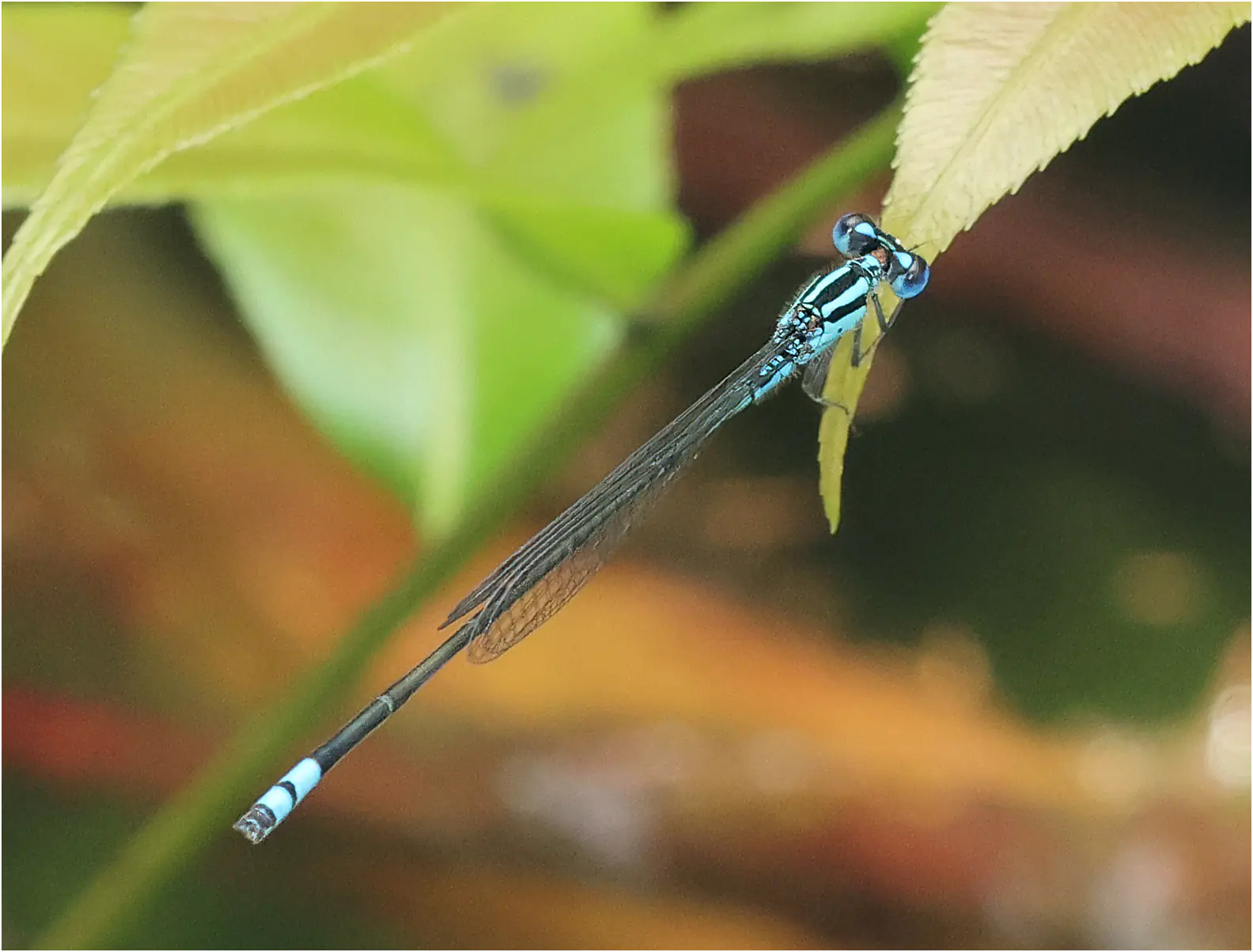
The exact size is also missing from Lieftinck's document; I assume its size is close to that of its double, P. microcephalum [now Pseudagrion siamense], which reaches 30 to 34 mm.
It is present in Borneo and presumably in southern Sumatra (there are two credible observations on iNaturalist).
IUCN Red List.
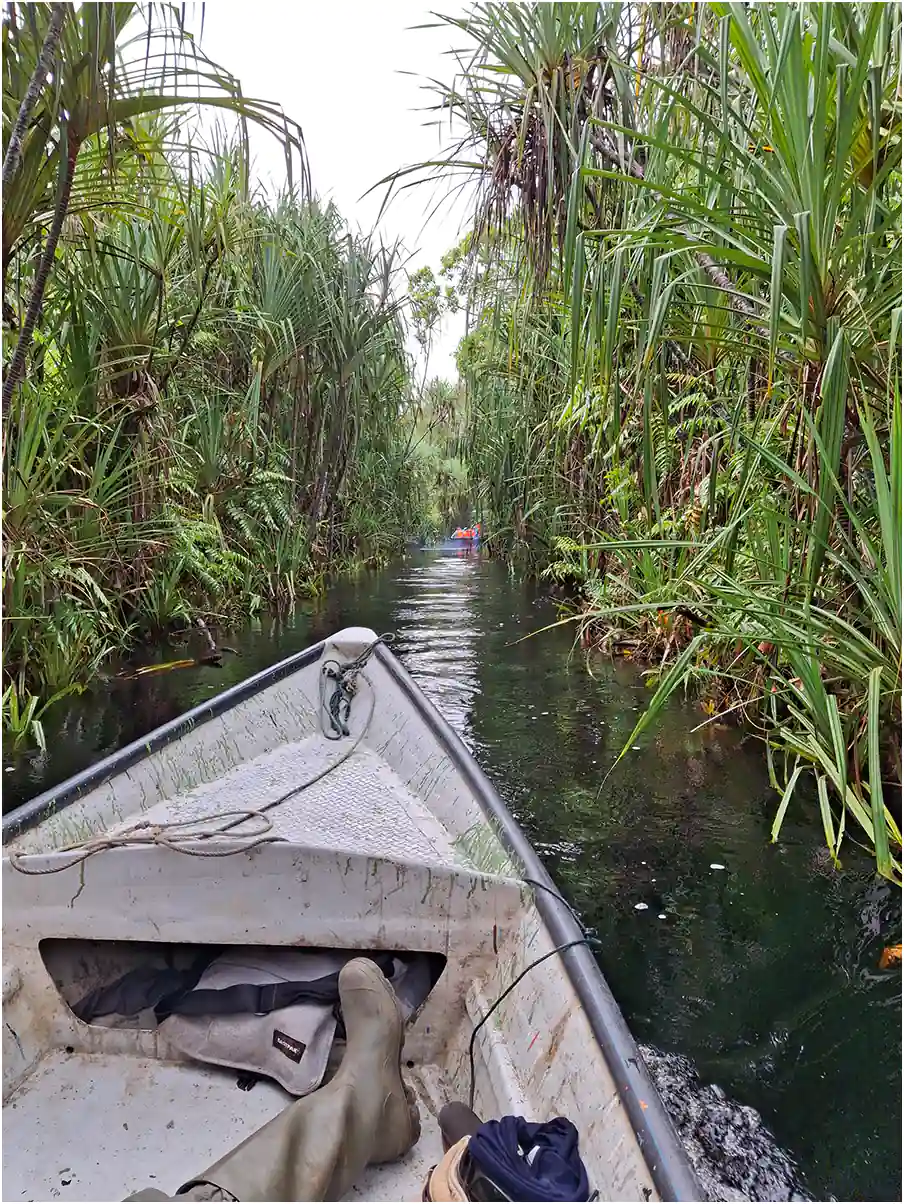
Here is the biotope in which we encountered it:
Etymology of Pseudagrion coomansi
Pseudagrion (2) from ancient Greek, pseudo, "false", "erroneous", and agrion, this, as Selys (1876) writes, to reflect the difficulty of separating this genus from Agrion; "Pseudagrions seem very close to true Agrions". Agrion, from ancient Greek Agrios for "wild", "living in the fields".
Coomansi is a tribute by Lieftinck to Louis Coomans de Ruiter (1898 - 1972), an ornithologist, botanist, entomologist, and collector who gathered a collection of 130 species in western Borneo for our author, at least 16 of which were new. Lieftinck also dedicated at least five other species to him: a Coeliccia, an Elattoneura, a Podolestes, a Leptogomphus, and a Libellago!
Maludan National Park, Malaysia, Sarawak, 28/03/2025
1- Lieftinck, 1937 – Descriptions and records of South–east Asiatic Odonata. Treubia 16: 55–119. P. 86.
2- The Naming of Australia’s Dragonflies, Ian Endersby & Heinrich Fliedner, Busybird publishing.