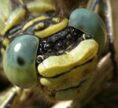

Stenagrion dubium is a Coenagrionidae featuring a very long abdomen, 40 mm (1) for a 7 mm thorax. Up close, it is very attractive, because while the blue spots at the tip of its abdomen add a bit of color, that is nothing compared to its face, eyes, and thorax, luminous yellow and green, dominated by an original blue pattern. And I couldn't resist having too many photos taken of this shadow sprite.


Stenagrion dubium is a damselfly whose colour blend I honestly loved; the pronotum is richly decorated with blue featuring an uncommon double central line that continues onto the rest of the thorax, and its antehumeral stripes are spectacularly "torn"—moreover, this is a feature that is not absolutely constant, as individuals with complete stripes can be found on iNaturalist.
It is quite difficult to find another damselfly with which it could be confused, in Borneo or anywhere else in Asia.
However, since Hämäläinen, 1997 (2), there has been another Stenagrion, Stenagrion petermilleri, of which I have not been able to find any photographs, but whose thorax forms "a mosaic of black, dark brown, blue, and olive-yellow". It is found exclusively in Palawan Province, Philippines.


We encountered it in the rain, but downpours must not matter to it, because it lives in the spray and splashes of waterfalls. Here, it was at the foot of a tiny waterfall, where a forest stream joins a ditch along the road. It was in good company, since with it—or rather in the vegetation-choked ditch—we discovered Coeliccia nigrohamata and cf. nemoricola, Drepanosticta rufostigma, and Devadatta clavicauda.

There are two forms (3) of Stenagrion dubium, which differ only in facial color: a form with a yellow face, the one we encountered around Kuching and in western Sarawak, and a form with a blue face throughout the rest of Sarawak, Brunei, Sabah, and Kalimantan.
Furthermore, it is endemic to Borneo.colour:
IUCN Red List.


Étymologie de Stenagrion dubium
Stenagrion, from the Greek stenos, meaning "narrow", and agrion, from the Greek agrios—wild, living in fields. Laidlaw (4) writes, "Body very slender...", which could explain the narrowness referred to. But he begins his description with "Wings petiolated to the level of A*". It is therefore also possible that, imitating Selys and his genus Stenobasis (which became Archibasis), he wanted to emphasise the long-petiolated wings (see the etymology of Archibasis melanocyana).
If he added the term Agrion, it is because he first described the species under the name Pseudagrion dubium (1), while expressing the reservations that justify its specific name.
Dubium, from the Latin dubium, meaning "doubt" or "hesitation", reflects the uncertainty regarding its placement in the genus Pseudagrion. It was Laidlaw himself who, in 1915 (4), supported by Ris's doubts, created the genus Stenagrion for it.
1- Laidlaw, 1912 - List of the Odonata taken on a expedition to Mt. Batu Lawi together with description of supposed new species - Journal of the Straits Branch of the Royal Asiatic Society, No. 63 - P. 102.
2- Hämäläinen, 1997 - Stenagrion petermilleri spec. nov. from Palawan, the Philippines (Zygoptera : Coenagrionidae) - Odonatologica 26(4) : 473-475
3- Dow, 2019 - Odonata from Sri Aman Division south and west of the Lupar River and from the Kelingkang Range, Sarawak - Journal of the International Dragonfly Fund 137 (1-26).
4- Laidlaw, 1915 - Contributions to the study of the dragonfly fauna of Borneo. Part III. A collection made on Mount Kina Balu by Mr J.C. Moulton in September and October 1913. Proceedings of the Zoological Society of London, 1915, 25--39. P. 39.