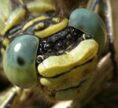
There are currently 88 species of Teinobasis (22 have been discovered since 2005) distributed from Southeast Asia to Australia, where Teinobasis rufithorax is found, which I had the pleasure of encountering. Before this trip to Borneo, I had never encountered another member of this genus in Asia; in Sarawak, we encountered three: Teinobasis cryptica, T. ruficollis, and T. suavis.


We only encountered a single female in a swampy forest peat bog, in the company of Rory Dow (1); what could be better than encountering a species in the presence of its describer at the site where the holotype was collected?
Moreover, and this is quite a stroke of luck for an amateur, Teinobasis cryptica is distinguished from all other Teinobasis (at least in Sundaland) by the fact that the dorsal surface of the thorax is pale, not covered with black colouration: "Easily distinguished from other Teinobasis species known to occur in Sundaland by the pale dorsum of the synthorax in both sexes" (1).
The abdomen of the female measures 31.5 mm (excluding the ovipositor and anal appendages); it presumably measures around 37 mm.
Rory Dow told us that he thought the males lived in the canopy; Robin Ngiam & Marcus Ng stated that they saw both sexes hanging underneath leaves (2) in the shade.

The photograph opposite, showing Rory Dow examining one of his captures, was taken a few minutes after those of this female T. cryptica and gives an idea of its biotope: a swampy forest where every step can hold a surprise...
It is currently known in Borneo only from Sarawak and Brunei, but also from Peninsular Malaysia and Singapore.
IUCN Red List.
Etymology of Teinobasis cryptica
Teinobasis (3); Selys had described this species as belonging to Telebasis, which is an exclusively American genus. When Kirby created this new genus in 1890, he replaced the Greek word tele, meaning "at a distance", with teino, meaning "to extend", in order to emphasise the fact that the wing is very petiolate and that this narrowing extends, in Selys's own words, "to the origin of the quadrilateral beyond the postcostal vein".
Cryptica: Let's let R. Dow (1) explain this choice: "An adjective, from the Latin crypticus. Named for its cryptic colouration and behaviour. An adjective derived from the Latin crypticus, designating a species whose colouration and behaviour are mysterious."
1- Dow, 2010 – A review of the Teinobasis of Sundaland, with the description of Teinobasis cryptica sp. nov. from Malaysia (Odonata: Coenagrionidae) – International Journal of Odonatology 13 (2) 2010 : 205-230.
2- Robin Ngiam & Marcus Ng – A photographic guide to the Dragonflies and Damselflies of Singapore – John Beaufoy Publishing – 2022
3- The Naming of Australia’s Dragonflies, Ian Endersby & Heinrich Fliedner, Busybird publishing.