Identification of Neurothemis terminata males
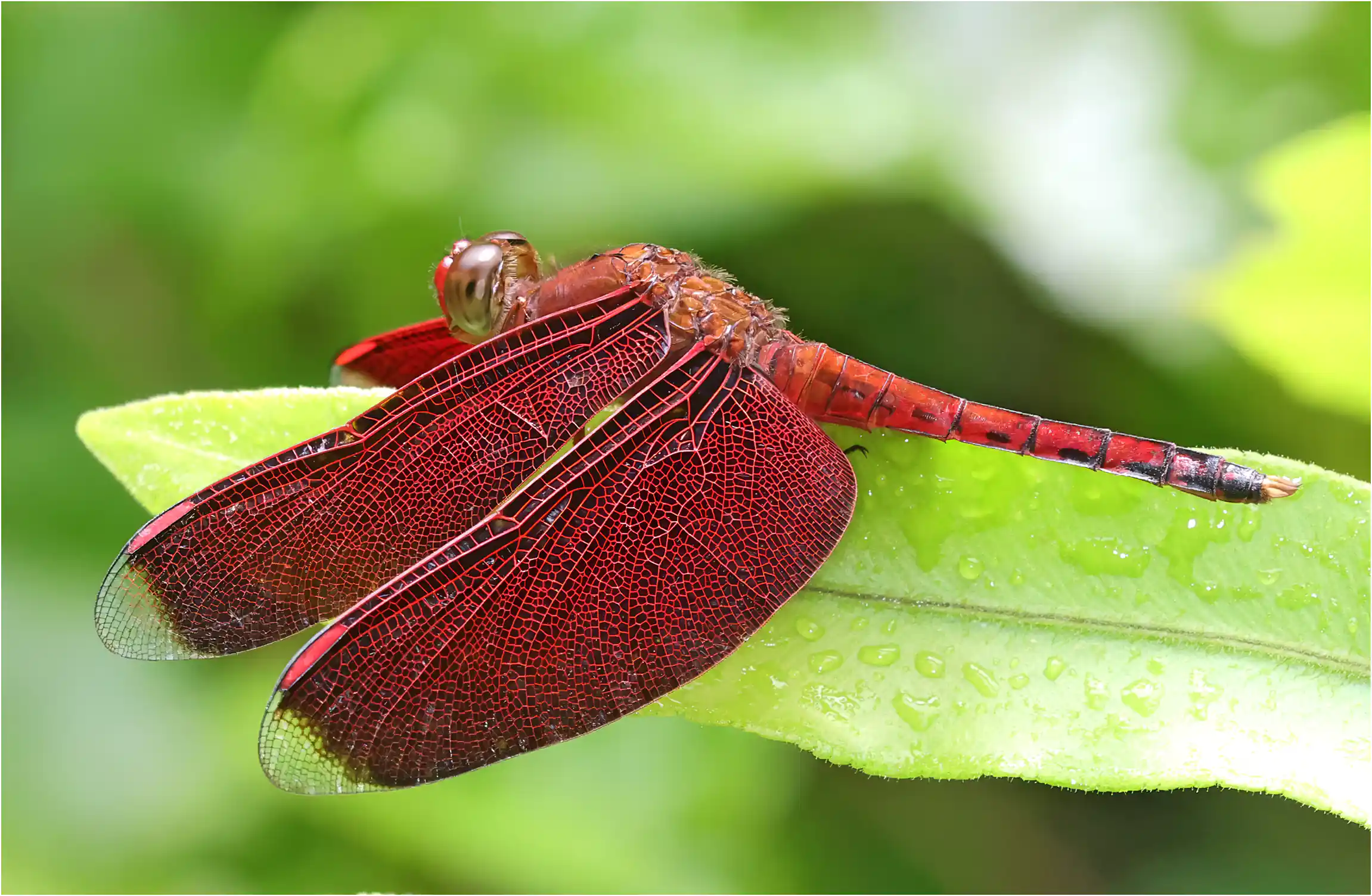
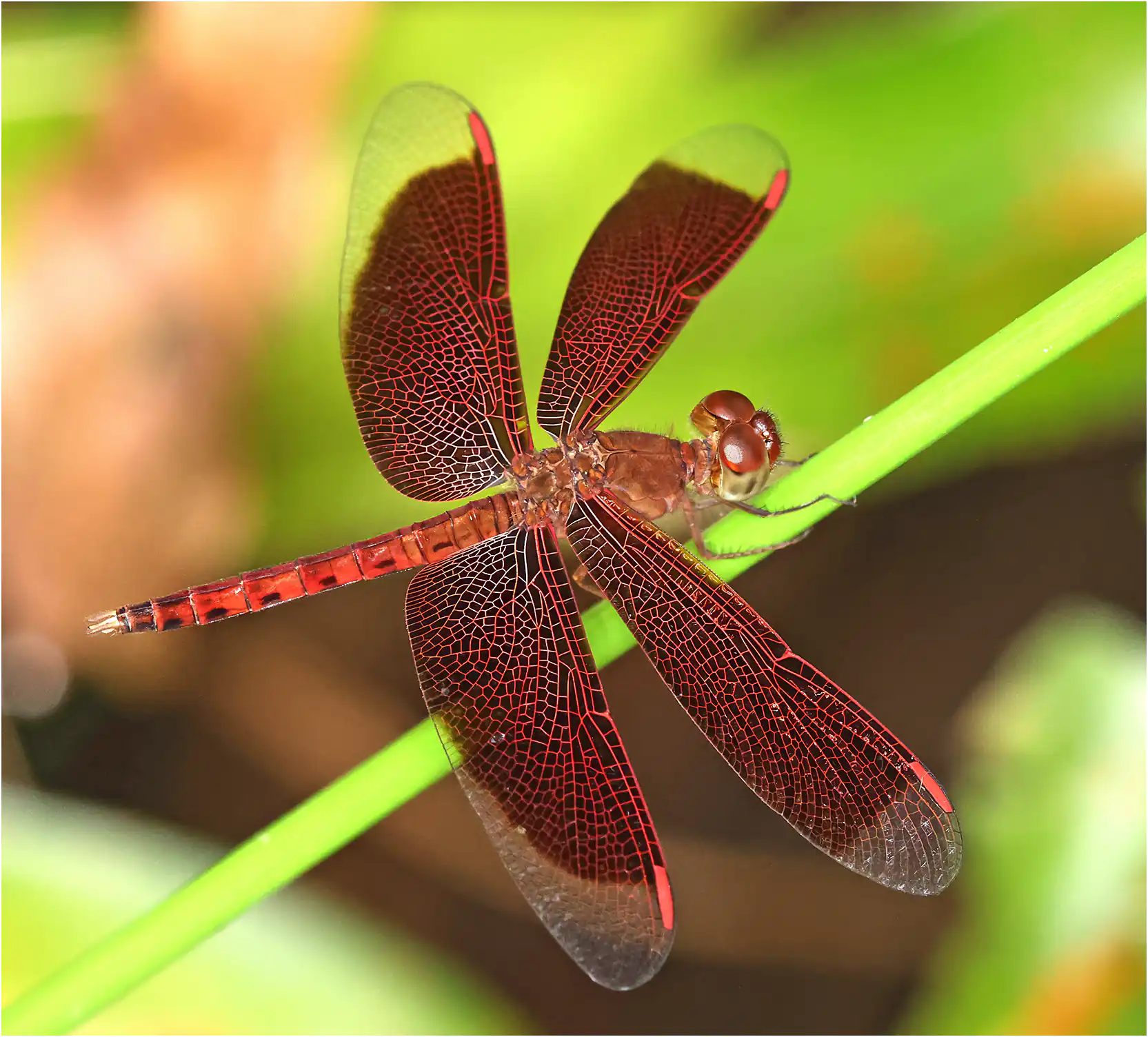
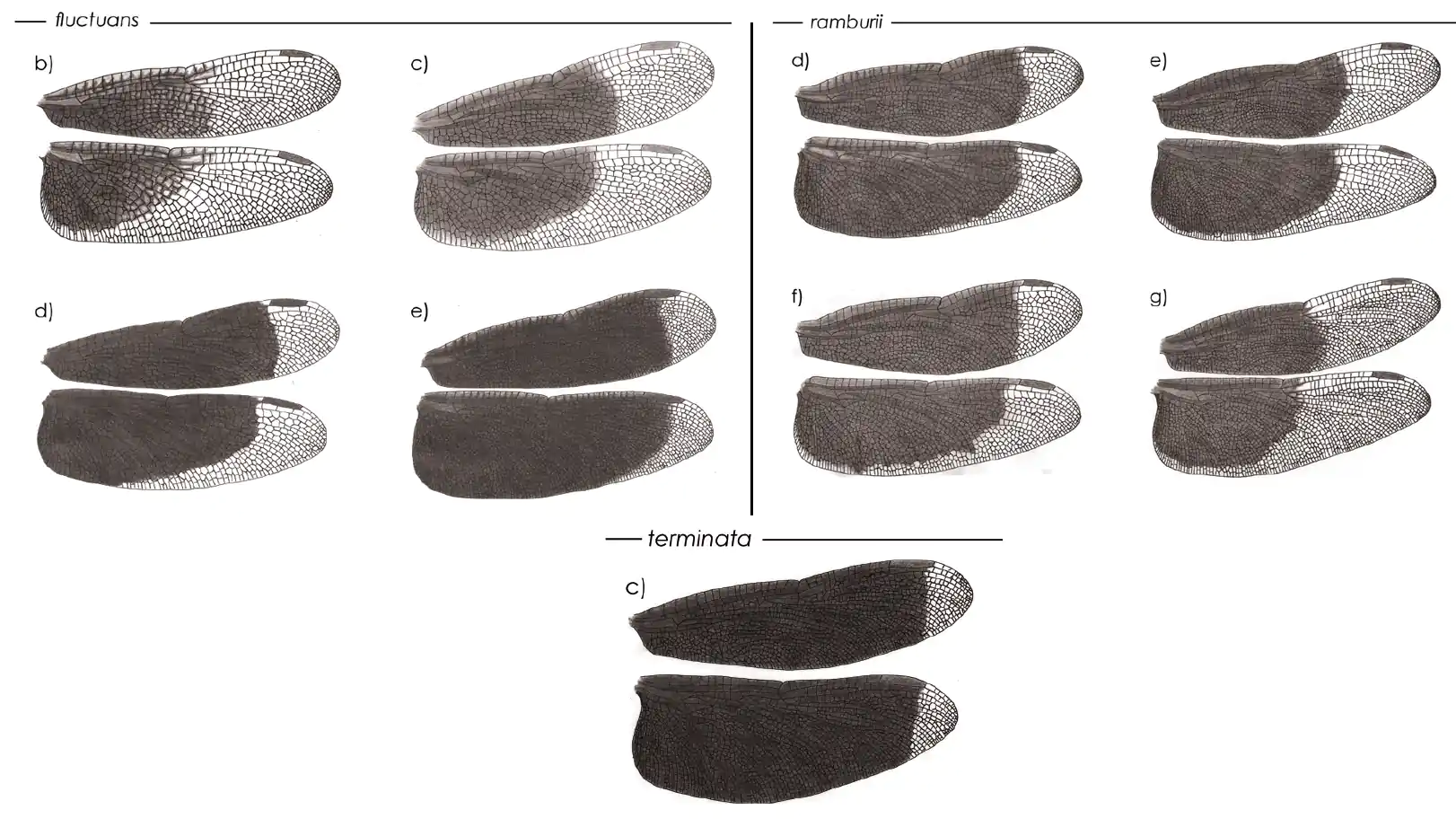
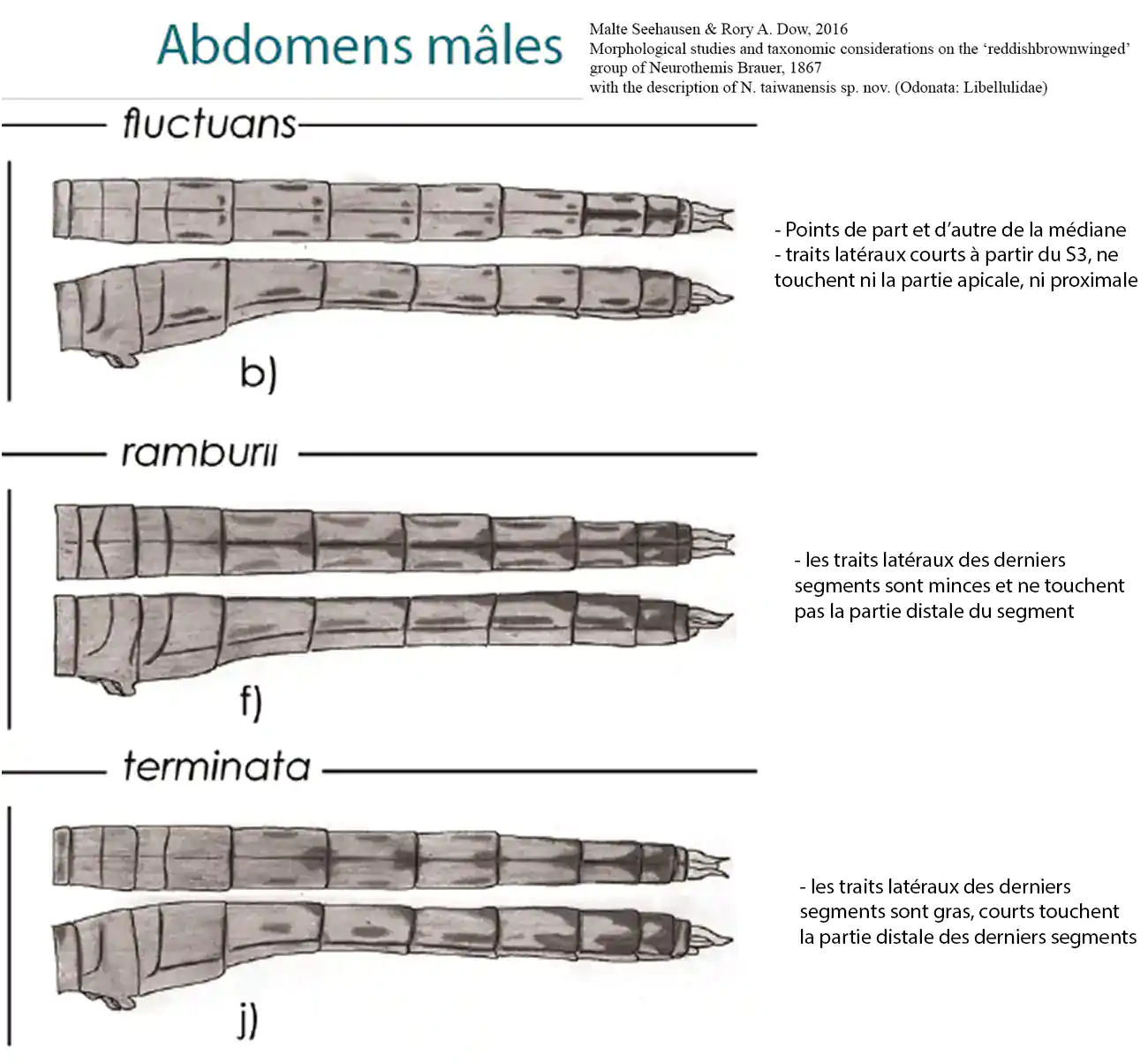
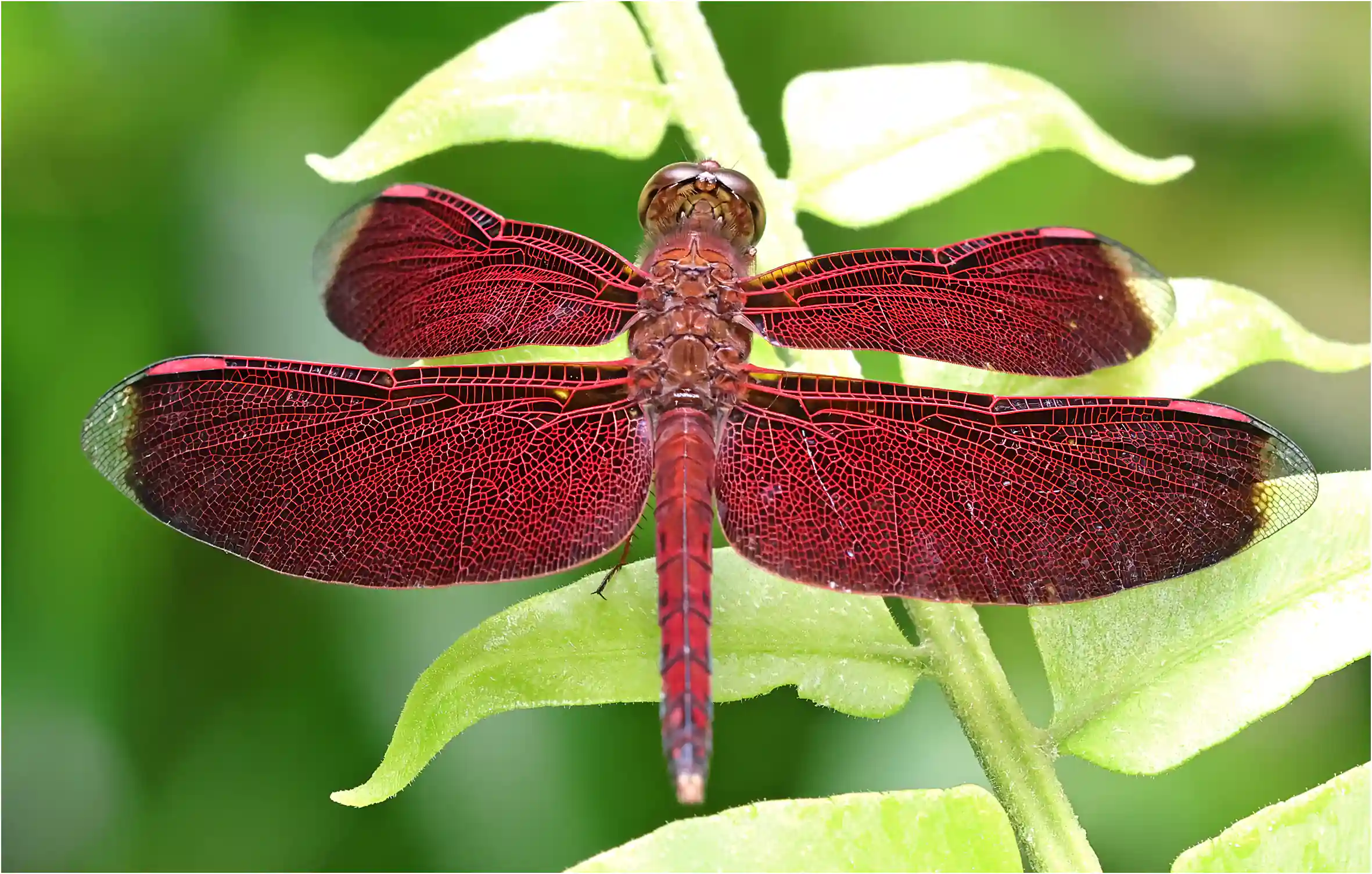
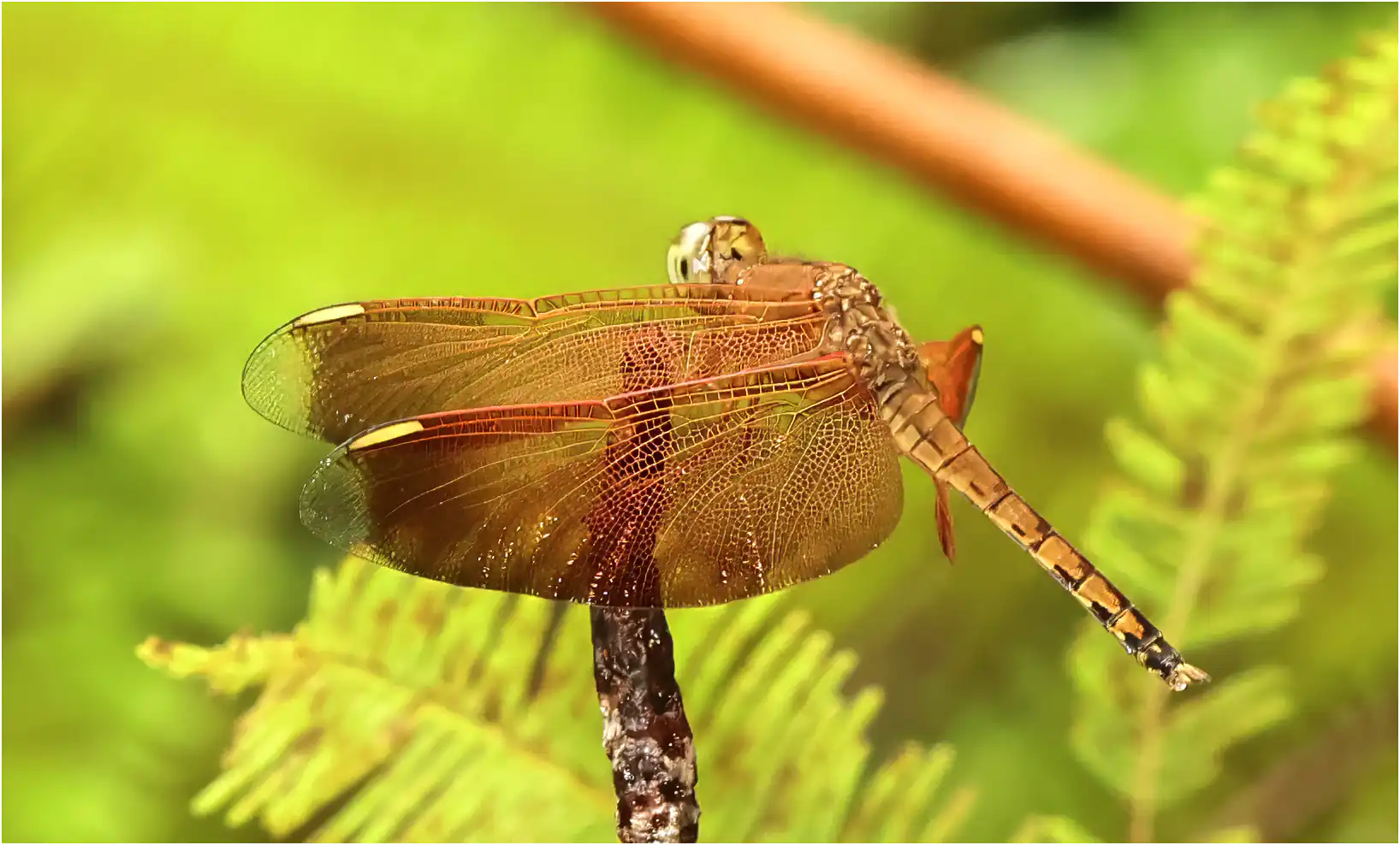
There are three Neurothemis species in Sarawak and Neurothemis terminata is the easiest to identify and separate from its two cousins N. ramburii and N. fluctuans. While all three are generally red with red wings, N. terminata is the only one whose hindwing coloration ends in a straight line at or beyond the pterostigma. For the other two, the hindwing coloration recedes toward the base.
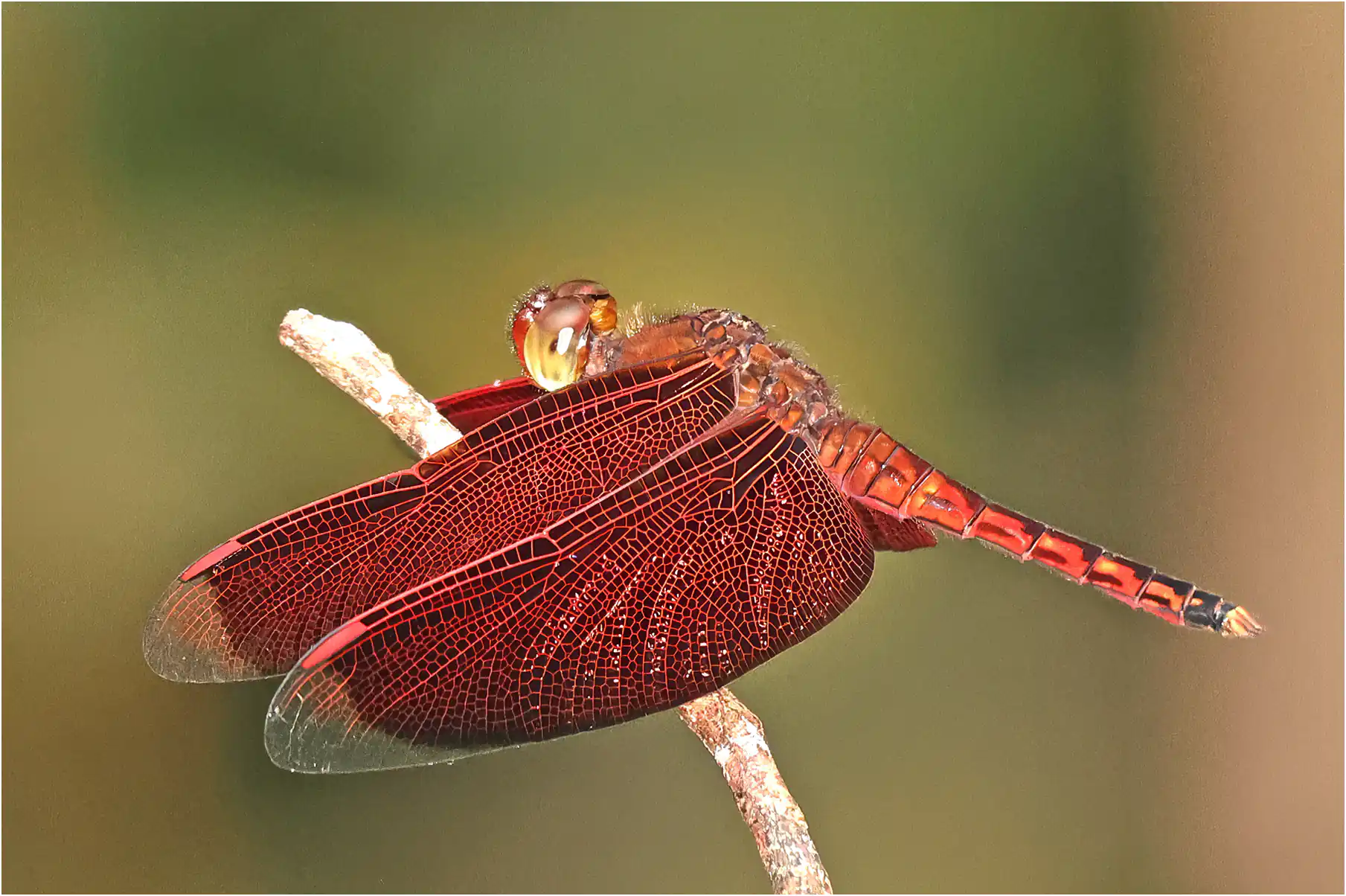
It is also distinguished by the lateral abdominal patterns, which, unlike in N. ramburii, are located in the distal part of the last segments.
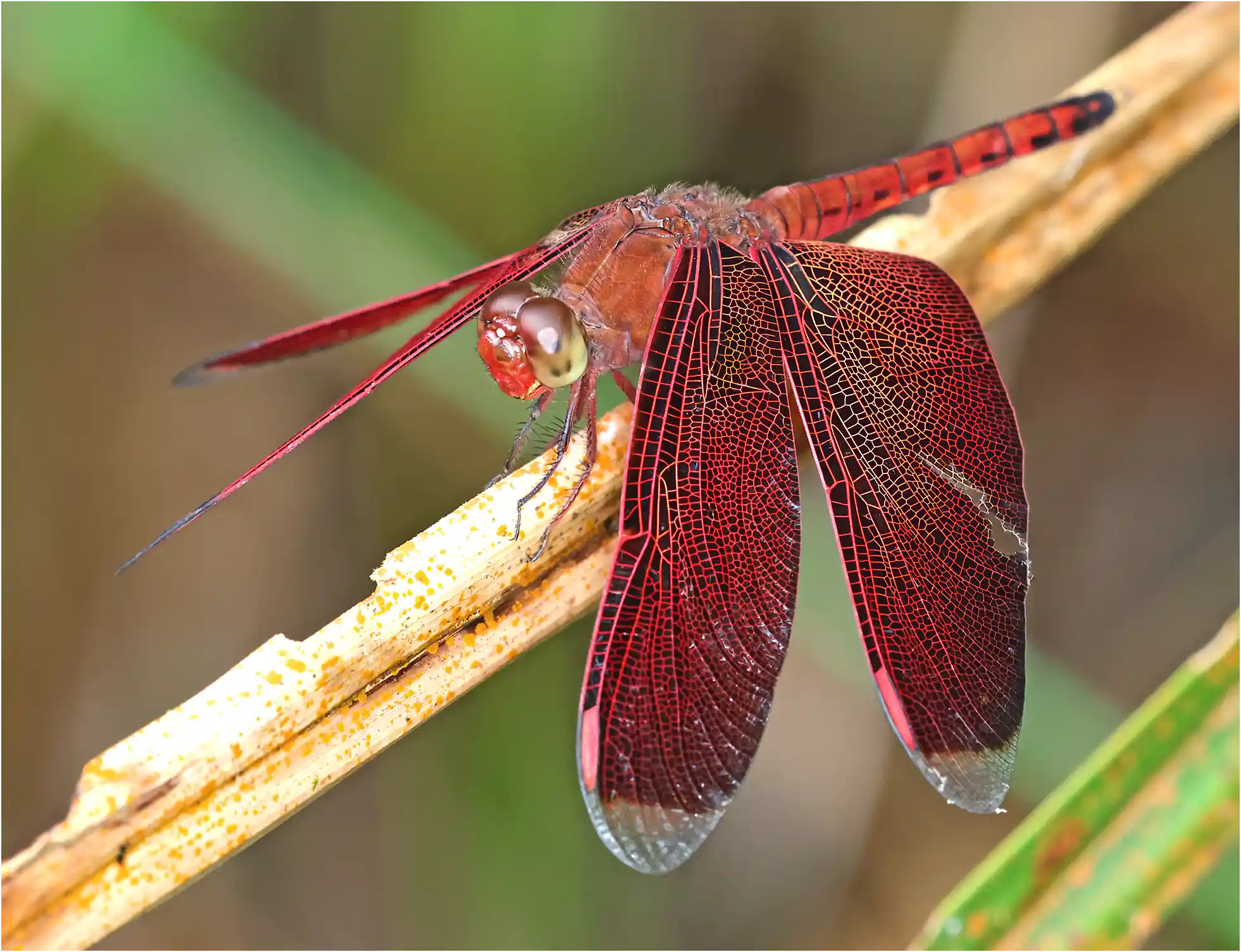
Neurothemis abdomens males in Sarawak, according to Seehausen & Dow, 2016 (1)
Size and habitat
It is roughly equivalent in size to N. ramburii, ranging from 32 to 43 mm.
We encountered them in the same type of habitat as the other two Neurothemis, which adds to the difficulty of identification in the field. It thrives in shallow waters and open environments such as ditches, irrigation canals, rice paddies, marshy areas, ponds, and streams—especially in human-modified areas!
Identification of Neurothemis terminata females
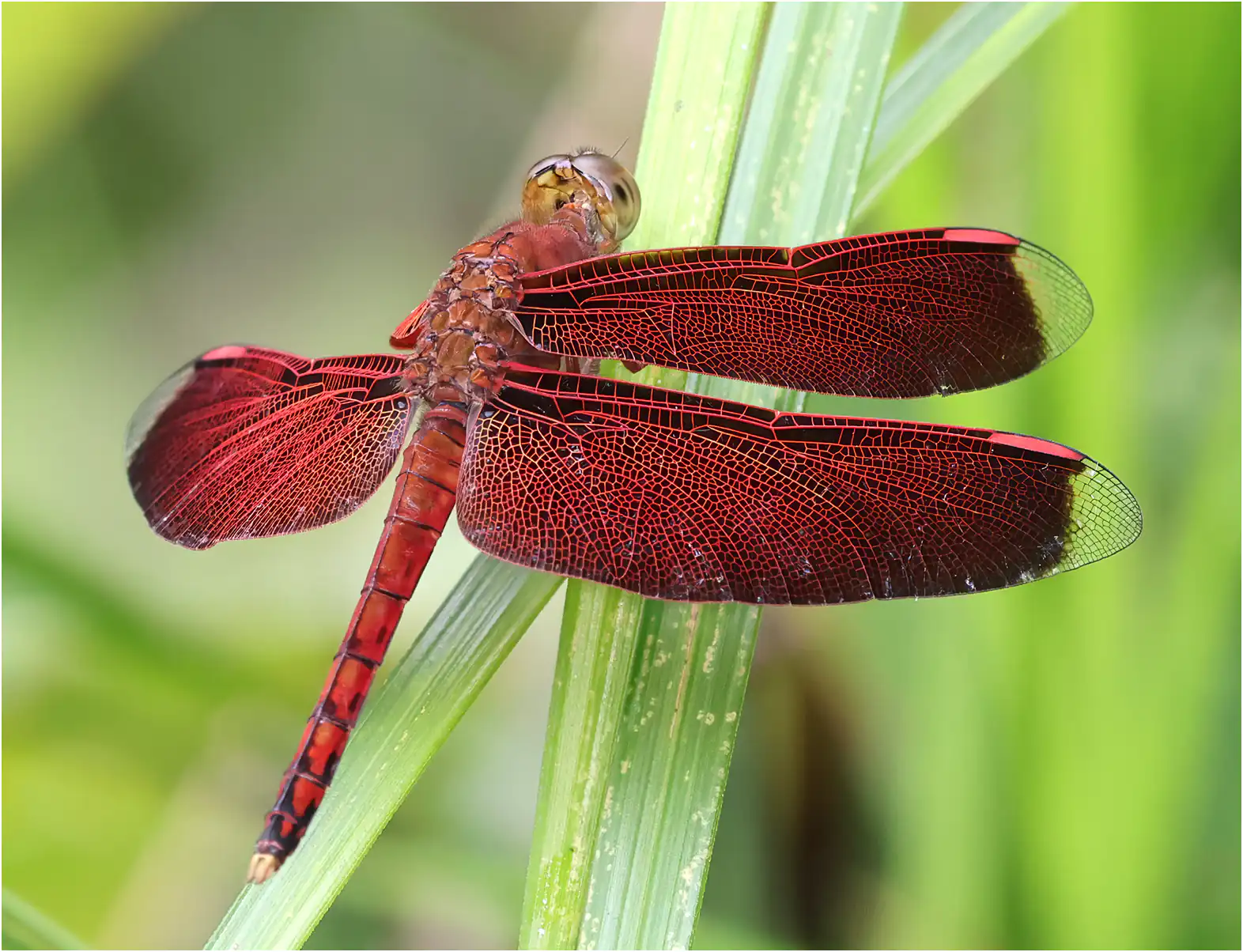
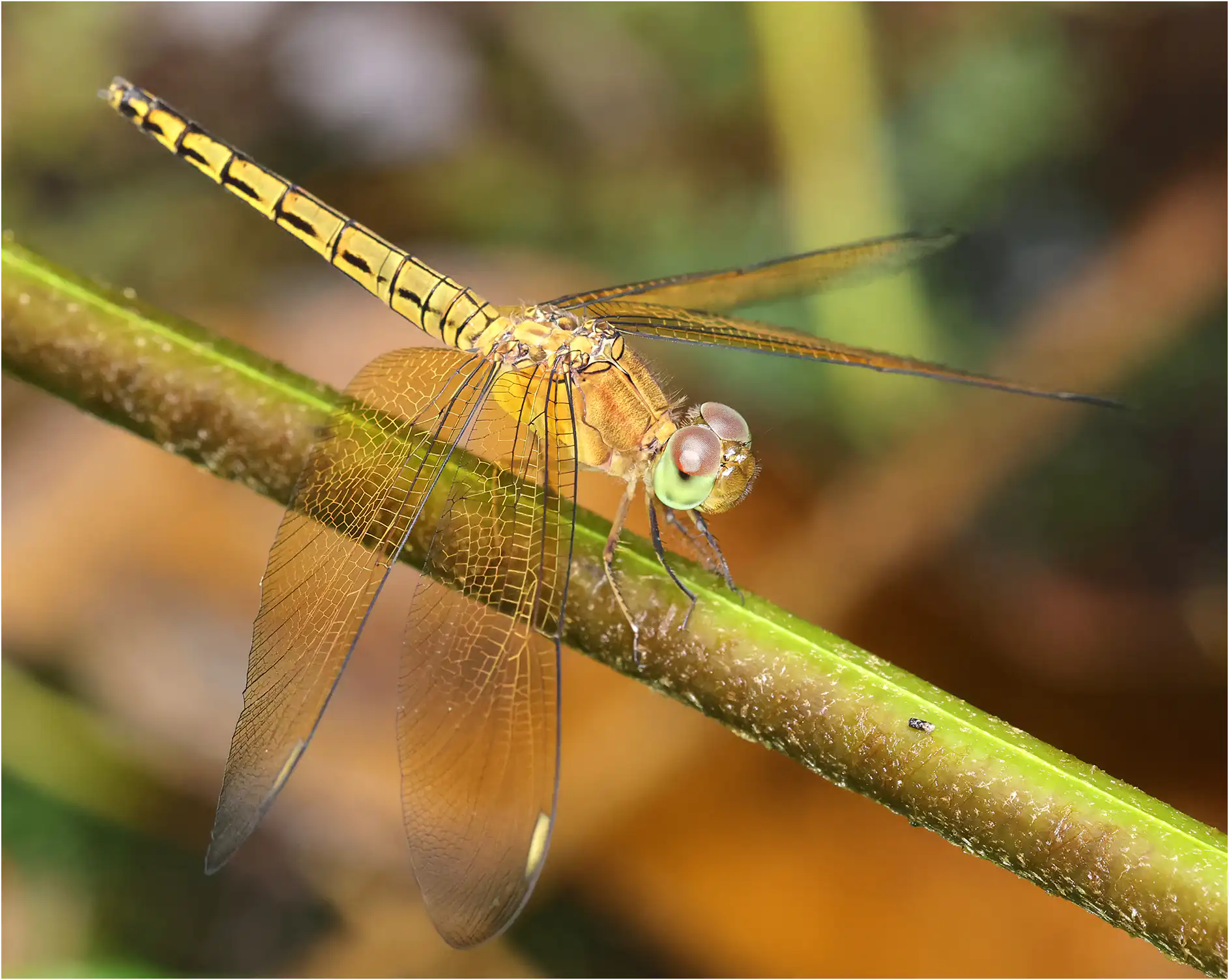
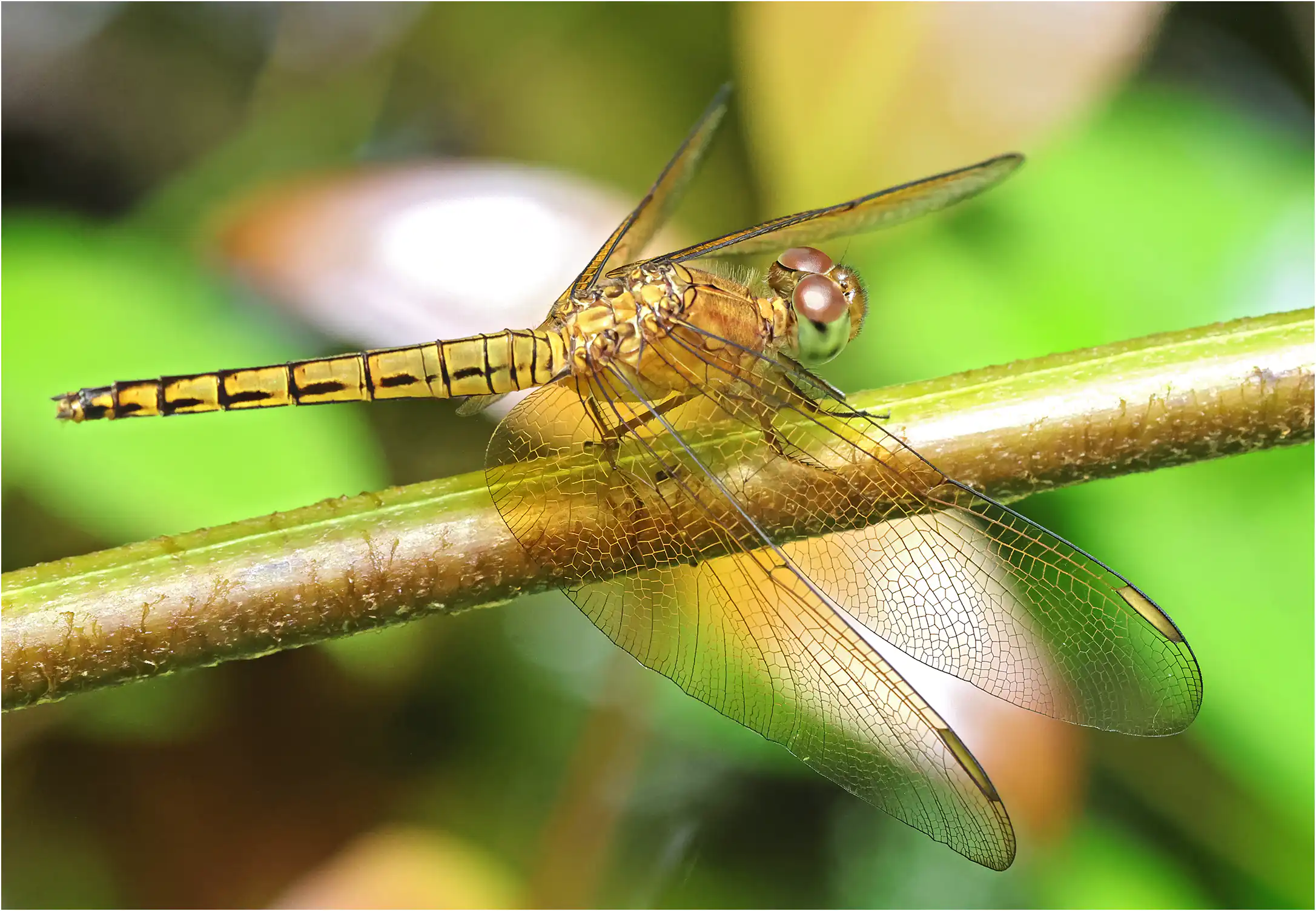
As with the males, one can rely on the abdominal markings to separate the females of the three species; those of N. terminata females have lateral abdominal stripes very distinctly shifted toward the distal part of the abdominal segments. In addition, on the young individual below, one can make out a developing wing colouration, which extends far out on each wing and ends in a straight line on the hindwing.
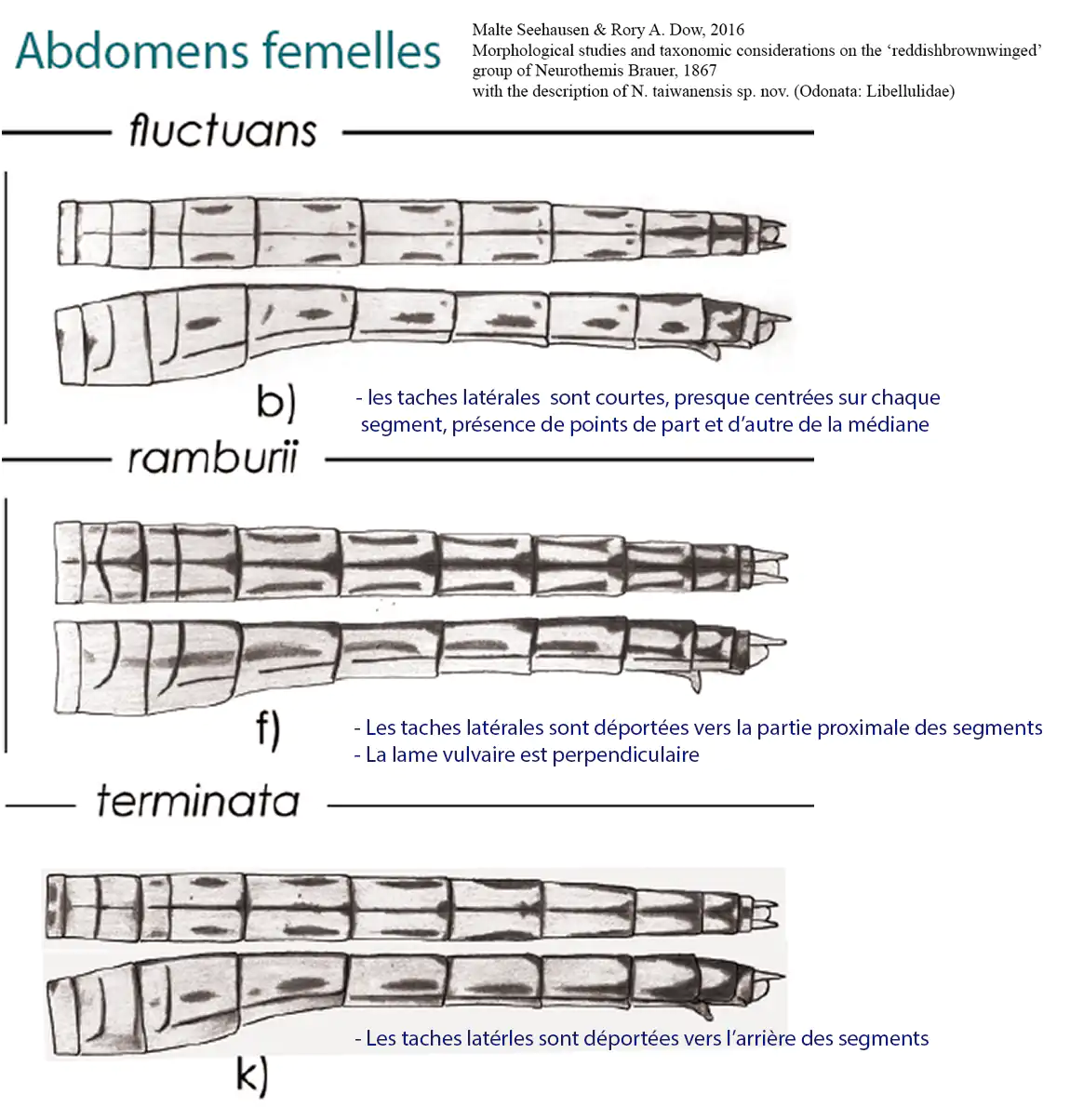
Abdomens of Neurothemis females in Sarawak, according to Seehausen & Dow, 2016 (1)
Geographical distribution
Its distribution extends from the Philippines to Borneo, Bali, Java, and Sumatra.
IUCN Red List.
Etymology of Neurothemis terminata
The species was named Polyneura apicalis by Rambur, 1842.
Neurothemis (3), from the Greek neuro for "nerve" or rather "wing venation" in entomology, and Themis—the Greek goddess of order and justice, which has been used many times since Hagen (1861). The name of the goddess of order is particularly well suited to taxonomy, the science that aims to describe and order families, genera, and species. Brauer created this genus name in 1867 to replace the genus Polyneura, created by Rambur in 1842, because the latter was already in use among Hemiptera. This genus name, like the current name, was intended to emphasise the large number of cells in their wings.
Terminata (4), from the Latin terminatus for 'terminated', limited, of course, in reference to the terminal arrangement of the wing colouration. And if Ris did not retain the species name apicalis, it was because it was preoccupied by Libellula apicalis (Guérin-Méneville, 1830), which would become Neurothemis fulvia!
Its English common name recalls the shape of the wing colouration at the apexes and also emphasises the position they adopt at rest, with the wings held lower than the rest of the body, shading their thorax from the sun: Straight-edge Red Parasol.
One last photo, not very good, of an immature male whose thorax and abdomen still retain their "female"-type colouration.
Bibliography
1- - Malte Seehausen & Rory A. Dow, 2016 – Morphological studies and taxonomic considerations on the ‘reddishbrownwinged’ group of Neurothemis Brauer, 1867 with the description of N. taiwanensis sp. nov. (Odonata: Libellulidae) – Journal of the International Dragonfly Fund.
2- Ris, F, 1911 - Libellulines, Vol. 2. Collections Zoologiques du Baron Edm. de Selys Longchamps, Catalogue systématique et descriptif - Hayez, Bruxelles. P. 348. (I would like to especially thank Rory Dow here, who, in the papers he publishes alone or with co-authors, cites all sources and thus spares hours of research to find the original descriptions. If I am pointing this out, it is because this is often not the case, and older publications are then very difficult to find because the species name, the genus name, or both have changed! )
3-The Naming of Australia’s Dragonflies, Ian Endersby & Heinrich Fliedner, Busybird publishing.
4- Fliedner, 2023 - The scientific names of Ris' odonate taxa, IDF Report.