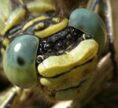

Description of Agrionoptera sexlineata
AAgrionoptera sexlineata is a spectacular Libellulidae with yellow eyes surmounted by brown, featuring a glossy black frass, and a metallic green thorax marked with three yellow lines on each side. A bluish pruinosity develops between the wings and extends onto the first abdominal segments. These segments are dorsoventrally flattened and dark in mature individuals, with ultimately only S6 and S7 remaining bright red.
The hindwings are narrow at the base and all four wings are apically spotted.

Identification
This species is new to me, and in the field, I had a hard time separating it from Nesoxenia lineata, of which I had previously seen only a single female in Peninsular Malaysia. But the latter shows greyish-blue eyes, broader yellow lines on a darker thorax, a slenderer abdomen, and its S8 is extensively red (black in Agrionoptera sexlineata).

It is said that it can also be confused with its cousin Agrionoptera insignis; while the latter's eyes are pale, its thorax is very dark and its abdomen is entirely red, except for the last three segments. Brauer, who created the genus Agrionoptera in 1864, saw no difference.
It should be noted that this confusion is highlighted in the English vernacular names; while it is quite logical for both Agrionoptera species to receive the same genus name "Grenadier"—Grenadier for A. insignis and "Handsome Grenadier" for A. sexlineata—N. lineata is given the name "Striped Grenadier" even though it obviously belongs to another genus! I suppose this name comes from The Grenadiers, an infantry regiment of the Indian army (before independence) whose uniform featured a long red tunic over blue trousers.
There is even a "Scarlet Grenadier", Lathrecista asiatica!


Size, habitat and geographical distribution
Agrionoptera sexlineata measures 40 to 44 mm in total length in Singapore, according to Ngiam & Ng (2). Selys measures the abdomen of his specimen, which comes from Malacca (Peninsular Malaysia), at 24–23 mm (sic) (1), which gives a total length of about 38 mm.
It favours marshy forest ponds littered with leaf litter, perching on a twig overlooking the body of water. This was indeed the case for the subject above, but the first one was undoubtedly roaming in a much more open habitat, without a body of water in its immediate vicinity.
The magnificent female below was observed not far from a forest river. Unfortunately, I did not realise that my flash was not firing, and the photos are underexposed and not very sharp.


Note the yellow line running along the dorsal surface of the abdomen up to the seventh abdominal segment and the dark spot at the wing apex.
Its distribution includes Borneo, Sumatra, Singapore, and the southern half of the peninsula.
IUCN Red List.


Étymologie d'Agrionoptera sexlineata
The etymology of Agrionoptera presented by Enderby & Fliedner (1) is somewhat complex; Agrion (from the Greek agrios – living in the fields, wild) is the name used by Fabricius to designate all zygopterans, while in the second part of the genus name, one recognises the Greek word ptera meaning "wing" or "winged" (a component of many words in our entomological vocabulary, such as apterous or dipteran). When Brauer created this genus name in 1864, he wanted to emphasise the similarity of the wings with those... of zygopterans (or Agrion for Fabricius), citing the genus Euphaea or the Calopterygidae.
Sexlineata, from the Latin sex for "six" and lineatus for "striped" (furnished with lines), naturally refers to the thorax of the species; Selys writes (1): "Bronze thorax with a dorsal line and three narrow sinuate yellow stripes on each side."
1- Selys, 1879 - Nouvelles observations sur les odonates de la région de Nouvelle-Guinée - Annali Del Museo Civico Di Storia Naturale Genova, in volume 14, pages 287-324 - P. 304.
2- Robin Ngiam & Marcus Ng - A photographic guide to the Dragonflies and Damselflies of Singapore - John Beaufoy Publishing – 2022.
3- The Naming of Australia’s Dragonflies, Ian Endersby & Heinrich Fliedner, Busybird Publishing 2015.