I have met the male Agrionoptera insignis in Malaysia in 2013, in poor conditions, then in 2022, both males and females, in northern Australia (Northern Territory, then far north Queensland), the subspecies known as allogenes. At the time, I did not know what distinguished this subspecies from the others and I still do not, especially since there are numerous subspecies, and many species and subspecies (thirteen, including allogenes) have been synonymized with Agrionoptera insignis.
In Sarawak, I only briefly saw a single male.
Identification of Agrionoptera insignis
With almost its entire slender abdomen red, except for the first and the last three segments, which are black, in Borneo it can only be confused with Lathrecista asiatica (seen here in Peninsular Malaysia), which has grey-blue eyes, a lighter thorax and first segment that becomes covered in bluish pruinosity with age, and above all, only the last two segments black (again in Peninsular Malaysia).

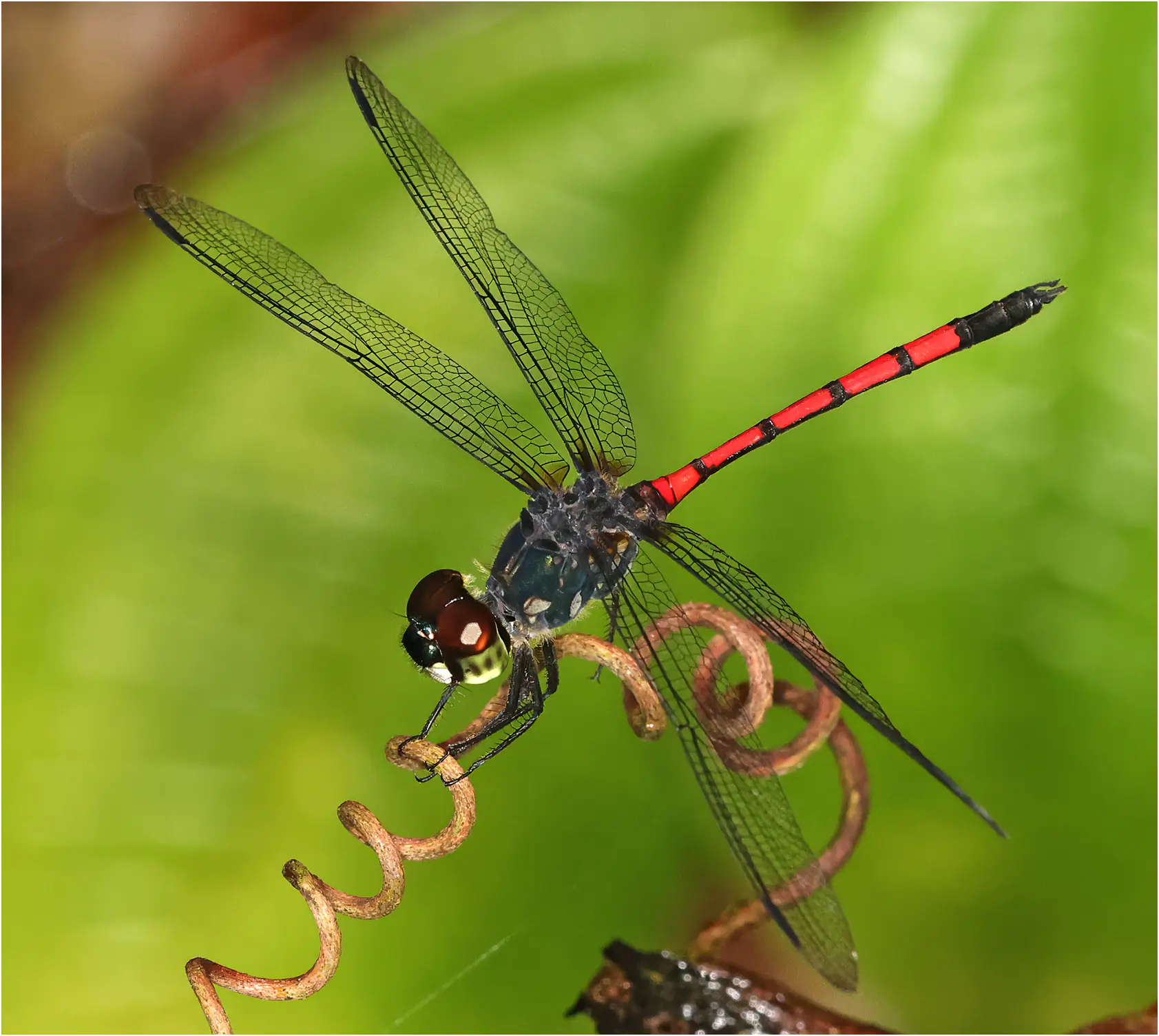
Note above the narrowness of the wing base, which Jules Rambur had clearly noted (1).
Size, habitat, and geographical distribution
Ngiam & Ng (2) tell us that in Singapore, it measures 37 to 41 mm.
Male Agrionoptera insignis is found near slow streams or rivers, on forest ponds, or at forest edges. It readily perches on a support above the water, from where it attacks conspecifics passing through its territory in battles where individuals face each other in a spectacular wheeling display.
It is found from Myanmar to southern Japan, via Hainan, down to New Guinea and northern and eastern Australia, across Malaysia, Indonesia, the Philippines, Borneo, Sumatra, and all the Austro-Pacific islands.
Etymology ofAgrionoptera insignis
The etymology of Agrionoptera presented by Enderby & Fliedner (1) is somewhat complex; Agrion (from the Greek agrios – living in the fields, wild) is the name used by Fabricius to designate all zygopterans, while in the second part of the genus name, one recognises the Greek word ptera meaning "wing" or "winged" (a component of many words in our entomological vocabulary, such as apterous or dipteran). When Brauer created this genus name in 1864, he wanted to emphasise the similarity of its wings to those... of zygopterans (or Agrion for Fabricius), citing the genus Euphaea or the Calopterygidae.
Insignis, from the Latin insignis for "distinctive", "remarkable" (insignia), and Rambur writes: "This species is very remarkable for the narrowness of the base of the hindwings."
Note that in English vernacular language, it is called simply "Grenadier". Its cousin Agrionoptera sexlineata is named "Handsome Grenadier", while Lathrecista asiatica is named "Scarlet Grenadier", and Nesoxenia lineata is the "Striped Grenadier". The term "Grenadier" is therefore used for different genera...
I suppose this term comes from the pre-independence Indian infantry regiment, "The Grenadier", whose uniform featured a long red tunic over blue trousers, since these odonates all wear, to varying degrees, red and blue.
1- Rambur, Jules, 1842 – Histoire naturelle des insectes. Névroptères – Librairie encyclopédique de Roret. pp. 534 [123]
2- Robin Ngiam & Marcus Ng - A photographic guide to the Dragonflies and Damselflies of Singapore - John Beaufoy Publishing – 2022
3- The Naming of Australia’s Dragonflies, Ian Endersby & Heinrich Fliedner, Busybird Publishing 2015