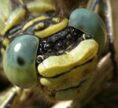

Prodasineura notostigma (1) (Platycnemididae) belongs to a genus comprising 39 species and numerous subspecies. Sixteen species (2) are present in Borneo (2 not yet described in 2013), including 13 in Sarawak (3). Some are very inconspicuous, very rarely encountered, and have a very restricted distribution range, while others are common and more widespread—such is the case with this Crescent Threadtail, as it is called in Singapore.

It is not difficult to identify due to the shape of the light blue antehumeral stripe, which is crescent-shaped (Crescent), its blue face, and its completely black abdomen with the exception of a thin, elongated spot on the second segment. It measures 34 to 37 mm (4) with an excessively thin abdomen.
It is one of those odonates sensitive to flash light—especially to pre-flashes, that small burst emitted by the flash to gauge the amount of light required to correctly expose the subject, which is invisible to us. This very faint flash very often causes the insect to flinch or take off immediately, and the main flash then captures it in flight, and if you are lucky, the photo is sharp, or nearly so, as below.

Prodasineura notostigma is found in forests along slow-moving rivers. Here, it was found alongside Telosticta santubong. Its distribution extends across Malaysia and Singapore to northwestern Borneo and Sumatra. Here, in peninsular Malaysia.
IUCN Red List.

Etymology of Prodasineura notostigma
Selys described the species in the genus Alloneura. However, this genus name was preoccupied by a dipteran described by Rondani in 1856.
Prodasineura (Cowley, 1934) (2); I was unable to access the document in which Cowley separates this genus from Alloneura (Selys, 1860). In any case, Cowley finds the genus "Alloneura, Selys" very close in venation to Disparoneura, the etymology of which means "distinct venation". To emphasise this specific characteristic and proximity, he created this anagram of Disparoneura to place the Alloneura within it.
Notostigma ; "not", in Greek, for "the back", and "stigma",0 in Latin, meaning "brand mark" or "spot", to emphasize the light spot on the second segment of an otherwise black abdomen. Selys wrote: "Une tache étroite oblongue au 2ᵉ segment... - A narrow oblong spot on the 2nd segment..."
1- Selys, 1860 – Synopsis des Agrionines – Dernière légion : Protoneura - p. 452.
2- Dow & Ngiam, 2013 - Prodasineura yulan (Odonata: Zygoptera: Platycnemididae), a new species from Sarawak - Zootaxa 3670 (1): 087–090
3- 2- Dow, 2021 – AN ANNOTATED CHECKLIST OF THE ODONATA (INSECTA) KNOWN FROM SARAWAK WITH RECORDS TO DISTRICT LEVEL – Sarawak Museum Journal · January 2021
4- Robin Ngiam & Marcus Ng - A photographic guide to the Dragonflies and Damselflies of Singapore - John Beaufoy Publishing – 2022