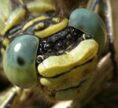

Amphicnemis cf. dactylostyla is an as yet undescribed Coenagrionidae, closely related, of course, to its cousin A. dactylostyla described by Lieftinck, 1953 (1). It belongs to a very difficult genus that currently includes 22 species in Asia and 12 in Borneo.
Some of them are very similar and can only be distinguished by the presence of a possible spine on the pronotum or by a thorough examination of the anal appendages.
Identification was provided here by Rory Dow, the specialist in odonates of this large island, who was in the field with us and used this name.

Here, identification is greatly facilitated by the fact that the pterostigmata of the hindwings are yellow, while those of the forewings remain orange or light brown.
They are characterised by the metallic green colour of the upper parts of the thorax and abdomen, while the lower parts are yellow, a very pale final segment and appendages, this abdomen being excessively long compared to the thorax.
In describing A. dactylostyla, Lieftinck wrote, "This new species is the third member [along with A. platystyla and A. martini] of a small group of Amphicnemis from Borneo, characterised by a combination of morphological features. The most striking are the square shape of the pterostigma, the unarmed posterior prothoracic lobe [without a spine], and the short lower branch of the male's superior anal appendages." A. cf. dactylostyla is therefore certainly a fourth species of this small group.
However, it differs from these by the colouration and shape of the pterostigmata and that of the superior anal appendages (the inferior ones are rudimentary and barely visible in the photos).


In fact, it is classified by Dow (2) under the heading Amphicnemis martini complex in this 2021 document, where he refers to another paper, including Dow & Reels, 2010 (3) where he writes about this Amphicnemis sp.: "Problematic Amphicnemis taxa that are the subject of ongoing investigation". This investigation or research has apparently not yet reached a conclusion, since in March 2025, in this peat swamp forest, Rory Dow still referred to it as A. cf. dactylostyla.
I do not know its size, though it is likely similar to other Amphicnemis species, under 40 mm.

Its distribution is obviously not precisely known; it is certainly endemic to Borneo, perhaps even to Sarawak.
I assume that this female, found among these males, belongs to the same species; the pterostigmata are distinctly duller, as is often the case for females of all genera.

Etymology of Amphicnemis dactylostyla
Amphicnemis (Selys, 1863): Amphi— from the Greek ἀμφί, meaning "on both sides", and -cnemis, meaning "leg" or "tibia", which was used to create many genera starting with Platycnemis—genera that no longer have anything special regarding the width of their tibia but share common wing venation features.
Robin Ngiam & Marcus Ng (3) propose the following explanation regarding the word "amphi": Selys created the genus Amphicnemis to place A. wallacii, which he found similar to Amphilestes macrocephala (now Rhinagrion macrocephalum). This species features black dots on both sides of the thorax. I find this explanation rather hard to accept, having encountered R. macrocephalum myself… but I have no other explanation.


Dactylostyla from the Greek "daktulos" meaning "finger" and "styla" from the Greek stylos for "column", "pillar", and then from the Latin "stylus", meaning "stylus" or "puncheon", likely in reference to the shape of the upper branch of the superior anal appendages.Martini (Ris, 1911) (4); Ris wrote (in German): "The legal advisor, Dr Martin, who resides in Diessen, on Lake Ammer, was kind enough to entrust me with a collection of odonates that he had brought back from Borneo in 1910." Ludwig Martin (1858-1924) was a German physician who lived and practised his profession for a time in Palu, on an island in Sulawesi. He collected insects, mainly Lepidoptera, across several islands of Indonesia (then the Dutch East Indies colony).
1- Lieftinck, 1953 - New dragonflies (Odonata) from Borneo, with notes on their habits and larvae - Treubia 22 (2): 381-406. P. 386.
2- Dow, 2021 – AN ANNOTATED CHECKLIST OF THE ODONATA (INSECTA) KNOWN FROM SARAWAK WITH RECORDS TO DISTRICT LEVEL – Sarawak Museum Journal · January 2021
3- Dow & Reels, 2010 - The Odonata of three National Parks in Sarawak - Agrion 14(1) : 14–19.
4- Fliedner, 2023 – The scientific names of Ris’ odonate taxa, IDF Report.