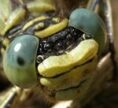

Dysphaea dimidiata belongs to a genus that comprises nine species (1), three of which are present in Borneo and in Sarawak (2) in particular. Considered by Selys (3) as a subgenus of Euphaea, it has been a full genus in the family Euphaeidae since Kirby (a family that resembles Calopterygidae, which explains why Selys described it in his Synopsis des Caloptérygines).
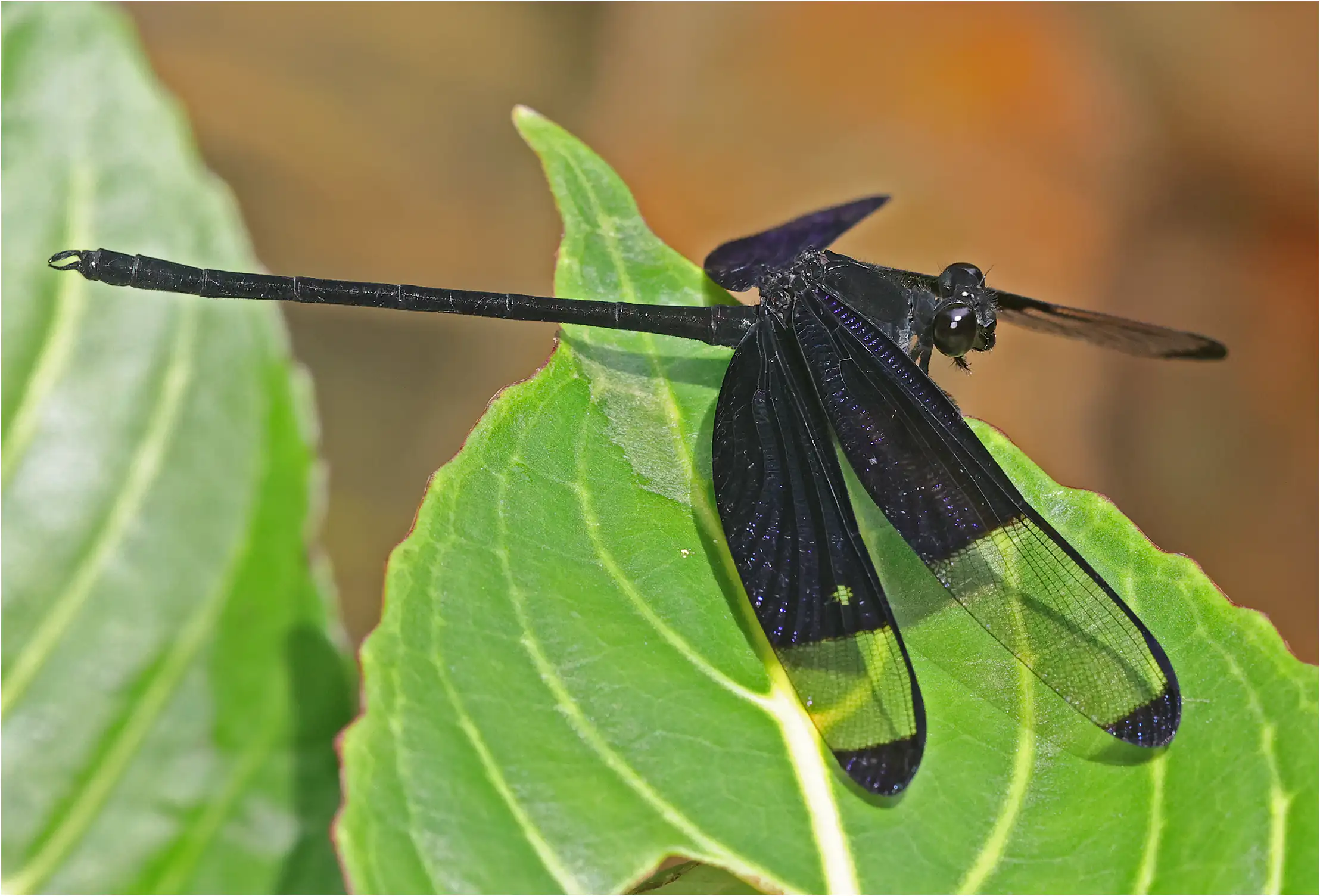
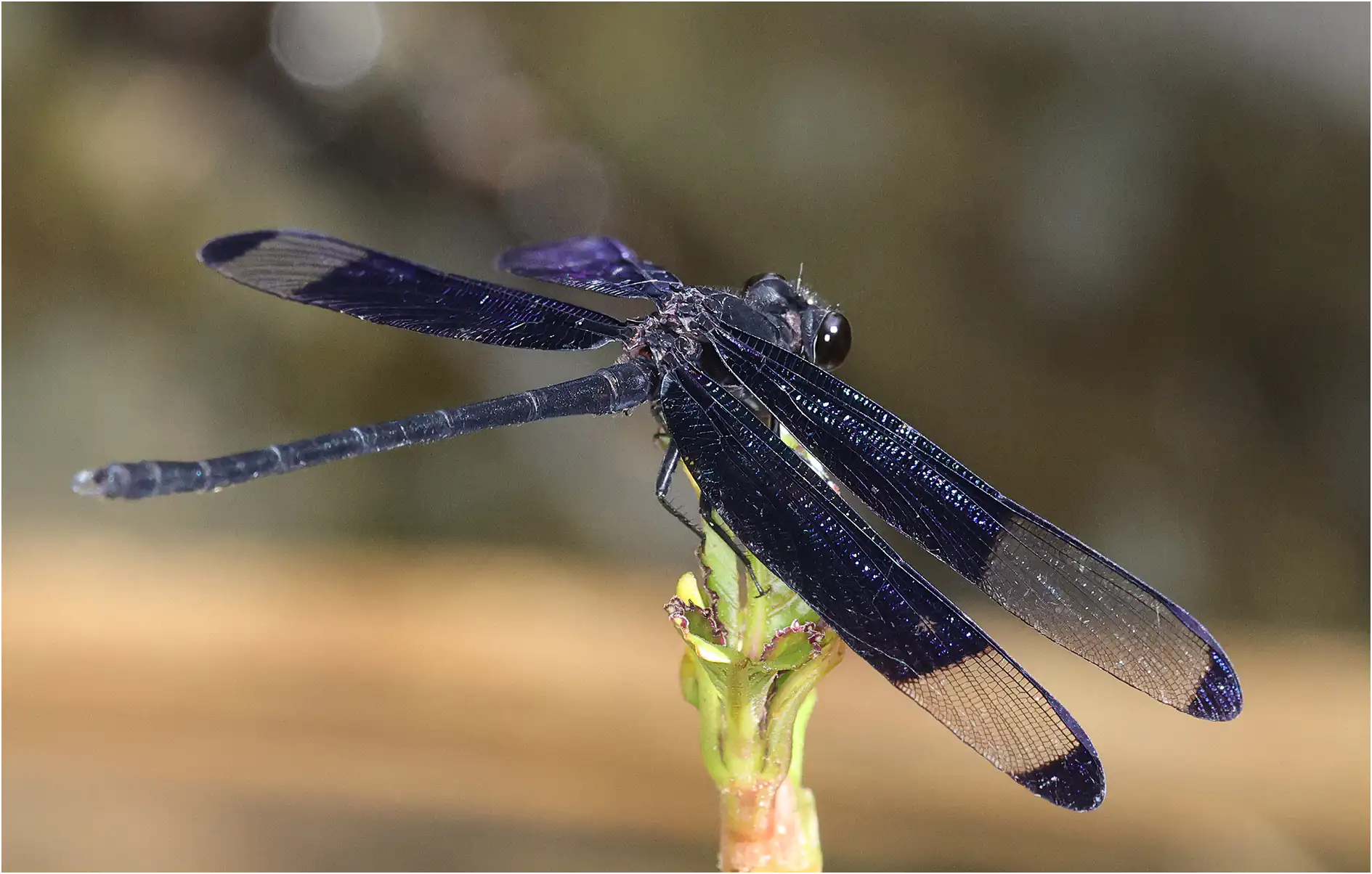
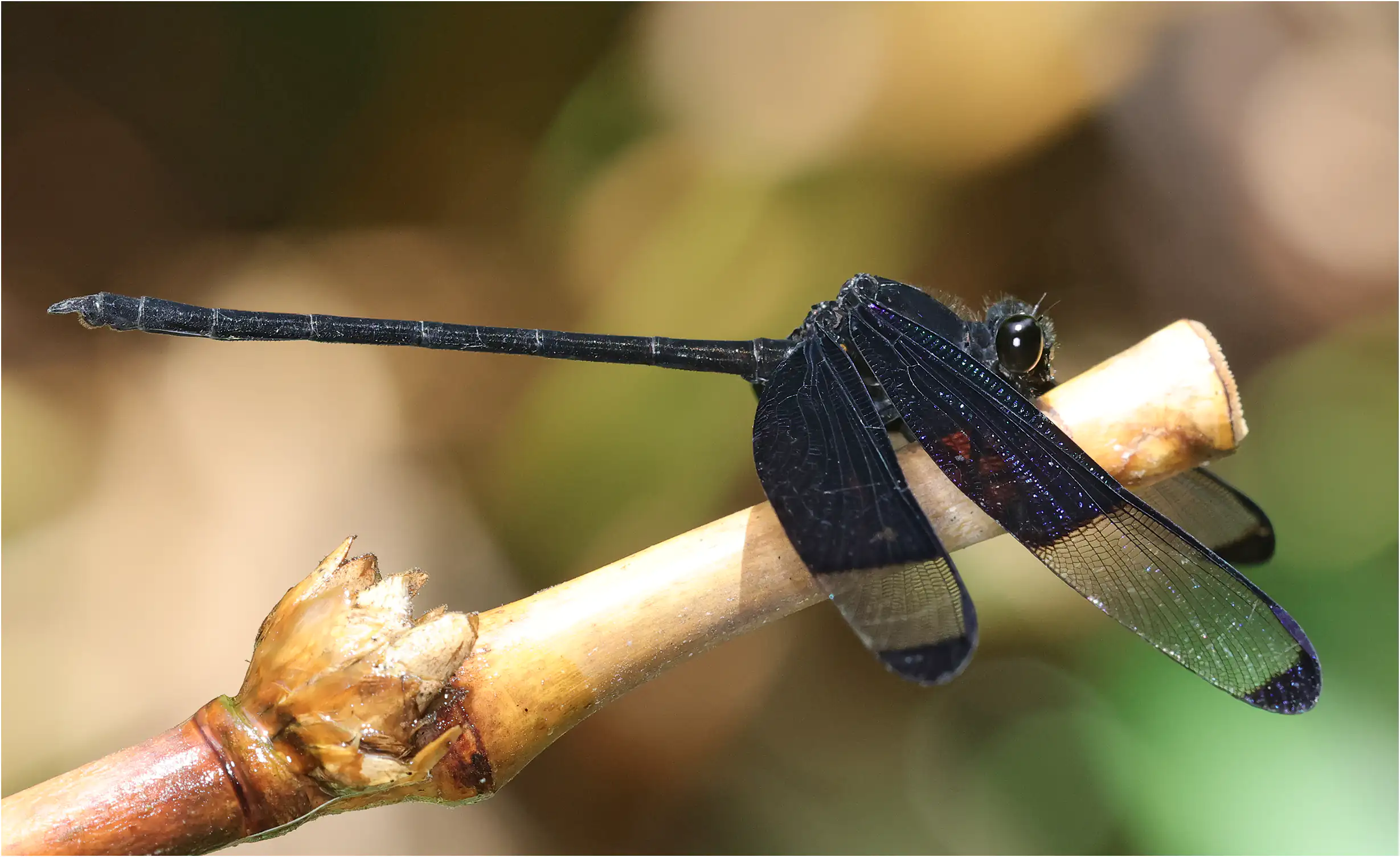
It is a magnificent zygopteran with the appearance of an anisopteran when resting on a perch with its wings spread, positioning them like many Libellulidae in a plane lower than that of the thorax. In this way, it displays all the beauty of its wings, which are extensively marked with black—a colouration that reflects violet hues under certain angles of light.
English speakers call it the Black velvetwings.
The respective proportion of hyaline and coloured areas varies across its distribution range, but the forewing always shows a larger hyaline area.
Those I encountered in Peninsular Malaysia presented exactly the same type of distribution. On this page, you will also find photos of a mating pair, providing an opportunity to see a female that we did not encounter in Sarawak.
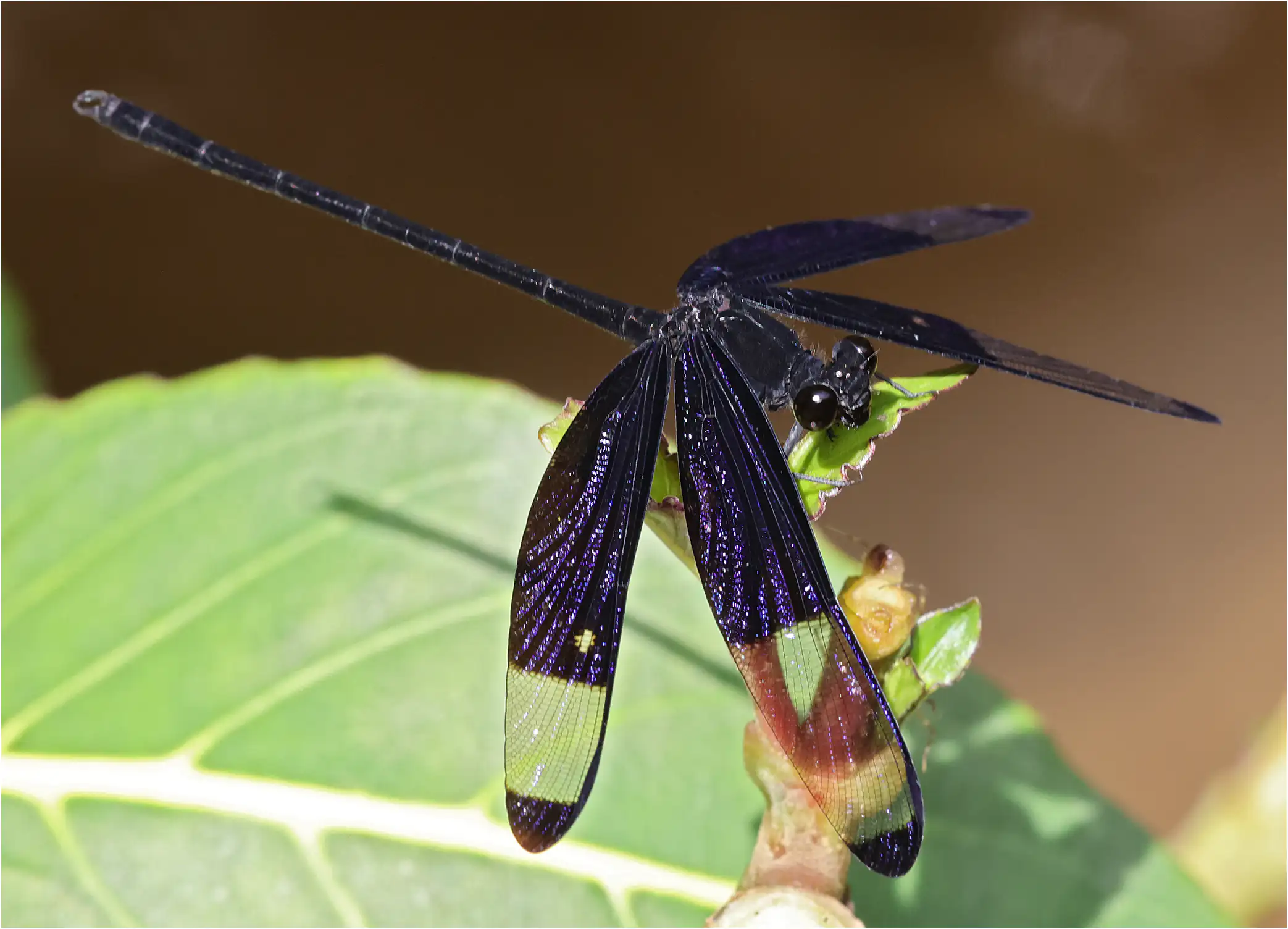
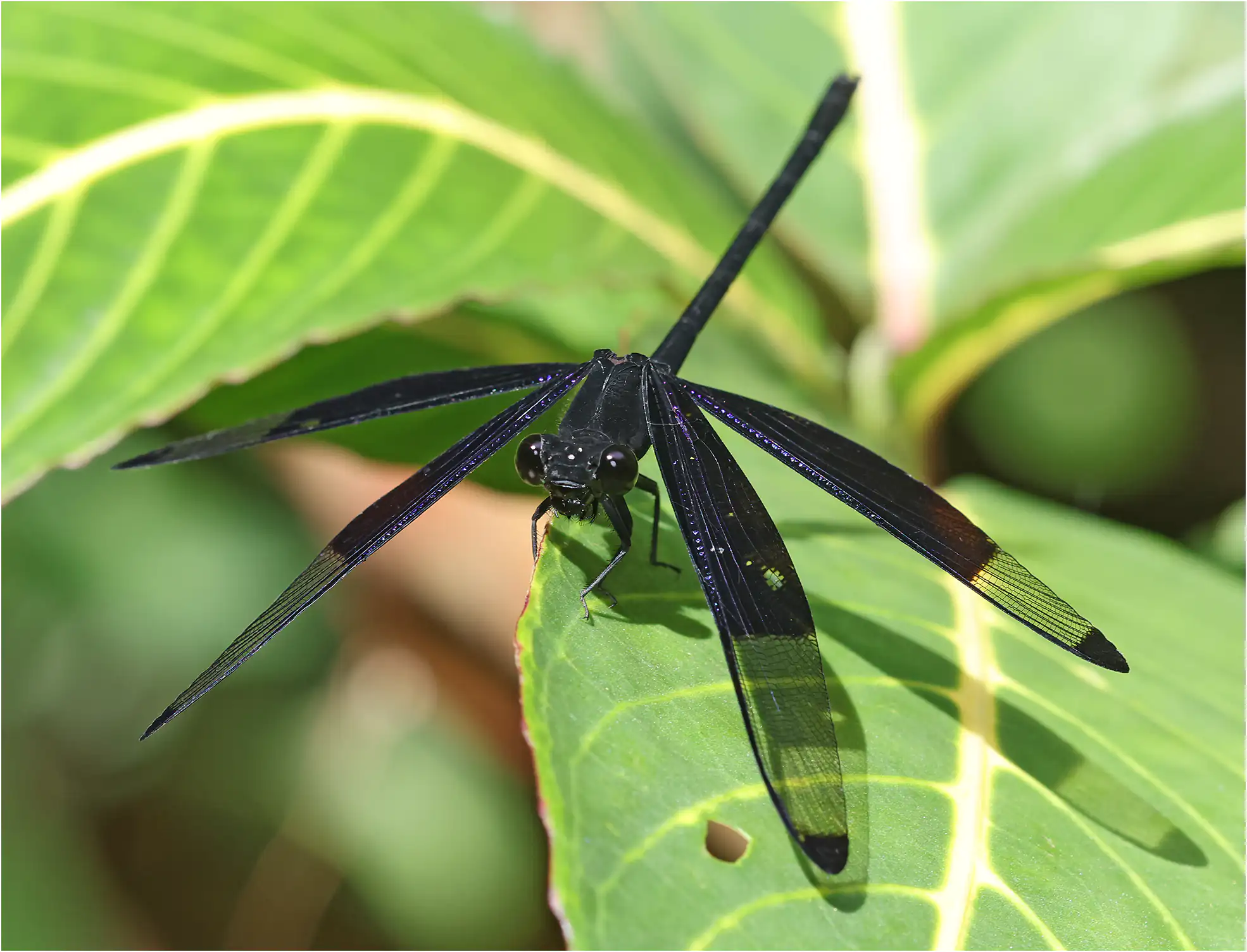
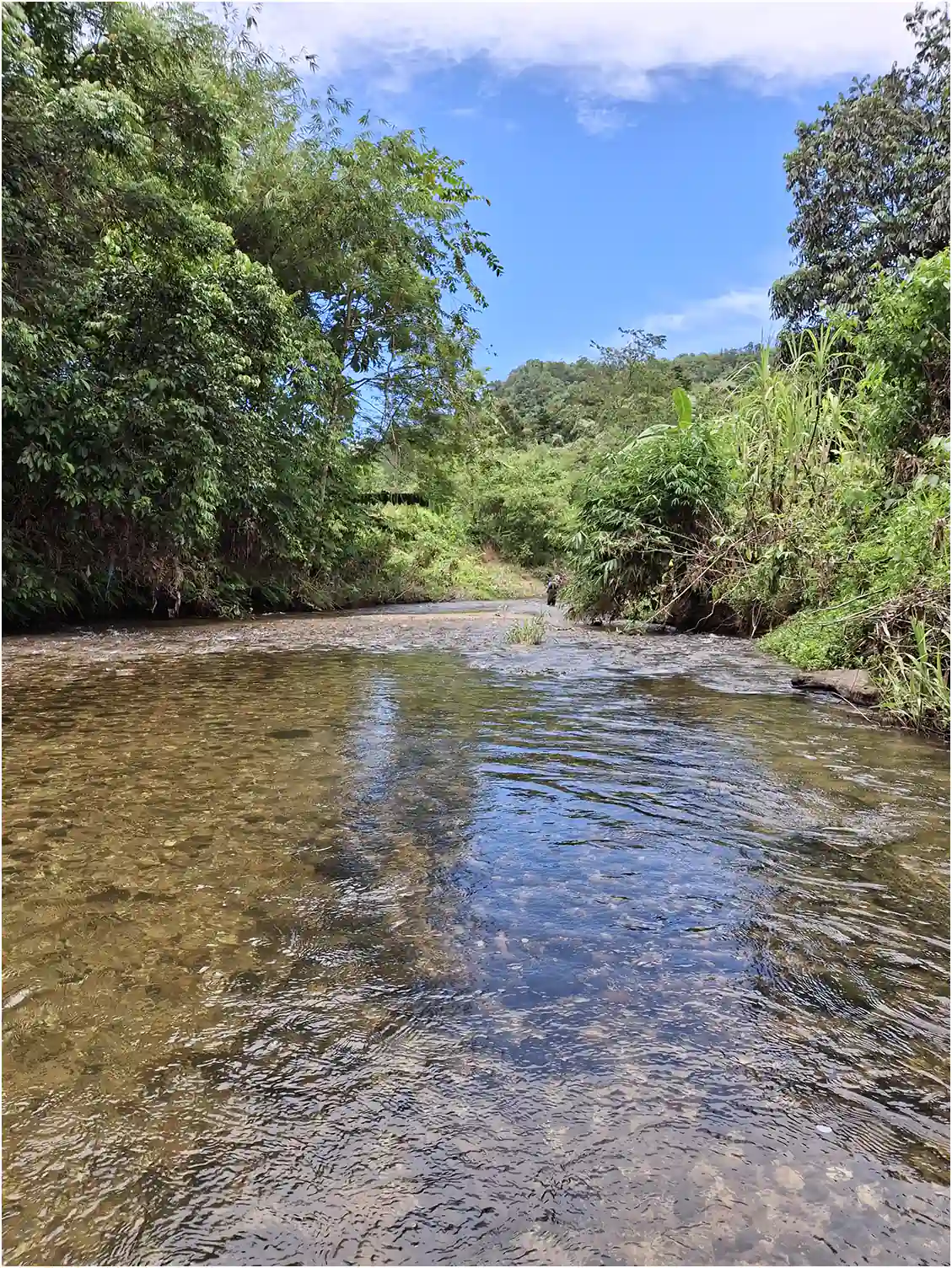
We encountered them on a wide river, the Timuoh River, a fairly open environment with a bed covered in pebbles and gravel, where submerged logs or rocks obstructed the current in places. They like to perch on this type of support overlooking the current, from which they suddenly take off to catch prey or chase away a rival, usually returning to the same spot.
It is worth noting that this was our first sunny day after six predominantly rainy days.
On this river, it was found alongside Neurothemis longipes, Libellago stictica, Libellago semiopaca, Rhinagrion borneense, Onychothemis coccinea, Pseudagrion perfuscatum, not to mention the parade of species very common in this environment such as Heliocypha biseriata, Prodasineura verticalis and even Orthetrum schneideri et testaceum !
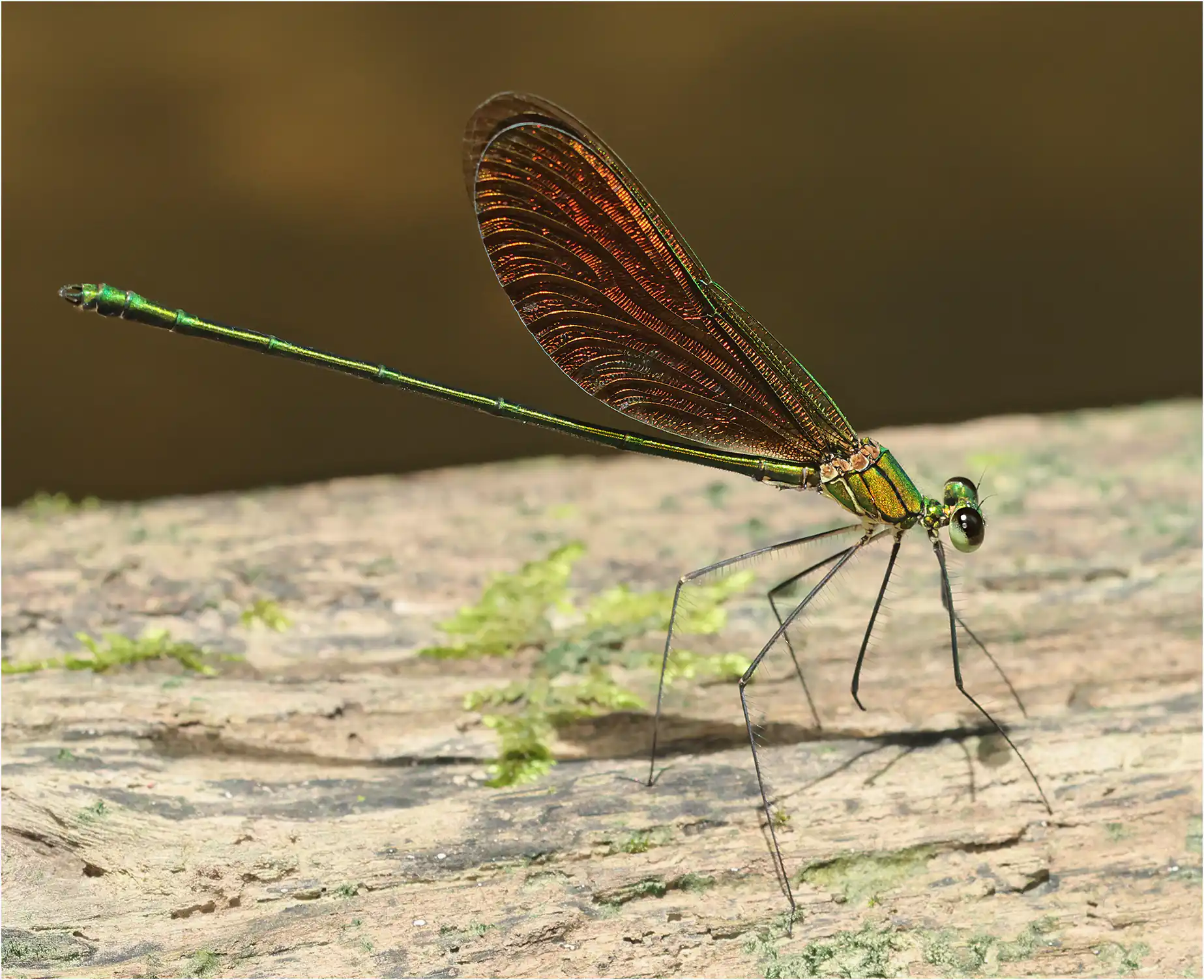
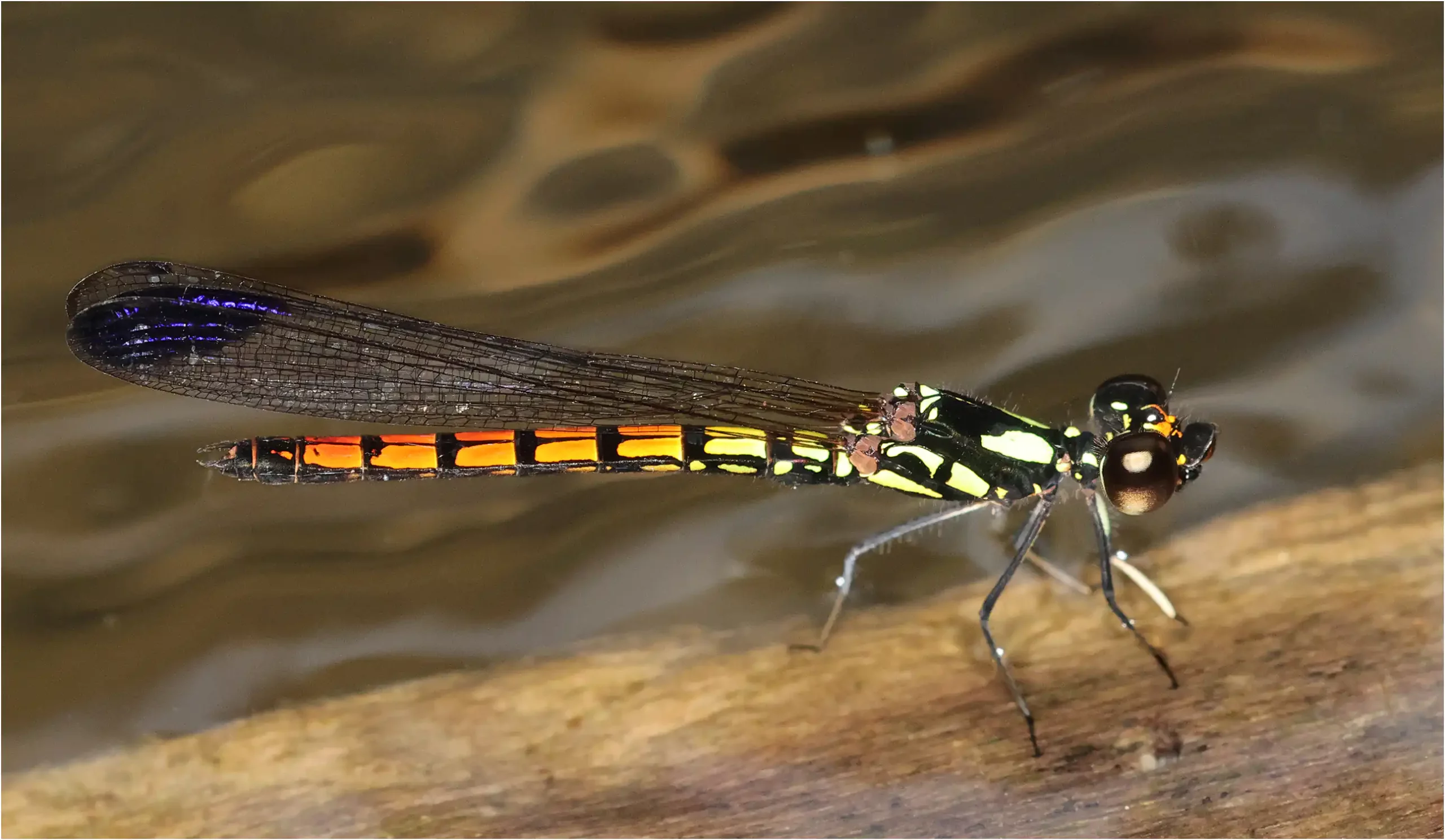
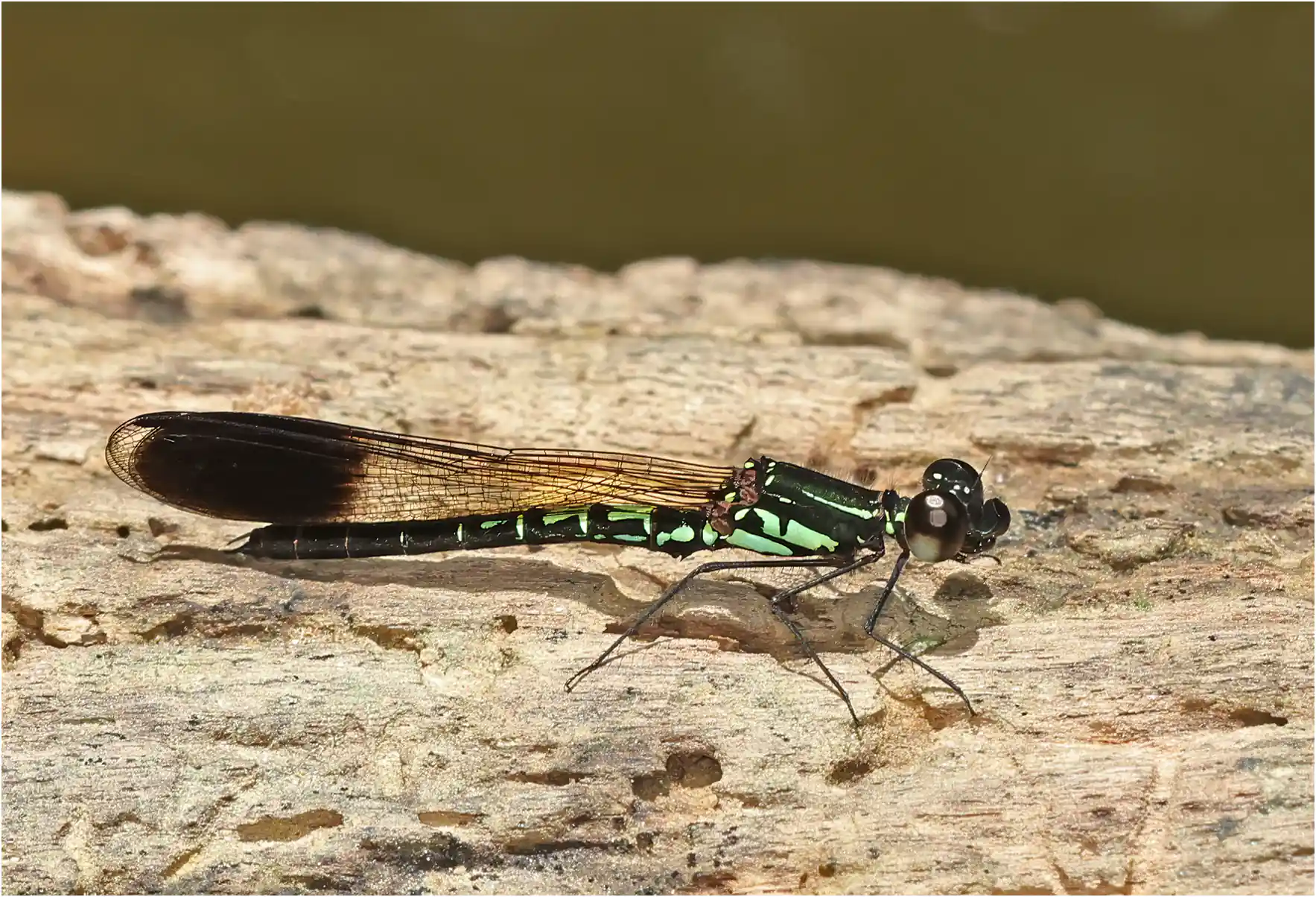
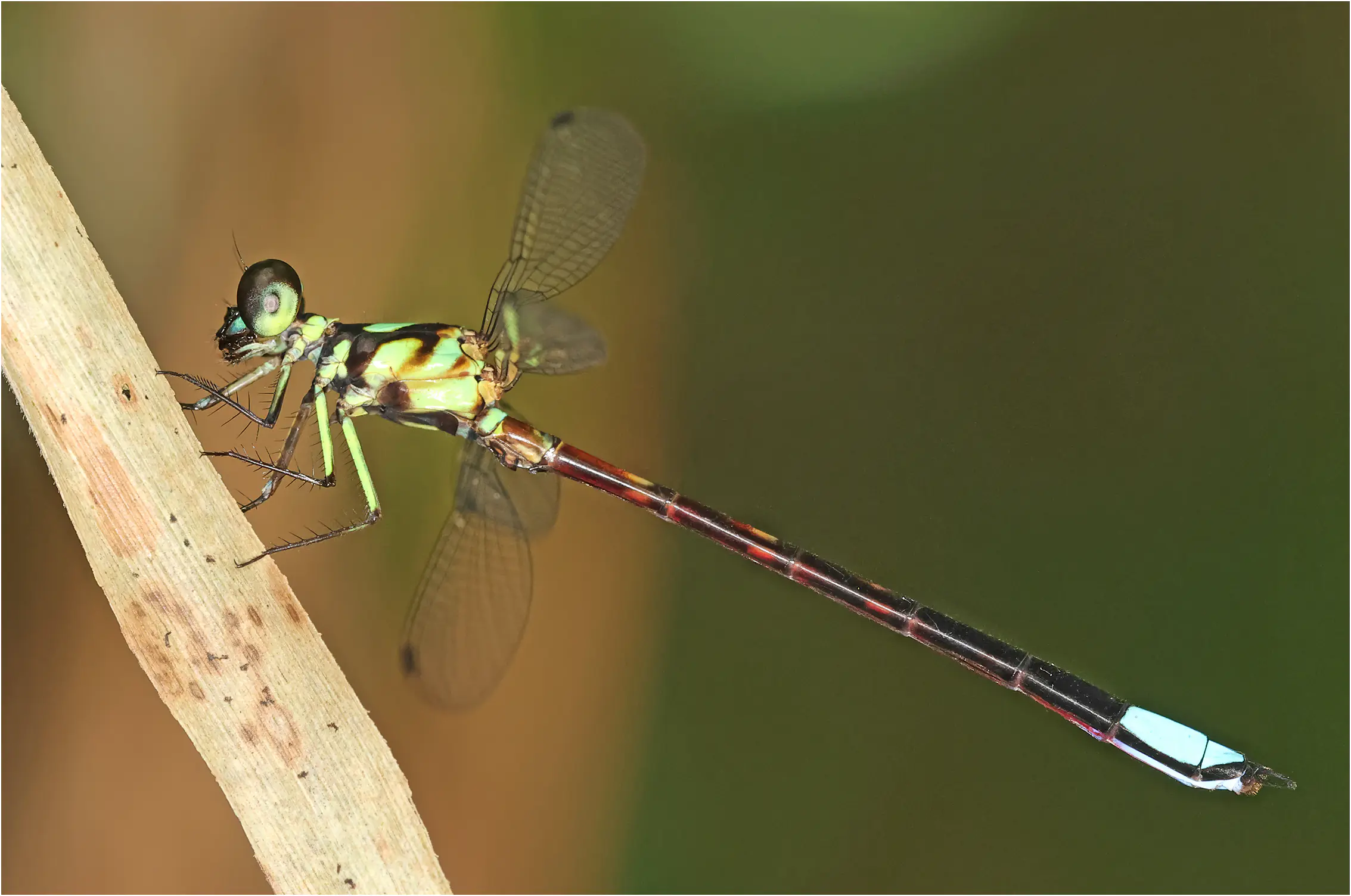
Sarawak, Timuoh River, Annah Rais Hot Spring, 24/03/2025
According to Ngiam & Ng (4), in Singapore, it measures 44 to 48 mm.
Hämäläinen, Dow & Stokvis (1) point out that the abdomen of the lectotype, excluding the anal appendages, measures 35 mm, giving it a total size of about 44 mm. Lectotype, because there is no male holotype designated by Selys, his collection containing five pinned specimens; to provide a very precise description, the authors had to select the best-preserved specimen.
Its distribution extends from extreme southern Thailand through Malaysia and Singapore, to Java and northern Sumatra, and further north, of course to Borneo, then Palawan.
IUCN Red List.
Etymology of Dysphaea dimidiata
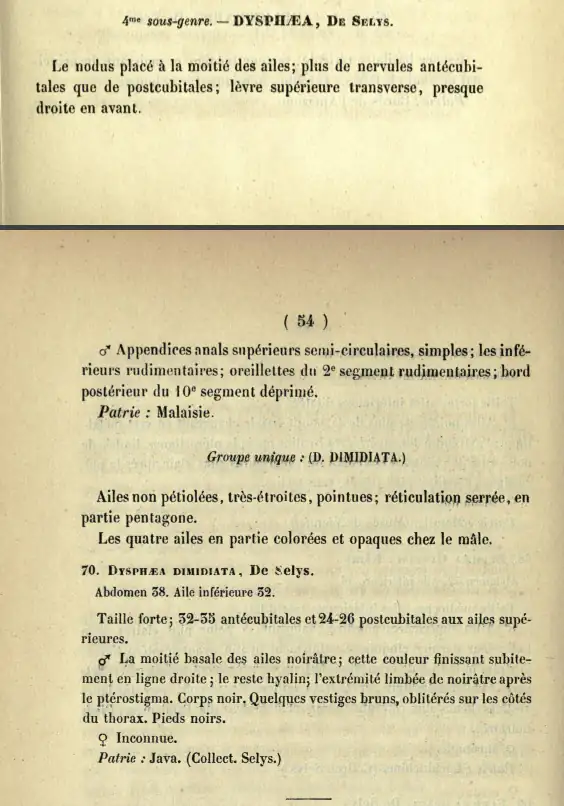
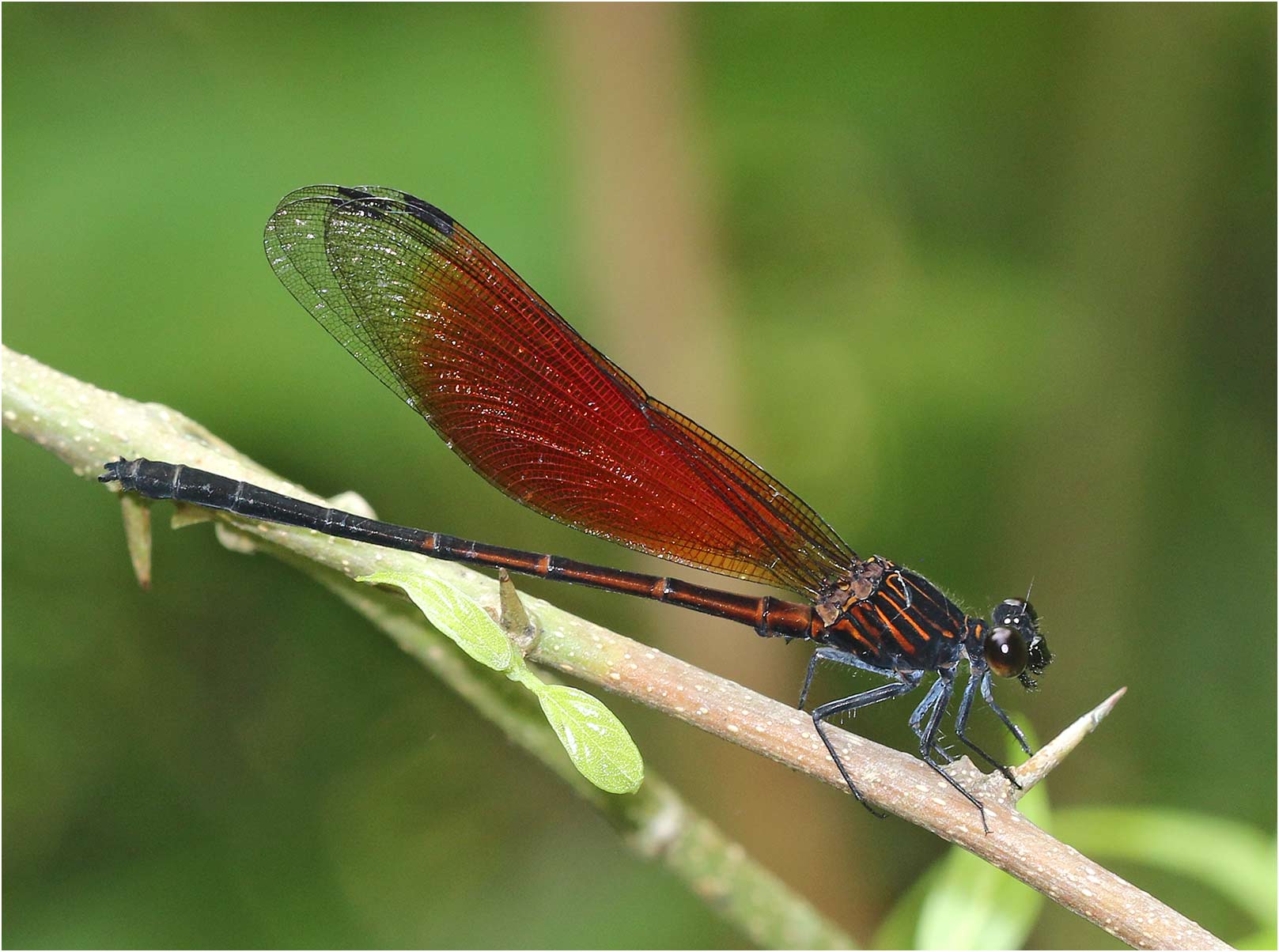
Dysphaea comes from two Greek words: "dys", meaning "badly" or indicating "an anomaly", and "phaeos", meaning "dark", "obscure" (and certainly not from "phaûos" (?), which would mean "shining", as suggested by Ngiam & Ng (4)). When Selys created this genus, he established it as a subgenus of Euphaea, and all the Euphaea known at that time, which he described in the same document, had blackish or partially blackish wings—using "eu", which means "well" or "true", and "phaea" for "dark", as we have just seen, thus meaning "well-darkened wings". He might have named this genus differently had he known Euphaea ochracea at the time, which he would describe in 1859 and which is an exception with its... ochre wings.
However, none of these Euphaea showed this dark / light / dark alternation at the time, unlike Dysphaea dimidiata, for which he created the genus, and which therefore presents an anomaly.
Dimidiata comes from the Latin dimidiatus, which means "divided in half" or "halved", emphasizing the fact that the dark wing is here cut in two by a clear zone.
1- Hämäläinen,Dow & Stokvis, 2015 - Revision of the Sundaland species of the genus Dysphaea Selys, 1853 using molecular and morphological methods, with notes on allied species (Odonata: Euphaeidae)- Zootaxa 3949(4):451-490
2- Dow, 2021 – AN ANNOTATED CHECKLIST OF THE ODONATA (INSECTA) KNOWN FROM SARAWAK WITH RECORDS TO DISTRICT LEVEL – Sarawak Museum Journal · January 2021
3- Selys-Longchamps, Edm. de. 1853. Synopsis des Caloptérygines. Bull. Acad. Belg. 20, Annexe, 1-73 - P. 54.
4- Robin Ngiam & Marcus Ng - A photographic guide to the Dragonflies and Damselflies of Singapore - John Beaufoy Publishing – 2022