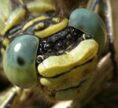
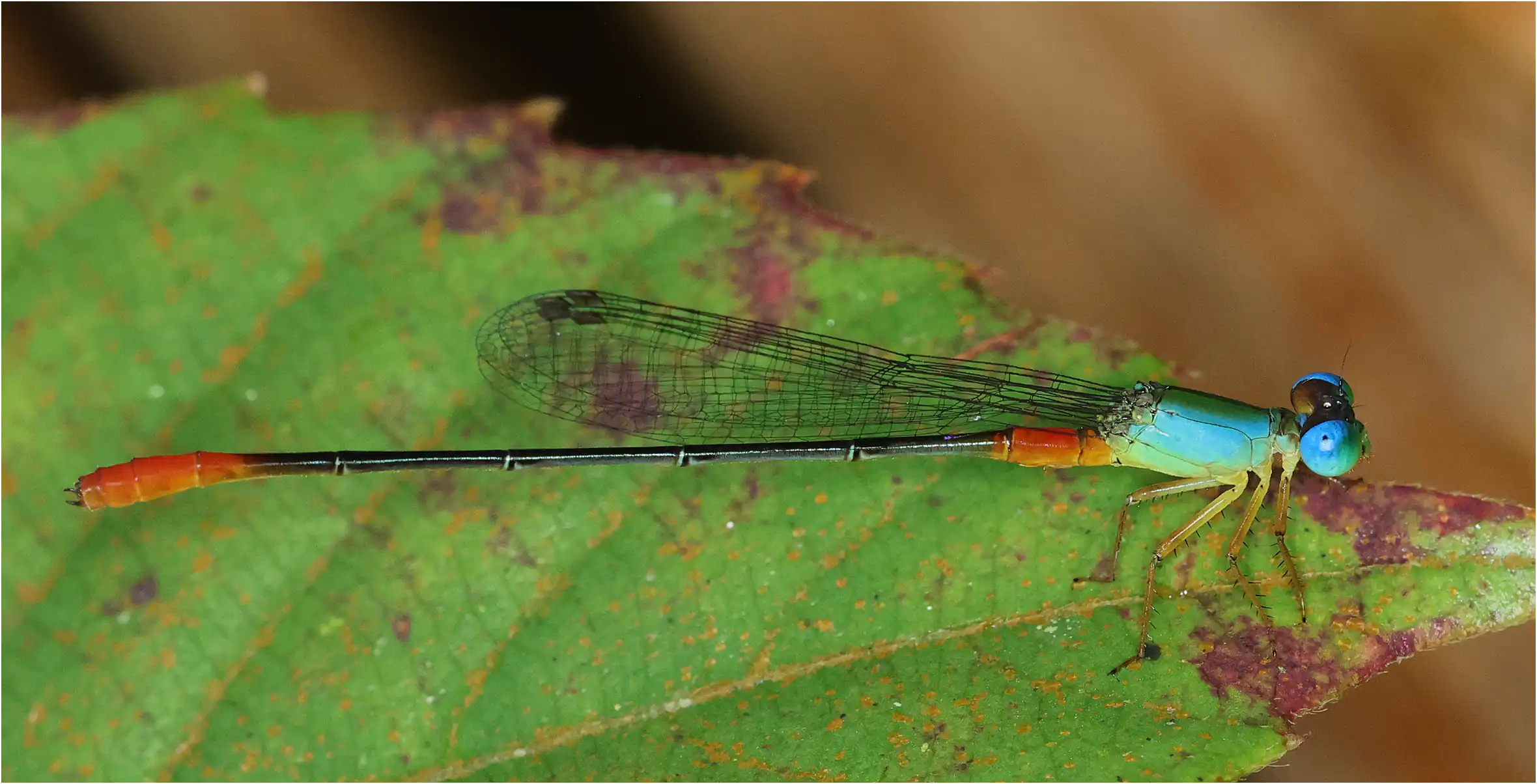
Même si j'avais déjà rencontré Ceriagrion cerinorubellum en Malaisie continentale, il n'est pas difficile de comprendre pourquoi j'ai été ravi de le revoir ! Il présente un assemblage de couleurs tout à fait spectaculaire, variable en fonction de l'âge, avec une apparence très particulière du thorax, lisse et glabre. Le rouge ou orange intense des premiers segments contraste avec le bleu/vert pâle du thorax et semble en feu.
Malheureusement le temps était à la pluie et les photos manquent de gaieté.


It is, of course, impossible to confuse it with any other damselfly. Brauer (1) measured this beauty—his specimen came from Ceylon (our modern-day Sri Lanka)—at 37 mm; in Singapore (2), it is given as 35 to 38 mm.
And its blue-green eyes are to die for!

It is found in all kinds of environments; in this reserve, a few were inhabiting low grasses along a pond, at the edge of a wood. It is also found in marshes or somewhat open streams in forests.
It is known, like Ceriagrion in general, to be aggressive toward other damselflies; according to my research on cannibalism, Ceriagrion is actually the second genus most involved in cannibalism after Ischnura, and I have recorded nine cases concerning Ceriagrion cerinorubellum (I discovered a ninth case while writing these pages). And I certainly had these figures in mind when I took the photos below; it features two mature males, the one being attacked appearing deformed, with an abnormally bent abdomen.


But "alas", it was likely just an altercation, or even more probably a mating attempt (it happens!); in the first photo, the upper male seems to be trying to bring his pincers-like anal appendages close to the lower male's pronotum. The two individuals separated and disappeared into the vegetation.
Its distribution area is gigantic across subtropical and tropical Asia, from Western India to Vietnam and the Philippines. Further south, it reaches Borneo, Malaysia, and Indonesia.
IUCN Red List.
Across this range, it receives numerous vernacular names, the most common of which is Orange-tailed Marsh Dart, Ornate Coraltail in Singapore, Painted Coraltail or Bi-coloured Damsel (?) in India, and even Painted Waxtail.
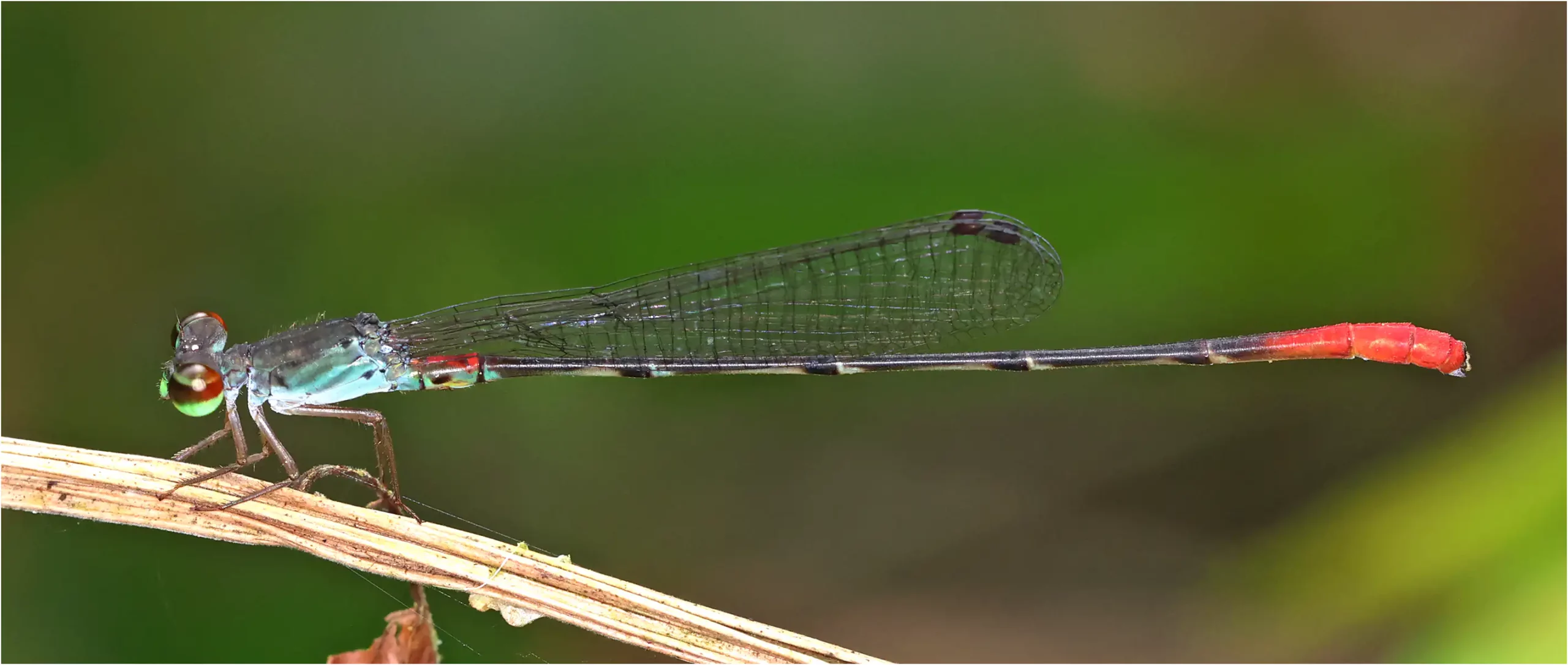
The subject below on the right is likely old, and the dorsal side of its thorax has become quite dull.


Females are very similar to males, and one must pay attention to sexual characteristics to distinguish them; checking, of course, the shape of the anal appendages or the last segments, and the absence of a projection beneath the second segment (S2).


But they are sometimes much duller.

Etymology de Ceriagrion cerinorubellum
It should be noted that Brauer described the species under the name Ceriagrion (Pyrrhosoma) cerino rubellum and that he believed he was holding a species described by Rambur under the name Agrion cerinum, 1842, but the anal appendages of the latter species were described as short (one can see how long they are in some of my photos). This Agrion cerinum is now named Ceriagrion coromandelianum, also present in Ceylon (but not in Borneo).
Ceriagrion (3) ; The genus was established by Selys, 1876, when he split the large genus Agrion, presumably for the species cerinorubellum, from Agrion (widely used for creating names of... Coenagrionidae, derived from the Greek agrios for "wild", "living in the fields") and the Latin cerinus meaning "wax color" (or "wax appearance"?), like the smooth and hairless thorax of the genus.
Cerinorubellum was composed by Brauer from the names of two species he mentions in his document: Agrion cerinum by Rambur (future C. coromandelianum) and Agrion rubellum by Van der Linden (which would become Ceriagrion tenellum (de Villers)). Rubellum in Latin means "reddish", "tending toward red".
I would like to remind once again that all the cited authors were working on collection specimens, dried out and whose colors might have greatly changed. Most of the time, when they referred to earlier works, there were no drawings, particularly of the anal appendages.
Finally, note that Fraser (1947)(4) described an African Ceriagrion so similar that he named it Ceriagrion rubellocerinum (here in Ghana)!

1- Brauer, 1865 - Auf der Fregatte Novara gesammelte Libellulinen - Verhandlungen der Kaiserlich-Königlichen Zoologisch-Botanischen Gesellschaft in Wien - Vol.15, p. 501-512. P. 511.
2- Robin Ngiam & Marcus Ng – A photographic guide to the Dragonflies and Damselflies of Singapore – John Beaufoy Publishing – 2022
3- Fliedner, 2006. The scientific names of the Odonata in Burmeister’s "Handbuch der Entomologie".
4- Fraser, 1947 - THE ODONATA OF THE IVORY COAST BASED ON THE MISSION OF DR. R. PAULIAN AND P. LEPESME - Transactions of the Royal Entomological Society of London, 1947. P. 28.