
Vestalis amaryllis, a Calopterygidae, is one of the many Vestalis species we encountered along streams featuring alternating shaded areas and sunlit spots—a habitat also favoured by Euphaea impar and Drepanosticta rufostigma, among others.
The region we surveyed hosts several of these "Flashwings", as anglophones call them, most likely including Vestalis amaryllis and V. amoena. The main difficulty lies in distinguishing them, which requires a clear view of the anal appendages. While obtaining such a view is not inherently problematic, the real challenge is that the reference illustrations provided in the literature—such as those by Lieftinck (1)—are ventral views (i.e. viewed "from below") drawn from museum specimens.

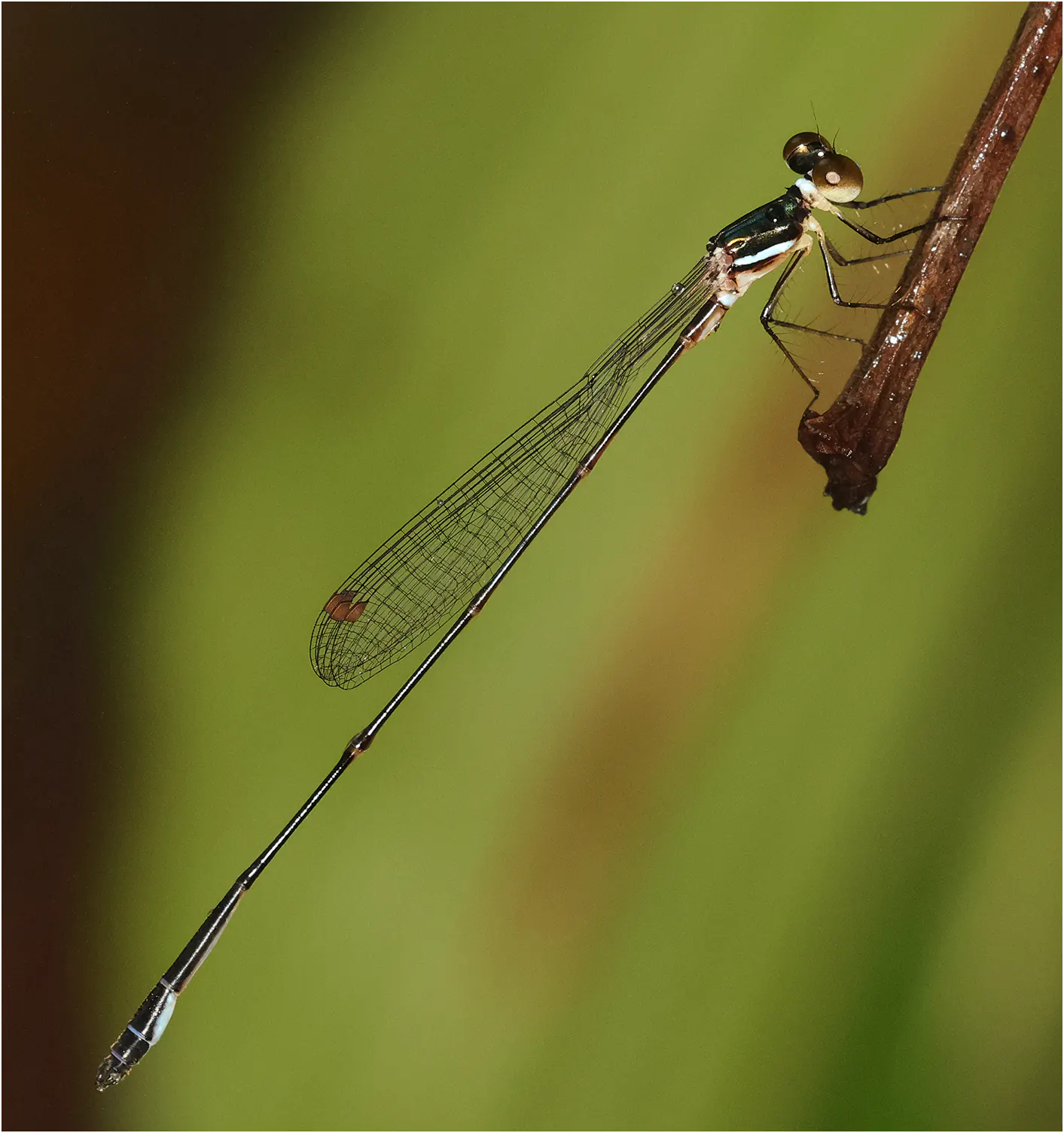

In the field, capturing specimens and then photographing them is impossible without a huge loss of time. We chose to photograph only, and consequently, certain identifications remain impossible.
Fortunately, for this species, Lieftinck provided a dorsal view, slightly offset towards the centre, of one of the upper appendages of this species, which I have placed next to that of my subject. These are two different views of the anal appendages of the same subject, the only individual featured in all the photos on this page.


I have many other photos—some perhaps of Vestalis amoena, others showing anal appendages—but it is impossible for me to assign them with certainty to either species until I can find dorsal views of the anal appendages. I attempted to compare my photos with those in the book by Ngiam and Ng (2), which illustrates V. amoena, but the authors reproduced Lieftinck's ventral views.

Vestalis amaryllis is known from Borneo, the Bangka Islands off Sumatra, and the Balabac Islands in the Philippines.
IUCN Red List.
It inhabits small, quiet forest streams (3), precisely where we observed it.
Its abdomen (1) measures 40 to 48 mm, making the total length approximately 55 mm.


Etymology of Vestalis amaryllis
Vestalis: this genus name was created by Selys (1853). He almost certainly followed the prevailing classical trend of the era, bestowing historical or mythological names upon genera and species. The Vestals were the virgin priestesses dedicated to Vesta, the goddess of the hearth in ancient Rome.
Amaryllis, from the Ancient Greek "amarullis", is derived from the verb "amarysso", meaning "to shine" or "to sparkle", undoubtedly referring to the metallic sheen reflected by the habit of this zygopteran.
1- Lieftinck, 1965 – The species-group of Vestalis amoena Selys, 1853, in Sundaland (Odonata, Calopterygidae). Tijdschrift voor entomologie, 108, 325--364. P. 345.
2- Robin Ngiam & Marcus Ng - A photographic guide to the Dragonflies and Damselflies of Singapore - John Beaufoy Publishing – 2022
3- A Guide to the Dragonflies of Borneo, their identification and biology. A.G. Orr, Natural History Publication (Borneo) – 2003