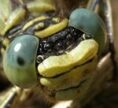
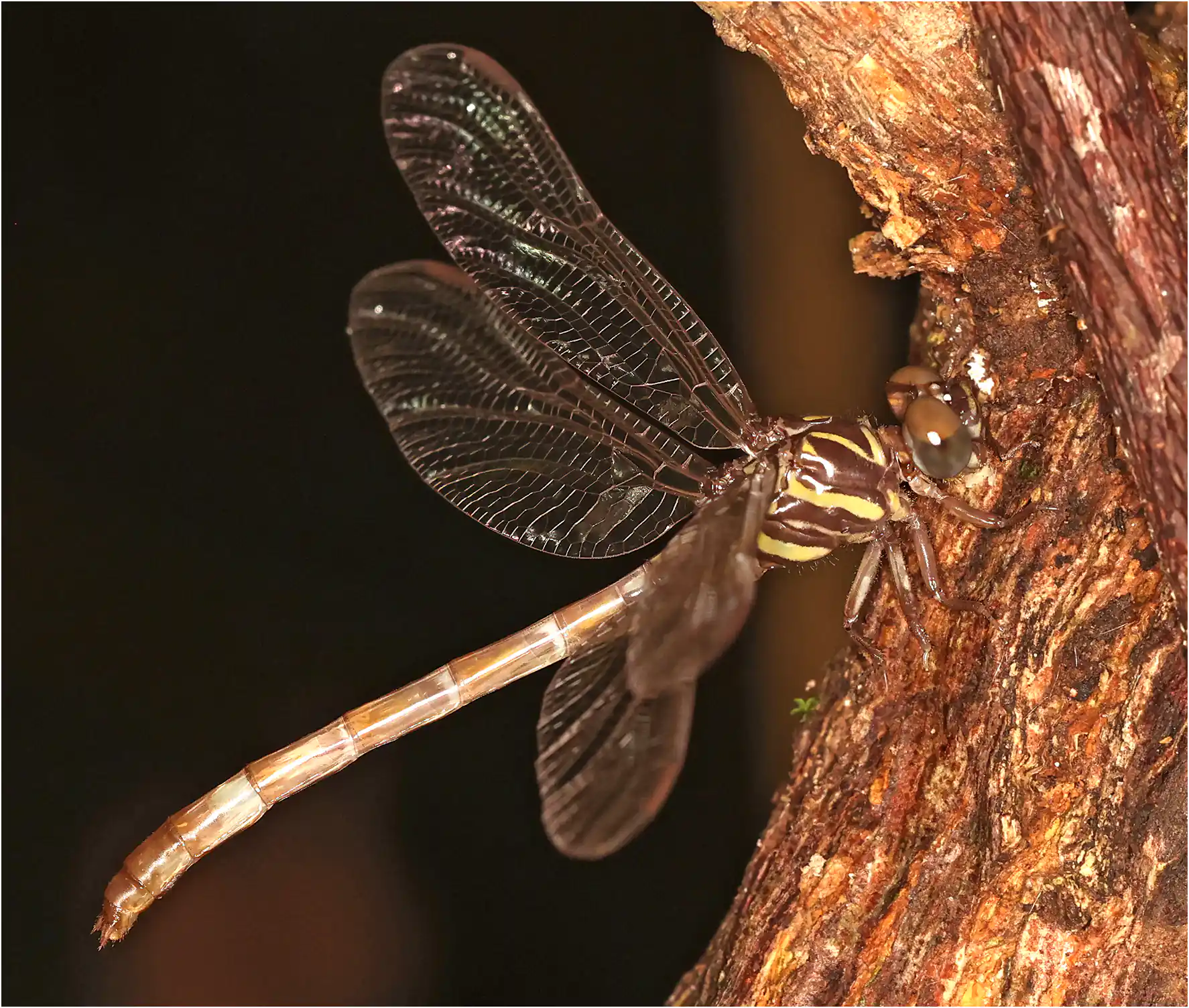
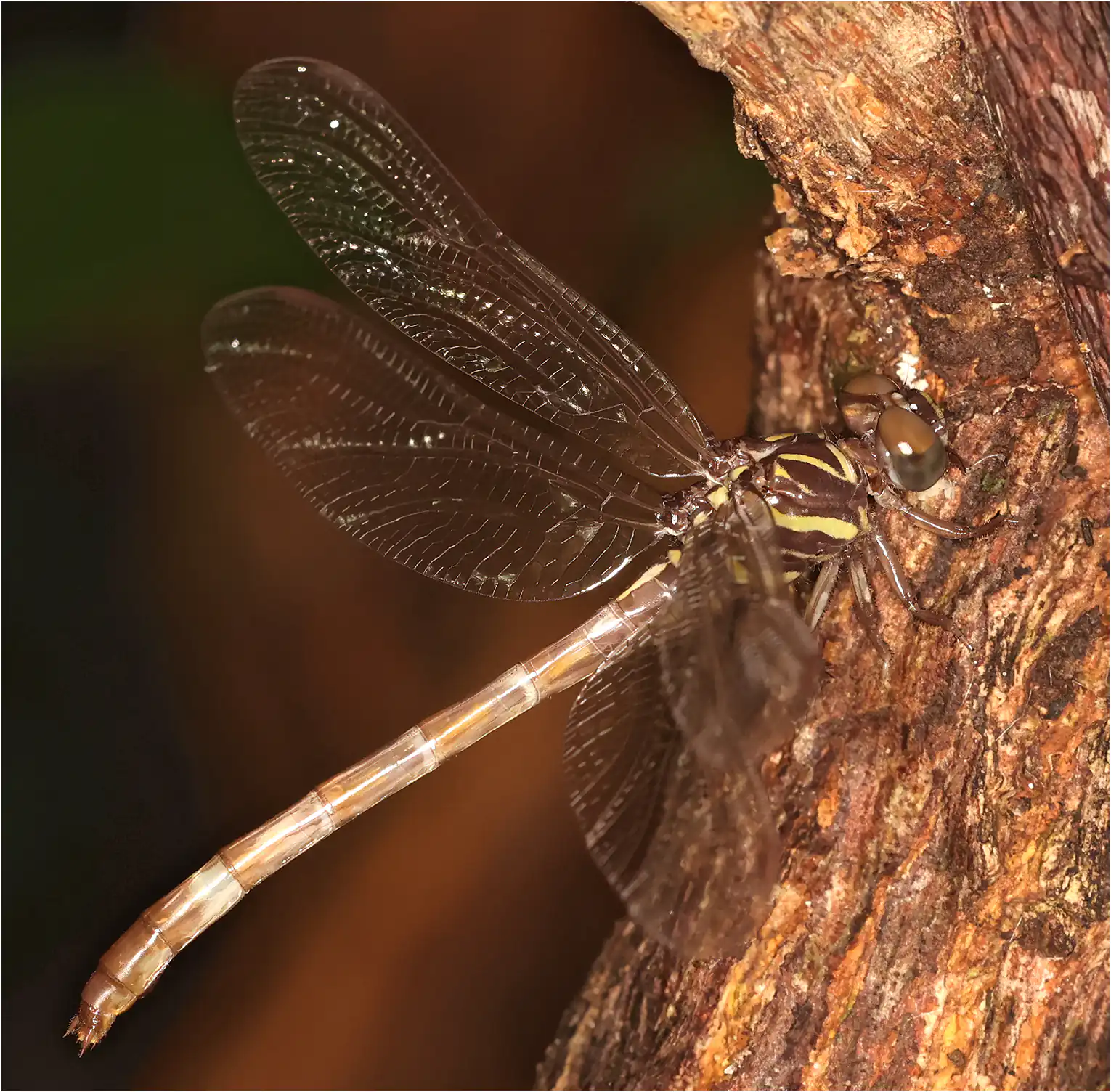
It was in the Ankasa Reserve, on a small, heavily shaded forest river, that I had the chance to discover this emerging female Paragomphus nigroviridis (Gomphidae). We failed to identify it on the spot, and then called it Paragomphus serrulatus. While researching the species to put it on this site recently, I had a real doubt; K.-D. Dijkstra, called upon for help, wished us good luck in managing to identify it! So, I tried my luck with the partial checklist of Odonates of Ghana, that of the Atewa Forest, by K.-D. Dijkstra (2013), which only lists four species; there are no photos of Paragomphus nigroviridis on iNaturalist or observation.org, and it was on ADDO that I found what I was looking for. The photos of the male and female presented there by K.-D. Dijkstra match our subject well.
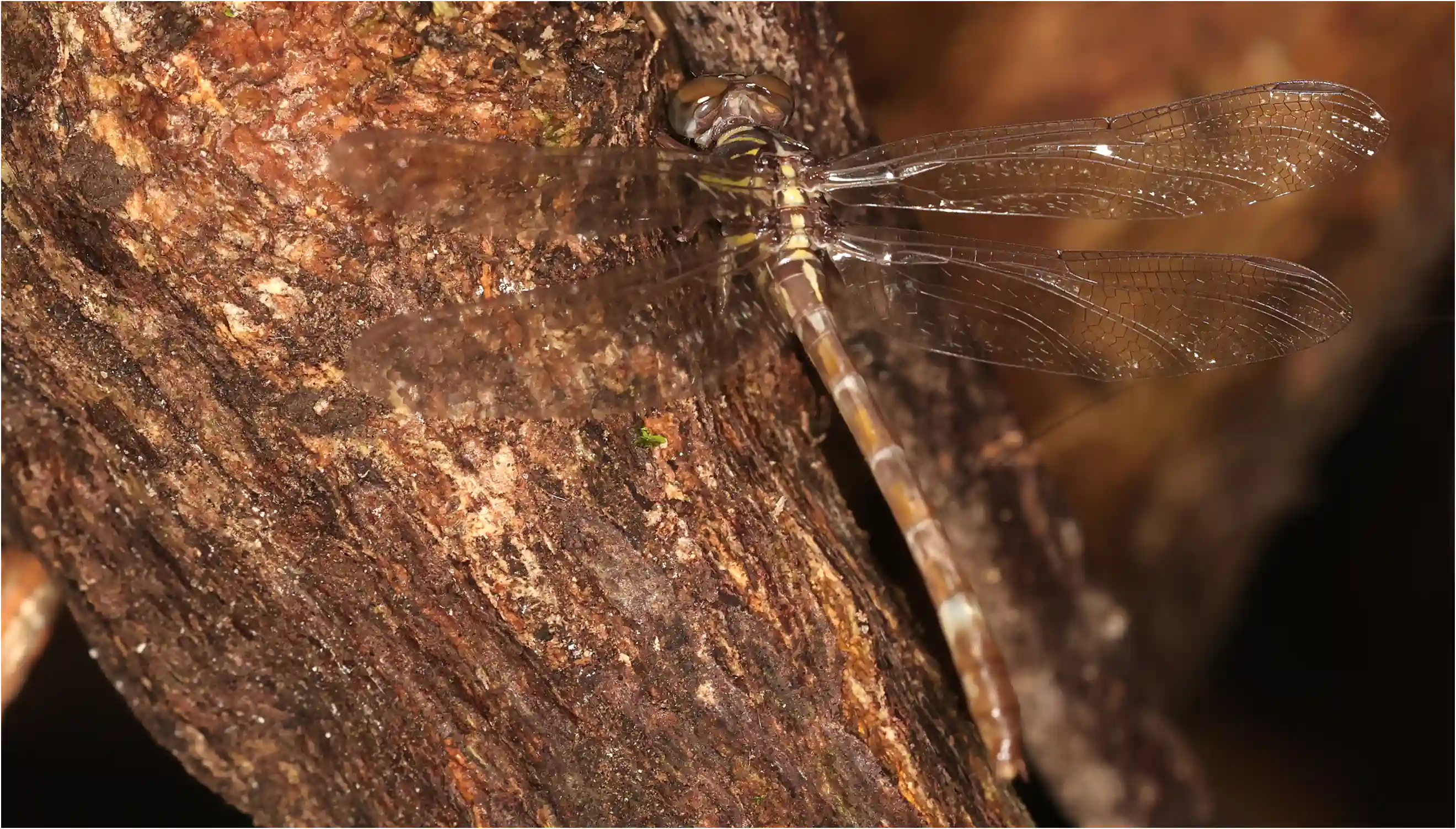
We indeed find this same "L" or "7" shape on the upper part of the thorax, accompanied laterally by a small colored triangle (which ADDO summarizes as "7.") and which continues more or less briefly forward with a thin yellow line (which Fraser (1949) describes as a vestigial antehumeral stripe). We observe the same two broad yellow bands on the thorax separated by a very thin one. On the abdomen, we note the presence of a long yellow spot on the dorsal side of S2 and a single spot on the anterior part of the 7th segment.
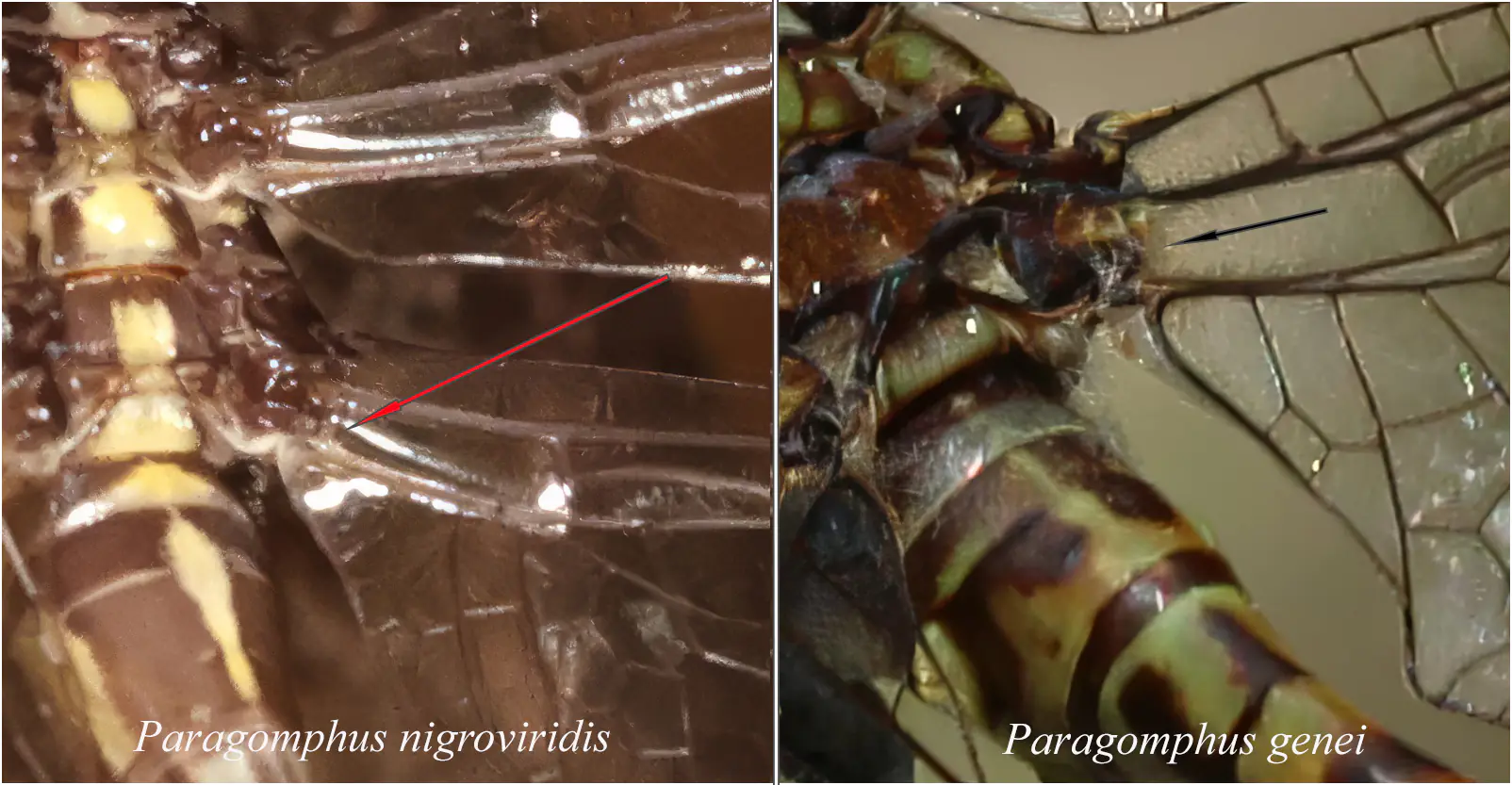
And above all, Cammaerts (1969) writes at the end of the description presenting this new species: "Paragomphus nigroviridis sp. n. can be easily distinguished from African species of the genus by the presence of a subcostal basal crossvein on each of its wings (also in P. abnormis (Karsch, 1890) from Cameroon)..." but P. abnormis shows different thoracic patterns. I also have a photo showing this detail for a forewing, but it is not worth displaying.
[Unfortunately, Klaas-Douwe Dijkstra pointed out to me after writing this article that this venation criterion is no longer considered reliable and that other species have been described since 1969, particularly in Dijkstra et al. (2015). However, the specialist does not rule out the possibility that the species is correct.
Nevertheless, I have not found any other species presenting this "7" with a dot next to it. Of course, if another species exhibits this dot next to the "7", the identification would have to be downgraded to the genus level.]
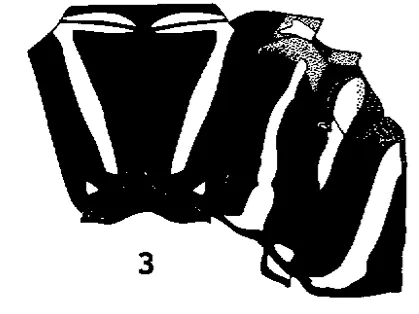
Cammaerts (1969) provides an illustration of the pterothorax showing the elements already mentioned. But since it is a male, one can expect certain differences for a female, such as our subject. He tells us that it is indeed Paragomphus nigroventris that Fraser (1949) describes under the name P. abnormis; Fraser gives the length of its abdomen as 32 mm.
I discovered it perched on the trunk of a tree on the bank of a shallow forest river (I was standing with my feet in the water to take these photos), in a dark area, as my flash photos show. Curiously, we had just photographed Gomphidia gamblesi and we would not encounter any other Gomphidae during these two weeks. This habitat completely matches what is read on ADDO (adapted from Dijkstra & Clausnitzer 2014).
Its distribution is thought to extend from Guinea and Sierra Leone to the eastern Democratic Republic of the Congo, reaching northern Gabon to the south, with varying gaps along this route. But looking at the ADDO map and the scarcity of reliable data, past confusions, and the apparent rarity of this species, there is reason to be skeptical. It would undoubtedly be desirable to revise the African species of this genus.
IUCN Red List.
Etymology of Paragomphus nigroviridis
The genus Paragomphus was established by the British entomologist John Cowley in 1934 to replace the genus Mesogomphus (Förster, 1906), which was preoccupied by a genus of fossil fish. With the Greek prefix "para," meaning "beside" or "near," the chosen genus name indicates that they are very closely related to Gomphus (Leach, 1815). Gomphus comes from a Greek word meaning a peg or bolt, referring to the shape of the abdomen (in most species), which resembles a peg used for assembling boats. Nigroviridis; Cammaerts does not explain this name, which comes from the Latin niger, meaning black, and viridis, meaning green. However, he uses these adjectives numerous times in his description, notably: "Synthorax adorned with distinct green patterns on a black background." It is undoubtedly the coloration of this odonate that earned it its species name. In English, it takes the name Black-and-Green Hooktail.
Dijkstra, (2013). A Rapid Biological Assessment of the Atewa Range Forest Reserve, Eastern Ghana:137-142. 2013 - Checklist of Odonata Recorded from Ghana - Conservation International.
Dijkstra, K.-D.B. (editor, 2019). African Dragonflies and Damselflies (ADDO).
Dijkstra, K.-D.B., Mézière, N., and Kipping, J. (2015) - Sixty new dragonfly and damselfly species from Africa (Odonata). Odonatologica, 44, 447-678, p. 656.
Fraser, F.C. (1949). Gomphidae from the Belgian Congo (order Odonata). Revue Zoologie Botanique Africaines, 42, 101-138, p. 119 (Paragomphus abnormis).
Cammaerts, R. (1969). Paragomphus abnormis (Karsch, 1890) et deux espèces précédemment confondues avec ce taxon (Odonata Gomphidae). Bulletin Annales Société royale d'entomologie de Belgique, 105, 234-248.