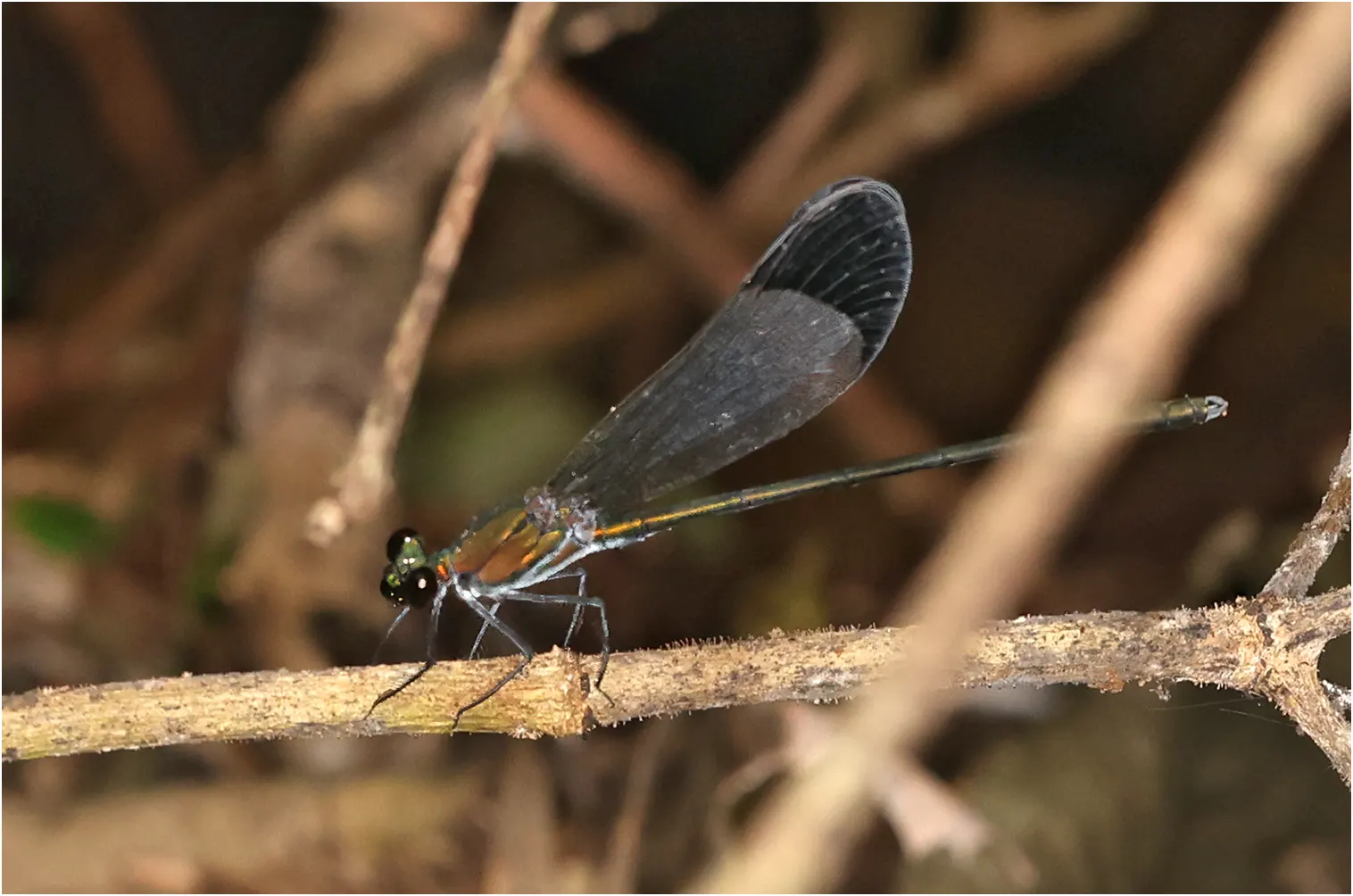
We encountered Sapho bicolor several times, but it proved impossible to approach despite all my attempts; I think it took off as soon as I got within 5 meters of it. And bad luck, I was still using a full frame that day, which makes the subject look even further away. I am very annoyed about it because it is a magnificent odonate and my photos do not do it justice.
The genus, endemic to tropical Africa, includes seven species (World Odonata List) and differs from the genus Umma mainly in that its members are more robust, with larger pterostigmas, and often display colored wings (ADDO (2023)). But it is not impossible that one day the genera will be merged into the genus Sapho, which would have precedence...
There are only two representatives of the genus in Ghana, and they are easy to tell apart since S. ciliata shows fully colored wings. Furthermore, Sapho bicolor is the only Calopterygidae in Africa to display such broad wings with such a sharp color demarcation. It is worth noting that in Central Africa a superba form is described, in which the dark area is bordered by a magnificent diffuse whitish or white zone. It was described by Selys, who gives its abdomen length as 44–45 mm, making a total length of about 59 mm.
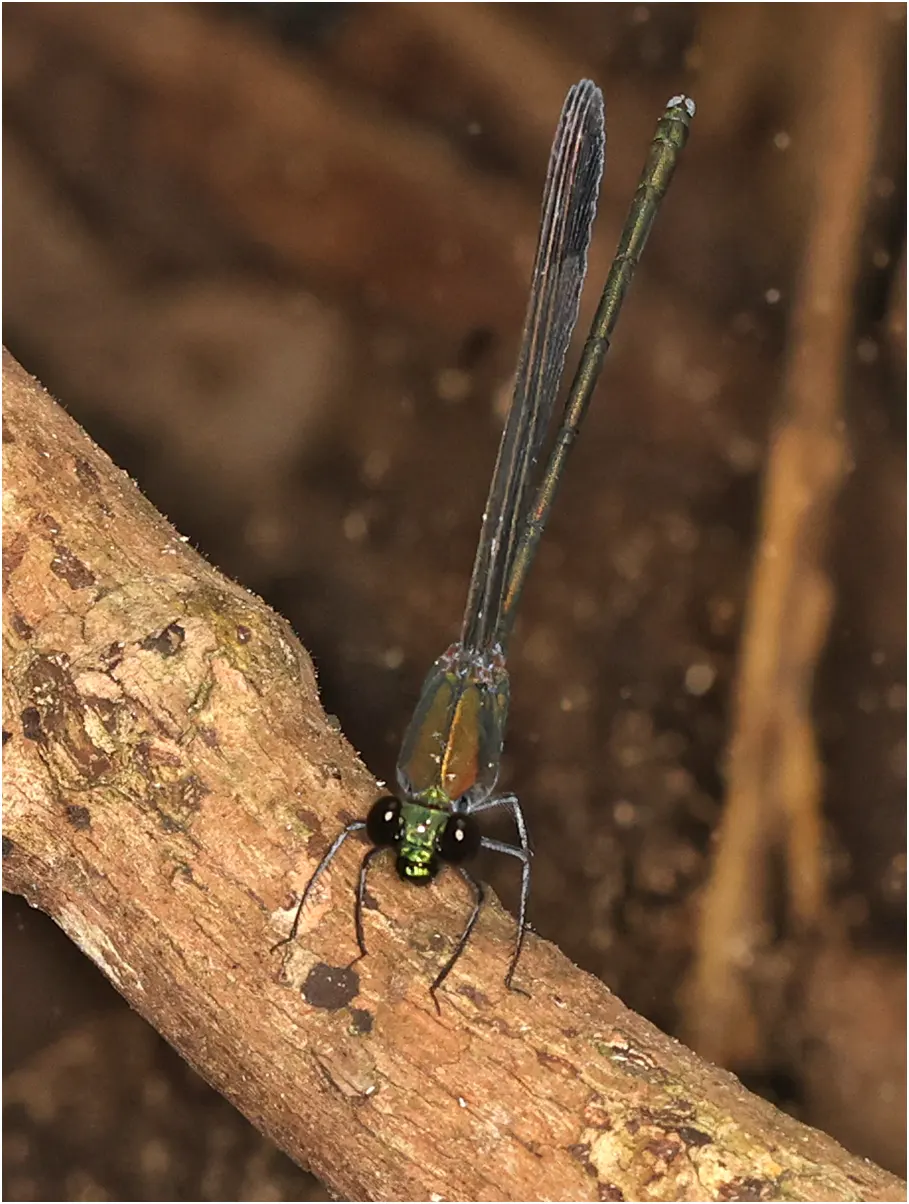
It inhabits heavily shaded forest streams, but these photos were taken in a disturbed environment of brushwood and fallen trees within a swampy area. In the jungle, it is sometimes difficult to know if a stream isn't hidden just a few meters away in the vegetation.
Its distribution extends from Guinea, Sierra Leone, and Liberia to Gabon, Cameroon, both Congos, and the Central African Republic. However, it is not currently known in Benin.
IUCN Red List.
Etymology of Sapho bicolor
Sapho refers to Sappho or Sapho, an ancient Greek poetess (7th century BC) from the island of Lesbos. Selys, in his Synopsis des Caloptérygines, created numerous genera and multiplied references to mythology and history; genera were thus named Phaon (a ferryman on the island of Lesbos with whom Sappho would fall in love) and Cleis (the name of Sappho's mother and daughter). See Fliedner (2006).
Bicolor is simply the Latin adjective for two-colored, which naturally refers to the wings of this odonate.
Dijkstra, K.-D.B (editor ADDO), 2023 – African Dragonflies and Damselflies (ADDO) – Genus Sapho – [The link may not work; web.archive link from the ADDO website, now offline.]
Fliedner, 2006. The scientific names of the Odonata in Burmeister’s « Handbuch der Entomologie ».
Selys-Longchamps, Edm. de., 1853 - Synopsis des Caloptérygines. Bull. Acad. Belg. 20, Annexe, 1-73 – P. 21.