
As you might guess from my photos, Elattoneura analis lives in dark environments! We must immediately explain the reason for the quotation marks around its species name; it certainly does not belong to this African genus, and if this name is retained, it is currently for the sake of simplicity, pending order being restored to the taxonomy. See Dow & al., 2019 (1).

It is a Platycnemididae with a long abdomen, 31 mm, and a small thorax and head, 6 mm, barely exceeding 37 mm overall if referring to the size given by Selys, 1860 (2).
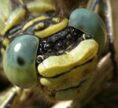
Once out of the forest, it is easy… to identify due to various details which, combined, rule out any risk of confusion: males and females have tricoloured eyes barred with brown, a dark antehumeral stripe marked with 2 or 3 light dots or lines in its distal part, and the lower dark thoracic stripe interrupted by a light colouration in its terminal part, while the very distal part bears a small light-coloured spot.
The male bears a very distinctive pattern on S2, "...une tache orangée ovale, pointue en arrière, ...an oval orange spot, pointed behind, ..." (2).
Males and females show pterostigmas that Selys describes as blackish on collection specimens, but which are brown, well surrounded by a light area in males: "Ptérostigma en losange assez allongée [sic], noirâtre ; un peu plus clair à l'entour, surmontant une cellule. - Pterostigma a rather elongated rhombus, blackish; a little lighter around the border, surmounting one cell." (2).
Finally, while the abdomen is very dark, black, with light rings at the junction of the segments, the tip of the ninth, the upper surface of the tenth, and the upper anal appendages—which are short, cylindrical, and pointed—are light-coloured.

"Elattoneura" analis resembles Prodasineura verticalis (or rather members of the P. verticalis/humeralis complex, which presents other taxonomic issues), but the eyes of the latter are redder, and while the anal appendages are (sometimes!) also light-coloured, neither S10 nor S9 are whitish. Furthermore, they do not inhabit the same environments.
Note below the pterostigmas surrounded by a light border.


We observed it on the banks of a river in fairly dense forest.


It is present in Borneo, Sumatra, and the Malay Peninsula, but absent from Singapore.
IUCN Red List.
Young males and females are blue; it is worth noting that blue adult males reportedly exist.
Females share the same features: eyes barred with a brown band, small coloured markings on the dark antehumeral stripe, and brown pterostigmas discreetly edged in light.
They were discovered in the immediate vicinity of the males.


Etymology of Elattoneura analis
Elattoneura (3) from the Greek "ellaton", for "smaller", and "neuron" which in entomology is translated as "vein in a wing". This refers to the reduced length of a vein that serves as a reference in damselfly systematics.
Analis from the Latin "anus", for "ring", to which is added the suffix -alis denoting a relationship, likely referring to the coloured half-rings at the junction of the abdominal segments: "Un triangle aux 9ᵉ et 10ᵉ jaunes, ainsi que des vestiges de demi-anneaux aux segments intermédiaires. - A triangle on the 9th and 10th yellow, as well as remnants of half-rings on the intermediate segments."
Elattoneura analis male, Sarawak, Bung Ngiraja, 26/03/2025
1- Dow, Butler, Reels, Steinhoff, Stokvis & Unggang,2019 – Faunistic Studies in Southeast Asian and Pacific Island Odonata – Journal of the International Dragonfly Fund – N° 27.
2- Selys, 1860 – Synopsis des Agrionines – Dernière légion : Protoneura, p. 451.
3- Dragonflies and Damselflies of Namibia, Frank Suhling & Andreas Martens, Gamsberg Macmillan, 2007