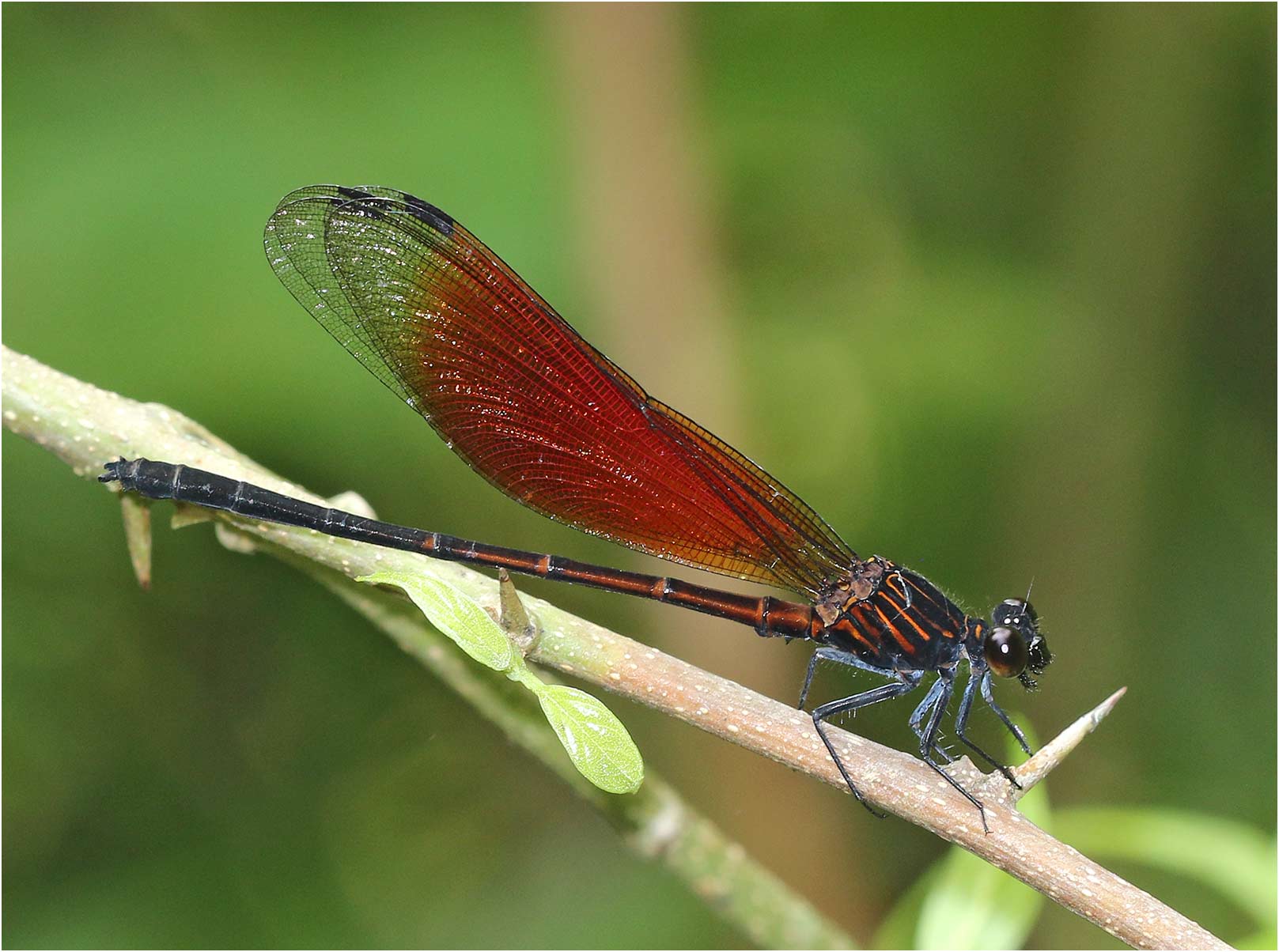
We only observed Euphaea tricolor (Euphaeidae) on a wide river with a significant current that only waders or bold bravery allowed one to master; I didn't want to risk my equipment, so I had to content myself with staying on the bank and trying my luck with my 150 mm macro lens boosted by a 2x teleconverter.
Günther ventured a bit further, and Chris, as usual, adopted his "hippo" mode.


There are 6 species of the genus Euphaea in Borneo (1), but apart from this one, I only photographed the magnificent and much more common E. impar. All these Bornean Euphaea have one thing in common: they present hyaline forewings.

To an amateur, they are very close to Dysphaea; however, in the latter, the nodus is located in the middle of the wing, whereas it is more basal in Euphaea, and segment 10 does not feature a dorsal projection (which is present in Euphaea, see the linked photo of E. impar above or this photo of Euphaea masoni in Vietnam).


Identification of Dysphaea tricolor
Even though Euphaea tricolor is very close to E. subcostalis and E. subnodalis, the identification of this species poses no problem, as its hindwing is so characteristic; it is opaque from the nodus (or just before) to the apex (for the other two, this opacity is even more basal). In the basal part of this area, it is adorned with a blue iridescent zone, which produces a magnificent effect when it is in flight.
Furthermore, by clicking on the photo, one can distinguish a light area under S2, which corresponds to a lateral extension of the seminal vesicle, a sort of auricle (2), surprisingly coloured in light yellow. This is a key criterion for this species.
Size, habitat and geographical distribution
Selys (3) tells us that its abdomen measures 33 mm, which gives about 42 mm for the entire insect.
The site where we encountered it completely matches its usual habitat, consisting of rocky and rapid forest rivers.
It is endemic to Borneo, where it is much more abundant in the north, Sarawak, and Brunei.
IUCN Red List.
Etymology of Dysphaea dimidiata
Euphaea refers directly to the name of the family to which this genus belongs, the Euphaeidae, which English speakers call Satinwings. Selys (1840) reportedly combined the Greek "eu", meaning "well" or "true", and the term "phaios" (and not "phaûos" (?), as read in (4), which would mean "shining") meaning "dark", which indeed applies to the wings of many members of this family (except E. ochracea, which he would describe in 1859).Tricolor, from the Latin "tricolor", which means "three-coloured". It only remains to determine which three colours Selys is referring to, which is not entirely obvious in his description: likely the yellow of the face, the black of the thorax and abdomen, and the iridescent blue of its wings...
1- Dow, 2021 – AN ANNOTATED CHECKLIST OF THE ODONATA (INSECTA) KNOWN FROM SARAWAK WITH RECORDS TO DISTRICT LEVEL – Sarawak Museum Journal · January 2021
-2 Tol, J. van & N. Norma-Rashid, 1995. The genus Euphaea Rambur in Borneo (Odonata : Euphaeidae). Descriptions and records of Malesian Odonata, 3. - Tijdschrift voor Entomologie 138: 131-141, figs. 1-40. [ISSN 0040-7496]. Published 15 June 1995.
3- Selys, 1859 - Additions au synopsis des Calopterygines. Bulletins de l’Académie royale des sciences, des lettres et
des beaux-arts de Belgique. P. 442.
4- Robin Ngiam & Marcus Ng – A photographic guide to the Dragonflies and Damselflies of Singapore – John Beaufoy Publishing – 2022